
Judy needed to put her husband in a memory care facility. His dementia caused increased mood swings, and the police had to visit their home multiple times. She now lives alone yet still cares for her partner.
Harry lost his wife to Cancer. They planned to do a lot of activities together, but now he has lost all motivation. He gets angry when people feel sorry for him and pushes back that when Family and friends would like to see him get out more.
Philis and Leon are at a crossroads. He continues to move inward, she reaches outward. Struggling with needing personal interaction, she has gone out and gotten a part time job, while he spends more time in the house.
In each case, Money is not the problem. Unintentionally, Retirement life has drifted into an increasing pattern of solo living, even if they still have a spouse.
According to the Pew Research Center, 32% if 55 to 64 years of age and 41% of those over 65 are unpartnered. In the same study, unpartnered adults tend to be less successful economically than those living with a spouse or partner.
When someone transitions from a career, they are not just adjusting a spouse or partner dynamic. An entire system is disrupted. A calendar, expectations, accountability, and built-in interaction all disappear at once. That is true whether someone is single, widowed, or sitting across from a spouse who operates on a completely different rhythm.
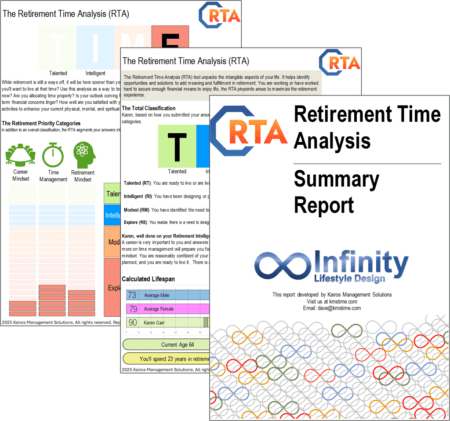
The Retirement Time Analysis (RTA) consistently shows this gap. Only 38% of individuals believe they can effectively manage their time without the structure of a job, while over 40% are neutral or unsure.
Without structure, two things tend to happen. Some retirees drift into overcommitment mode of Caregiving, Volunteering, or reactive obligations. Others fall into under-commitment involving long stretches of unstructured time that quietly erode motivation.
You see both in your examples. Judy’s time is consumed. Harry’s time is empty. Philis and Leon are splitting into two different time realities.
It is easy to assume the issue is the absence of a partner. The data points somewhere else.
With the RTA, only 17% of individuals strongly agree they have a clearly defined purpose outside of work, while 26% openly disagree. At the same time, over 78% say their career provided value and meaning.
That imbalance creates a predictable outcome. When the career ends (especially when a partner is absent or disengaged) there is nothing to replace the role that work once played.
That is why Harry pushes people away. It is not Grief alone. It is a collapse of identity with nothing to anchor to. It explains why even couples drift into “solo retirement.” One person reconstructs purpose. The other does not.
One pattern emerging from the Retirement Time Analysis is that financial preparedness rarely predicts Lifestyle preparedness. Participants who score highly on purpose, structure, and social engagement consistently describe greater confidence entering retirement than those who simply feel financially ready.
That distinction matters because retirement is lived through daily routines and Relationships, not financial statements. Purpose, structure, and connection become the systems that support life after work.
The assumption is that being partnered protects against isolation. The data contradicts that. Retirees lose up to 50% of their social connections when they leave the workforce.
More than one-third of adults over 45 report loneliness, and nearly 25% over 65 are socially isolated.
That applies whether someone is married or not. Philis and Leon are a clear example. Same household. Different social realities.
The RTA highlights that social connection is not incidental. It is structural. Active social engagement improves Mental Health, reduces Anxiety, and increases Longevity. Yet more than 25% of participants show no intent to stay socially engaged in retirement.
That is not simply a relationship issue. It reflects a planning process that rarely considers structure, purpose, and social design together.
To maintain structure, introduce time as a formal planning dimension before heading or even in post-career. Time budgeting, weekly design, and activity mapping should sit alongside financial planning. Retirement creates roughly 40% more discretionary waking time. If that time is not intentionally allocated, it will be filled reactively.
Purpose must be operationalized, not just discussed. If you have a partner, do it together. If you are alone, find an accountability partner. Create your own defined purpose statement. Then, if you have a partner, do it together.
Treat relationships like a portfolio. This is where your prior work fits naturally. A social network audit forces Clarity and helps you know where to invest relationship capital. Social fulfillment in retirement is rarely accidental. It is designed.
The rise of the solo retiree is not just about people being alone. It is about the collapse of default systems. Couples used to mask gaps in structure, purpose, and social design. As more people age alone (or live parallel lives within a relationship) those gaps become visible. Retirement Planning must adapt accordingly.
One pattern continues to emerge through the Retirement Time Analysis. Financial readiness is only one part of retirement. Structure, purpose, relationships, and the intentional use of time often determine how satisfying retirement becomes.
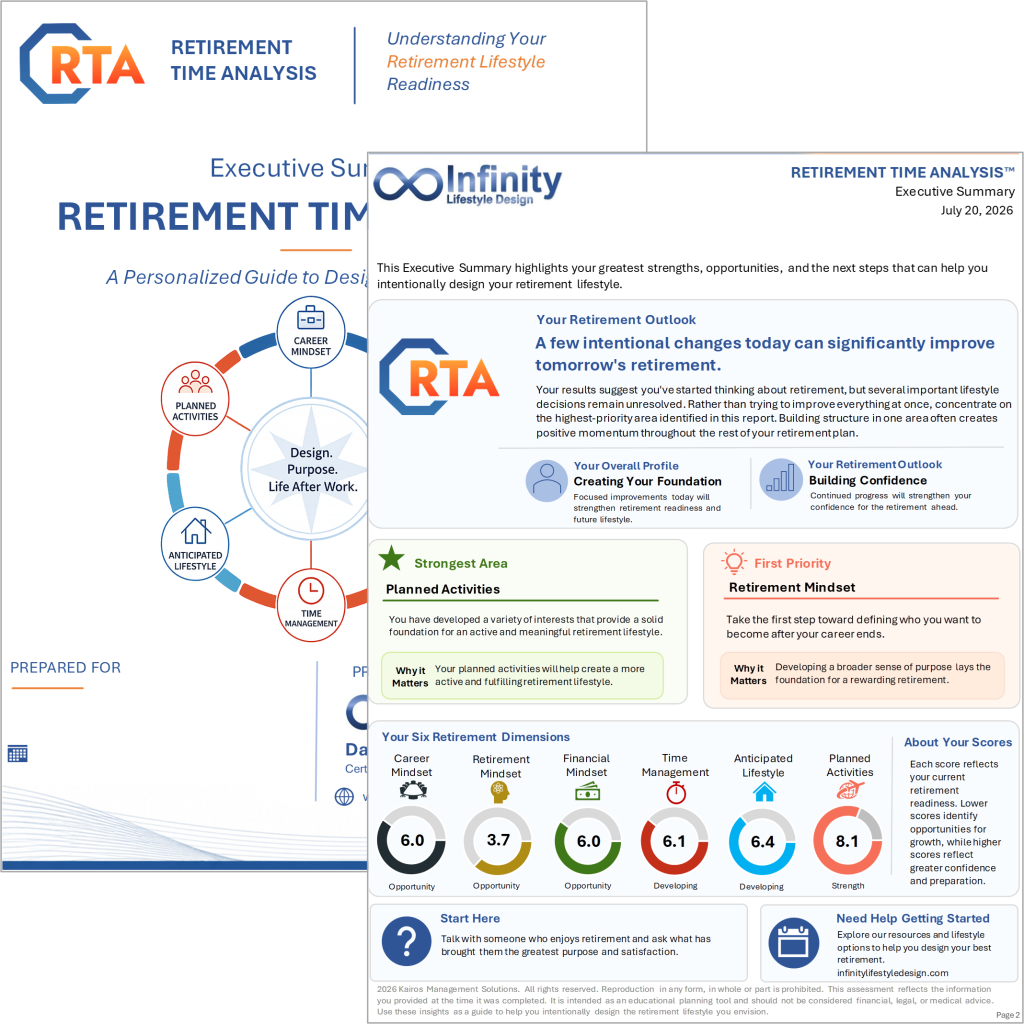
If this article made you think about your own retirement, take the Retirement Time Analysis below and receive your personalized Retirement Time Summary.
David Buck is the author of the book The Time-Optimized Life, coauthor of The Retirement Collective, and founder of The Infinity Lifestyle Design. Learn how to apply the concepts of proactive planning and using your time.
Content development for this article involved human expertise supported by AI-generated analysis and formatting.
The post Living Together. Retiring Alone. first appeared on Infinity Lifestyle Design.