
Thomas and his wife were headed out on a cruise to celebrate his birthday. They were leaving out of the port city close to where his mother lived. He asked his 86-year-old mom to come and join them for a birthday dinner before the ship disembarked.
Smiling he shared, “Not surprisingly she said, ‘I have to work today. Happy birthday, we can celebrate when you get back.’” Thomas’ mother continues to find purpose late in life through the work she does. Financially, life for her is not a problem. She is not going to outlive her Money.
That can’t be said for many people approaching Retirement and trying to determine whether their financial strategy will be enough.
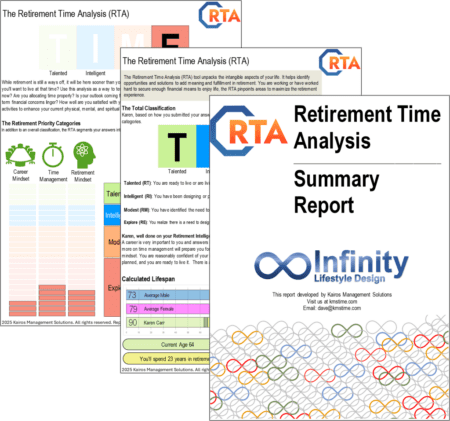
Through the Retirement Time Analysis, we consistently see individuals who have prepared financially for retirement but have never quantified how they intend to use the additional 30% to 40% of discretionary time retirement creates.
So, what does life look like when there is a nagging fear of outliving your resources? Surprisingly, much of that Anxiety can be traced back to an inability to picture what retirement will actually look like.
Many people spend years preparing financially for retirement but never prepare for how they will use the additional time retirement creates. The Retirement Time Analysis helps uncover gaps in purpose, structure, Relationships, and retirement readiness before they become sources of anxiety.
Lacking Clarity in life can cause an almost perpetual state of hesitation. Hesitation to spend. Hesitation to commit. Hesitation to fully engage in the very life you worked decades to build.
Longevity, when misunderstood, becomes a psychological burden instead of a gift. The average American is now living to 79.0 years, and if you’ve already reached 65, you are likely staring at nearly 20 additional years of life. For many, that means retirement is not a short chapter, it is potentially the longest uninterrupted phase of life they will ever experience.
That is where the real problem begins.
Financial planning for retirement is based on a number tied back to a model. Yet, about 40% of U.S. households are projected to run short of money in retirement, with many relying on home equity to survive.
That model number, based on a set lifespan, does not account for the Lifestyle that will be lived. When time is undefined, money can feel insufficient, regardless of how much exists. This is why nearly half of retirees either believe they will outlive their savings or are at risk of doing so. It is not always a math issue. It is often a clarity issue.
From the work done within the RTA, one consistent pattern emerges. People prepare for the end of their career and at the same time do not prepare for the length of their life. When you begin to view retirement through a time lens instead of only a financial one, something shifts.
Longevity exposes a different risk. As we age, everyday living costs become more predictable. Yes, healthcare costs are uncertain, but physical and even cognitive questions lend to stable general expenses.
Therefore, some of the unease is not just running out of money but also running out of clarity. A 25-year retirement without structure can feel longer than a 40-year career.
We see this consistently where individuals lose nearly 40% of their structured time when they leave work. Social networks shrink dramatically because many relationships are tied to a job. Purpose can become optional instead of required. Without a plan for time, longevity creates drift. That drift creates anxiety.
Short of working all the time like Thomas’ mom, there are ways to address the potential impact of living beyond your means (running out of money).
Thomas’ mother is not afraid of longevity. She’s lived for over eighty years and has landed on a routine. Money is not her defining metric in life.
She still has purpose, structure, and a reason to engage with her time. It’s work, but it does not have to be the same for you. Longevity, when paired with clarity, becomes opportunity. The goal is not simply to make your money last as long as your life. It is to build a life that makes those additional years worth living.
David Buck is the author of the book The Time-Optimized Life, coauthor of The Retirement Collective, and owner of Kairos (Time) Management Solutions, LLC. Learn how to apply the concepts of proactively planning and using your time. Take the Time Management Analysis (TMA), the Retirement Time Analysis (RTA), or all the other free resources offered to help bring more quality time into your life.
The post Why Longevity Feels Riskier Than It Really Is. first appeared on Infinity Lifestyle Design.