
I am not on Facebook much but I still get the occasional post or message with something like, “If you recently got a friend request from me, ignore it. My account got hacked!”
I also get multiple texts a week along the lines of “Your password to [insert financial company] is due to expire in one day, click on the link below to reset and keep access to your account.”
There are just a couple of ways bad actors are trying to steal my identity. I am not alone. Identity theft and fraud cost Americans approximately $43 to $47 billion annually, with losses reaching $47 billion in 2024, driven by both traditional identity theft and scams. These crimes affected over 18 million U.S. adults in 2024, with average individual losses often exceeding $1,000.
Identity theft is invasive, external, and often sudden. Someone takes what is yours; your name, your accounts, your credibility and uses it for their own benefit. The violation is clear, the damage is measurable, and the response is urgent.
There is something else that can have a detrimental impact, but it is far more subtle: Identity Loss.
Identity theft is something that happens to you. Identity loss is something that happens within you.
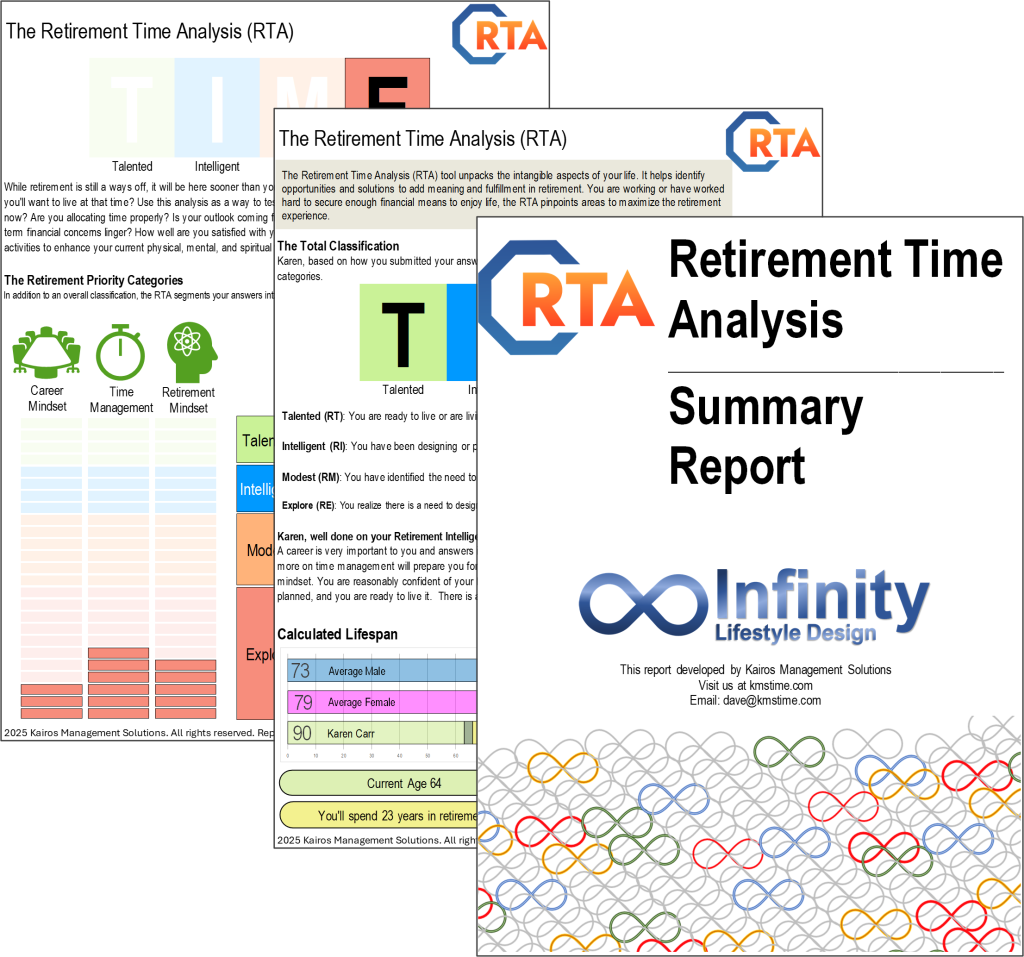
Before Retirement changes your schedule, it helps to understand how prepared you are for the Lifestyle changes that follow. The Post-Career Lifestyle Test explores areas such as purpose, structure, Relationships, and daily routines that often become more important after work ends than many people expect.
For most professionals, identity is deeply tied to their career. Titles, responsibilities, daily routines, and social interactions all reinforce a sense of self. Work provides structure, connection, and purpose. These are three elements that are difficult to replicate once removed. When retirement arrives, those pillars do not gradually fade; they are often removed all at once, which can feel like theft.
The Retirement Time Analysis (RTA) consistently highlights this reality. A career is not just a source of income; it is a primary source of meaning. When that disappears, many new retirees are left asking a deceptively simple question: Who am I now?
The loss has begun.
Unlike identity theft, there is no alert system. No notification that something is wrong.
Instead, it shows up in behavior. A lack of direction. Difficulty making decisions. A tendency to default back into work-like environments, even when unnecessary. Some retirees take on part-time roles not out of financial need, but because they cannot replicate the structure and validation their career once provided.
Work rarely provides only a paycheck. It provides deadlines, accountability, social interaction, recognition, and a reason to get moving each morning. When retirement arrives, all of those can disappear at the same time. What appears to be boredom is often a loss of structure.
Research points to the same conclusion: a significant percentage of individuals derive their primary sense of worth from their profession. When that anchor is removed there is a gap, not just in time, but in identity.
The practical implication is clear: identity must be rebuilt intentionally.
This is where most Retirement Planning falls short. Financial readiness is treated as the primary milestone, but emotional and identity readiness are often assumed. The RTA challenges that assumption by unpacking how individuals think about purpose, time, and lifestyle, not just Money.
I am not waiting until retirement to ask, “Who am I now?” That would be too late for me. I’d encourage you to start by listing the roles your career currently fulfills: decision-maker, problem solver, mentor, income provider, social connector.
Then ask a harder question: Where will each of these roles live when work is gone? If you cannot answer it, you have identified where loss can occur. The objective is not to eliminate identity tied to work, but to begin redistributing it before retirement creates a vacuum.
I’m having fun exploring this now.
I can easily say now, “I already have a time structure.”
Yet if you are like me, the reality is that you probably have a professional time structure but are much more ad hoc on the personal side. Retirement is all personal, so time organization becomes difficult and even challenging.
I’ve worked on this and it is not easy, but try and create a simple weekly personal framework. Assign categories to your time such as Health, relationships, Growth, contribution, and personal interests. Now block them into your calendar. Treat it like you’re your work schedule.
Clarity does not appear on its own, you need to create it. Start with your own purpose statement (a simple format is below):
My life is focused on ______, and I pursue that by ______.
Here is mine: I am focused on using the time God has given me as wisely as possible.
It does not need to be permanent or profound. It needs to be usable. This becomes a filter for decisions, a guide for time allocation, and a replacement for the direction once provided by your career. Without a defined purpose, retirees tend to react to time. With one, they begin to direct it.
While identity theft demands recovery, identity loss invites design.
Those who choose to blueprint a lifestyle tend to experience retirement differently. Their time becomes structured around meaning, not just availability. Their relationships become deliberate, not incidental. Their financial resources become tools, not constraints.
Identity theft requires recovery. Identity loss requires reinvention. The sooner we recognize the difference, the more intentional we can become about designing a life worth stepping into rather than simply leaving a career behind.
David Buck is the author of the book The Time-Optimized Life, coauthor of The Retirement Collective, and owner of Kairos (Time) Management Solutions, LLC. Learn how to apply the concepts of proactively planning and using your time. Take the Time Management Analysis (TMA), the Retirement Time Analysis (RTA), or all the other free resources offered to help bring more quality time into your life.
Content development for this article involved human expertise supported by AI-generated analysis and formatting.
The post Identity Theft Versus Identity Loss first appeared on Infinity Lifestyle Design.