
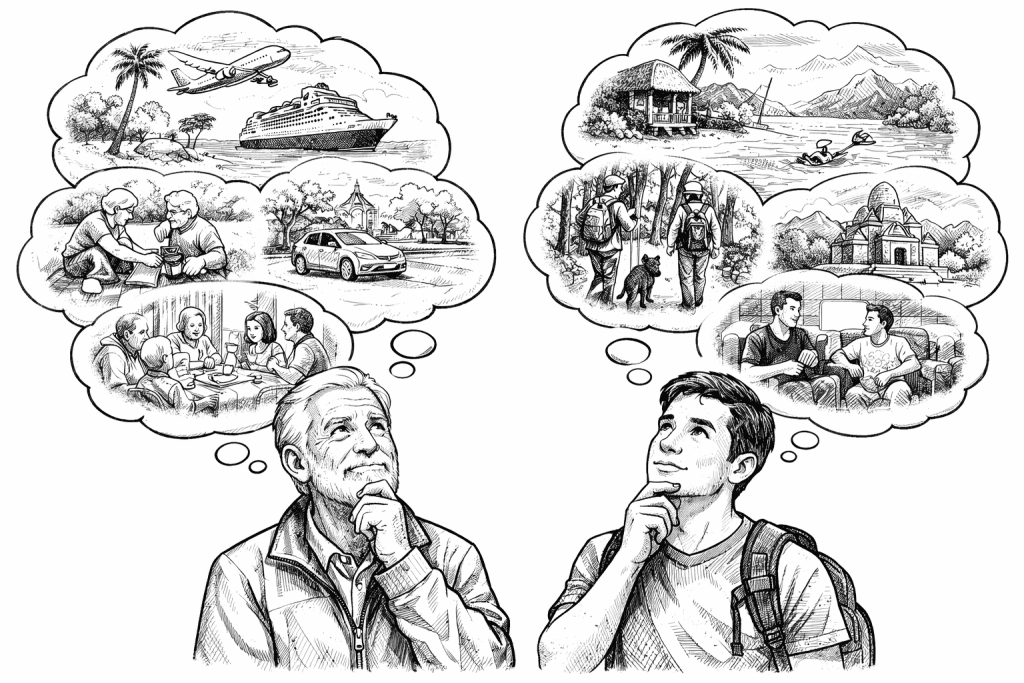
In the middle of a morning walk, my wife and I began to discuss what trips we might want to take and activities we wanted to do. I have talked about bucket lists in this newsletter before; aspirational opportunities that you plan but may not complete. We were reviewing these when the conversation swerved into the type of memories we want to create.
Elaborate vacations and exotic Travel can certainly bring future reminiscences. Yet do they have the power of everyday and ordinary memories? That became the discussion for much of the rest of our walk. It was enlightening to see that we started to land on more basic activities as the basis for more powerful commemorations.
A day with a grandchild.
A hike with a son.
A Family meal.
A drive in the neighborhood.
A visit with an old friend.
These might be ordinary. They might seem like routine. However, they might produce more powerful and lasting memories than that international vacation you took 5 years ago. When it comes to planning your time, consider the opportunity to create quality time in the familiar and common activities you do in life today.
One of the quiet lessons that shows up repeatedly in the Retirement Time Analysis is this: meaning is rarely created in grand gestures—it’s formed through repeated, relational moments.
When people imagine Retirement, travel dominates the mental picture. Trips. Cruises. Destinations. Yet when respondents describe what they most look forward to day-to-day, the answers shift quickly: connection, routine, familiarity, presence. Why not the same for those in-career?
That matters because retirement doesn’t just remove work – it adds nearly 40% more waking hours that must be filled with intention. And while bucket-list experiences are powerful, they are episodic. Everyday time is where identity, belonging, and emotional Health are actually reinforced.
A weekly breakfast with a friend does more to anchor time than a once-a-year vacation.
A standing walk with a spouse shapes memory more reliably than a highlight reel.
A routine visit with family creates continuity, something our brains and nervous systems crave.
The paradox is simple: the more ordinary the activity, the more often it can happen. And frequency—not novelty—is what turns moments into memories.
The Retirement Time Analysis (RTA) provides time benchmarks to help you understand the the impact that retirement will have on your approach to life should you choose to stop working.
At the time of this article, I am compiling data for a company that has their sales and administrative teams taking the Time Management Analysis. The assessments show intensity in the attributes that align with the work that is done.
Participants are strong in planning, prepared for meetings and equipped to complete assignments. They know how to get their tasks done and pride themselves on their organization.
It is when you blend in the “non-work” aspects of time management that things begin to slip. Personal care is the greatest opportunity, where contributors ready admit a lack of emphasis on owning activities that increase their well-being. In addition, the old standby challenges of procrastination and distractions contribute to a lack of focus on individual activities outside of work.
One of the most revealing patterns that shows up in the Time Management Analysis isn’t about productivity at all. It’s about where attention actually goes versus where people believe it goes.
The items associated with meaning; Relationships, health, reflection, learning were almost entirely unprotected. They existed only in the margins, dependent on leftover energy rather than intentional choice.
That insight is where the TMA becomes more than a productivity tool. It exposes a memory gap in the making.
Because the hours most likely to create lasting memories—shared meals, unhurried conversations, physical presence, quiet walks—rarely survive a reactive calendar. They don’t feel urgent. They don’t announce themselves. And they’re the first to disappear when time pressure rises.
Yet years from now, they’re the only moments that will be remembered.
The TMA doesn’t ask, “Are you busy?”
It asks, “Is your time aligned with the life you’ll want to remember?”
For many people, the answer is uncomfortable but clarifying.
And often, the shift doesn’t require more time.
It requires protecting ordinary moments before they’re crowded out.
That morning walk inspired me to shift my efforts to honor the quality moments that happen every day. I don’t need to plan a Bucket List item to have memories to last a lifetime. It does not mean I am going to trash my list. Nope, I still have some fun and exciting things I want to accomplish.
What I am going to pay attention to (and I hope you do as well) are the numerous instances where small quality time can translate into everyday memories that can be drawn upon to help shape a time rich future.
David Buck is the author of the book The Time-Optimized Life, coauthor of The Retirement Collective, and owner of Kairos (Time) Management Solutions, LLC. Learn how to apply the concepts of proactively planning and using your time. Take the Time Management Analysis (TMA), the Retirement Time Analysis (RTA) to help bring more quality time into your life.
The post The Power of Everyday Memories first appeared on Infinity Lifestyle Design.