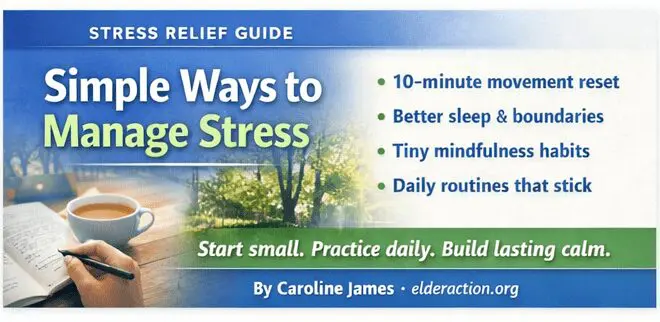
 Is the Stress of life moving in on you, causing worry that makes Sleep difficult, and turning you into a crazy person that even your Family doesn’t recognize? You’re not alone. In this blog, writer-researcher Caroline James provides a solid game plan for bringing you peace. Caroline and her husband, Jim, are founders of https://elderaction.org.
By Caroline James
Busy parents juggling work demands, bills, and family dynamics often carry stress so constantly that it starts to feel like the default setting. Common stress triggers, work-related stress, financial pressures, and family conflicts, can stack up as daily stressors until the mind stays on alert and the body feels worn down.
The challenge is that the pressure blurs together, making it hard to name what’s actually driving it. Learning to connect those everyday triggers to ease stress is the first step toward steadier calm.
Understanding Stress and Your Body’s Alarm System
Stress can be confusing because it shows up in your thoughts and your body at the same time. A helpful definition of stress is that it’s an experience that feels challenging emotionally and physiologically. When your brain senses pressure, it flips on a survival response and releases cortisol to help you push through.
That can be useful in short bursts, but constant stress keeps your system switched on. Over time, cortisol and adrenaline can chip away at mood, focus, sleep, and energy. Managing stress early helps prevent Burnout from becoming your new baseline.
Picture your smoke alarm going off every time you toast bread. Eventually, the noise feels normal, but it still drains you and disrupts the whole house. Daily stress can work the same way, even when nothing is truly urgent.
With the alarm system understood, you can choose calming habits that fit your real life.
Choose 6 Proven Levers to Lower Stress This Week
Stress is your body’s alarm system, not a personal failure. When you lower the “inputs” that keep that alarm stuck on (like poor sleep, skipped meals, or nonstop work), your mind and body can return to calm.
- Do a 10-minute movement reset (most days): Pick one simple option, brisk walking, gentle cycling, stretching, or a short bodyweight routine, and do it for 10 minutes after lunch or before dinner. Regular Exercise benefits include burning off stress hormones and releasing mood-supporting chemicals, which can make your stress response feel less hair-trigger. If 10 minutes feels like too much, start with 5 and add a minute every few days.
- Steady your blood sugar with a “protein + fiber” anchor: Stress can push us toward quick carbs, then the crash can make irritability and worry louder. Aim for a balanced Diet and stress-friendly meals by adding one anchor per meal: protein (eggs, yogurt, beans, chicken, tofu) plus fiber (fruit, oats, veggies, whole grains). A beginner move: keep a consistent breakfast three days this week, something like oatmeal with nuts or toast with eggs and fruit.
- Use a 2-minute Meditation when the alarm goes off: When you notice the stress surge, racing thoughts, tight chest, snapping at someone, pause and practice a tiny meditation technique. Try this: sit, feel your feet on the floor, breathe slowly, and count 10 breaths, starting over if you lose track. Scientific reporting suggests mindfulness can reduce stress, and short practices are often easier to repeat than big sessions.
- Protect your sleep with one “closing shift” rule: Sleep is when your nervous system resets; without it, the alarm system stays sensitive. Choose one rule you can actually keep: set a consistent wake time, stop screens 30 minutes before bed, or write a quick worry list and a “tomorrow plan” to get thoughts out of your head. If sleep has been short lately, you’re not alone; short sleep duration is common, and small changes can still help.
- Set a work-life boundary that’s visible and repeatable: Stress often spikes when your brain believes work never ends. Pick one boundary for this week: no email during meals, a 10-minute buffer between work and home tasks, or a hard stop time two days this week. Make it concrete by telling one person (“I’m offline after 6:30”) and adding a simple end-of-day shutdown note listing your first task tomorrow.
- Lower decision fatigue with a “minimum plan” for tough days: On high-stress days, aim for maintenance, not perfection: one movement snack, one balanced meal, one calming pause, and one bedtime step. Write your minimum plan on a sticky note or phone note so you don’t have to think. This works because it reduces choices when your stress response is already using up mental energy.
Pick two levers that feel most doable, try them for seven days, and let consistency, not intensity, do the heavy lifting.
Calm-Building Habits You Can Repeat Daily
Habits work because they reduce guesswork when life gets loud, and they give your nervous system predictable “safe signals” you can rely on. Choose a few that fit your schedule and keep them simple enough to repeat on ordinary days.
One-Minute Morning Check-In
- What it is: Name one feeling, one need, and your next tiny step.
- How often: Daily, after waking.
- Why it helps: It turns vague stress into a doable plan.
Three-Round Deep Breathing
- What it is: Do 3 rounds of slow inhale and longer exhale.
- How often: Daily, or during stressful moments.
- Why it helps: It signals “not an emergency” to your body.
Midday Mindfulness Touchpoint
- What it is: Try daily course engagement for 2 minutes, noticing breath and body.
- How often: Daily, midday.
- Why it helps: It builds steadier attention and coping over time.
Evening Worry-to-Plan Note
- What it is: Write three worries, then one next action for each.
- How often: 3 to 5 nights weekly.
- Why it helps: It reduces mental looping when you want rest.
Kind Self-Talk Reframe
- What it is: Replace “I can’t handle this” with “I can handle the next step.”
- How often: Whenever you notice harsh self-talk.
- Why it helps: It lowers pressure and supports follow-through.
Pick one habit today, then adjust it so your whole household can stick with it.
Common Questions About Everyday Calm
If stress keeps stacking up, these answers can help you simplify.
Q: What are the common signs that indicate I am experiencing too much stress in my daily life?
A: Common signs include irritability, constant worry, tight shoulders or headaches, trouble sleeping, and feeling like small tasks take huge effort. You might also notice more forgetfulness or withdrawing from people. A practical first step is to write down your top three symptoms for a week and what was happening right before them.
Q: How can I create a routine that helps me maintain a healthy work-life balance and reduce stress?
A: Start by choosing two fixed anchors, such as a consistent start time and a consistent stop time, then build around them. Add one small daily reset, like a short walk or device-free meal, so your brain gets a clear “off” signal. Protect the routine by lowering your daily “must-do” list to your top three priorities.
Q: What quick stress-relief techniques can I practice during a busy day to feel more calm?
A: Try a 60-second longer-exhale breath cycle, then unclench your jaw and drop your shoulders. If your mind is racing, name five things you can see and three you can feel to ground yourself. For a longer-term skill, the MBSR intervention is a structured approach many people use to build steadier coping.
Q: How does improving my sleep and diet habits contribute to better stress management?
A: Better sleep makes Emotions easier to regulate and improves patience and focus the next day. Steadier meals and hydration reduce energy crashes that can mimic Anxiety and make problems feel bigger. Choose one change you can repeat, like a consistent wake time or adding protein at breakfast.
Q: What steps should I take if I want to start a small side business without feeling overwhelmed by paperwork and legal complexities?
A: List every recurring admin task you expect, then circle what you can simplify, such as using templates, batching emails, and setting one weekly “paperwork hour.” Break legal and tax steps into a checklist and handle one item at a time, starting with basic registration and a simple record-keeping system. If you’re exploring ways to streamline setup, ZenBusiness can be an option. Small, steady choices add up faster than you think.
Start Small, Practice Daily, and Build Calm That Lasts
Stress can feel like a constant background noise, especially when responsibilities and paperwork keep piling up faster than relief. The stress management summary here is simple: use a steady, compassionate approach that notices patterns, chooses doable tools, and returns to them even after setbacks, pairing motivational strategies with real-life support when needed.
When applying stress reduction tips in small, repeatable ways, the nervous system gets more chances to settle and confidence grows alongside building resilience. Calm comes from small choices repeated, not from waiting for life to slow down. Choose one positive Lifestyle change to begin now by picking a single technique from this guide and using it at the same time tomorrow. This is how encouraging mental wellbeing turns into steadier days.
For many years, Bob Gatty worked as a writer, editor, and communications consultant, based on the Washington, DC area with a focus on government and politics. He began at The Pittsburgh Courier, an African American weekly, covering crime and the courts. His salary was $55 per week before moving on to two local Pennsylvania dailies. At age 24, he began reporting for United Press International covering state politics in Pennsylvania and then New Jersey, where he was UPI’s state capitol bureau in Trenton.
Tempted by the allure of Washington, DC and big-time politics, at age 29 Bob became press secretary and chief of staff for two Congressmen – first Republican Edwin B. Forsythe, and then Democrat James J. Florio, who later became governor of New Jersey and until his recent death was a frequent podcast guest and co-host of Bob’s NFN Radio News podcast (now called Lean to the Left).
After seven years on Capitol Hill, Bob opened a communications business in Washington, first providing political media consulting to candidates and then freelance Washington coverage for business and trade magazines, plus creative communications services for trade and professional associations, including social media. This work involved articles and analyses of key governmental developments affecting businesses, such as the food and Health industries, retailing, and the environment.
His work as a communications consultant to trade and professional associations included launching and editing association publications, providing website content and social media assistance, and covering conferences and conventions.
Bob retired from G-Net Strategic Communications in 2016 and moved to Myrtle Beach, SC, where he launched his blog site, first called Not Fake News, now known as Lean to the Left.
Hijacked Nation
In August, 2020, Bob and co-author Chris Waldron, one of Lean to the Left's most loyal and prolific contributor, published "Hijacked Nation-Donald Trump's Attack on America's Greatness," a two-volume compilation of blogs regarding Trump's presidency and the consequences for our nation. A followup volume was published by Luna Global Media in September 2024. It is available at https://amzn.to/4ePrTF7 .
In all three volumes, blogs from Not Fake News and Lean to the Left create a virtual play-by-play of key actions of the Trump administration and Congress. For more information, please visit https://leantotheleft.net/books/, and visit Bob's Author's Page on Amazon, https://www.amazon.com/stores/Bob-Gatty/author/B08C7HWXZ5?ref=ap_rdr&isDramIntegrated=true&shoppingPortalEnabled=true&ccs_id=4e603563-7251-4074-b54d-40800c4ce40a.
The Lean to the Left Podcast
The Lean to the Left podcast provides commentary and interviews with newsmakers and others with interesting stories to tell. Video and audio podcasts stream twice weekly on major channels. More info at https://podcast.leantotheleft.net.
The Lean to the Left YouTube Channel
You'll find all of the audio tracks for the Lean to the Left Podcast here plus original videos, including complete video versions of each podcast.
https://www.youtube.com/@LeantotheLeft.