
Have you ever really thought about how frequently you ask for help?
Is it often? Maybe it’s infrequently or maybe it’s next to never.
What about how often you offer help to others?
The reason I ask is that these 2 things could have a direct impact on whether you will successfully achieve your goals or not.
In my experience people are usually quite one sided when it comes to the world of asking for or offering help; they either tend to over-index on asking for help or are habitual offerors of help.
Think about it, we all have them: the acquaintances who regularly ask for help — be it the friend who always wants to borrow some Money, or the work colleague who always seems to be behind or the Family member who always needs a lift.
We also all have met people in life who unconditionally offer help: the friend who will pile in when you need a hand moving home or the person who will provide a listening ear when you seem stressed or the work colleague who will offer to stay late to work on your deliverable.
[For Clarity, whatever the situation, offering help is where you’re willing to get involved with something that is not directly related to your world and you are not getting rewarded for. The same applies to asking for help where the thing you are asking for is not directly beneficial to the other person.]
So what? Why does it matter if you are an Asker or an Offeror? Does being one or the other make it more less likely that you will be successful?
Let’s look at what research tells us.
There is a fair amount of research that shows that the act of Helping has psychological, social, physical and mental health benefits for the helper including:
There is also various research into what happens when you ask others for help, most notably:
If there are proven benefits to both asking and offering help: why don’t we see more people doing them? Similarly when we think of the most successful people we know, do they tend to be Askers or Offerors?
The reality is they are probably doing a bit of both; is that the right thing?
Whilst there is an acknowledgment that offering too much help can lead to “volunteer burnout” or “compassion fatigue,” there is little research into the interplay of asking for and offering help.
Adam Grant, the organisational psychologist, talks about the difference between Givers, Takers and Matchers in a business and concludes that the majority of workers match the amount of help they give and take over time whilst having too many takers in organisations will lead to negative results. He also argues that over-indexing as a giver can be a good thing (building strong networks) and a bad thing (liable for Burnout) at the same time.
Over time I have become fascinated by this interplay because I came to realise that I am a person who will infrequently ask for help, neither in my personal nor business life.
I regularly offer help to all my acquaintances (which can cause problems as I have a lot of acquaintances) but have come to the conclusion that I am missing out substantially by taking this approach (especially as a Solo Founder of a business) — my hypothesis is that by balancing out my Asking and Offering I will more likely achieve my goals.
I didn’t stop there; I began thinking about all the people that I spend the most time with and assessed whether they were more likely to be Askers or Offerors — people always seemed to gravitate towards one or the other.
The more I thought about it, the more I realised that, by looking across both dimensions simultaneously, people could be classified into four Help Types: The Fortress, The Extractor, The Martyr and The Multiplier.
Each has its strengths but each also has its weaknesses. Some are more celebrated in certain cultures than others but let’s have a look at each of these four.
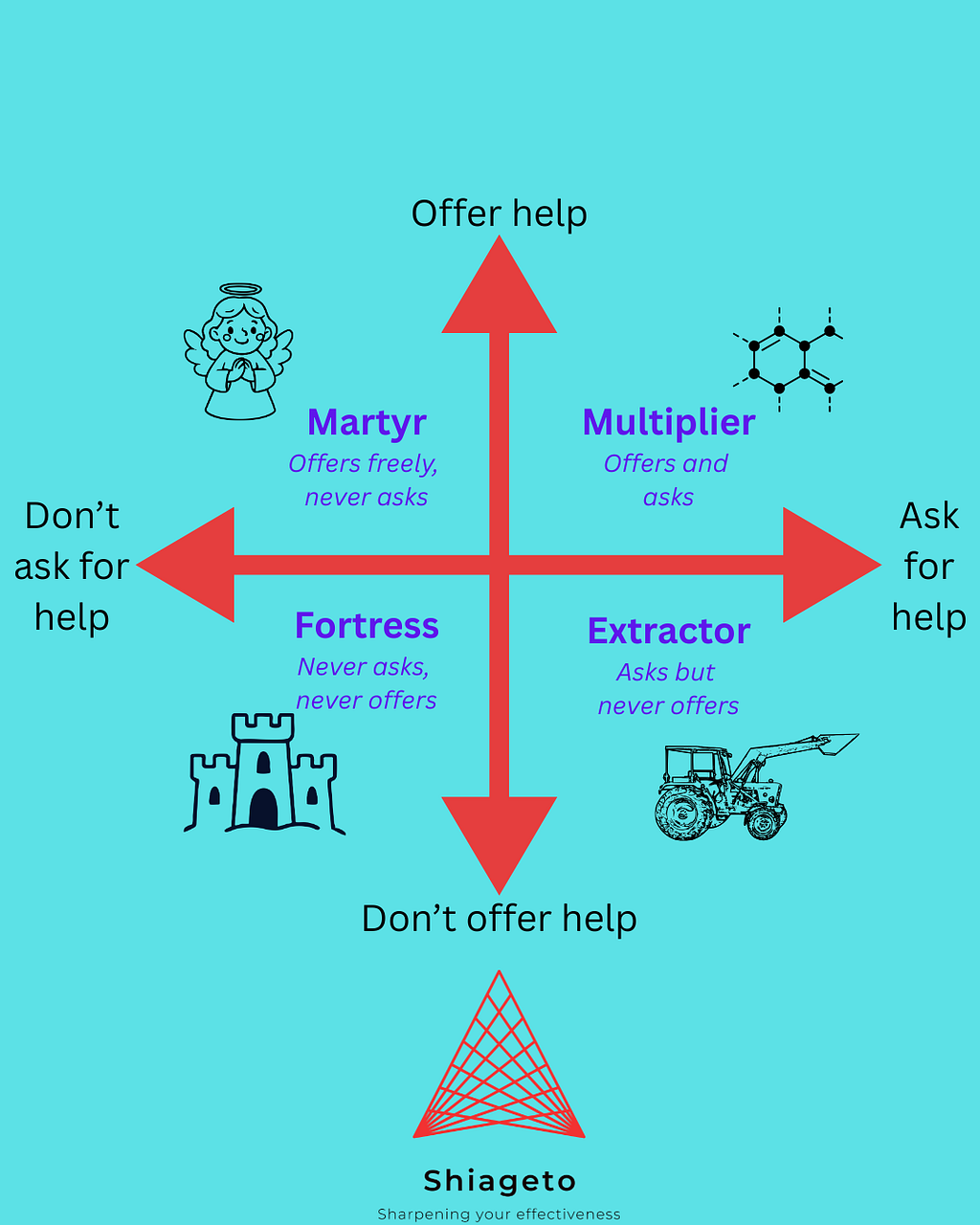
(Never asks. Never offers.)
A Fortress is the sort of person who prides themselves on independence.
They don’t burden others. They don’t rely on others. They don’t need others.
At least that’s the story they tell themselves — I have definitely been guilty of this at times in life; the consequence of a natural introversion and big ego taking over.
Fortresses often equate self-sufficiency with strength. They’ve usually been rewarded for competence and autonomy, and they quietly distrust the capability — or discretion — of others.
IQ, EQ, FQ strengths: deep individual problem-solving (IQ), greater resilience (EQ), less likely to be sucked into other people’s issues (FQ)
IQ, EQ, FQ weaknesses: risk of picking the wrong option because of limited thinking (IQ), discomfort with vulnerability and inability to adapt (EQ), slower pace on their own issues without external input (FQ)
Fortresses will only ever get so far because so much of life today is about being networked which means they can survive but they rarely blossom.
Let’s put it another way: You will very rarely hit the heights of any goal, organisation or relationship as a Fortress.
(Asks. Rarely offers.)
These are the most Machiavellian of the four types, the type of people that understand leverage and use it.
They are comfortable asking for introductions, insight, time and resources. They move fast and may seem to achieve things but that is solely because they are using other people’s capability.
I must admit, I can think of a couple of unique situations where I have been guilty of this personality type — it feels good at the time.
The thing is, you might get some short term gain but it catches up with you.
When value only flows one way, other people feel the imbalance and will move to correct it. It might not be public and it might not be noticeable but your social credit erodes quietly before it collapses publicly [this happened to me].
IQ, EQ, FQ strengths: knows where the information is (IQ), high self awareness and able to charm others (EQ), hyper focused on personal goals (FQ)
IQ, EQ, FQ weaknesses: often lets own skills deteriorate (IQ), self centred, not a team player (EQ), can go off track if wider goals do not align to their own (FQ)
Extractors have a shelf life; whilst they are rarely confronted directly, they’re simply excluded — eventually.
If you are an Extractor, people will stop returning your calls long before anyone says anything directly to you.
I vow to limit my time as an Extractor.
(Offers freely. Never asks.)
Martyrs are often the most celebrated and the one we all want to be. This is because Martyrs are generous, responsive and reliable.
They seem superhuman when they step in, when they fix things and when they support others.
But they almost never ask for help themselves.
Why is that?
Often because asking feels like weakness. Or burdening others feels uncomfortable. Or they believe seniority means self-sufficiency.
Having spent a lot of time in the insecure-overachiever environment that is top-tier consulting, I can say that this is a prevalent mindset and one I have gravitated most to in my life.
Inevitably, it doesn’t stay positive indefinitely for this personality type. Over time, something corrosive happens:
Fatigue; Resentment; Quiet disengagement.
It’s no coincidence that Martyrs are the ones that burn out most or end up deeply dissatisfied.
IQ, EQ, FQ strengths: may get tangential knowledge from helping others (IQ), high empathy and popularity (EQ), high energy leads to greater output (FQ)
IQ, EQ, FQ weaknesses: risk of not applying the right skills to their own problems (IQ), liable to not take care of their own needs, make themselves too vulnerable (EQ), overstretched and limited time to focus on own needs (FQ)
The tragedy of the Martyr is: They confuse selflessness with sustainability. And people around them appreciate them for that — right up until they break.
I’ve seen this a lot in my old world and the sad fact is, because of Survivorship Bias, Martyrs get quickly forgotten too.
I worry that I have spent too long operating in this Helping Behaviour already and I need to address that.
(Offers. Gives.)
Multipliers are the ones who operate differently. They give generously — but not indiscriminately. They ask confidently — but not excessively.
They understand something fundamental:
Interdependence is not weakness. It is scale.
They don’t hoard capability; they don’t extract value; they circulate both.
They realise that asking for help prevents blind spots and that giving help builds long-term optionality. Multipliers build and maintain ecosystems where value flows in both directions thanks to reciprocity.
IQ, EQ, FQ strengths: tap into collective intelligence (IQ), calibrated reciprocity (EQ), maintain focus by uniting different efforts (FQ)
IQ, EQ, FQ weaknesses: potentially less investment in improving their own skills (IQ), liable to not take care of their own needs sufficiently (EQ), potential to be overstretched (FQ)
Out of the four personality types, being a Multiplier is where you want to be.
They don’t just perform. They compound. This is where success truly lies!
My research has led me to conclude that this is the behaviour that I see adopted by the most successful people I have encountered and where I want to gravitate more towards.
Be honest, where would you put yourself on the Help Matrix?
In most societies and organisations, people will be bombarded with an expectation to be self-sufficient and to be helpful…
Think about it:
Everyone wants the most from you and expects you to just get on with it.
Unfortunately whilst this sounds admirable, it will more than likely end up with people gravitating to being a Silent Fortress, a Secret Extractor or a Burnt-out Martyr — very rarely does it forge good Multipliers.
The irony of this situation is that the most dangerous quadrant in most high-performing organisations is not the Extractor.
It’s the Martyr.
Because Martyrs are praised, promoted and overloaded. They become central nodes — but with no inflow of support.
Eventually, the system consumes them.
What I’ve come to realise more and more is that the one type of personality that society needs more of are Multipliers.
Especially in business where the future of complex organisations depends on distributed intelligence, cross-boundary collaboration and psychological safety.
Which means it depends on people who can both give and ask.
This is the approach I will be taking to mature my Helping Behaviour towards being more of a Multiplier — feel free to unashamedly copy it:
A. The first step is to realise where you sit on The Help Matrix
Be honest:
Until you know where you are starting, you can’t redefine your position.
If you don’t know (or can’t be honest) ask those closest to you.
B. Work out which quadrant you want to be in for different parts of your life
This may sound like a weird thing to ask yourself but, your Helping Behaviour Type will be contextual. In some scenarios it may actually be of benefit to be an Extractor, for example, especially if you are a newbie surrounded by Experts. Whereas in other situations being a Martyr may be the best place to be.
Look across the different parts of your life and your Helping Behaviour Type, what does it look like all together? Is it close to being a Multiplier?
C. Change the narrative in your head
Underneath the matrix sits a more uncomfortable question:
What story do you tell yourself about strength?
Until you change the underlying story you will invariably default back to your natural style. A good way to do this is to look to role models that have the behaviour you want to adopt and/or to experiment with a new narrative and see the impact it delivers.
If you really want to become a Multiplier you will need two major psychological shifts:
D. Start moving to being a Multiplier in places where you have the most power
It is always easier to make the most changes where you have the most control and for most of us, this is where we exhibit our true leadership.
Start exhibiting the behaviour that you are least comfortable with; if you’re a Martyr start saying no more often. If you’re an Extractor, start offering help more freely.
The reality is that in modern leadership, you aren’t measured only by what you produce. You are measured by whether capability grows around you — and continues without you.
If you never ask for help, you limit your growth.
If you never offer help, you limit your relevance.
If you only ask for help, you will wear out goodwill.
If you only offer help, you limit your longevity.
If you do both well, you build something that outlasts you.
And that is the real value of the Multiplier Effect.
The good news is that it doesn’t have to be a 1:1 ratio of asking and offering; as you make changes just look to improve your ratio to get them more in balance.
My current ratio is more like 1:20 in terms of asking and offering so my goal is to get it to 1:5 over the next couple of months and we’ll see after that.
I have no doubts that it will open up so many good things for me and for Shiageto Consulting so follow me to see how I get on 🙂
Faris
Faris is the CEO and Founder of Shiageto Consulting, an innovative consultancy that helps firms and individuals sharpen their effectiveness. Connect with him here
Success = IQ x EQ x FQ
Want to assess your levels of IQ, EQ and FQ? click here
Originally Published on https://farisaranki.medium.com/