

In today’s increasingly complex and matrixed organizational structures, the ability to lead without formal authority has become one of the most crucial leadership competencies. Whether you’re a project manager coordinating cross-functional teams, a subject matter expert driving organizational change, or a team member tasked with influencing peers, mastering the art of leadership without hierarchical power is essential for professional success and organizational effectiveness.
Leading without authority represents a fundamental shift from traditional command-and-control management to influence-based leadership. It requires a sophisticated understanding of human psychology, relationship dynamics, and organizational systems. This comprehensive exploration examines the principles, strategies, and practical applications of this vital leadership skill.
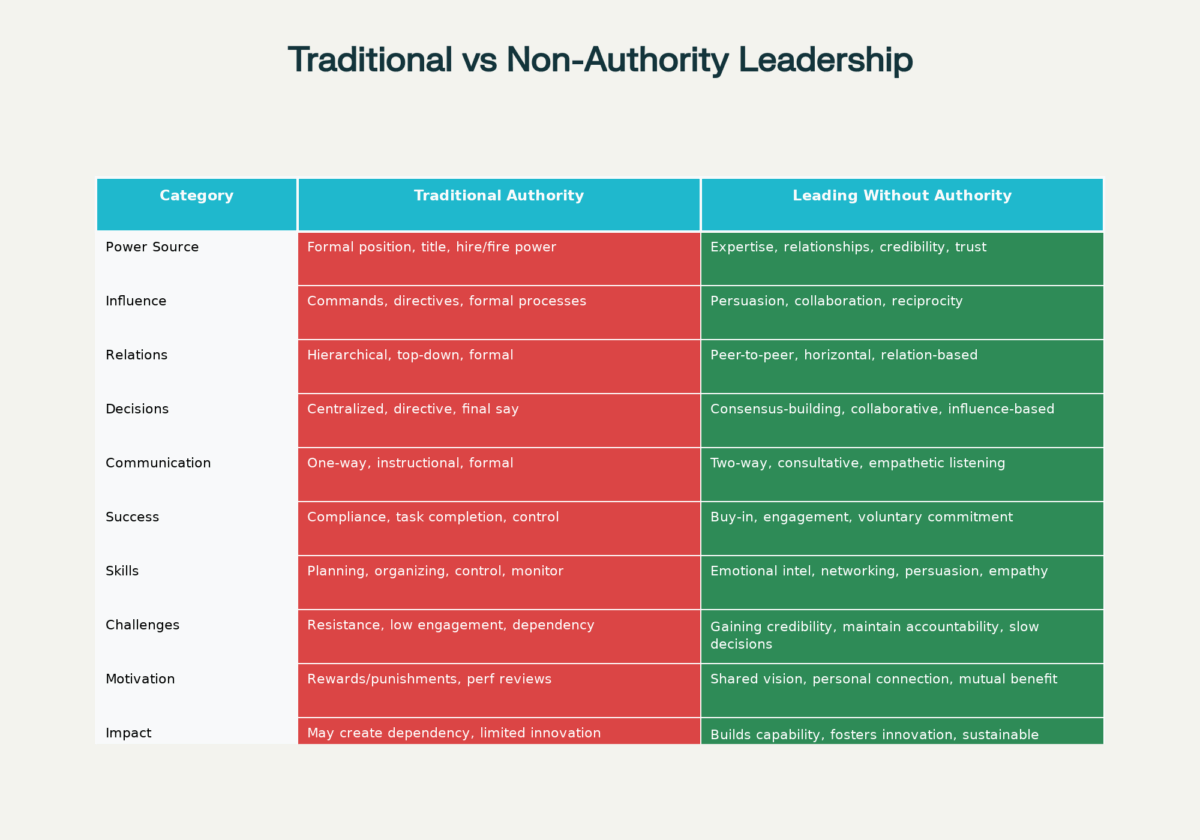
Traditional Authority vs. Leading Without Authority: A Comprehensive Comparison
The traditional organizational pyramid, with its clear hierarchies and well-defined authority structures, is rapidly giving way to flatter, more agile organizational forms. Matrix organizations, cross-functional teams, remote work arrangements, and project-based structures have created environments where formal authority often doesn’t align with the need for leadership and influence.online.hbs+1
Research from multiple studies shows that employees in highly matrixed environments are less likely to strongly agree they know what is expected of them at work. This ambiguity creates both challenges and opportunities for those who can master influence without authority. The most successful professionals in these environments are those who build robust Relationships, influence decisions, and drive outcomes throughout the organization without relying on official titles or positional power.tieonline+1
This shift is not merely organizational but reflects broader changes in workforce expectations. Modern employees, particularly younger generations, seek meaning, autonomy, and collaborative work environments rather than top-down directive management. They respond better to leaders who inspire and engage rather than command and control.oakinnovation
At the heart of leading without authority lies a deep understanding of what motivates people to act voluntarily. Robert Cialdini’s groundbreaking research identified seven universal principles of persuasion that remain fundamental to influence: reciprocity, commitment and consistency, social proof, authority (expertise-based rather than positional), liking, scarcity, and unity.fm-magazine+1
Reciprocity forms the cornerstone of influence without authority. When someone does something beneficial for another person, it creates a psychological obligation to return the favor. This principle operates powerfully in workplace relationships. Research shows that when leaders offer help, support, or recognition without immediate expectation of return, they build influence capital that can be leveraged later.freemannews.tulane+2
Social proof becomes particularly relevant in peer influence situations. People are naturally inclined to follow the behavior of others, especially those they perceive as similar to themselves. Leaders without authority can harness this by showcasing examples of desired behaviors and highlighting when others have successfully adopted new approaches.fm-magazine
Authority based on expertise rather than position carries significant weight in professional environments. When individuals demonstrate deep knowledge, consistent results, and sound judgment, others naturally seek their guidance and follow their recommendations. This expertise-based authority is particularly powerful because it’s earned rather than assigned.forbes+1
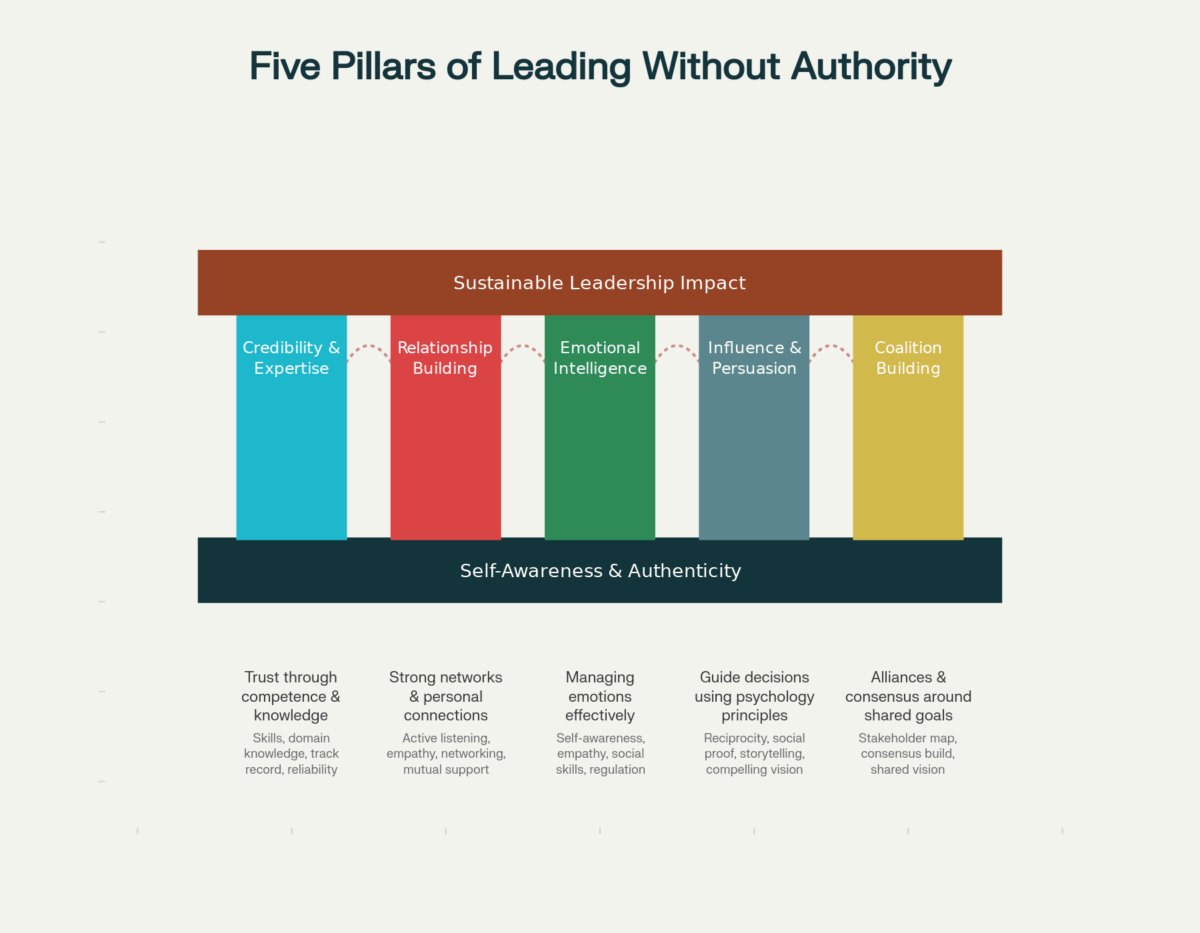
The Five Pillars of Leading Without Authority: A Framework for Influence and Impact
Effective leadership without authority rests on five interconnected pillars that work synergistically to create sustainable influence and impact.
Credibility serves as the foundation for all other influence activities. Without it, even the most sophisticated influence techniques fall flat. Credibility in the context of leading without authority encompasses several dimensions: technical competence, track record of results, reliability, and authenticity.forbes+1
Building credibility requires a strategic approach to developing and showcasing expertise. This involves staying current with industry trends, continuously developing skills, and positioning oneself as a valuable resource for others. The most effective leaders without authority become known as subject matter Experts whom others naturally turn to for guidance and insight.freemannews.tulane
Research indicates that people follow those they trust to have the knowledge and experience to guide them successfully. This trust is built through consistent demonstration of competence, willingness to acknowledge limitations, and commitment to helping others succeed even when there’s no direct benefit to oneself.gallup+1
Strong relationships form the infrastructure through which influence flows. In environments where formal authority is absent, the quality of interpersonal connections often determines success or failure. Effective relationship building in professional contexts requires intentional effort and emotional intelligence.forbes+1
The most successful relationship builders understand that influence is fundamentally about serving others’ interests while advancing shared objectives. They invest time in understanding colleagues’ motivations, challenges, and goals. They practice active listening, demonstrate empathy, and consistently follow through on commitments.executiveeducation.wharton.upenn+1
Relationship building also involves understanding organizational networks and informal power structures. Every organization has informal leaders and influencers who may not appear on the organizational chart but wield significant influence over opinions and decisions. Identifying and building relationships with these key individuals can dramatically amplify one’s ability to drive change and influence outcomes.hellomonday+1
Emotional intelligence serves as the operating system for effective leadership without authority. It encompasses self-awareness, self-regulation, empathy, and social skills. Leaders with high emotional intelligence can navigate complex interpersonal dynamics, manage conflicts constructively, and inspire others to voluntary action.greator+1
Self-awareness enables leaders to understand their own emotional triggers, strengths, and limitations. This understanding is crucial when operating without formal authority because reactions and behaviors are scrutinized more closely by peers who have the option to disengage or resist.simpplr+1
Empathy and social skills allow leaders to connect authentically with others, understand diverse perspectives, and tailor their approach to different personalities and situations. Research shows that Emotions are contagious and flow most strongly from leaders outward, making emotional intelligence particularly important for those seeking to influence without formal power.davidhager+1
Effective persuasion in professional contexts goes beyond simple tactics to encompass a sophisticated understanding of human motivation and decision-making. The most successful leaders without authority master multiple influence strategies and know when to apply each one.freemannews.tulane+1
Rational persuasion involves using logical arguments, facts, and evidence to influence decisions. This approach works particularly well with analytically-minded individuals and in cultures that value data-driven decision making. However, research shows that pure rational persuasion has limitations and must be combined with other approaches for maximum effectiveness.logicmelon
Inspirational appeals connect individual actions to larger purposes and values. Leaders without authority who can articulate compelling visions and help others see how their contributions matter often generate higher levels of voluntary commitment than those relying solely on logical arguments.sfmic+1
Consultation involves involving others in the decision-making process and incorporating their input into solutions. This approach not only improves decision quality but also increases buy-in and ownership of outcomes. When people feel their voices have been heard and their expertise valued, they become invested in successful implementation.indeed+1
Building coalitions represents the scalable dimension of leading without authority. While individual relationships form the foundation, coalitions amplify influence by creating networks of aligned stakeholders working toward common objectives.simplystakeholders+2
Effective coalition building requires strategic thinking about stakeholder interests, potential sources of resistance, and pathways to consensus. The most successful coalition builders understand that successful alliances are built on mutual benefit rather than one-sided extraction. They invest time in understanding what different stakeholders need and find ways to create win-win outcomes.thomas+1
Coalition building also involves managing group dynamics and facilitating productive discussions among diverse stakeholders. This requires skills in meeting facilitation, conflict resolution, and consensus building. Leaders who can help groups navigate disagreements and reach mutually acceptable solutions become invaluable resources that others seek to engage with.indeed+1
The fastest path to influence without authority involves becoming genuinely valuable to others through expertise and results. This means developing deep knowledge in areas that matter to the organization and consistently applying that knowledge to help others succeed.forbes+1
Value creation goes beyond technical expertise to include problem-solving capabilities, strategic thinking, and the ability to see connections across different parts of the organization. Leaders who can help others navigate complex challenges, identify new opportunities, or avoid potential pitfalls quickly build reputations as valuable contributors.freemannews.tulane+1
The key to leveraging expertise for influence is sharing knowledge generously while maintaining high standards of quality and accuracy. When people consistently receive valuable insights and assistance from someone, they naturally begin to seek that person’s input on other matters and defer to their judgment in areas of expertise.executiveeducation.wharton.upenn+1
The principle of reciprocity can be strategically applied in professional contexts to build influence capital over time. This involves identifying opportunities to provide value, assistance, or support to others before making requests for their help or cooperation.tnmcoaching+2
Effective application of reciprocity requires understanding what different stakeholders value most highly. For some, it might be access to information or expertise. For others, it could be recognition, career development opportunities, or help with challenging projects. The most successful leaders without authority become skilled at identifying these currencies of exchange and making strategic investments in relationships.theleadershipedge+1
The timing and authenticity of reciprocal actions matter significantly. Genuine offers of help that are clearly motivated by desire to contribute rather than immediate self-interest build more influence capital than obvious quid pro quo transactions. The goal is to build a reputation as someone who contributes to others’ success, creating a natural inclination for people to reciprocate when opportunities arise.tnmcoaching
Consensus building represents one of the most powerful tools for leaders without authority because it transforms potential resistance into active support. Rather than trying to convince others to adopt predetermined solutions, effective consensus builders involve stakeholders in problem identification, solution development, and implementation planning.indeed+2
The process typically begins with alignment on problem definition and desired outcomes. This foundational step is crucial because stakeholders who disagree on the nature of the problem will struggle to agree on solutions. Effective facilitators help groups work through these definitional discussions patiently and thoroughly.indeed
Once problems are clearly defined, consensus building moves to collaborative solution development. This involves structured brainstorming, evaluation of alternatives, and gradual convergence on preferred approaches. The most successful leaders facilitate these discussions in ways that ensure all voices are heard while maintaining focus on achieving workable outcomes.frontline-negotiations+1
Leading without authority inevitably involves encountering resistance, disagreement, and conflict. Unlike formal leaders who can escalate decisions or mandate compliance, leaders without authority must develop sophisticated skills for working through these challenges constructively.relationshipone+1
The first step in managing resistance is understanding its sources. Resistance may stem from competing priorities, resource constraints, different values or perspectives, or simple miscommunication. Effective leaders take time to diagnose the root causes of resistance rather than assuming people are simply being difficult or uncooperative.forbes+1
Once sources of resistance are understood, leaders can address them through appropriate strategies. This might involve providing additional information, adjusting proposed solutions to address legitimate concerns, finding creative ways to align competing interests, or simply Investing more time in relationship building and trust development.inc+1
Project managers represent perhaps the most common example of leaders without authority in modern organizations. They are typically responsible for coordinating work across multiple departments and functions while having little or no formal authority over team members.sfmic+3
Successful project managers master several key practices for leading without authority. They invest significant time upfront in building relationships with team members and understanding their primary responsibilities and constraints. They communicate project objectives in terms of how success will benefit each team member’s department and career goals.lyrahealth+1
They also become skilled at managing competing priorities by working with functional managers to negotiate resource allocation and time commitments. Rather than simply demanding compliance with project timelines, effective project managers help functional leaders understand trade-offs and make informed decisions about resource allocation.eff+1
Change agents and organizational development professionals often find themselves in positions where they need to influence behavior and attitudes across entire organizations without having direct authority over most stakeholders. This requires sophisticated understanding of organizational dynamics and human psychology.forbes+1
Successful change leaders typically begin by building coalitions of influential stakeholders who can champion change initiatives within their respective areas. They invest time in understanding informal power structures and identifying key opinion leaders whose support will be crucial for broader adoption.simplystakeholders+1
They also master the art of storytelling and vision communication, helping people understand not just what needs to change but why change is necessary and how it will benefit them personally and professionally. The most effective change agents connect organizational change initiatives to individual values and aspirations rather than simply mandating new behaviors or processes.inc
Subject matter experts and technical leaders often need to drive adoption of new technologies, methodologies, or best practices across organizations where they have expertise but no formal authority. This requires balancing technical competence with influence skills.managementcenter+1
The most successful technical leaders focus on Education and demonstration rather than advocacy. They create opportunities for others to experience the benefits of new approaches firsthand rather than simply arguing for their adoption theoretically. They also invest time in understanding business implications of technical decisions and communicating in terms that non-technical stakeholders can understand and value.forbes+1
They build credibility by consistently delivering results and being transparent about limitations and challenges. When technical recommendations don’t work as expected, they take responsibility and adjust approaches rather than making excuses or blaming others.yorkcountychamber+1
While relationships form the foundation of leading without authority, overreliance on personal connections can create vulnerabilities. When influence is based primarily on individual relationships rather than competence and value creation, it can be fragile and difficult to scale.park+1
The most sustainable approach combines strong relationships with demonstrated expertise and consistent results. This creates multiple sources of influence that reinforce each other rather than depending on any single factor.freemannews.tulane+1
Leaders without authority who ignore organizational politics do so at their own peril. While it’s important to maintain integrity and authenticity, understanding how decisions really get made and where informal power resides is crucial for effectiveness.executiveeducation.wharton.upenn+1
This doesn’t mean engaging in manipulative or unethical behavior, but rather developing political awareness and skill. Effective leaders understand stakeholder interests, organizational priorities, and decision-making processes well enough to navigate them successfully while maintaining their values and principles.thomas+1
Credibility and trust, once damaged, are difficult to rebuild. Leaders without authority who make commitments they cannot keep or who are inconsistent in their actions quickly lose influence and find it difficult to regain.rochemartin+1
The solution involves being more conservative in making commitments and more systematic in tracking and fulfilling them. Many successful leaders without authority maintain detailed systems for managing commitments and following up on promises made to ensure nothing falls through the cracks.cultureally+1
leading_without_authority_action_plan.csv
Generated File
Developing effective leadership without authority requires systematic effort and continuous refinement. The action plan provides a structured approach for building influence over time through four distinct phases: Foundation Building, Relationship Development, Influence Execution, and Sustaining Impact.
Foundation Building focuses on establishing credibility and self-awareness. This involves documenting achievements, developing expertise through challenging projects, building a track record of reliability, and practicing self-reflection. Success indicators include clear articulation of value proposition, recognition as a subject matter expert, and improved emotional regulation.
Relationship Development emphasizes building networks and understanding stakeholders. Key activities include mapping key influencers, scheduling regular touchpoints, practicing active listening, and demonstrating empathy. Success is measured by comprehensive stakeholder mapping, regular communication patterns, and increased trust from others.
Influence Execution involves applying influence principles and building coalitions. This includes strategic use of reciprocity, creating shared visions, forming alliances, and facilitating consensus. Success indicators include voluntary help from others, team alignment around common goals, and collaborative decision-making processes.
Sustaining Impact focuses on measuring effectiveness and scaling influence. Activities include tracking behavioral changes, adapting approaches based on feedback, developing others in influence skills, and expanding to new areas. Success is demonstrated through measurable behavior change, increased effectiveness over time, and organizational recognition of leadership capability.
Evaluating effectiveness when leading without authority requires different metrics than traditional leadership assessment. Success indicators focus on voluntary engagement, behavior change, and sustainable outcomes rather than simple compliance or task completion.execed.business.columbia+1
Engagement metrics include levels of voluntary participation in initiatives, quality of contributions from team members, and retention of key stakeholders over time. High-performing leaders without authority typically see increasing levels of engagement and discretionary effort from those they work with.
Influence indicators encompass the extent to which others seek input on decisions, adopt recommended approaches, and advocate for initiatives with their own networks. Effective leaders build influence that extends beyond direct interactions to create ripple effects throughout organizations.
Outcome measures focus on achievement of objectives through voluntary cooperation and collaborative effort. This includes successful completion of cross-functional projects, adoption of new processes or technologies, and sustainable behavior change across stakeholder groups.
The trend toward flatter, more networked organizational structures suggests that leading without authority will become increasingly important for professional success. Several developments reinforce this trajectory: continued adoption of matrix organizations, Growth in remote and distributed work, increasing emphasis on collaboration and Innovation, and changing workforce expectations around autonomy and meaning.
Organizations are recognizing that traditional hierarchical leadership models limit agility and innovation in rapidly changing environments. Companies that can develop broad-based influence capabilities across their workforce will have significant advantages in adaptation and execution.
This creates both opportunities and imperatives for individual professionals. Those who master influence without authority will find themselves increasingly valuable and sought after. Those who rely primarily on positional authority may find their career options becoming more limited as organizational structures continue to evolve.
The skills and principles outlined in this exploration provide a foundation for developing these crucial capabilities. However, like all leadership competencies, leading without authority requires continuous practice, reflection, and refinement. The most successful practitioners treat it as an ongoing development area rather than a destination to be reached.
Success in leading without authority ultimately depends on genuine commitment to serving others while advancing shared objectives. When this authentic service orientation combines with sophisticated understanding of influence principles and consistent application of relationship-building practices, the result is sustainable leadership impact that transcends formal organizational boundaries and creates lasting value for all stakeholders involved.
The ability to lead without authority represents one of the most valuable professional capabilities in the modern Economy. Organizations need people who can drive results through collaboration and influence rather than command and control. Professionals who develop these capabilities position themselves for success regardless of their formal title or position in the organizational hierarchy.
As we move toward increasingly networked and collaborative organizational forms, the distinction between formal and informal leadership will continue to blur. The principles and practices of leading without authority will become fundamental leadership competencies rather than specialized skills. Those who begin developing these capabilities now will be well-positioned for the leadership challenges and opportunities of the future.
The post Leading Without Authority: The Art of Influence in Modern Organizations appeared first on Business Advisor and Executive Coach | Doug Thorpe.