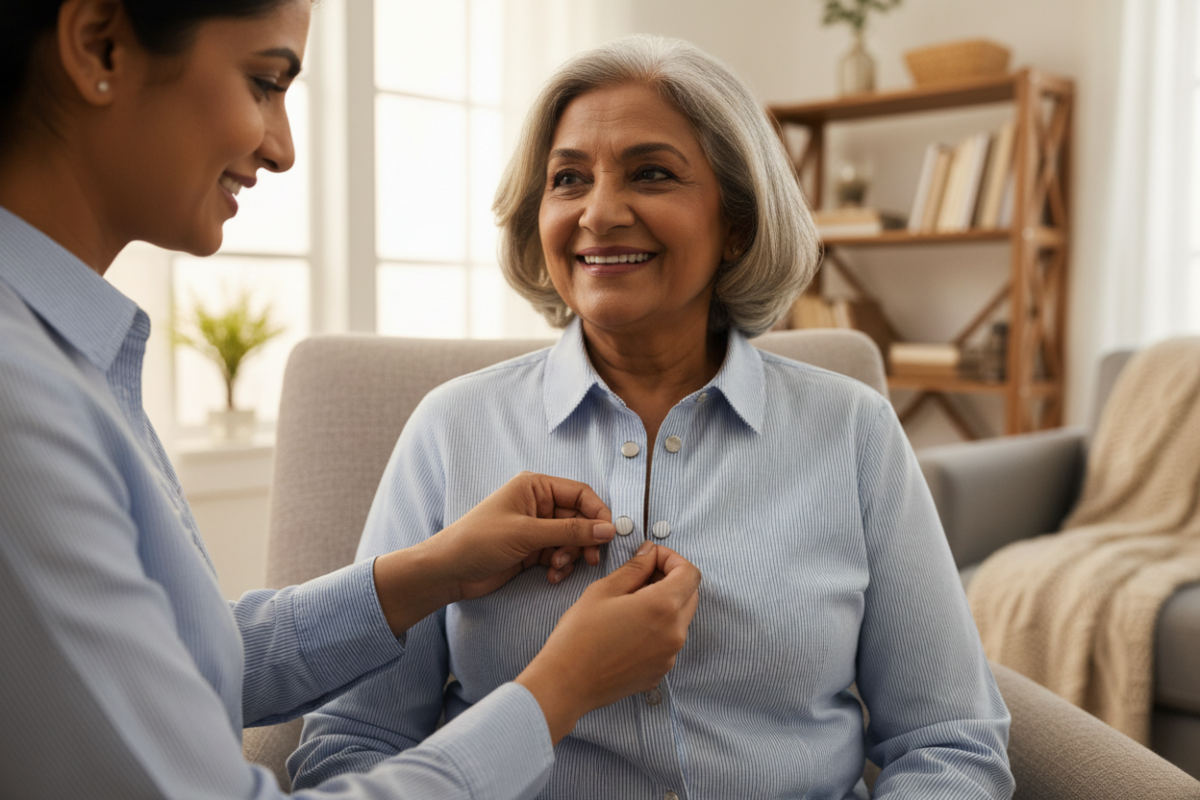
Getting dressed should not feel like a daily obstacle. But for many older adults, small tasks like fastening buttons can quietly become harder over time.
At first, the changes may seem minor. Your parent may take longer to get dressed, stop wearing certain shirts, or ask for help with clothing they used to manage on their own. They may brush it off or say nothing at all. For many Family caregivers, buttoning problems show up gradually, then suddenly feel like a daily source of Stress.
If that sounds familiar, it may be time to look at whether your parent needs easier clothing. Magnetic button shirts for seniors can help reduce frustration, support independence, and make daily dressing feel more manageable. The same is true for magnetic zipper clothing, which can help with jackets, hoodies, and outerwear that have become hard to close.
Buttons require more hand control than most people realize. To fasten a shirt, a person needs finger strength, grip, coordination, range of motion, and enough vision to line everything up correctly.
That becomes harder for many older adults because of:
This is why many caregivers start searching for adaptive clothing arthritis, easy to put on clothes for Elderly parents, or clothing for seniors with limited mobility. The issue is not always the shirt itself. It is the closure.
If you are not sure whether buttons have become a real problem, these are some of the most common signs to watch for.
One of the earliest signs is simply more time. If your parent used to get dressed quickly but now seems stuck on a shirt or jacket, buttons may be slowing them down.
You may notice them starting over, pausing midway through dressing, or needing much more time to finish getting ready.
If your parent used to wear collared shirts, blouses, cardigans, or button-front pieces and now avoids them, pay attention.
This is often one of the clearest clues. Many older adults quietly stop wearing clothes they like because the closures have become too difficult to manage.
If your parent starts asking for help with buttons, cuffs, or collars, that is worth taking seriously. Even occasional help requests can signal that dressing is becoming harder than they want to admit.
For many seniors, asking for help with a shirt can feel like admitting a loss of independence.
Your parent may not say, “I can’t do buttons anymore.” Instead, you may see signs of frustration.
These can include:
This is often when family caregivers start realizing the problem is bigger than it first seemed.
If buttons are lined up incorrectly, skipped, or only partly fastened, that can be a sign that your parent is struggling to manipulate or sequence them correctly.
This can happen because of poor dexterity, limited vision, or cognitive changes. Either way, it usually means traditional button-front shirts are no longer the easiest option.
When dressing becomes harder, many older adults start relying on the same simple pieces again and again. They may choose pullovers, stretched-out shirts, or old favorites that are easy to manage, even if they would rather wear something more polished.
That is often when magnetic closure shirts become a helpful solution. They allow seniors to keep the look of a button-down without the strain of traditional buttons.
If your parent no longer wants to wear nicer clothing to dinner, family gatherings, appointments, or social events, it may not be because they stopped caring. They may simply be avoiding clothing that has become too hard to put on.
This is one reason adaptive clothing for seniors can matter so much. Easier dressing can help people keep wearing the styles that make them feel more like themselves.
Buttons often feel hardest when someone is stiff, tired, rushed, or sore. If your parent seems especially slow or irritated with buttoning shirts in the morning, hand pain or limited dexterity may be part of the problem.
If buttons are difficult, zippers may be difficult as well. Small zipper pulls can be just as frustrating for someone with arthritis, tremors, or weak grip strength.
That is where magnetic zipper clothing can help. Jackets and zip-up layers with magnetic closures can be easier to start and close than traditional zippers.
This is often the biggest sign of all. If getting dressed now feels frustrating, emotional, or time-consuming on a regular basis, the current clothing is no longer working well for your parent.
Daily dressing should not feel like a battle. The right clothing solution can make mornings smoother for both the senior and the caregiver.
When an older adult struggles with buttons, the impact goes beyond one shirt.
It can lead to:
That is why easy dressing clothing for seniors can make such a difference. The right clothing change often helps with both the practical and emotional side of care.
Magnetic button shirts for seniors are designed to look like traditional button-down shirts, but instead of requiring someone to push small buttons through buttonholes, hidden magnets allow the front to close much more easily.
That makes them a strong option for older adults who struggle with:
For caregivers, they can help reduce dressing time and frustration without making a parent feel like they are wearing something clinical or institutional.
Magnetic button shirts can help seniors:
That is why they are often one of the most practical types of adaptive clothing for seniors.
Buttons are not the only closure that causes trouble. Many seniors also struggle with zip-up jackets, sweaters, hoodies, or vests.
Magnetic zipper clothing can make it easier to close those garments without the fine motor challenge of lining up and starting a traditional zipper manually.
For older adults who have trouble with coats or layered clothing, this can be another simple change that makes dressing much easier.
You do not need to wait until dressing becomes a major problem.
It may be time to look for easy to put on clothes for elderly parents if:
Making the switch earlier can help preserve independence and reduce frustration before dressing becomes even harder.
If you are shopping for adaptive clothing for arthritis or other dressing challenges, look for clothing that combines ease and dignity.
Helpful features include:
That balance matters. Most people are more willing to wear clothing that feels like their usual style.
This can be a sensitive subject. Many parents do not want to hear that they are struggling, even when it is obvious.
A better approach is to focus on ease, comfort, and convenience.
You might say:
That keeps the conversation centered on support, not limitation.
If your parent is struggling with buttons, you are not imagining it. And they are not simply being difficult.
For many older adults, buttons become harder because of arthritis, weak grip, tremors, limited mobility, or other age-related changes. What looks like a small problem can turn into daily frustration, embarrassment, and stress.
The good news is that there are better options. Magnetic button shirts for seniors and magnetic zipper clothing can make dressing easier, reduce caregiver strain, and help older adults stay more independent without giving up the look of traditional clothing.
Sometimes the right clothing change does more than save time. It helps restore confidence and makes the start of the day feel easier for everyone.
Originally Published on https://joeandbella.com/blogs/news