

For long-time readers of my newsletter or read my book The Time-Optimized Life, you know I have battled distractions for decades. I still do.
I am a big proponent of proactive planning to address this challenge.
Nonetheless, I still find myself drifting off into a fog of lost time and then having to play catch-up when already planned tasks become a high priority.
What I’ve learned (and what the data now confirms) is this: planning alone does not prevent distraction. Discipline can help. But there is more to it than simple and quick behaviors.
The Distraction Time Analysis results show why. Individuals who rate themselves as highly or commonly distracted are not lacking awareness. In fact, most already know what they should be doing. The breakdown reveals something more uncomfortable: distraction spikes when focus systems and personal care collapse, not when planning disappears. In other words, people don’t drift because they failed to plan—they drift because they failed to protect attention in real time.
This aligns closely with the 2025 Time Management Analysis Year-End data, where focus emerged as the weakest category across participants. Nearly seven in ten respondents struggled with procrastination, interruptions, and an inability to say no. Planning existed.
Calendars existed. To-do lists existed. What didn’t exist consistently was follow-through under pressure (one of my opportunities to improve).
That distinction matters.
Planning assumes a future version of you who is rested, motivated, and emotionally steady. Distraction shows up when the present version of you is tired, overstimulated, or anxious. When those two versions collide, planning loses and distraction wins.
This becomes even more pronounced in post-career life. The 2025 Retirement Time Analysis Year-End Report highlights that while many respondents feel financially confident, a large percentage fall into the Explore or Modest categories when it comes to time structure and Retirement mindset. More time does not equal better focus. In fact, unstructured time often amplifies distraction because there are fewer external constraints.
The subtle but critical shift that needs to happen is to view distraction is not a planning problem but a regulation problem.
When distraction wins, it is usually because one (or more) of these systems failed:
The data supports this. In the TMA, personal care consistently lagged behind organization and planning. In the DTA, electronic distractions: phones, email, and social media were not just present, they were unchecked. And in the RTA, lack of purpose correlated strongly with weaker time management confidence.
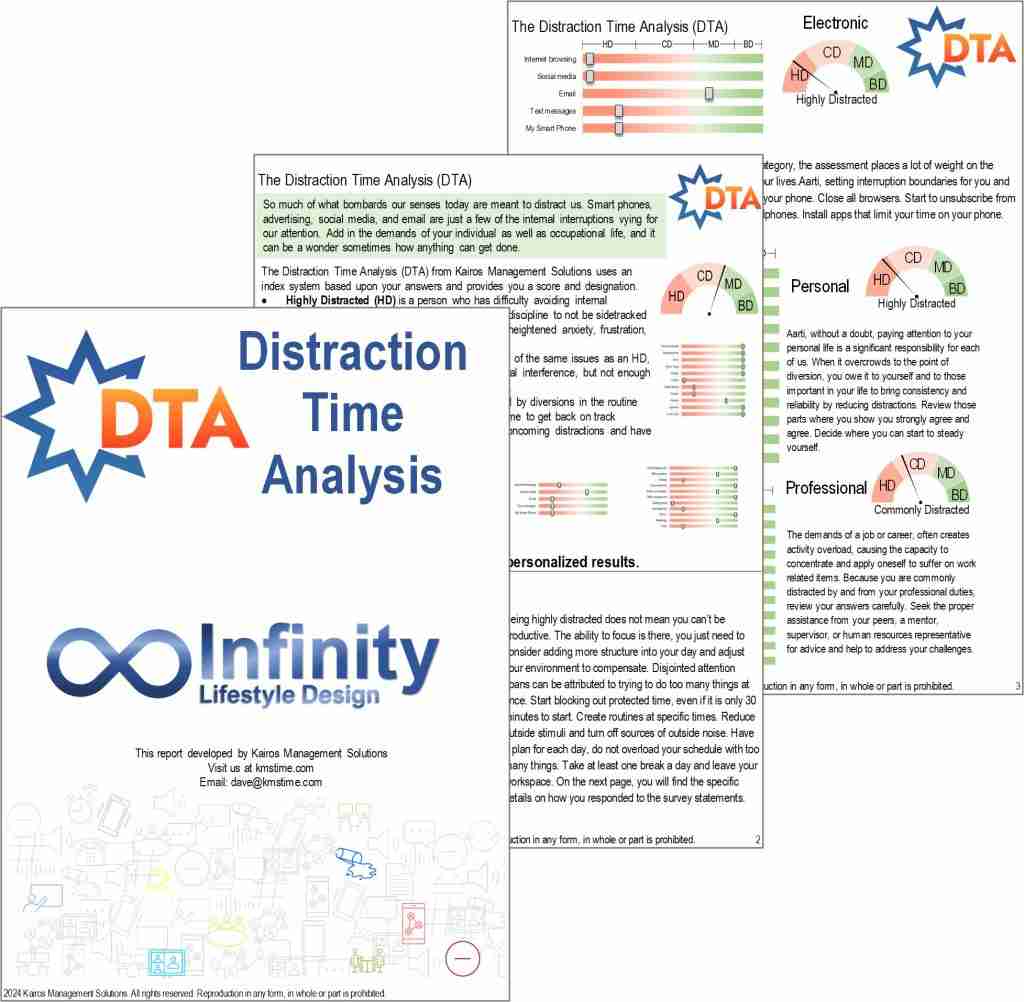
Take the DTA report and find out!
So what needs to change?
We need to stop asking, “Did I plan well enough?”
And start asking, “Did I design my day to withstand distraction?”
That means shifting from planning tasks to engineering conditions:
I still plan. I still calendar two weeks out. I still separate from my phone. But I now accept that planning is only the map. Attention is the vehicle. And without caring for the vehicle, the map doesn’t matter. (By-the-way, I am at the dealership getting my car worked on while I type this).
Distraction doesn’t mean you are undisciplined. It means your systems are mismatched to your reality. Fix the systems and planning starts to work again.
David Buck is the author of the book The Time-Optimized Life, coauthor of The Retirement Collective, and owner of Kairos (Time) Management Solutions, LLC. Learn how to apply the concepts of proactively planning and using your time. Take the Time Management Analysis (TMA), the Retirement Time Analysis (RTA), or all the other free resources offered to help bring more quality time into your life.
Content development for this article involved human expertise supported by AI-generated analysis and formatting.
The post When Planning Fails to Stop Distractions first appeared on Infinity Lifestyle Design.