
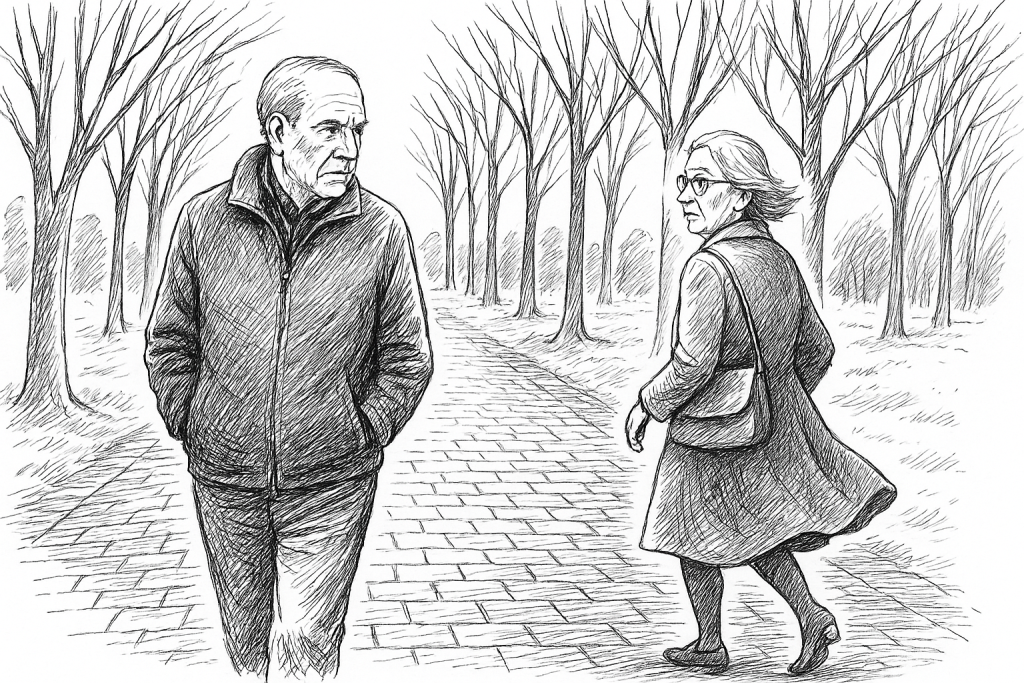
Elizabeth mentioned her husband would be coming home for good. Justin was an engineer who worked internationally for months at a time.
They had a routine when he was away and then when he was home. However, that habitual life was going to change, radically.
“Are you both ready for this?” I asked.
Taking her time, Elizabeth answered, “I don’t know. It has been like this for years; I am afraid we are going to drive each other crazy. But we’ll figure it out when he gets back”
I pitched they start now, and adapt not strategize when in post-career living.
Part 3 of a 3-part series highlighting some of the key insights from the 2025 Year-End RTA report. Download your copy today for free.
Check out Part 1. Check out Part 2.
Many couples spend decades side by side (or not…in the case of Justin and Elizabeth) —raising kids, managing careers, surviving market crashes and late-night laundry.
Nonetheless, staring at the open horizon of Retirement, something unexpected happens. Lifelong partners discover they’re heading into their next chapter with two very different stories.
This is the silent tension playing out in homes across the country. And the 2025 Retirement Time Analysis (RTA) data reveals just how common it is: when couples take the assessment together, a striking pattern emerges. One spouse is ready. The other is hesitant. One dreams of Travel and freedom. The other feels Anxiety and loss. It’s not always spoken – but it’s there. Left unaddressed, it can shape (or sabotage) the very years they’ve worked so hard to enjoy.
The 2025 RTA Year-End Report combines data from all Retirement Time Analysis assessments in 2025 to highlight areas of time vulnerability when career ends and retirement life begins and what can be done.
Culturally, retirement is sold as a synchronized stroll into the sunset. But that image assumes alignment—and most couples never have the conversation deeply enough to realize they might not be in sync.
The 2025 RTA dataset shows three key disconnects:
In other words, they Love each other. They’ve built a shared life. But their retirement expectations are not always shared.
Most couples don’t talk in detail about what retirement will actually look like. Like Justin and Elizabeth assume they’ll “figure it out.” But misaligned expectations create friction that can quietly grow into resentment.
Here’s what happens couples aren’t aligned:
Retirement isn’t just a math equation. It’s a lifestyle shift. Lifestyle planning must be done as a team sport.
Many couples believe retirement will simply be a continuation of how things have always been. But that assumption can be dangerous. Retirement is a reinvention, and reinvention requires communication.
These aren’t romantic questions. But they’re the ones that lead to the kind of retirement where both of you feel seen, heard, and fulfilled.
If you’re within 5–10 years of retirement—or already there—it’s not too late. The goal isn’t perfect alignment. The goal is Clarity, empathy, and a plan that works for both of you.
Take the Retirement Time Analysis as a couple. Name the gaps. Build a retirement that brings you back to the same page. Because you’ve made it this far together. Now it’s time to design a future that honors both dreams.
Bythe way, Elizabeth and Justin are figuring it out. It is a work in process, but isn’t that how life should be anyway?
David Buck is the author of the book The Time-Optimized Life, coauthor of The Retirement Collective, and owner of Kairos (Time) Management Solutions, LLC. Learn how to apply the concepts of proactively planning and using your time. Take the Time Management Analysis (TMA), and the to help bring more quality time into your life.
Content development for this article involved human expertise supported by AI-generated analysis and formatting.
The post The Retirement Misalignment of Couples first appeared on Infinity Lifestyle Design.