
“We must continue to improve!”
I have heard variations of this statement throughout my career. Heck, I’ve even said it myself. Yet, individuals, teams, and entire companies get comfortably set in their ways and wake up one day and wonder why that promotion slipped away or why the company is Downsizing.
Continuous improvement from a business standpoint has been around for well over 100 years. Starting in the early 1900s with Frederick Winslow Taylor and workflow optimization to modern approaches such as Lean, Six Sigma, and TQM—the concept is here to stay.
Walter Shewhart, a data scientist at Bell Labs, initially developed a concept in the 1920s called the Plan-Do-Check-Act (PDCA) cycle. It is widely known as a four-step process for implementing and managing changes in any process. I found it by accident and then also found out we used it by accident at Kerusso during our summer tradeshow season. Let me explain.
Shewhart’s approach here is to identify a problem or area for improvement, set objectives, and develop a plan to achieve them.
Kerusso, like many companies, uses outside or third-party representative groups to help sell our products to independent retailers. The easier a manufacturer makes it for a rep to sell the product, the more inclined the rep is to show retailers.
This became our plan. We designed the floorplans and merchandise strategy in the space to allow the salesperson to quickly move through our line, showing new and best-selling products, as well as “package selections” – a one-time scan ordering multiple items.
Having a couple major shows on the schedule (as well as a variety of smaller ones), we moved into Shewhart’s Do stage to implement the plan on a small scale (e.g., a pilot program) to test its effectiveness.
We set the first show to the plan and then proceeded to adapt what we had done based on instantaneous feedback from reps and customers alike. While the primary strategy stayed in place, the secondary and deeper execution processes changed or adapted and became the next step in the process.
After the first event, we convened a cross functional team and unintentionally applied the next step of Shewhart’s process to Check or monitor and measure the results of the pilot program against the initial objectives.
The feedback we received from the reps as well as the initial sales results told us we were onto something. However, we still adjusted and modified certain elements to the next show and floor plan to maximize the impact of our planning and doing.
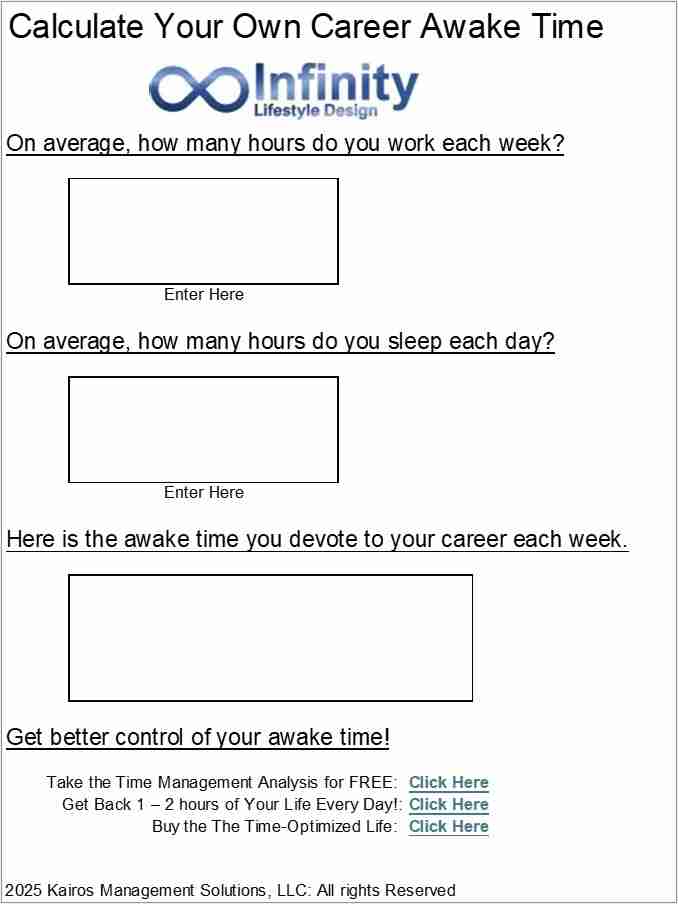
Calculate your own “career awake time.” This simple excel sheet let’s you enter the number of hours you work each week, as well as the average hours you Sleep per day.
At the next tradeshow, we embraced (again unintentionally) the last of Shewhart’s contribution and Act. Based on our results, we adopted the changes we felt were successful and modified and adjusted further once we were on site. It led one of the reps to tell her boss that Kerusso was the best organized space out of all the fifty plus companies in the showroom.
Yet, because PDCA is a cycle, we not done – we’ll never be done. We are stuck in a continuous loop of self-improvement and productivity.
What about you – the individual? How can this apply to you?
My experience has shown me; we want to make macro or huge changes in our lives and get frustrated when we can sustain or even begin to reform our ways. Your goal is to self-evaluate and identify one key opportunity first and work from there. That is what is done with a tool like the Time Management Analysis (TMA).
A PDCA program does not start with a blanket statement like, “I’ve got to use my time better.” It identifies a key behavior like distractions, which could be a root cause of time challenges. From there, you start the process.
You’ll continue in the cycle until you are satisfied and then begin to add the other elements.
Whether it is PDCA or some other form, continuous improvement never ends, it’s a cycle of Growth and awareness that will open more opportunities and more cycles.
David Buck is the author of the book The Time-Optimized Life, coauthor of The Retirement Collective, and owner of Kairos (Time) Management Solutions, LLC. Learn how to apply the concepts of proactively planning and using your time. Take the Time Management Analysis (TMA), the Retirement Time Analysis (RTA), or all the other free resources offered to help bring more quality time into your life.
The post Continuous Improvement Isn’t a Slogan—It’s a Cycle first appeared on Infinity Lifestyle Design.