
 Exploring Krakow – Because Adventure Has No Age Limit
From medieval squares to mouthwatering pierogi, Krakow greeted us with warmth, music, and history at every turn. This trip wasn’t just a getaway — it was a reminder of how easy, affordable, and energising European adventures can be, even (or especially!) after 50. With a bit of planning, a sense of humour, and the right Travel apps, it’s all within reach.
KRAKOW — DAY ONE
September 18th 2025 — up early and full of anticipation! We had to take my car because Olivier had forgotten to do the APK on his (typical!). We left around 9:30 for Eindhoven Airport, parked, and—small world—bumped into old friends, Elsbeth and Mark, whom I hadn’t seen in nearly twenty years. Coffee, catching up, and a quick mission to find gifts for Martin (he’d asked for stroopwafels, of course).
We flew with Wizz Air, a Hungarian budget airline, and everything went smoothly. I slept most of the way. We actually landed in Katowice—it was cheaper from the Netherlands—and had planned to rent a car anyway, since we wanted to visit the salt mines and Auschwitz.
Everything was super efficient. Go Schengen! We breezed through, grabbed some zloty just in case, though Revolut worked perfectly (no extra charges—highly recommended). Then off to our rental company, “Flex on the Go” — which, I must admit, I first read as “Sex on the Go.” Three gorgeous young men later, I wasn’t entirely wrong…
We got a great Citroën C3, plugged in the iPhone, and voilà—GPS sorted. Incredible when you think how far we’ve come from wrestling with paper maps. From maps to TomTom to phones — what a journey in itself!
The drive was easy and lovely: forests, wide roads, clean toll booths. It could have been Germany, really. Nineteen degrees, slightly overcast — perfect travel weather.
We checked into our hotel, the Grand Polonia Conrad, just outside the centre, close to Martin. (We later discovered he’d meant the Conrad Hotel next door, which was actually cheaper—but never mind!) After unpacking, we debated: bus or car? He’d warned that parking downtown was expensive, but in the end we took the car—and I’m glad we did.
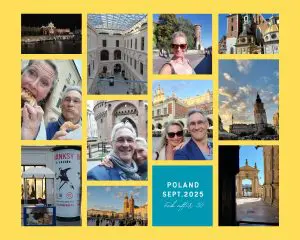
We found a convenient car park we ended up using every day—around eight euros for 3–4 hours—and off we went. What a city! Krakow is utterly charming: music everywhere, cobblestones, street performers, romance. We strolled through Stare Miasto, past the Barbican and under St. Florian’s Gate, admiring the old architecture and lush greenery. The suburbs looked a little drab—rather HLM-like—but inside the city walls, it’s pure magic.
We reached the Main Market Square, which at 200 x 200 metres is the largest medieval square in Europe. From there, we wandered toward Wawel Hill (yes, spelled Wawel, not Wavel!), home to the royal castle and cathedral glowing golden in the evening light.
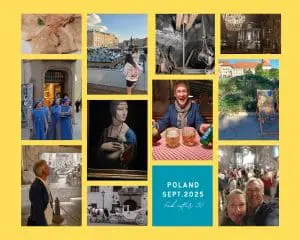
Dinner was at Pod Wawelem, a lively, traditional restaurant with live music and heaps of atmosphere. We ordered alcohol-free beer (Lech and Książęce, both delicious). I wasn’t hungry for a big meal, so I had two starters: a herring salad and pierogi stuffed with cabbage and mushrooms—divine!
Afterwards, we wandered along the river, danced a little in the square (because why not?), and soaked up the cheerful buzz. Krakow seems to be in a constant state of gentle celebration.
Finding the car was easy (a small miracle for Olivier and me!), and we drove back tired, happy, and full of that special travel joy—the kind that reminds you how wonderful it is to keep discovering, learning, and laughing at every age.
💫 Day Two: A Day of Shadows and Light
As usual, we began our morning with Qigong in our spacious room — a grounding start to what would turn out to be an emotionally intense day. (We always joke that my intermittent fasting goes out the window when we travel, and today was no exception.) The hotel breakfast was perfect: fresh fruit, oats, soya milk, nuts, dates — you name it.
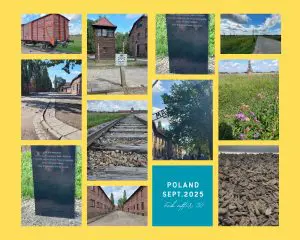
After breakfast, we drove about an hour to Auschwitz-Birkenau, armed with our IDs (thank goodness I had my driving licence — my passport was safely locked away). Security was tight, including metal detectors, and the visit began with a short but harrowing film.
Nothing, truly nothing, prepares you for the sheer scale and desolation of this place. We’ve all seen documentaries, films, and photographs — but standing there, on that cold, vast ground, reality sinks in differently.
Auschwitz and Birkenau — two camps just three kilometres apart — operated as one immense, horrific complex. Initially built in 1940 for Polish political prisoners, it evolved into the largest centre of mass extermination in history.
The efficiency of it all was chilling. Registration, deposits, coded uniforms, categories by coloured triangles — green for criminals, red for political prisoners, pink for homosexuals, black for “asocials,” purple for Jehovah’s Witnesses, yellow for Jews. Even within the unimaginable cruelty, there was bureaucracy.
The exhibition inside the barracks was haunting. Suitcases, glasses, mountains of children’s shoes. And behind one glass wall — two tons of human hair. We were asked not to take photos there, out of respect. I’ll never forget that sight. It was used to make blankets and mattresses. The level of organisation, the utter dehumanisation, the way life was reduced to utility — it freezes your soul.
Auschwitz was, disturbingly, also a laboratory. Doctors, including the infamous Dr. Mengele, conducted experiments on twins, pregnant women, and others — human beings treated as specimens. Many of those doctors had taken the Hippocratic oath.
As we moved to Birkenau, the sheer immensity of it took my breath away — 25 times larger than Auschwitz. Just endless rows of what used to be barracks and railway tracks stretching into nothingness. Most people arriving here never stood a chance; they were sorted on the platform and sent directly to their deaths.
We walked for hours, in silence, each absorbed in thought. Our Polish guide was exceptional — his grandfather had been imprisoned here for stealing, and his passion and compassion were palpable. The group was multinational, English-speaking, subdued. At times, it felt almost surreal — this quiet pilgrimage through a place where humanity lost itself.
I learned things I didn’t know, even after years of reading and visiting Memorials. Like how prisoners called one of the barracks “Canada,” because it stored the belongings of those killed — a place of plenty, in their eyes. I had also forgotten how, even in 1945, as the Soviets approached, 60,000 prisoners were forced on death marches in freezing cold; only a fraction survived.
The weight of it is indescribable. You go almost numb. Yet we must keep going, witnessing, remembering. As Elie Wiesel said, “To forget the dead would be akin to killing them a second time.”
When we finally emerged, the air felt different. Heavy but alive. We had coffee and cake — comfort food, strange as it sounds, to process what we’d seen. Then we drove back quietly, both shattered, physically and emotionally.
Later that evening, we returned to Krakow for something I didn’t realise I needed — connection. We met my cousin Martin and his lovely wife, Ola, whom I hadn’t seen since their wedding here fifteen years ago. They took us to a beautiful restaurant called The Square, all glass and greenery, like an indoor-outdoor garden.
We sat outside, talking for hours over traditional food, prosecco, and even a bit of vodka — laughter slowly thawing the ice left by Auschwitz. It felt warm, real, grounding. Amazing how, even after years apart, some connections remain effortless and true.
This day was a lesson in contrasts: horror and humanity, darkness and light, despair and resilience. As we walked back through Krakow’s softly lit streets, I thought how precious it is to still feel deeply — to keep our hearts open, to remember, and to choose connection over indifference.
DAY THREE – Salt, Art & Soulful Connections
Saturday – today’s focus: the famous Wieliczka Salt Mine.
We both felt so privileged to be here, soaking in yet another layer of Polish history. Having a car makes everything so much easier, though we hadn’t counted on the traffic! Krakow is a busy, modern city — large green avenues, smooth roads, and a fascinating mix of shops: Kaufman and Rossman from Germany, Auchan and Carrefour from France. Everything feels both familiar and distinctly Polish.
And a fun fact: you can drive up to 140 km per hour on the motorway!
Blue sky, 27 degrees — perfect day for adventure.
I had actually visited the Salt Mines before, but they’re so extraordinary I wanted Olivier to experience them too.
The Wieliczka Salt Mine, just outside Krakow, has been in use since the 13th century, when rock salt was first discovered. It became one of Poland’s greatest economic treasures — so much so that the word salary comes from salarium, or “salt Money” in Latin. The mine was active for over 700 years and was declared a UNESCO World Heritage Site in 1978.
As you descend, you follow centuries of human ingenuity. Water seeps through the salt-rich rock, creating a brine that’s pumped up and evaporated — a process unchanged since prehistoric times. It’s impressive, but I couldn’t help thinking about the 60 horses once lowered down here by rope, living and working underground — some for over 30 years. Only one ever returned to the surface alive. Heartbreaking.
We joined one of the many guided tours (they offer several languages). The tourist route is about 3 km long, and you walk down through three main levels — the mine reaches a depth of 327 meters in total, though the deepest point is now flooded and accessible only to divers. Thankfully, it’s surprisingly spacious — wide tunnels, high ceilings — not at all as claustrophobic as I had feared.
The highlight, of course, is the Chapel of St. Kinga — the world’s deepest underground chapel, carved entirely out of salt. Three brothers worked for 70 years to complete its intricate sculptures, altarpieces, and chandeliers. An incredible testament to craftsmanship and faith. From an engineering perspective too, it’s genius — wood was lowered to reinforce the structure as the salt was hoisted up.
There’s even a restaurant and museum down there, for those who want to linger.
But we had more on our list, so we squeezed into the rickety old metal lift — packed like sardines — and were relieved to feel the sunlight and warm air again! A well-deserved cappuccino and dessert later, we headed back to Krakow for one last city wander.
It’s such a vibrant, evolving city — bike paths everywhere, fancy cars, modern cafés — quite a change from my last visit. We parked and explored the Wawel Cathedral, climbing up for a panoramic view and descending to the royal crypts below. Then, after strolling around Wawel Castle and cooling off with a cold beer, it was time for a true art lover’s treat: the Czartoryski Museum.
Founded in 1878, it’s one of Poland’s oldest museums, filled with treasures collected by Princess Izabela Czartoryska — including works by Rembrandt and, most famously, Leonardo da Vinci’s Lady with an Ermine. Breathtaking.
From there, we headed back to the hotel for a quick shower and grabbed our little Dutch gifts (stroopwafels and clog pencils!) before driving to Stawowa, where Martin, Ola, and their two boys live. A beautiful semi-detached home in a leafy suburb, complete with an enviable home gym and a gorgeous boxer named Indiana Jones — “Indie” for short. And yes, their Family name is Jones! Perfect.
We met their charming 13-year-old son, Sebastian (the youngest, Stefan, was at a tennis tournament). The evening that followed was pure joy — delicious food (Ola’s stuffed peppers were divine), endless conversation, laughter, and yes, far too much to drink. Two bottles of cava, one of wine — and that was just for the three of us, since Olivier abstains. But it was worth it.
We left after midnight, knowing we’d pay for it tomorrow, but cherishing every minute. I finally turned off the light at 1:30 a.m. — too wired and happy to Sleep.
SUNDAY – Salt, Sleep & Gratitude
Alarm at six. Feeling better than I deserve to!
Breakfast at seven was surprisingly packed — three bus groups at once — but I managed a bit of food, hoping to absorb last night’s excess. Olivier, my hero, drove us an hour back to Katowice under a flawless blue sky.
Car return? Easy. Souvenirs at the airport? Less so. Not much to choose from, though I did find a lovely pink shawl that ended up being perfect for Alexander’s wedding the following weekend.
And so, another intense, wonderful weekend comes to an end.
So much to process — but no rush. Life is full, and I am deeply, joyfully grateful for mine.
Reflections – On Travel, Time & Being Truly Alive
As I look back on this trip — the salt mines shimmering with centuries of human effort, the laughter shared over dinner with friends, the early mornings, the late-night talks, the new streets discovered — I’m reminded why I Love to travel.
It’s not just about ticking places off a list. It’s about saying yes to life — again and again.
To curiosity. To connection. To spontaneity. To the joy of seeing how other people live, eat, love, and dream.
At fifty and beyond, travel feels even richer. We bring perspective, gratitude, and a sense of play that only time and experience can give. We’re old enough to appreciate the history beneath our feet — and young enough to still dance on cobblestones.
Each journey adds another layer of salt and sparkle to who we are becoming.
So here’s to keeping that spirit alive — to flowing with the unexpected, to walking those 300 steps with gratitude for strong legs, and to savoring every cappuccino, every conversation, every sunset, as if it were our first.
As they say,
“Travel isn’t about finding new landscapes, but about seeing with new eyes.” – Marcel Proust
And that, truly, is what being Fabulous After Fifty is all about. ✨
The post Travelogue Krakow & Auschwitz – Birkenau September 2025 appeared first on The Kennedy Connection.