
In this eye-opening episode of Meet the Expert with Elliot Kallen, we delve into the future of mental wellness with special guest Katarina Maloney, CEO of IQ Mind. As a pioneer in neurotechnology, Katarina shares how cutting-edge brainwave tuning is transforming lives—from reducing Depression and PTSD to enhancing elite athletic performance. This non-invasive, drug-free solution may be the breakthrough millions have been waiting for. Whether you’re an investor, concerned parent, or curious about boosting brain potential, this episode offers invaluable insights.
Katarina Maloney is the CEO of IQ Mind, a California-based neurotech company revolutionizing mental Health through advanced brainwave diagnostics and tuning. After suffering a severe concussion herself, Katarina turned a personal health crisis into a passionate mission to make neurofeedback accessible and effective. Under her leadership, IQ Mind is deploying brain-optimizing solutions across clinics, schools, sports organizations, and even with U.S. veterans. With partnerships spanning 23 countries and 7,000 hospitals, her vision is clear: heal the world, one brain at a time.
While this episode isn’t directly about Finance, the implications for wealthy investors and forward-thinking entrepreneurs are profound:
Katarina also revealed a strategic acquisition of Pro Sports Technologies to integrate neurological data into sports safety—highlighting IQ Mind’s expansion into sports analytics and concussion prevention.
Q: Is this technology safe and scientifically backed?
Yes. The tech has over 50 years of development, with ties to institutions like Johns Hopkins and Harvard, and is used in NASA pilot training. It’s FDA-approved and insurance-reimbursable in many cases.
Q: What about teens and veterans?
IQ Mind works directly with school districts and the VA to help underserved youth and veterans overcome depression, PTSD, and Anxiety—often seeing improvements after just one session.
Q: Can high-functioning professionals or business owners benefit?
Absolutely. The tech is also used for brain optimization, helping leaders improve focus, memory, and resilience—enhancing their edge in business and life.
If you or someone you know is struggling with mental wellness, or if you’re simply curious about unlocking peak brain performance, this episode is a must-listen.
Contact Elliot Kallen at 925-314-8503
Email: [email protected]
Explore more episodes at www.prosperityfinancialgroup.com
Learn more about the guest’s work at IQMIND.ai
Visit the Neurofeedback Advocacy Project for community impact data.
Elliot Kallen: Well, good morning. Good afternoon, everyone. I’m Elliot Kallen, CEO of Prosperity Financial Group, and welcome to another exciting episode of Meet the Expert with Elliot Kallen. Today, we’re talking about the human brain, reshaping it. It sounds a little bit like out of the movie Stepford Wives where we’re going to get people to be obedient, but it’s not. It’s dealing with depression and concussions and PTSD and so many things that we’re trying to find cures for. And if you’ve ever had that feeling or know somebody that’s gone through any kind of Trauma or has an issue or depression or pre-suicide or anything having to do with that, that’s what we’re talking about today and some incredible innovations with Katerina Maloney. Let me welcome Katerina Maloney. And she is from IQ Mind. Hi, Katerina. How are you?
Katarina Maloney: Hello, sir. I’m very good. Thank you so much for having me.
Elliot Kallen: Great. So we’re going to talk about this brainwave thing and how the concept works. And she’s an entrepreneur in Southern California. We’ll put you in touch with her when we’re all done and how to reach her. But if you want to reach me throughout the show, it’s 925-314-8503 or elliot, E-L-L-I-O-T at prosperityfinancialgroup.com. Or you’ve got about another 125 plus episodes, top 2% in the world on financial podcasts at prosperityfinancialgroup.com. Very exciting what we’re doing. So let’s talk a little bit about the brainwaves. And I’m going to talk a little bit about it as we move on because I’m very involved and very attached to our charity, A Brighter Day.info, which deals with teen depression and anxiety with the goal of stopping suicide. But let’s just talk in big pictures and then we’ll get down to that as we go. So what are you doing? That’s because it’s incredibly innovative and it doesn’t require a pill. It requires action. What are you doing? What is this?
Katarina Maloney: So I enqueue mine. Imagine you’re walking in the clinic and with 20 minute brain scan, you know all your potentials, your weaknesses, and your strengths of your brain. You exactly know how it functions. And with 20 minute tune up, we can as well basically sharpen your focus, get rid of your memory problems, help to perform better in a school, get rid of Grief, work on a lot of different Emotions. And the way how it works is that your brain is electrochemical organ. And majority of the treatments in last, I don’t know, three decades, focus only on the chemistry part. And they must have focused only on the chemistry part because electricity development and technologies were not existing yet. But today there’s a change. What we are capable to do is to non-invasively read your brain. We don’t send any energy to your brain. We don’t control your thoughts. We don’t do absolutely anything. All we do is read your brain waves in each of your centers that are basically working in a sense as if your brain waves that are supposed to be, let’s say, five megahertz or something, but they are 15. They are overfiring. Therefore you have a certain symptoms. And what we can do is to notch the brain and because brain is very self-efficient organ, brain loves to learn. And all we do is we don’t even give the instructions. We don’t tell the brain what to do. We just give it instructions and we reward the brain. Brain loves the reward. And when we do that, the brain wave corrects. They lower or they go higher. It depends what is the norm for you, right? And when that happens, your symptoms goes away. And with our technology, I mean, this is not a nonsense. This is not a future. This is today. The company that is under us that we work with basically, we are in the middle of acquisition of it right now. Been in the business for 20 years. The owners started with the space mapping and they went into the brain mapping. But where I want to go back to the brain is that we know how to map it and we know what is the standard, what is the norm? We know how to tune it up to have a normal brain waves. And when we do that, our results are astonishing. Like, let me tell you, 95% improvement in depression, 70% improvement in migraines, over 50% improvement in TBIs, over 60% improvement in ADHD symptoms. And the list goes on. Potentially it’s enormous, but we’re not talking only about the eradicating deficiencies of the brain. Let’s talk about brain optimization itself, because we all know that we’re using only certain percentage of the brain, right? Since the technologies were not there yet. And brain research started only in the 60s. And majority of that was focusing on neuroplasticity as of how the brain functions in general, right? Now we are capable. And I’m sure you know, Elon Musk is doing a lot of things in there to understand that actually who you are, your personality, your thoughts, your memories, everything is technically in the electricity of the brain. And what we are capable to do is to optimize the brain to better potential. So you’re using it better. And when we do that, example, we’ve been working for a decade with the Red Bull athletes. Their mental edge is pretty much amazing. You can see that how they perform in any of the triathlons or jumps or any sports, from snowboarding to mountain biking, all of them are absolutely amazing. And they did a project, Red Bull endurance project, you can find more information on their website. And their athletes were able to increase reaction time 30%. So imagine you are one of the best already, and you still are able to buy brain tune up, increase your brain performance 30%. So we go not only about taking care of all the minuses all the mental disorders, symptoms, and so forth, so forth. But we can definitely make you a better version of yourself.
Elliot Kallen: Well, it’s pretty exciting. I feel like in some ways, this could be incredible technology and totally misused by the wrong people. If it ultimately gets out in that, but we’re gonna we’ll get to that in a moment. Let’s talk about the best ways to do it. Since I’m very much in touch with depression, suicide, and stopping that. So how would this work with today’s teens?
Katarina Maloney: Today with the teens, we know that our children are in the trouble. The depression levels, suicides are up like 800%. The new norm in what social media, I blame it partially on social media, too, we lost contact with each other, me and you, when we grow up, we used to go play outside. Today, my four year old niece practically grabs my phone, turns on her YouTube. And she does shortcuts on YouTube that I don’t even know about. And when I was four, I was probably still eating dirt on the playground. But she knows how to navigate through YouTube. The advancements of younger generations today is it’s going too fast, but they have no system to cope. There is a human touch is missing because today it’s just easier to send text message or jump on a game online. We didn’t have those possibilities. So so where teens and young children are heading today is not a very good direction. And we definitely need to help them to be able to manage their symptoms and their deficiencies of their brain because they are children, they are our future. And what we can do for them is definitely we’ve been working with multiple different school districts, even in Los Angeles, to help. Basically, all we do is give the child 20 minutes can, and we know where what’s happening in them. And then the tuneups take care of their depression levels. And they Love to come back because they see the potential and they see the improvement already in one sessions. If you go, if you would love to see a lot of different underserved communities and communities itself that we ever work with our technology, you can go to a neuro neurofeedback advocacy project and you can see all the results there. And you can see how amazing potential it has on the impact of the community itself. So teens are definitely on our radar.
Elliot Kallen: Well, this is pretty exciting. What you’re doing. We’re talking to Katarina Maloney from Southern California. She is CEO of IQ mind. They have just, they are innovating. We’re gonna talk more about this, what’s going on with the human brain and trying to eradicate up to a percent. Obviously, this is not a foolproof system here. We’re trying to eradicate things like depression, anxiety, and we’re going to talk about veterans in one moment. And the plate of the youth of the veteran that is just horrible in the United States right now. But if you want to reach me, I’m at 925-314-8503 or Elliott, E-L-L-I-O-T at prosperityfinancialgroup.com. And the website is prosperityfinancialgroup.com. So let’s talk about, we’re talking about the human brain again. And I want to ask you, you’re doing all these studies, which is amazing. And the skeptic in me is like, Oh, is this real? Is this not real? And you know, everybody, once you start talking about brains, we get scared and we’re talking about our team. We’re going to get more scared that what are we doing to the brains? And I even have a personal question afterwards, but our veterans today are just really suffering. It’s probably the most single suffering group of teens and veterans in society. That’s PTSD, that’s depression, that’s homelessness. There are a lot of things happening there. And we’ll forget even drug abuse and alcoholism and human toxicity there, but just the things that are fixable, how does this work with them? And are you working with the VA to get more involved?
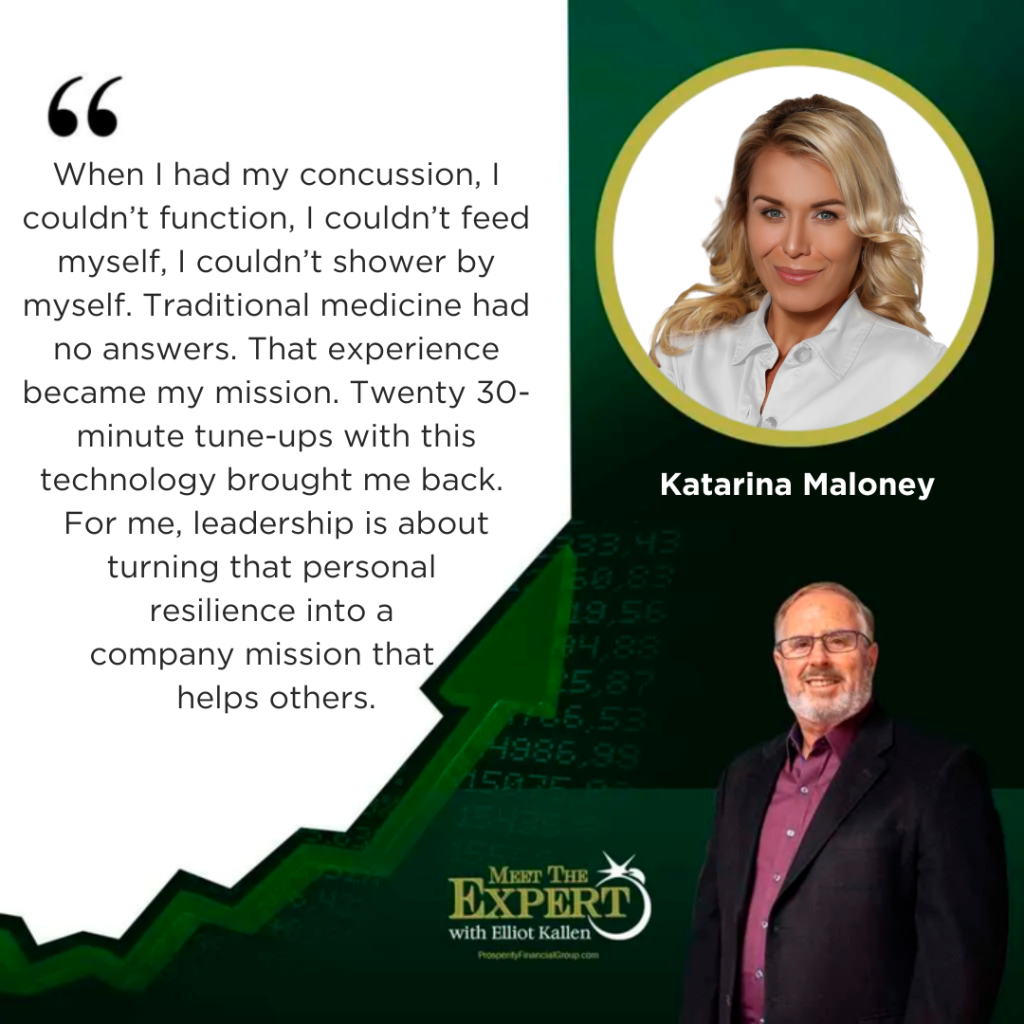
Katarina Maloney: Yes, we are. And I’m going to get back to it, but first I’m going to help with your with your questions there. Okay. So let me tell you something. So this technology is over 50 years old. Okay. We are working with top hospitals, John Hopkins, Harvard universities. The research is, we have a mountain of research. This is not something new. This has been around for some time. A lot of people know it under neurofeedback, biofeedback, QEG or ERP, but the name stands for something like a car. So if you imagine a car, you might have a Toyota and you might have a Ferrari, right? So it depends. So our technology is more equivalent to the higher standard of the car. Then it depends who drives the car, right? We have Experts. We, let me just say that NASA pilots training involves this technology too. It’s, we have FDA approvals. We are in 23 different countries in 7,000 hospitals around the world, 7,000 hospitals. So this is not something new. This is established. And to begin with me and you are meeting here today because I had a, something, something amazing happened to me. I had a positive experience and let me start with that. Okay. I had a terrible concussion, terrible fall in 2018, so bad. And it didn’t happen on a battlefield or in a football game as a football player or in a car accident that many people have. Actually, it happened in my own doctor’s office. Just one second can change your life. I hit my head. Okay. No big deal. It happens to a lot of people but my symptoms included a lot of different mental disorders symptoms, and I was not able to function. I was not able to feed myself. I was not able to take a shower by myself. I had a vertigo nonstop, 24 seven doctors, any brain best injury centers in whole Southern California were not able to help me. And that determination became my mission. Okay. And that positive experience because of this technology, which 20 tune-ups 20, 30 minute tune-ups brought me back to normal, like nothing happened. So imagine my Lifestyle that I was not able to kill myself physically, not able to. So today we are talking here. So this technology is backed up with a lot of different people hundreds and hundreds of people. And right now in the United States, we’re bringing it. We already have all the CPT codes from all the insurances, including Medicare. And we want to make this available for everybody because there’s lots of outdated treatments out there are not available after COVID. We all know that the mental crisis increased a normal Therapy sessions with a therapist, I have a three to six months waiting time. A lot of people are going after the medicine drugs and they should probably but this is not about replacement therapy. This is about offering another option. And yes, for veterans, for PTSD, wow. Our PTSD levels of improvements are over 70%. We’ve been working with VA for a long time. We all know in Southern California that the major problem of of homelessness is actually a veterans problem. It’s not a homelessness problem. It’s actually mental health problem. And we are definitely helping them. And veterans shouldn’t be helped. They did something for our country. They stood up on the front lines, they tried to help and we left them behind. And I take any personally, and I really hope that we’re going to make a big difference there.
Elliot Kallen: Well, you’re doing something amazing Katerina which is great. You know, one thing that I was reading about and you and I talked earlier before this is that you mentioned that this helps empower individuals, I’ll quote you, to achieve mental Clarity and cognitive wellbeing. So now I’m a reasonably intelligent person and I want to take my own brain to another level. Is that doable or is that just something different? Something that’s not?
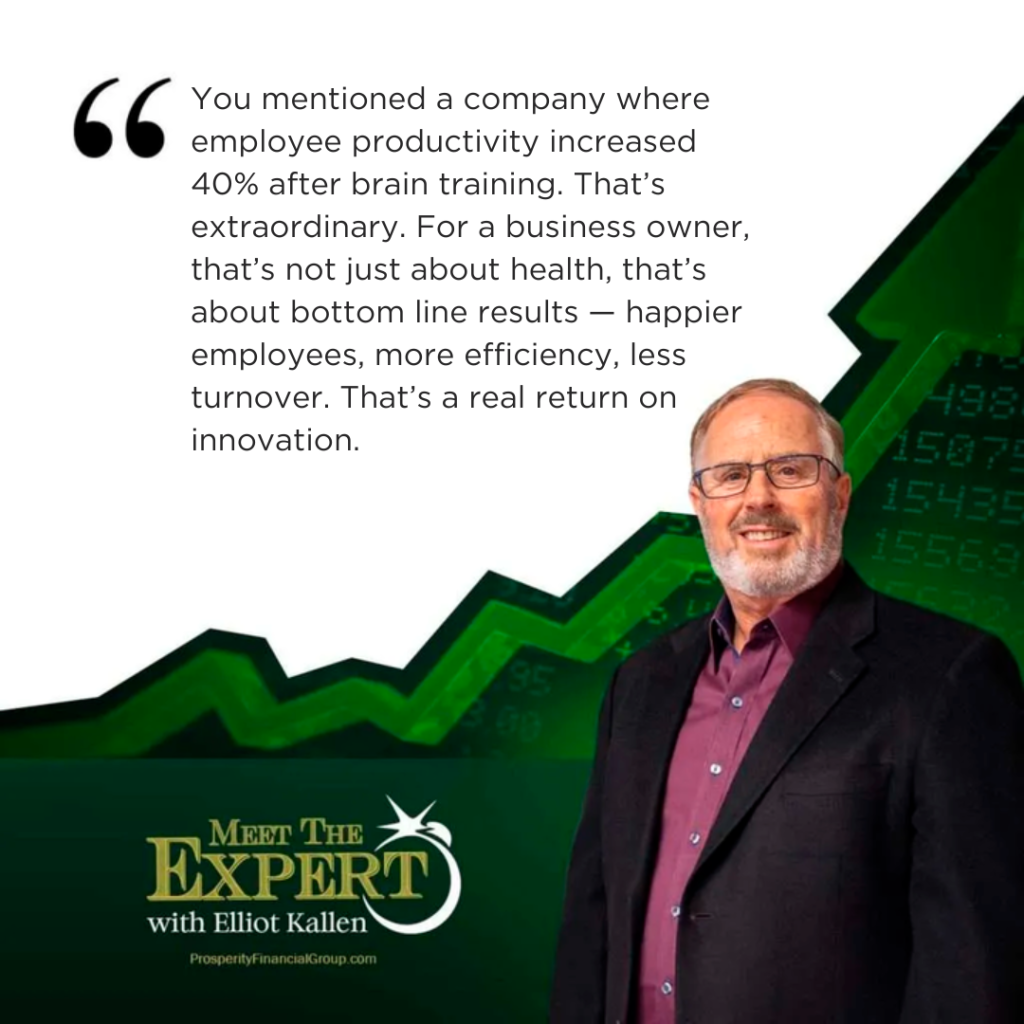
Katarina Maloney: Absolutely. What if you are a genius, Elliot, and you don’t know about it because you might have a blood flow problem or there could be some chemistry problem. We can definitely see it. If you take it that we’re using our brain only one, like three, 4% less than under 5%. But if, what if with our new studies, we can improve the usage of our brain centers, we can help to rebuild pathways and you’re going to have a better memory that you have. I’m not saying you have a bad one. I’m just saying you might improve, right? Improve. You will Sleep better. There was a study we did with a company. We basically treated all their employees for three months, right? Their productivity level increased 40%. Why do you think that happened? Because I don’t want to say it makes people happier, but if they are truly working to their potential, our natural state is not to be miserable. Our natural state is to be happy. And if we can help people be happy and we can heal the brain, one brain, he’ll heal the world one brain at a time. I would definitely choose that because just like I mentioned the neurofeedback advocacy project, some of the communities we work with native American tribe, we see an effect actually that there is less arrests in the community, less crime less children misbehaving in a school less people visiting ER for psychiatric reasons. It affects us on a much bigger level than just on our physical level. It affects us on a societal, on a connection with other people, right? We had a patient who Elderly why a daughter basically explained that he doesn’t want to play with her grandchildren. He wants to go in a shed every time when they come around, he seems to be annoyed. He seems to be not himself. He started a treatment and he’s spending so much time with the grandchildren and the whole Family is happier. And that’s what matters, right? Nothing else matters. Just the simple things, simple daily things.
Elliot Kallen: Well, that’s very exciting. What you’re doing. Maybe I just, I need to schedule a session. Tell me if I’m the patient now, I obviously would not be covered by insurance because I’m not suffering from something that would be insurable. So that’s a cash situation. So if I would have come down to San Diego tomorrow, what would that look like? What’s the process?
Katarina Maloney: Actually, there is a lot of different clinics around the country that takes cash only, and they have a still three to six months waiting time, even in your city, I’m sure. And to get covered by insurance, all we do have to do is to look at your, we have to run a psych and neuro eval pretty much to see if there is something and you are, you need these treatments. But if you would like just to go visit and see what is happening in your brain and increase the brain performance practically in every city in United States there are clinicians who offering this service and the treatment costs can be anywhere from $150 to $400 per treatment.
Elliot Kallen: Wow. Wow.
Katarina Maloney: And there is still three to six months waiting time.
Elliot Kallen: Well, I’m sure at that price, I’m sure there is, you know, that’s just super affordable for everybody. So we’re retraining our brain. We’re training somebody’s brain. It really needs some retraining. Is what, is there a side effect with personality changes? Cause you know, your brain drives your personality too. So if you’re altering one or you altering another,
Katarina Maloney: You know, personality, what is personality? Personality is it’s something that it’s said, but like I mentioned before, we are not mentally miserable, right? Even if somebody is irritated and acts upon it because of being under Stress or being in a situation he doesn’t like to be what our brain and brain performance can do is to help you with the resilience against stress. So therefore you’re not going to be reacting strongly as you would prior, right?
Elliot Kallen: Well, so the reason we’re talking is not just about the brain, Katarina, is because we have lots of business owners who are our clients and they want to know how you’ve been a success. You know, your company’s obviously successful. Your product is innovative. It’s super interesting and different, which is good. So you’re disturbing the marketplace, which is a good thing to be doing. And so you’ve got, take us through your typical day, your CEO, you’re driving the company, you’re driving your employees, and you’re having to fight a marketplace that can be pretty anti change that. So what does it look like for you on a week or a day?
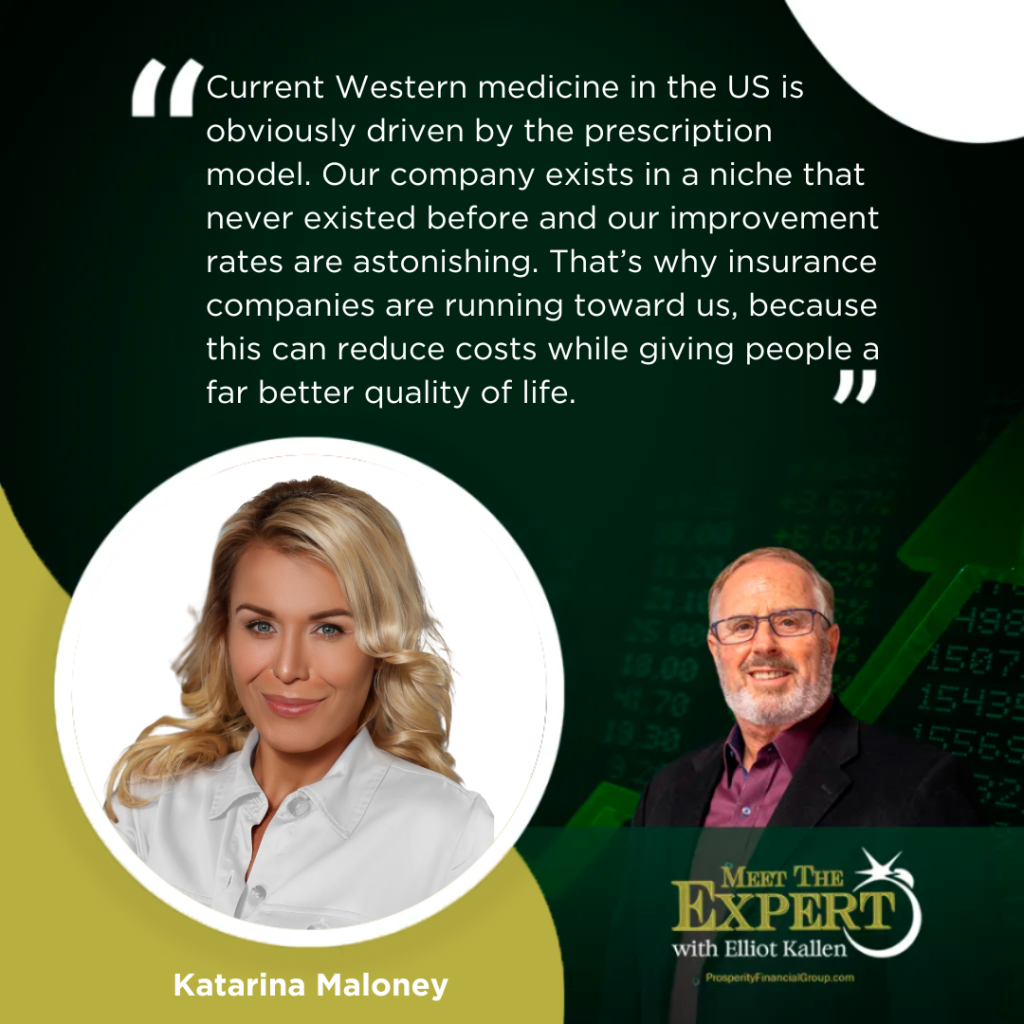
Katarina Maloney: So you’re absolutely right. Current Western medicine, United States is obviously driven by prescription model. And brain itself is such an unknown organ. And with the current problems after the COVID a lot of people their stigma, I don’t, I’m going to say stigma is going away. And the reason why is because if we’re all sad, we feel okay to say it in a sense. So if I could explain that our company kind of exists in our market niche exists somewhere between psychology and neurology in a space that was never developed before. But our improvement rates are astonishing and insurance companies. I’m sure you know that you can find this fact online that United States spend more Money on mental health than actually on Cancer. Insurance companies are running towards to us to get this to get this established because it will make their lives better too. In my day to day. Oh my God. I don’t know if you want to know. We are in currently in a fundraising mode. We just acquired new company called pro sports technologies where we are focusing on athletes in making the football safer place and making collision sports safer. We acquired a company with the patents where we can track movement analytics motion life analytics from a helmet, knees and our shoulders. And the reason why we did that is because we can, we would love to put our technology into a football player’s helmet and see what’s happening on neurological and a brain activity level during a game. Because obviously TBI is a serious problem in NFL and they having a lot of problems with it too. And we partnered up with a very big sports agent. He’s legendary Lee Steinberg and his Legacy, his whole life legacy is to help the people he represented and help the help to make the football safer one, one parent at a time. So we really hoping that we’re going to be able to do that.
Elliot Kallen: That’s great. I’ll have to make sure we talk separately about how to add you to our website for the charity. And as a resource, that would be great too.
Katarina Maloney: We would love that. And actually speaking of Lee Steinberg, he just started his foundation for concussion, traumatic brain injury, and brain health. And maybe, you know, I can suggest a phone call between your your charitable organization for the teens and his, because he definitely wants to focus on our children as well.
Elliot Kallen: I would love that. That would be terrific. That would be terrific. So we’ve been talking with Katarina Maloney. We’ve been talking about brain health. It’s very exciting. It’s incredibly innovative what we’re doing, what they’re doing, excuse me, what they’re doing. And IQMIND in Southern California, you definitely, if people want to read more about it, Katarina, they want to read about foundations, they want to read about, where to get more information. How do they do that?
Katarina Maloney: They can find us on our website, IQMIND.ai, and as well IQMIND.inc on any major social media networks. We’re more than happy to talk to anybody, suggest a clinic or work with us and see how we can help teams, hospitals, or, any elderly homes or anybody that would like to basically get set up a clinic or treatment or so forth, so forth. And, I mentioned IQMIND.ai, but I just want to mention that everybody knows that our database has an AI option and there is some AI in, in a technology set up. And the reason for that is because with all the data we’re getting, it would take thousands and thousands of clinicians to go through that to see the results. And a math learning technology is helping us to get today where we are. And that is the reason for us to use it because it’s very beneficial.
Elliot Kallen: This is so innovative and creative. It’s been a great show, Understanding the Human Mind. Please go to her site. Make sure you look at the IQMIND.ai. Get a feel for it. Go to the neurofeedbackadvocacyproject.com. That’s another one. You get great information. You don’t have to believe me. It’s obviously doing its job. I have somebody in my family, two people that did ERP and it changed their lives around from depression, which is just amazing. And that’s crude and elementary compared to probably what you do at ERP.
Katarina Maloney: Absolutely. It’s the diagnostic part for us to see what the brain is doing and how it’s reacting during stress, during motion during sleep and so forth and so forth.
Elliot Kallen: Great. So if you want to hear more about this and more about all of our Beat the Episode, Beat the Expert Related Talent, exciting business owners like this, innovative, creative, great to listen to, great to watch. If your video versus just sound or both, it’s at www.prosperityfinancialgroup.com. Come reach out, have a conversation with us and you’ll hear more about these things. Katarina, thanks for being here today. Pleasure was all mine. Thank you so much. Have a great day, everybody.
The post Disrupting Healthcare with Brain Tech with Katarina Maloney appeared first on Prosperity Financial Group | San Ramon, CA.