
In this episode of Meet the Expert with Elliot Kallen, we explore the evolving U.S. healthcare landscape with Dr. Anthony Mazzarelli—physician, lawyer, and CEO of Cooper University Health Care. Together, they unpack why America ranks lower in healthcare outcomes despite spending the most, discuss the controversial future of Medicare for All, and delve into how compassion and Innovation are transforming patient care. For affluent investors and informed consumers, this discussion offers critical insights into healthcare policy, end-of-life care, and what the next decade might hold.
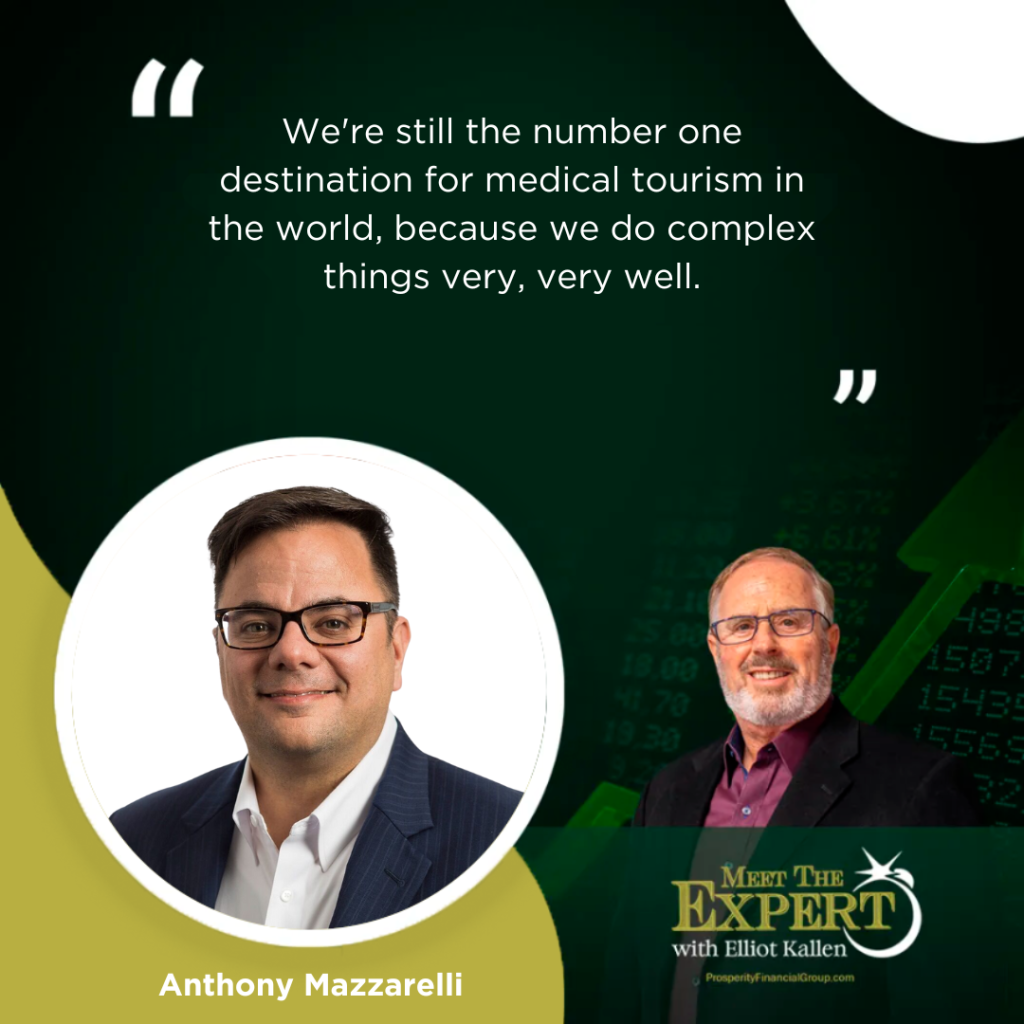
Dr. Anthony Mazzarelli is the CEO of Cooper University Health Care and co-author of Compassionomics. With dual degrees in medicine and law, he leads one of the largest academic medical systems in New Jersey. His work emphasizes the measurable value of compassion in healthcare and his leadership is reshaping how institutions view patient outcomes and provider well-being.
Why Is U.S. Healthcare So Expensive?
Despite Investing heavily, the U.S. doesn’t achieve commensurate outcomes. Dr. Mazzarelli explains that care philosophies—particularly the drive to “do everything” at the end of life—skew spending. Late-life interventions like dialysis or surgeries extend life marginally but drive up costs significantly. Comparatively, countries like the Netherlands balance cost, access, and quality more effectively by emphasizing preventive care and shared cultural values.
The Iron Triangle of Healthcare
Dr. Mazzarelli outlines the “Iron Triangle” of healthcare: cost, access, and quality. Improvements in any two often compromise the third. For example, California’s push for a Kaiser-style HMO system may lower costs but limit treatment choices—especially for cutting-edge therapies.
The Role of Compassion in Outcomes
In his book Compassionomics, Dr. Mazzarelli cites over 500 studies showing that compassionate care not only enhances recovery but also reduces overall healthcare costs and burnout among providers. Compassion is not just a virtue—it’s a critical metric for financial sustainability and performance.
New Frontiers: GLP-1 Drugs and Longevity Medicine
GLP-1 drugs like Ozempic are reshaping the fight against obesity, which is linked to numerous chronic diseases. But despite their effectiveness and cardioprotective properties, coverage by insurers remains limited due to short-term cost concerns. Dr. Mazzarelli also hints at upcoming anti-aging therapies (senolytics), which could redefine life expectancy and economic modeling in healthcare.

Elliot Kallen raises a vital patient perspective: how can consumers better manage their healthcare? Dr. Mazzarelli underscores that most people already know what to do—Exercise, healthy diets, regular screenings—but compliance is the barrier. He also warns that navigating the healthcare system remains complex, especially with rising interest in concierge care, which is only accessible to a select few.
In a closing reflection, Mazzarelli shares his forecast for the next five years: expanded outpatient services, increased use of AI to streamline medical records, and a deeper emphasis on compassionate connections between doctors and patients. The longer-term? Life spans that may reach 120+ years and healthcare models that must evolve to meet new demands.
To connect with Elliot Kallen or view more episodes of Meet the Expert, visit ProsperityFinancialGroup.com or contact:
[email protected]
925-314-8503
Explore more insights on wealth, innovation, and leadership tailored for high-net-worth individuals. Subscribe for updates and stay financially informed.
Elliot Kallen: Well, good morning and good afternoon, everyone. I’m Elliot Kallen, CEO of Prosperity Financial Group, and welcome to another exciting episode of Meet the Expert. We’ve got ourselves a doctor, and a lawyer, and an accomplished author, and a big gigantic CEO of a university healthcare system. He’s going to rock our world with what’s going on in patient care, patient advocacy, and you, as a listener anywhere in the United States, can do to improve your life when it comes to medical care. Let me welcome Anthony Mazzarelli here.
Anthony Mazzarelli: Thank you, Elliot. Thanks for having me. I don’t like you raising expectations too high. Let’s lower expectations.
Elliot Kallen: All right. He’s going to keep you out of the hospital. We’ll just do that. Anyway, let me tell you about Anthony in a second. If you need to reach us about any part of the show, we’re 925-314-8503. It’s Elliot, E-L-L-I-O-T, at prosperityfinancialgroup.com, and a website with about 100 plus more of these episodes, prosperityfinancialgroup.com. Very exciting what we do. We typically talk to CEOs about subjects like this. They could be from healthcare. They could be from electronic cars. They could be the future of lithium batteries. It’s subjects that affect our lives every day that you could watch this or listen to it and get something out of it in about a 24 to 30-minute program. I’m so glad what we’re talking about today. Anthony, let’s get going, or Mazz, I know you like to be called Mazz. Doesn’t matter to me. Whatever you want to call me is fine. I’m not going to try to hold that against you that you’re from South Jersey, because I’m from North Jersey, West Orange, and we don’t really call South Jersey part of New Jersey.
Anthony Mazzarelli: Well, we don’t consider North Jersey part of New Jersey. It makes sense, right?
Elliot Kallen: It’s okay. You guys have a Philly cheesesteak. We’ve got real New York food, but we appreciate everything you’re doing.
Anthony Mazzarelli: That’s right. You call it pork roll. You call it Taylor ham. We get it. We get it.
Elliot Kallen: You are an author of Compassionomics. I know that. You are somebody who works diligently on trying to statistically, because you’re obviously running something that’s larger than you at a patient in room 5502. You’re not really doing that. But you’re doing a large number, law of large numbers, again, trying to get better outcomes, and we’re all trying to be healthier in this country. My daughter, I want to tell you, Anthony, is getting ready to move to Holland, the Netherlands. And one of the reasons she’s moving there, among many, but is the quality of life. And Holland, Norway, and Sweden are ranked number one, two, and three, depending on who’s ranking them. Maybe third Denmark in there. And I got it, for the most part, it’s a very homogeneous type of societies there versus us that’s very diversified and not even sure what a minority is anymore because it depends on which city you’re in. We’ll decide on who’s a minority and who’s a majority. But nevertheless, we’re kind of a melting pot of issues and so forth. And medical care is no different than that. And they’re ranked number one or number two on medical care in the world. We’re ranked, I think the last time I looked at it was, I think, 18th or something like that. Maybe even worse, maybe 40th. And I know they use a lot of birth rates and health at birth as statistics and not necessarily Cancer and things like that. So what’s going on? What are the trends in medical care right now? And why aren’t we, and to back into that question, Anthony, and I’m going to ask you a couple follow-ups to that. Why aren’t we higher ranked? Because I know we spend more Money per patient than any other country in the world by far. We have more money coming out of the federal government into this, you know, these quasi-free programs like Medicare, Medicaid, not always free depending on your income on Medicare. We’re spending a lot of money. It’s the same problem we have on Education and outcomes that we have on medical care and outcomes. So what’s going on there?
Anthony Mazzarelli: Right. So I think it depends on how you rank us, but we’re generally 15th, 16th as far as the quote rankings, but we are by far first for our spending per capita, right? The amount of money we spend on each person much, much more than any other country. A couple of interesting tidbits about that. One is, and you sort of hit on it, it depends what you do in those rankings, right? There’s certain things that there’s no better place to go to in the world than to get your health care in the U.S. in certain areas, but there are other statistics where we don’t do as well. Infant mortality is one of those things. There’s other aspects we don’t do as well. I don’t think, I think when you look at it overall, I don’t think the delta between us and number one is a reason to move out of the country, but I’m happy to have that discussion with your daughter sometime so we can bring her back home to reunite the Family. But part of it has to do with, is the way we think about health care. So one of the things people don’t talk about is if you take, there’s been some studies where you look at industrialized countries, so the UK, Spain, the U.S. and a couple of other countries. Basically the spending per person per capita is essentially the same until you get into about your mid-sixties. From your mid-sixties on, it’s dramatically higher in the U.S., dramatically. But essentially the spending is the same up until that point. And it has to do with the way we think about access to care, care at the end of life. We think about care in the U.S. as everybody wants, they want access, they want quality care, they want access, and they want it to be, they want it to be cheap to them. And so cost care and access is this sort of iron triangle, they call it, where if you’re going to increase two of them, you’re going to increase a third, right? The third one on that iron triangle. And so that really comes into play when we talk about the U.S. health care system. Do we have a lot of inefficiencies? Yes. Is there waste? Yes. Are there ways we could do it better? Yes. But at the end of the day, our culture is do everything for everybody as fast as you can. And that certainly has some cost to it as well, aside from the idea that there are things that we could do better.
Elliot Kallen: So here’s an interesting point that I grew up with, not really understanding it. There used to be a radio spokes talking head on radio called Dean Adel out of San Francisco area. He was on for 25 years. And I don’t even know if that gentleman’s alive anymore. Went from, I think he was an ophthalmologist surgeon and he became a talk show host in the early days of talk shows. And he used to say kind of what you’re saying, he said, look, we are amazing in this country with all the things that are happening. And we’re talking about nothing like today because it’s 20 years back. So everything is different. And he said, what we do differently is we get you to live longer with all of our great innovations in most countries. But the last two years of it, you’re going to be in a Nursing home anyway. So what’s the big deal? Yeah. Is Europe different than that?
Anthony Mazzarelli: Yeah. Yeah. That’s the issue. And not only just that, you know, the nursing home in two years, but even, for us as a society, if you’re in the critical care unit, the ICU of a hospital and you have a few months to live, we will do everything to make those two months into two and a half months. And, if your kidneys start to go, we’ll get you dialysis. We’ll do all these things at the end of life to extend you a couple of weeks. And a lot of people would say, like, I’m not sure that’s worth it until it’s your family member or it’s you, then you think it’s worth it, right? And so that’s the sort of reconciliation that other countries have come up with culturally that’s a little bit different in the U.S. That does not explain why we’re 15 or explain why, 17 percent or $5 trillion of the GDP is spent on health care. But it’s one of the several things.
Elliot Kallen: So in years ago, and I forgot who was president when this came out. We talked about not providing end of year heroics as a nation. And it was cool. These are called death squads. If you remember these…
Anthony Mazzarelli: Death panels
Elliot Kallen: Death panels
Anthony Mazzarelli: and it was we started having the discussion to rein in costs in health care and immediately the political sort of wins. And I can’t remember. The interesting thing about health care, Elliot, is that what is considered conservative versus liberal, you just wait 20 years and they flip in health care. No one can remember what is what, because it’s such a complex issue, unlike other issues where you know exactly what side things come down. But the death panel discussion was a way to kind of keep costs down to have these difficult discussions. And it didn’t go well, right? Because like I said, if it’s your family member, the extra two weeks means everything. The extra two years means everything. It’s hard to put a price on life. And culturally, we want to do everything. We want that access and we want people to live as long as possible. But again, that’s only one aspect of the several things driving the cost in the U.S. health care system.
Elliot Kallen: Yeah. I don’t know if you remember. There was a Speaker of the House from Wisconsin, I believe his name was O’Neill. Or Paul Ryan. I think you’re thinking of Paul Ryan. Excuse me. I’m thinking of Paul O’Neill, the Yankees hitter. But Paul Ryan. Thank you. There was a picture of him in front page of one of the magazines, probably Time or I get it, with him pushing off a cliff that was made a picture grandma in or grandpa in his wheelchair. And that was when we were talking about reigning in health care and Obamacare at that time. But if you think about the emotional side of it as you’re working on, look, I’m one of those. I don’t have parents that are alive anymore. But certainly, I would hope my kids want to do whatever they can do to keep me alive. But there’s a quality of life that’s maybe not worth living. But you can’t tell your kids that because they want to get every minute with you.
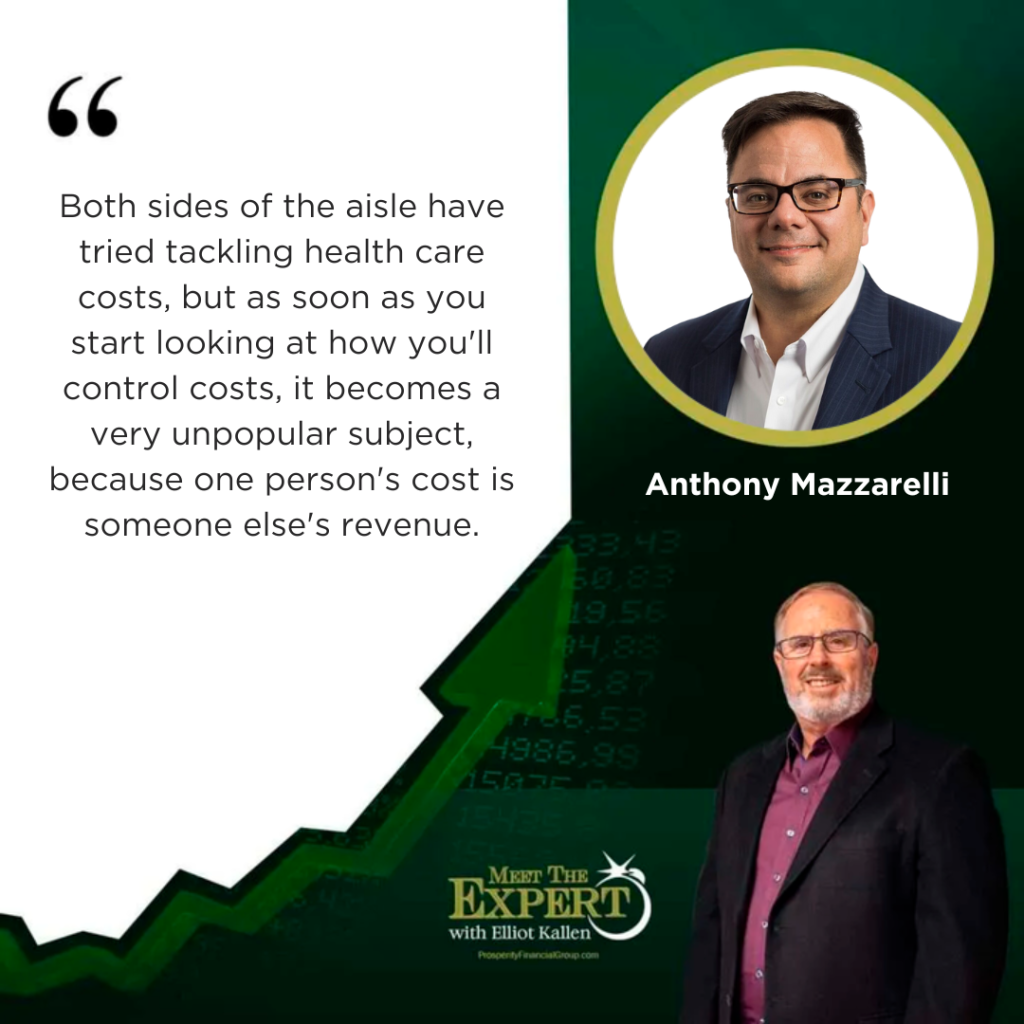
Anthony Mazzarelli: Yes. And, to give you an example, both sides of the aisle, you have Paul Ryan, who tried to tackle this cost issue and he brought out PowerPoints and he tried to show numbers and it just wasn’t, like you said, an emotional issue. So he couldn’t control costs. Then you look on the Democratic side, when there was all the people running the last, not this last election, but the first time that Biden had won, there was all the Democrats on the stage. And there was a congressman, I think from Maryland, who everyone was taking this platform Medicare for all. And the congressman, again, I believe was from Maryland, has worked in the health care industry enough to have said, well, that’s not realistic. Medicare doesn’t even cover costs for hospitals. If everybody went to Medicare, all the hospitals will close. And he got booed. He got booed off the stage because no one wanted to hear the facts. So, you know, this idea of controlling costs is just, it’s popular from the standpoint of, hey, we want to control costs, it becomes very unpopular when you start looking about how you’re going to do it, because one person’s cost is someone else’s revenue. And so this becomes a very difficult discussion.
Elliot Kallen: We’re talking with Anthony Mazzarelli, Anthony’s CEO of the Cooper University Health Care System, all about, you know, where the future of medicine is. And he’s both a doctor and a lawyer. And again, I’m holding it against him that he’s from South Jersey, but we’re going to get beyond that for this. If you need to reach me, I’m at 925-314-8503 or Elliot, E-L-L-I-O-T at prosperityfinancialgroup.com. So let’s talk about Medicare for all. You just brought up that subject. And let’s talk about what Europe does. And that is, you know, England’s got a two-tier system. The Netherlands have a one-tier system. I think Germany is a one-tier system. Canada, we know, is famous for a one-tier system, but it takes you nine months to get a hip replacement. Or at least that’s the stereotype, I should say. Maybe that’s not true anymore. And I have no idea about south of the United States border how good or how bad that is. But I don’t hear of an American wanting to go to Brazil or Argentina to do anything but cosmetic surgery. Nobody does that. But people still are coming here from all over the world, and even from the Middle East. And Israel has a great reputation of medicine. And you would think they don’t need to come here, but they’re still coming here.
Anthony Mazzarelli: Yeah, when it comes to medical tourism, we’re still the number one destination in the world, right? Because we do complex things very, very well. And the U.S. health care system does do those complex things well. It’s the basic amount of care that we do differently than the other health systems in the world. It’s interesting that you say, you know, what countries are one-tier, what countries are two-tier. Almost all of them have, no matter how many tiers they say they have, they typically have a tier, another tier, whether it’s talked about or not, that you can pay into. That if you have enough money, you pay into getting better care, and you skip the lines, and you do different kinds of things like that. And yeah, the U.S. health care system has certain minimums amount of care that we provide to everybody. The question is, is it the most cost-effective way to spread those dollars out? Is there another way to do that? But it is hard in the U.S., particularly the U.S. health care system, to have revolution. It’s usually more evolution. And so, big, giant changes are hard to get people to accept. And like we talked about, the politicians who start talking about it immediately have trouble, you know, making that change. So I don’t know at what point things will get so high in the GDP of what we’re spending that maybe it’ll be a bigger change, or will it be incremental changes over time? But there’s certainly, you have to deal with cost, access, and quality. Those are the three metrics, and you generally can get two of the three.
Elliot Kallen: All right. Let me ask you what’s wrong with this system here. I’m from California. I have a PPO with Blue Shield. I’m not trying to do a plug for Blue Shield, and, you know, I’ve used my deductible every year. I have four back surgeries. I’m made of titanium, three knees, both arms, shoulders, wrists, biceps. Everything’s been operated on me. Yeah, you’re biotic. Yeah. I get my money’s worth. But you’ve got a current governor here, and it is a blue state. So he’s not the only one that thinks this way. But there has been a move to get rid of all medical insurance companies in the state of California and enact Kaiser for all, or the Kaiser model for all in California, and get rid of PPOs as an option in California. So basically everything would be an HMO. And we know, if you know the Kaiser system, they don’t use heroic stuff at the end of your life. They’ve said, we’re not going to buy a $50,000 pill to keep you alive. You’re just not going to get it. We don’t think that’s cost effective. And yet, if I was on Blue Shield, I might be able to get that pill, and that would change my life. What do you think of that? Does that have traction?
Anthony Mazzarelli: You just sort of, you deem the trade-off, right? That’s the trade-off, which is a closed system like that is going to be able to contain costs better. They’re on both sides of the coin there. They probably look at quality differently. But then you eliminate choices. If people are willing to accept that, there is a rise in the number of groups that are payviders, that they provide care, and they’re also payers, closed systems. But then there are limitations, just at the very end of your example, right? And so that’s the trade-off. You’ll probably see a rise in that payvider. We’re seeing a greater rise in that than we are in the idea that maybe we can switch to an entire system change. But certainly there’s a lot of bureaucracy that happens when you deal with a third party. But when you think about it , who are the customers of a health system? Well, I think you and I would naturally think it’s patients, and those are our number one customers, but they don’t pay our bills. It’s the federal government through Medicare and Medicaid, and it’s commercial insurance that actually pay us. Very little money actually comes out of the pocket of those who provide care to. That’s an interesting interplay that’s different than other industries. And we’re also contracted with those rates. I mean, very few industries is the number one payer of healthcare in the US is the federal government through Medicare and the partnership with states and Medicaid. So the number one payer of healthcare in the United States is also the regulator. There’s not a lot of industries where the regulator is the number one customer. And you can imagine if Nike, if all of a sudden there’s been a rise in labor costs across the country for every industry, but it’s certainly in healthcare. We’ve got to get people to show up or you can’t have as many jobs where people work from home, wages have gone up for any number of reasons. We can’t just pass that along. If Nike, it happened to Nike, they would raise the cost of shoes and that would get passed along to consumers. We can’t do that, right? Because our payers, they’re either contracts or they’re the taxpayers, and those numbers don’t go up as fast as they would. We can’t just pass along those increased costs. And I’m not complaining. I’m just saying that’s the system as it is today.
Elliot Kallen: So I’m a consumer. You’re a consumer too, of course, of medical care. And we know that men in general, we make crappy patients. We’re not good about being in front of our medicine, our medical care versus women are way better, more in tune with their bodies. But we also know that the more we take care of ourselves, the greater the chance we’re going to find something early and detect it early or we’re just going to make sure that we exercise more because we want to be healthy. And I know that in 90 days, I got to go see my doctor. He’s going to yell at me for being 20 pounds overweight. When we talk about improving outcomes, and now, so this is a patient question. What should we be doing that we’re not doing as a society from the patient point of view?
Anthony Mazzarelli: I think there’s two different ways to answer that. If you’re asking, as me as a patient, how do I get healthier? There’s almost no one that couldn’t give you the list right now. You just basically did it. It would be that your Diet, your exercise, it’s to regularly go to the physician. So screening tests that we know save lives, that you get your colonoscopy at the right age. If you’re a woman, you get your mammogram. Most people know that answer, that it’s compliance with it that’s the problem. If knowledge got you there, there’d be no overweight doctors and nurses, but there’s plenty of those. And so, I think the answer from a consumer perspective, we kind of know what that pathway is. But the next question would be, okay, but I think you’re also asking, as a consumer, how is it best for me to navigate the US healthcare system to get the best possible outcomes? Those are kind of two different questions.
Elliot Kallen: Okay. So as we think about this, and we’re trying to improve it, and I’m there, we also know that one of the biggest causes of problems in society, or medical problems in society, is obesity. And drug-wise now, we’re on the cusp of potentially beating it, or docking it back. With all the GLPs, I’m talking about products like Ozempic or Wigovi, one has one, one has two ingredients. They’re working on FDA with three ingredients that actually fights fat, directly targets fat. So if we’re able, shouldn’t everybody who falls in that BMI category of obese, and I’m one of them, and probably just on my structure, I would have been one a long time ago, and you probably were somebody that is there too. Because if you have any kind of non-skinny body frame, you’re already obese. Yeah. Even if you have no fat, you’re just too heavy, relatively speaking. They really ought to update that, because those are just statistically incorrect. But shouldn’t we make that almost mandatory for everybody who’s obese to be on it? And we’d cut everything else down, like Diabetes and cancer, wouldn’t everything just drop dramatically?
Anthony Mazzarelli: So it’s an interesting question, because anytime you say, shouldn’t everybody do something, then that’s where you start to think about, you mentioned a lot of large numbers. So certainly seems like in the short run, knowing all the issues and the downstream effects of obesity, you’d say, whatever we can do to get people skinnier, do it. We’re going to find out with the GLP-1s that maybe there’s no side effect, but generally in medicine, you’re trading off one issue for another. So it certainly seems right now, with the data we have, that if we can get everybody thinner, then that would be a reason that we would have all these long-term savings. The issue is, someone is going to make the counterpoint to say, well, okay, great, then every insurance and the government should pay for a G1, because if they’re the biggest payer, everyone should reimburse for these things. But is it that inevitable that they do? Yeah, except some of them are going to take the position that, what do you mean? You already know how to, why do you need this medicine? You could just diet and exercise, right? That’s going to be the trade-off as the spending on this number goes up and up and up. If you look, a lot of insurance companies are not covering this anymore. You might say, well, hold on a second, hold on. Why would an insurance company not cover this? Because ultimately they save money in the long run, right? If you think about the economics of how insurance works, people switch insurances every year, right? Each insurance company knows how long they’re going to have someone on their insurance. And generally it’s three, four years, five years. So they don’t often invest in other companies’ savings, which is what essentially you do. So it’ll be interesting to see how much this gets reimbursed. And large employers, this is a huge cost. So sometimes an ounce of prevention is worth a pound of cure, but we don’t do really well in thinking long-term for investments in healthcare because the payers tend to not have people stay on these things long enough. And the moment something starts to drive up costs, there often tends to be barriers against it. So I think if you were to ask your audience, you’re going to hear more and more people saying their employers won’t cover these drugs, even though the long term probably saves money. And that puts aside the fact that we’ll probably find out eventually if there’s any harm that comes from this, but right now it seems like they’re a safe thing to do. In fact, they’re cardioprotective aside from the fact they help you lose weight.
Elliot Kallen: What does that mean to be cardioprotective? If I’m injecting myself with Ozempic, not to put a brand against, sorry if I put a plug for Ozempic here, I happen to be taking it when I take the semi-glutide, what is it doing for my heart?
Anthony Mazzarelli: So there are some studies that the GLP-1s are good for, they lower your risk for Heart Disease. So that’s aside from just the fact that you lose weight, there are some benefits to this classification of medication. But again, once you do the law of large numbers, we’ll probably find something that’s some kind of trade off. But right now they seem like great medications. I mean, bariatric, I look at our institution, bariatric surgeries are way down. Surgeries have a downside and are risky. And they’re down because people are losing weight using these medications. But you got to ask yourself, if there’s such a great investment in our long-term health, why are they not universally covered by everybody? And the answer is because the costs are rising faster than people can realize the ROI in getting people thinner. I got it.
Elliot Kallen: So Hugo, we’re talking to Anthony Mazzarelli, who’s CEO and obviously understands the world of patient and medicine. He’s CEO of Cooper University Healthcare System. He’s also a world-renowned author. Clear Compassionomics. Why don’t you tell us what that’s about?
Anthony Mazzarelli: Sure. So my co-author, Steve Trezak, and I have written two books. The first is called Compassionomics. And if you think of economics to study the Economy, genomics to study of genes, Compassionomics is the study of compassionate care on outcomes, on what it does to costs to those who provide care. And what we looked at in all the medical literature is as you increase that connection between those that provide care and those who receive it, so doctors and patients, nurses and patients, the better that connection, the more compassion in that interaction, the better outcomes you have, substantially better outcomes across almost every possible measure you can put in medicine, you overall lower costs. And then the third thing is, it actually decreases burnout, which is a major problem within the U.S. healthcare system. So then after we found this and the book’s out there and we do a lot of speaking about it, and it’s just really a book of data, all the studies that we looked at, literally every single study that talks about this. So it’s about 500 different studies. We then said to ourselves, well, really, why would it, when you focus on helping people and you have that connection with people, why would it only help healthcare workers? Maybe it helps anybody who focuses on compassion and helping other people. So we looked at all the data about just being other focused and being in connecting with people and being kind in the way we interact and connecting with others. And we found very similar results, which is that it’s better for your health. You live longer. Professionally, you do better. Teams that you manage do better. When you are other focused and focus on people, you have overall better outcomes for yourself, for those around you and your companies.
Elliot Kallen: Okay. Well, you’re accomplished. So you’re CEO, you’re managing all this, you’re writing books. So we have 60% of people that listen to this podcast or watch it. They’re in a leadership position and they’re always like you, trying to manage their time and juggle their day. And time management is so critical. How are you managing all this stuff?
Anthony Mazzarelli: So not great. Meaning I’m sure I have a work-life imbalance. I know I have a work-life imbalance that is not one people would be jealous of. But at the end of the day, to me, they all flow in the same direction. The way we manage our organization is to be people focused. The outcomes of our patients and our team members are the most important thing. And the data shows that focusing on our team members, focusing on reducing the barriers to having our team members connect with patients will improve outcomes, lower costs and decrease burnout. And therefore, really writing these books is an extension of the messages that we try to get out there and how we manage the organization.
Elliot Kallen: Okay. I just signed up about a year ago now for concierge medicine. My doctor decided to drop down to 400 patients plus his wife is his partner in a business. She’s probably got an equal number. I don’t know that for a fact. Here in California, I go to get a physical. I have to show up three times prior to my physical just to get all the tests done. And so the final meeting with him is probably the shortest meeting because I could spend hours doing these tests and carving up my brain and carving up my heart and carving up my liver. And they got all these great things. But not everybody is eligible for concierge medicine. What is concierge medicine in your mind? And why is that I’m hearing that more and more, including in North Jersey, which my brother just signed up for in North Jersey. It’s, I mean, it’s not for everybody because it’s expensive, but I feel like it is for everybody.
Anthony Mazzarelli: Well, yeah. So there are tiers of concierge medicine. So there’s the traditional model where you go to your, let’s say, let’s just take primary care. You go to a primary care physician and they’ll bill your insurance company or you can pay out of pocket if you want. Then there’s two levels of concierge medicine that is sort of emerging and probably levels in between. One would be you pay a certain fee a month or a year. Maybe it’s around a hundred dollars a month, maybe it’s less. And then you, and you’re, you’re that primary care physician is able to take a smaller panel of patients and provide you better access, right? So again, we talked about if costs are going to go up, that’s how you can get, you know, that’s how you get access up. You can’t have better access without more costs. And so that’s someone they give you, typically they give you your cell phone number. They’re much more hands-on, making sure you get your tests done and you come to the office. Then there’s a level of concierge even above that, where a lot of health systems now say, Hey, look, we’re going to do a concierge program that costs 25, 30, $40,000 a year, sometimes higher, where you get a doctor that has a handful of patients. They’ll come to your house for all your appointments. They’ll arrange for lab and blood work and imaging to be done at your home, if it can be. They’ll show up to the emergency department. When you go to the emergency department, they’ll go to your specialty visit with you. Oh, you’re having chest pain five states away. They’ll get on a flight and they’ll meet you there. So there’s different levels of concierge. The interesting part that no one talks about is the typical market forces do not apply in healthcare in this way. Well, why isn’t it just that the best primary care physician in a region makes the most money? Well, you cannot balance bill by law. So in other words, you can’t say, Hey, look, I’m the best primary care physician in North Jersey, right? We’ll take where you’re from. I’m the best primary care doctor. Therefore I’ll take what the insurance company gives me, but you have to add another 50 bucks on top of every visit, a hundred bucks on every visit, because I’m the best. That’s called balanced billing. That’s illegal. You cannot do that. So the market, everyone has to get paid, whatever they’re negotiating in that network, their network they’re in. You can’t have someone emerge. They can emerge better because of volume, maybe they get more patients, but they can’t emerge better based on rate. And most panels for primary care physicians are full. So the only option for them is to reduce the number of patients and do some kind of access amount of money that you are allowed to take, but you can’t just traditionally say I’m the best and this is what I charge. Now you can do it if you don’t take insurance. And that’s what you see happening in the world of psychiatry, where people are so fed up with the control that the insurance companies have on what they can and can’t do, that they end up just taking cash and they won’t take insurance at all. Yeah.
Elliot Kallen: Well, not everybody could do that with the expensive insurance, expensive medical care. So last question, Anthony, this has been great. And that is, let me have you put your goggles on for a moment, your futuristic goggles on for a moment. And let’s talk about where medical care and where medicine is in the next five years. What do you think?
Anthony Mazzarelli: Yeah. So I think what you’re going to see, first of all, it’s amazing how quick things change in Technology and medicine is on the forefront of the technology. So I think you’re going to see a major shift into outpatient. Things that used to have to be done in the hospital or stay in the hospital will continue to move into the outpatient setting. Procedures and things that typically are done in a hospital setting will get the knowledge and the technology to do them in an outpatient setting. So you’ll see a shift in the location of care and that will help lower the cost of care. I think you’ll see AI, Artificial Intelligence, be more and more in healthcare to help healthcare become more efficient. I don’t think that artificial, across every industry, my gut on this, and I’m not the only one to say this, is that AI is not going to take people’s jobs, but people who use AI are going to take people’s jobs from people who don’t use AI because it’ll help us be more efficient. I think it’ll help us be better in what we do in healthcare. I think you’re ultimately, five years from now, you’re not ever going to see your doctor’s head buried into the electronic medical record because the doctors see patients for free, they get paid to do paperwork, and that paperwork will be done with artificial intelligence just listening to you and that way the doctor can connect with you. I think you’ll see that. So I think there’ll be a lot of technological advancements that you’ll see over the next five years as care moves in that direction and as technology creeps in. And I think it’s going to be an exciting time for healthcare. Let me put something on your radar screen that I don’t think will hit in the next five years, but if you let these goggles look out to 10, 15 years, there is a classification of drugs called Sinalytics. And Sinalytics will actually stop the aging process of cells. And they’re starting to test these, I don’t think in humans yet. And then when those hit, whether they’re 10, 15, 20 years away, there is some thought that the first people to live into their 120s consistently, 130s, the first band of population of people may already have been born. That will change the economics of every industry if that starts to happen.
Elliot Kallen: Well, that’s exciting. I have heard that before, that sooner or later we’re going to have these, whatever we call it, octogenarians and living in the 120, 130, and so forth. So we’ve been talking with Anthony Mazzarella. This has been fascinating here. He’s CEO of Cooper University Healthcare. Anthony, if people have questions and they want to reach out to you or your organization, how do they do that?
Anthony Mazzarelli: Sure. They can reach out to me. The email’s fine. Mazzarelli-Anthony at cooperhealth.edu. That would be, that’s perfectly fine. I’m on LinkedIn. Any platform they want to get through to me, AJ Mazzarelli on Twitter. And happy to talk to anyone who wants to have this discussion further.
Elliot Kallen: Well, this has been great, folks. If you want to reach me or any, see any of these episodes on Meet the Expert with Elliot Callen, or you want to get hold of my book, the bestselling book called Driven, it’s Elliot, E-L-L-I-O-T at prosperityfinancialgroup.com. The website is prosperityfinancialgroup.com. The phone number is 925-314-8503. I keep my calendar on my website, which means you can make an appointment right on the website. It’s really easy. You don’t need to talk to me and see if I’m available next Tuesday. And I look forward to talking to you. So, Anthony, thanks for being here.
Anthony Mazzarelli: Thank you. Thanks for having me, Elliot.
Elliot Kallen: Thanks everybody. And have a super day. We’ll see you again.
The post Revolutionizing U.S. Healthcare with Dr. Anthony Mazzarelli appeared first on Prosperity Financial Group | San Ramon, CA.