
In this episode of Meet the Expert, Elliot Kallen sits down with Robert Hargrove, a globally recognized executive coach and author of Masterful Coaching.
If you’re a CEO, entrepreneur, or business leader, you might wonder: What separates high-achievers from everyone else? Is it raw talent, strategic thinking, or something deeper?
Robert shares his insights into how top executives and business owners break past their limits, develop a competitive edge, and achieve the impossible. He explains why even the most talented leaders need coaching and how the right mindset can take you from good to exceptional in business and beyond.
Some leaders stay stuck in “playing it safe”, while others embrace a “moonshot mindset” to build billion-dollar businesses. The difference? A willingness to take on the impossible and a deep commitment to personal transformation.
Robert draws on decades of coaching experience to explain how visionary leaders like Steve Jobs, Elon Musk, and Jeff Bezos approached success differently. Instead of chasing short-term wins, they focused on long-term impact, bold decisions, and continuous self-improvement.
“You can’t 10x your business without transforming yourself first.” – Robert Hargrove
The Three Essential Traits of Exceptional Leaders
Becoming a top-tier CEO or entrepreneur isn’t about credentials or fancy degrees—it’s about developing the right character, mindset, and adaptability. Robert breaks down three key traits that separate high-performing leaders from the rest:
Many executives assume coaching is for others—not them. But as Robert explains, the higher you climb, the more critical coaching becomes. Every top performer—whether in sports, business, or music—has a coach guiding them to their next level of success.
It’s a common myth that CEOs and executives should have all the answers. In reality, most leaders struggle with blind spots, decision fatigue, and strategy execution. Coaching helps them navigate challenges, refine their approach, and avoid costly mistakes.
Robert compares executive coaching to sports coaching. The best athletes in the world—Michael Jordan, Tom Brady, Serena Williams—all had coaches pushing them to train harder, think smarter, and execute better. Business leaders should think the same way.
“The higher you raise the bar of excellence, the more you need coaching—whether you’re a CEO or an athlete.” – Robert Hargrove
Many assume that natural talent determines success, but Robert argues that hard work, resilience, and adaptability play an even bigger role. He shares how the most successful business owners and entrepreneurs focus on:
Robert emphasizes that challenges are part of Growth. The most successful CEOs embrace discomfort, adapt to change, and stay committed to their vision.
If coaching is the key to success, how do you find the right coach? Robert shares that the best executive coaches:
Many business leaders hesitate to seek coaching, assuming it’s a sign of weakness. But Robert explains that it’s the opposite—coaching is what separates good leaders from great ones.
About Robert Hargrove
Robert Hargrove is a renowned executive coach and bestselling author of Masterful Coaching. Over the years, he has worked with Fortune 500 CEOs, entrepreneurs, and leadership teams, helping them achieve extraordinary business success.
His book, Masterful Coaching, is widely regarded as a blueprint for leadership development and personal transformation.
Elliot Kallen: Well, good morning, good afternoon, everyone. I’m Elliot Callan, CEO of Prosperity Financial Group. Welcome to another exciting episode of Meet the Expert with Elliot Callan. Again, we have so many entrepreneurs that listen to these shows. We’re not top 2 percent in the world at this point, which is very exciting.
We’re going to do a show designed for coaching. Desire for people that like being kosher. If you’re someone who’s thinking about getting into coaching business, executive coaching, or you are a CEO or CO, and you know, your company could use that little bit of oomph on how to get more motivated or how to get more outta the clock or how to get more things done.
Robert Hargrove here and so let’s talk about what we’re doing now with coaching for a moment. Robert’s out of Boston, he’s the coach’s coach, which means he coaches people on how to be a coach, and he himself is a coach. And he’s one of those people that some people think he created, especially in the New York Times, he created an entire movement of coaching.
I know coaching very well because I’ve been to many sessions with people like Anthony Robbins, Tony Robbins. I’ve walked on fire with him. I’ve done Weekend of Destiny. I’m a big fan of coaching and I know coaching is a lot more, Robert, than here’s my watch so now you can tell me how it’s built or what time it is.
So why don’t we talk about how do you grab attention as a coach and what exactly does a coach do?
Robert Hargrove: I think I remember you told me that you played sports. You were a hockey player at one time for a professional sports
Elliot Kallen: Absolutely played hockey and at a high level.
Robert Hargrove: So I wrote a book called Masterful Coaching a long time ago 1995 And I basically drew an analogy from sports.
And that is that if you look at, I walked into a bookstore, a Barnes Noble bookstore, and I saw a book called, Coaching for Improved Performance. And that seemed so dull. And I started thinking about, because I do come from the Boston area, and like L. A., we have a lot of champ, we win a many championships.
So I see a coach’s role is helping people to realize, An impossible dream or the way I actually usually write about helping people to realize an impossible future versus just a predictable future. Just like winning an NBA title or a Stanley Cup or the or the Super Bowl. So a coach’s job is to help people realize their impossible dream, whatever that is, changing the world creating a billion dollar unicorn from scratch whatever.
It’s also about helping people find a way to get a massive competitive advantage in their business. But, and the only way you can realize an impossible dream and get a mass, a, a come up with a breakthrough idea that will give you a massive competitive advantage is you have to change, you have to change something about yourself.
You can’t 10x your business without transforming yourself, your team, and your organization. So, that’s kind of it in a nutshell.
Elliot Kallen: Okay, that’s exciting. Well, we’re, this is Meet the Expert, really, Carol, and if you need to reach me, I’m at 925 314 8503 or www. prosperityfinancialgroup. com or Elliot, E L L I O T, at prosperityfinancialgroup.com. We’d Love your comments. We’ve got more than 100 episodes like this on our website. This is going to be great. We’re going to do this for the next 20 plus minutes and learn what coaching is about and why Robert is so good at what he does that some people have actually said he’s better than Anthony Robbins.
Just not as big, but just definitely better.
Robert Hargrove: You know, what’s interesting is you told me you had a lot of CEOs and entrepreneurs. C suite people listen to your website, and I’m sure that the vast majority of them are raving fans of people in sports. You know, the basketball, football, baseball, hockey.
Unfortunately, a lot of people seem to think, a lot of executives seem to think that coaching is not for other people, not for them, that they can go to the top, that they can realize their impossible dream. Without a coach. And unfortunately it’s really not true. The higher you raise the bar of excellence, the more you need coaching, whether you’re a championship athlete or a violinist at Carnegie hall or a CEO.
Elliot Kallen: So you and I know, I mean, there, we could do a thousand sports metaphors here and , to executives and how they apply and I don’t want, I don’t want to really do a lot of them because not everybody plays sports or follow sports, but we do know that there’s a difference of levels of mediocrity.
Where people are levels of mediocrity, of wallowing in mediocrity, and those that break out, those that are just exceptional. They do exceptional things, they have exceptional results. And I’m talking about in the business world now, not the sports world. Because in the sports world, I mean, if you’ve got a God given talent, that you could throw a pitch faster than everybody else out there.
Robert Hargrove: Yeah, that’s a very good point you make. Did they, you know, what is it that separates people like Steve Jobs or Elon Musk or Jeff Bezos of Amazon something? What is it that distinguishes them from everybody else? And I wanna know if you wanna give the answer to that question. I think it’s the, I really think it’s the willingness to take on the impossible.
So you find a problem that exists in the world and you find a customer who has that problem and you go for it. It’s always, I’m not the greatest fan of Elon Musk, but it’s been really fascinating to me that in a few years he came, he became a mission driven leader, and he created a company whose mission was to accelerate the shift to sustainable transport.
Now, over many years of being a coach for Fortune 500 CEOs, you know what the mission of most of them turns out to be? They always have a goal or a strategy, but for the most part, their attention is not focused on that moonshot or that new kind of car. It’s focused on meeting next quarter’s returns for Wall Street.
It oftentimes doesn’t get any bigger than that. It’s, it really comes down to the kind of person you are.
Elliot Kallen: If I were to pick three characteristics that CEOs and entrepreneurs have, that you’ve seen over 20, 30, 40 years of experience and these are three really good characteristics and traits that either they have it, or they could develop it, what do you think those are?
Robert Hargrove: That’s an excellent question. Let’s see if I can think of something right off the bat. I think the the first you know, most CEOs or entrepreneurs, C suite people they have excellent credentials. They went to Harvard Business School, they went to Stanford, they went, well, Mark Cuban went to the University of Pittsburgh.
The credentials really have very little to do with it. What I found over the years is that the most important criteria for getting to the top and staying at the top is character skills. Skills like integrity, honesty, authenticity re empathy self reflectiveness. Kester, I wouldn’t make the first the first thing I would do is I would place character skills over credentials and being a great CEO.
The second one is what I would say is daring to dream. I interviewed, I don’t know if you remember Werner Ehrhardt a long time ago, actually I interviewed him back in the 70s. And there’s one quote I still remember from that interview, and he said that a real leader is someone that dares to dream, and dares to dream beyond the wildest possible pushings of your imagination, and beyond that, and beyond that.
And that’s a direct quote that I’ve remembered for over 40 years. So that’s, so number one is character skills. It turns out that that soft is hard. The qualities like integrity empathy ambition it has a very, it have a very strong impact because they’re the things that create a following with other people.
So, character skills, daring to dream, and I think there’s a secret one that nobody knows about which is why I’m glad you asked the question. It’s that the willingness to be coached, a learning attitude, a beginner’s mind. I’ve always noticed that the, I always tell someone who’s a great client from me, because they have that Almost a childlike sense of wonder in beginner’s mind.
An attitude of learning versus knowing. And it actually comes very rarely, but the great ones all seem to have that. I remember listening, you didn’t want to get too much into sports metaphors, but I remember the other day I heard a, saw a YouTube video with Michael Jordan and he said he always did whatever the coach told him to do because he felt he had something to learn.
So those are my three part answers to your question.
Elliot Kallen: Let me play on that for a moment if I could with you, Robert.
Robert Hargrove: Yeah.
Elliot Kallen: And you’re, we’re talking to Robert Hargrove who is author, bestselling author of the book called Masterful Coaching. So he coaches both executives, executive teams. And he teaches coaching to coaches, future coaches.
Robert Hargrove: Very good framing. Thank you.
Elliot Kallen: Yeah, if you’re one of those people, Masterful Coaching is the name of the book. It’s a New York Times bestseller, and it’s a New York Times, as you do your research, will say that he spawned an entire movement. So good for you on doing that. Let me talk to you about where we are.
And and people need to reach me. It’s at elliot at prosperityfinancialgroup. com and the website is prosperityfinancialgroup. com. And don’t be afraid to send us some notes and I’ll pass them along to Robert and make sure that he answers whatever questions you might have in the future. But when I give, when I talk to business owners, and I’ve got a plethora of business owners as clients and we talk about the phases of their business, which is building it and in the middle of it, you’ve got some profitability or a lot of profitability and your kids are going to college and you’ve got the cash flow to cover it.
And hopefully you’re not getting divorced because you got stupid. And then the final third phase is now what do I do in my sixties and what do I do in my business? And I try to teach one major word to everybody when I say, Elliot, you’ve gone through a lot of difficulties in your life. You’re not at a straight line.
You’ve lost a child along the way, and you still have to build your business. You’ve had a lot of things that didn’t go well in your life, but somehow you came out the other side of this in a pretty good spot that most people would call me fairly successful at what I do. And I would say if I would describe any one word or two words about me, it would be tenacity and fortitude.
And they’re both soft tissue type of traits. Tenacity, fortitude, or integrity. I’m a big fan that character counts with you, Robert.
Robert Hargrove: Well, you’re lying to me or something. Something you just said kicked something off in me. So if I was to add a fourth point to what I said, the character skills, daring to dream, an attitude of learning, and what you just said stimulated me to think this, growth through adversity.
All, it seems like all successful people went through adversity at some point or another, that would cause most people to give up or not even try. So that’s how you describe yourself, and that’s extremely important, but not only that.
Elliot Kallen: I hope at my funeral that’s how people describe me, growth through tenacity.
But you brought something up that was really good, and that is, for the person who’s on the receiving side of advice, which is sometimes not easy to take, especially painful advice, are they willing to be coached? Can they listen, not just hear, can they listen and incorporate and inculcate into their soul the willingness to get better?
There are, and there are a lot of commercials on TV where there’s an older coach teaching somebody how to play baseball, or they’re crossing a log, and he’s, or he’s jumping up on there and then you see them in a professional world on that. And so many of us, Robert, get defensive when we’re being coached.
And we get mad at the teacher, that you can’t tell me what to do. I’ve been doing this for a long time. Especially if you’ve had success, who are you to tell me that? I’ve already make more Money than you, or I’m already more successful than you. And it they’re just, they’re bad listeners, and they’re bad learners.
So how does, if somebody is like that, how do you tell them that? And if they, if you’ve, if they’re like that and they want to improve themselves, how do they change that?
Robert Hargrove: I think it’s there, there’s two ways of, to, the human beings operate on, off of two, on, on two channels. One is the channel of getting better through learning.
The other is what I call defensive routines. And when you’re coaching someone, you’re like really walking a fine line between talking, keeping them on the the learning side of the tennis court. And keeping them off the defensive side of the tennis court. The offensive side and the defensive side.
And it’s, there’s a fine art to coaching someone to let’s say find their greatness or reach their biggest goals faster. And I’m making and where you stand in their greatness. That’s one of the, one of the things a good coach does. They stand in your greatness, even when you fall for it. Fall from it. But again, there’s a fine line between finding, standing in someone’s greatness and helping them to improve and then making the person, and making the person feel wrong, invalidated. And it takes a very skillful coach to be able to do that. But I think one of the things that makes a difference in terms of someone’s willingness to listen Is whether they have that mission that they’re going after, whether they have a dream that’s burning a hole inside them.
If I have a dream that’s burning a hole inside me, I’m much more, less likely to listen to what a coach has to say. Like, I want to become the CEO of the company. I want to make the team whatever it is. If I only have a small, if I don’t have a big dream, if I only have a small dream and I can get there without coaching.
Then much more easy for my defenses to be triggered. So one of the first jobs as a coach is to elevate, is to get people to dare to dream, to elevate their aspirations and motivations so that they become willing to accept coaching. I have another point to add to this, but, okay.
Elliot Kallen: I want to talk to you about passion for in a moment, but I want to bring up, when I’m, when I first started in business. Zig Ziglar was still on the circuit and so many of those old long bandigos, there were so many great coaches that were out there and I, in my twenties, I already was a big fan of coaching on there. So and I would, when I owned my company in the eighties, which was in it in my twenties. I brought in outside coaches to talk to salespeople.
I have 35 people there, and we did meetings at the Holiday Inn and Newark Airport, and I would bring in different coaches like yourself to talk about different things. And I found that Zig Ziglar had said one thing that was completely wrong, and I always wanted to correct this. And I’m sure he’s rolling in his grave with me even saying that, but he said anything that you can conceive, you can achieve.
And that’s, we now know that’s not true because I can tell you that I can dream that I want to be the next New York Jets quarterback and there’s no possible way, no matter how much training I do and go through, that I will be the next New York Jets quarterback. So I need to be realistic too on my dreams.
They need to be focused. And so that’s where I want to get into passion and focus with you for a moment.
Robert Hargrove: Well, there’s a few, I would agree and disagree with you. Nelson Mandela said everything is impossible until it’s achieved. Walt Disney said it’s fun to do the impossible. However I’m coaching a guy that’s the CEO of Honda.
And he made a point with me the other day. He said if I set the goals too high people feel demotivated. He said, if I set the goals too low, people feel demotivated. I think there’s a, you, as a CEO, as a manager, as a team leader, you want to set the goals not too, you have to have that dream out there that people are pointing to.
What was their line that shoot for the stars and hit the moon? But it’s, there’s a sort of a balance between, I think you have to do both. You have to shoot for the moon, and you have to have goals that are stretch goals, but are realistic, but you’re making me think of Zig Ziglar, and it brings, it comes back to an important point.
It’s not so lofty as what we’re talking about. It’s hard work. The people who are the best workers the best CEOs like are the people that work more than anybody else. Mark Cuban says, I knew I would succeed because no one was going to outlearn me or outwork me. And I remember that quote from Zig Ziglar where he said, was it, no it wasn’t a quote, it was a story he told called Acres of Diamonds.
Did you ever hear that one? He said you had to dig through acres, you had to dig through acres of dirt to get to the diamonds. And a lot of people aren’t willing to do, aren’t willing to do that. If you look at top CEOs and entrepreneurs, C sweep members. They’re people that work 10 times harder than anybody else.
Elliot Kallen: We’re talking to Robert Hargrove, who’s a coach and a coach’s coach and author of Masterful Coaching. And if you want to reach me again it’s Elliott, E L L I O T at Prosperity Financial Group or prosperityfinancialgroup. com. And we’re talking about coaching. This is exciting for me as a longtime fan of coaching.
If you’re an executive, you’re a CEO and you’re listening to this or COO, don’t be afraid. We’ll give you Robert’s information in just a few minutes. And how to reach him but these are the, just one of the things, he’s got a podcast called 10 Lessons You Can Learn on Coaches, and just pick his brains because you’re going to learn something from him on how to do what you do better, and that’s the kid.
And let me tell you about hard work for a second, Robert, if I could. I was very fortunate that, I don’t want to say I was very fortunate, I want to say I was very blessed. That my father was born in 1915, and he was part of the greatest generation when World War II happened. And, you know, when I came around, and he grew up in a Depression, and then World War II, and then, you know, lots of friends didn’t come back from World War II that he had, and so forth.
And he used to say to me as I was young, growing up, he would say, whisper in my ear, and he would say, remember that nothing makes up for hard work. Nothing. And granted, I always said, but dad, the garbage guys who pick up our garbage. Work hard. They work so hard. He said well, that’s because they don’t have the opportunity to make a lot of money and in those days But they still work hard, but nothing will make up for hard work You can’t just not work and then expect to have the opportunity.
They’re married to each other.
Robert Hargrove: That’s a beautiful point That’s a beautiful point. No, I don’t want to try to trump that it’s a great It’s a great point. You know, my son is, I have a son who’s I’m old, but I have a young son, he’s 16, he wants to get into a great college, Harvard, Stanford, whatever.
But I noticed that he spends a lot of time looking at his devices. You know, he’s always looking at the TikTok or Instagram or whatever the hell it is. And I said, I told him, all the time you spend on that, you’re not studying physics or calculus or whatever. And it’s not consistent with your goal.
I know you made me think of that.
Elliot Kallen: Passion. How important is passion? You know, that you go to work and you have this burn inside of you that you want to really succeed. Or, it’s a job, it’s a career, and I’m doing the best I can do. How important is that?
Robert Hargrove: I think it’s mission critical. You can see the both of us are you refer to us as geysers.
We’re not geeks, we’re more geezers than geeks. But you can see we both in this conversation. We both have a lot of passion i’m like a bursting rocket ship. I if I wasn’t tied to my chair I could take off I think it’s it’s essential and again It’s something you don’t often you often don’t see in big companies a lot of times big companies Knock the passion out of people because all of the hierarchy and the bureaucracy and the what I call the bureaucratic rigmarole.
So I think there’s, give everybody a little quiz that might be helpful in this call. One is to be really successful whether you want to get to the top and stay at the top or, If doing it at the top doesn’t matter, being great at what you do. What is what are you passionate about?
That’s question one. You can’t be great at something if you’re not passionate about it. It takes, I love talking about coaching, you can see how passionate I am. So what I’m asking now let me step back. I’m speaking to you who are listening. What is it that you’re truly passionate about? And that you love doing and are you making a living doing something that you’re passionate about?
So that’s the first question for each listener. What are you passionate about? The second question is What are you the best in the world at or at least what are you really good at? What is your strike zone? What are you really great at if you can marry what you’re passionate about what you’re good at you’ll you’ll be a good chance of being successful and the third question is And I hope everybody is reflecting on this is who are the people that you want to serve?
You know, someone, I heard the guy from Shark Tank, Kevin O’Leary, say the other day, something I really like Mr. Wonderfully said, the fastest way to make a million dollars is to find a customer with a problem. And he was referring not just to a customer, but to a group of customers. So, those three questions.
What are you passionate about? What are you the best in the world at? Or something like that. And who are the people that you want to serve? You put those three together, you’ll, there’ll be no stopping you. Well, I
Elliot Kallen: think as we wrap this up here Robert, I got my final question here. This has been great.
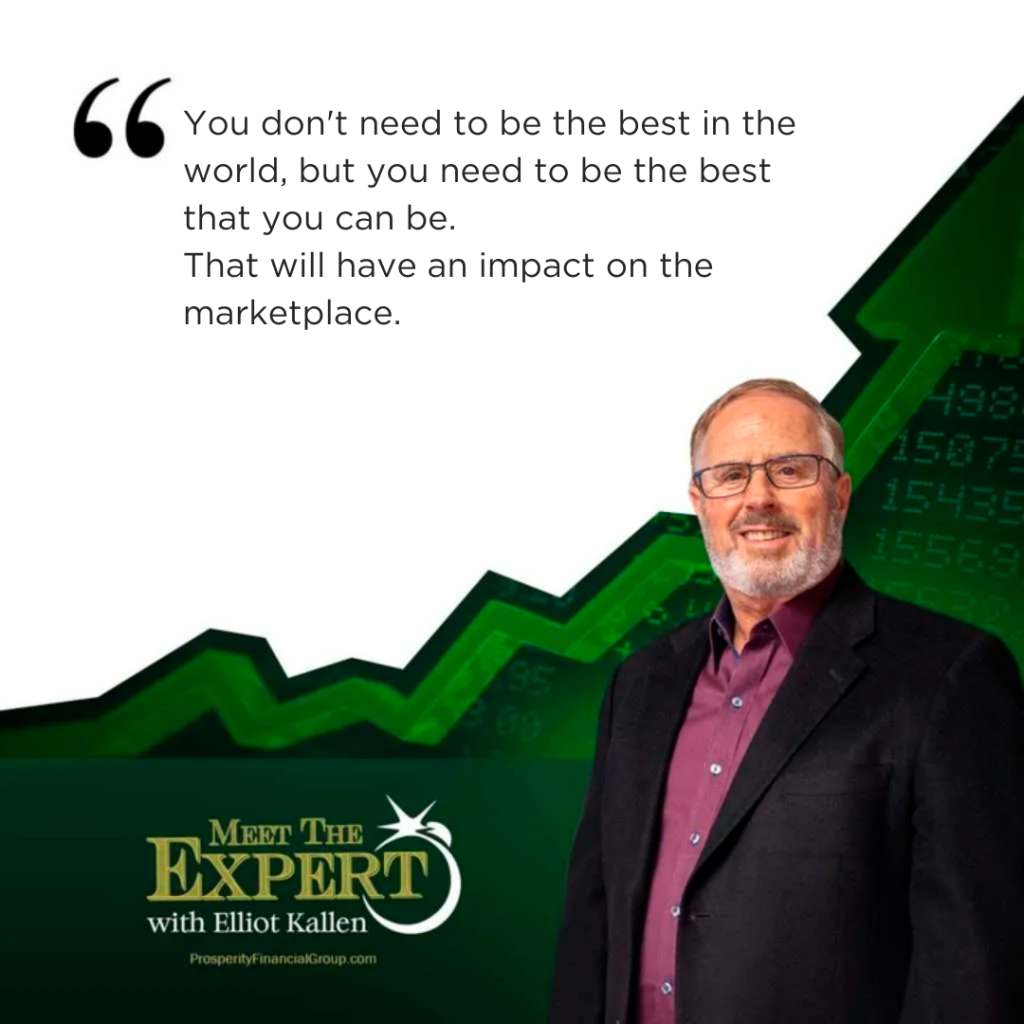
And I hope you could feel, everybody who’s listening to this, that how the passion for both of us, and why coaching is so important and how to harness your passion. You don’t need to be the best in the world, I know Robert said it, you don’t need to be the best in the world at something, but what you need to be is the best that you can be.
Robert Hargrove: Good at something. That’s what I was trying to say.
Elliot Kallen: There’s only one Michael Jordan out there. There aren’t 45 Michael Jordans, or one Magic Johnson, or one whomever. But if you’re the best you can be, at what you do, And you are going to have an impact to the marketplace.
Robert Hargrove: You know, a lot of people, a lot of people do have something passionate that they’re passionate about, but they’re not in touch with it.
Or they are really good at something, but they don’t even know what it is. It gets folded in with whatever, everything else that they’re doing. And I think that third thing is, who are the people that you want to serve? That’s very important. Why are you the number one business podcast? Because you’re trying to serve a certain group of people.
You’re trying to help your audience, Elliot, increase their impact. And their income as well as your own in the process.
Elliot Kallen: Absolutely. So greatest challenges, let’s end on this note if I could, Robert. Greatest challenges for a business owner or a CEO who’s trying to get coaching, trying to do better, trying to grow his company, trying to stay married, trying to be a good father or mother.
Maybe a good parent because they’re taking care, maybe a good child because they’re taking care of Elderly parents. You got a lot of things that could be happening in your life. For me, it’s always been time management. I’m CEO of three entities. I know for other people there aren’t enough hours in a day.
I always kid. I think 40 hours is a part time job. What do you think, am I saying the right thing or is there even a bigger challenge to most people like myself who run entities?
Robert Hargrove: Re, re reframe that for me again, please. I wasn’t sure. I understood.
Elliot Kallen: So, a lot of CEOs like myself, I’m CEO of three entities, three organizations that I’m CEO of, there aren’t enough hours in a day time management.
I, I can’t be a great dad, a great husband, a great business owner of company one, company two, organization three a great child to taking care of elderly parents. I can’t do all these things at the same time. It’s not possible to do, so I have to balance life out all the time, which means I’ve got to have good quality time management.
And if I don’t, then time eats me up, and I’m a servant to it. Would you say that’s one of the great challenges to executives today?
Robert Hargrove: I wouldn’t. As a process, we do it I want to say two things, actually, if I have a moment. One is, there was a great quote by Peter Drucker, the founder of Modern Management, and he said something that A little bit contradicts what you said, but not really.
He said, the only time anything of, anything is accomplished, I have learned, is when there’s a monomaniac with a mission who’s trying to balance his life. That’s when things happen. Having said that, there’s a time management Exercise we do at Masterful Coaching with our clients. And that is, we take three months of your calendar, and we look at what did you do every day, or even, we even actually break it down by the hour, and we break it down into three categories, things I did that made a difference, or make it, things I do that make a difference.
Things I do that are important, and things I do that are trivial. One of the things we’ve discovered in doing this exercise over 30 years, is that most people get stuck in doing what’s important, and forget to work on the things that make a difference. Everything is important. But, you have to have the discipline to take yourself out of doing things that are important, to doing things that really make the difference.
Having said that, I can empathize with, when you’re busy running three companies, no matter how you slice it, it’s hard to get through the day, but I’m sure you do a great job.
Elliot Kallen: So Robert, if people want to reach you, if they want to learn how to be a coach, if they want to reach out at an executive team and say, come coach my team to a new place, help us 3x and 10x.
Come bring us to another level. Come bring me personally to another level. How do they reach out to you Robert?
Robert Hargrove: You can call our office number in the Boston area, but it’s very easy to do things by zoom You don’t have to be in Boston as one is the number is six one seven nine five three Five two.Five two. That’s 6 1 7 9 5 3 5 2 5 2. You can also write my email and let me state it. Robert dot Hargrove. Don’t forget the dot Robert. Dot Hargrove. H-A-R-G-R [email protected]. You can catch me on LinkedIn. And you can see my books on Amazon. com. And I hope to, I really hope to see some people from this podcast.
I really enjoyed talking to you. You’ve done, you’re an excellent interviewer. You really framed you’ve, you framed the whole conversation very well, putting the various parts of my experience together with your experience. Reading me out.
Elliot Kallen: Oh, it’s a pleasure having you on. If you want to reach us again, we’ve been talking about coaching with Robert Hargrove.
Obviously, he’s outstanding at what he does. Masterful coaching is his book. The New York Times said he invented, basically, the world of coaching as we know it today. And perfected it. So, reach out to him, and you can reach me at Elliot, E L L I O T. At Prosperity financial group.com. 9 2 5 3 1 4 85 0 3 85 0 3, excuse me, or prosperity financial group.com.
Robert, great having you on.
Robert Hargrove: Thanks so much.
Elliot Kallen: Thank you, and we’ll see you again folks. Have a great day.
Elliot Kallen, Prosperity Financial Group
Robert Hargrove
The post The Coach’s Coach: Achieving the Impossible with Robert Hargrove appeared first on Prosperity Financial Group | San Ramon, CA.