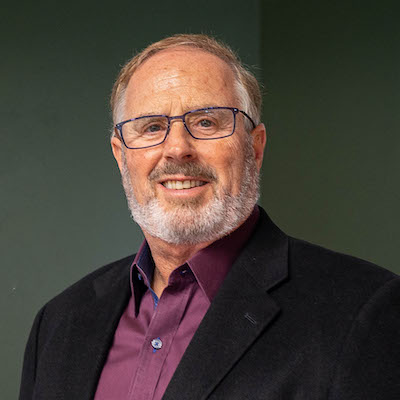

In this thought-provoking episode of Meet the Expert with Elliot Kallen, Elliot welcomes Laura Perrotta, President of the New Jersey Coalition of Automotive Retailers (NJCAR). With deep insight into how policy, electrification, and trade tariffs are reshaping the auto industry, Laura shares how dealers and consumers alike are being affected—and what’s coming next. This episode is a must-listen for investors, business owners with fleets, and anyone trying to navigate the changing road ahead in the vehicle and trucking sectors.
Laura Perrotta is President of the New Jersey Coalition of Automotive Retailers (NJCAR), representing over 500 auto and truck dealerships across the state. With decades of public policy experience and a no-nonsense approach to legislative advocacy, she’s a driving force behind practical automotive solutions in a fast-evolving regulatory landscape.
Elliot and Laura explore how state policies are often outpacing market realities, placing pressure on consumers, dealers, and fleet owners alike. From Tesla’s image crisis to charging grid limitations, the EV revolution may not be as linear—or as clean—as advertised. Laura also offers candid advice for aspiring leaders, especially women, emphasizing resilience and risk-taking in traditionally male-dominated industries.
Want to understand how these trends affect your fleet, investments, or vehicle strategy?
Contact Elliot Kallen at 925-314-8503 or email [email protected].
Explore more episodes at prosperityfinancialgroup.com.
To connect with Laura Perrotta, visit njcar.org or email her directly at [email protected].
Elliot Kallen: Well, good morning and good afternoon, everyone. I’m Elliot Callan, CEO of Prosperity Financial Group, and welcome to another episode of Meet the Expert with Elliot Kallen. Different today, we’re talking to the consumer, we’re talking to business owners, we’re talking about company owners that have fleets of trucks where people like to drive. We are talking with Laura Perrotta from New Jersey, my old stomping ground. I’m from North Jersey. Her office is down in Trenton. She is president of the New Jersey Automotive Retailers Association. Wow, that’s a heck of a job, a heck of a role, and we’ll talk about that as we go. What does that mean in the world? It’s obviously an organization that deals with legislative recommendations, what’s going on, boots on the ground. We’re going to talk about electrification of the automotive industry, why it’s not as exciting or doing as much as people think. But Laura, let me welcome you.
Laura Perrotta: Oh, thank you, Elliot. I’m really happy to be here with you today.
Elliot Kallen: Am I saying it properly, Perrotta?
Laura Perrotta: Yes, Perrotta, you got it. It kind of sounds like Prada, but it’s not, unfortunately.
Elliot Kallen: Well, thanks for being here, and we’re going to talk a little bit about that. We’re in the middle of a tariff war. Let me give everybody first our information to reach us. This is Meet the Expert. You can find me at 925-314-8503. You can email me at Elliot, E-L-L-I-O-T at prosperityfinancialgroup.com, or the website is prosperityfinancialgroup.com. You should look up Meet the Expert. There are 125 or so other episodes, very exciting, entertaining, different group of people every time. Sometimes they’re industry-specific with the financial world. It’s top 2% of financial podcasts in the world, everyone, not in the USA or California, but the world. And sometimes it’s people like Laura that’s industry-specific, and it’s a really, really fascinating, interesting topic that you don’t hear very often. So let’s get through this. We’re in the middle of a trade war right now, a tariff war, if you want to call it that, that that’s going to leave the soil different-looking and the farmland different-looking in a few months than it does today, even with the best of outcomes. So this just happened yesterday with my sister-in-law, whose lease is coming up on an Audi. She loves her Audi. It’s a small SUV Audi. And the Audi dealership says, I said to her, I can no longer compete with a new Audi for you. You should, if you want a German car, go get a BMW because they’re coming up with Money to support the Audi car, knowing they have to make a deal. But we at Volkswagen are not prepared to make that deal yet. So obviously, she’s really upset, like a lot of consumers, and she’s in a political and economic class that she can have that discussion. But what’s going on with tariffs and how does that look with the affordability of cars and trucks? Because I know you also handle, basically, if it has wheels, it’s coming under your purview.
Laura Perrotta: Yes. Well, Elliot, it’s really just unfolding as we speak. And just like every American who’s considering buying a car might be watching the news on tariffs, all of our 523 auto dealers and truck dealers in New Jersey are watching the headlines, too, and talking to their manufacturers and finding out, basically, how each model will be impacted. Because that all comes down to how much of their various vehicles they sell are imported, where their parts come from, where they’re sourced. And we’re seeing a real situation where, depending on the manufacturer and whether they’re going to eat the costs on the front end or when it might hit the consumer, but we all know eventually it will hit the consumer in some way or fashion if these stay in place. We’re seeing anywhere from a $2,000 increase per vehicle up to a $20,000 increase per vehicle. It just completely depends on the vehicle and their product mix.
Elliot Kallen: Wow. Very, very different. You know, the complaint that I keep hearing from Peter Navarro, who is in the trade department with the Trump administration, and he talks about BMW. And he says, when BMW sells a $50,000 car in Europe, they get a VAT tax credit. And when they sell that same car, because they got a 20% credit back in the U.S., they sell it for $40,000. I know nobody buys a BMW for $40,000, but theoretically $40,000. So it’s selling that German car is selling for $10,000 less in the U.S. than it does in Germany. But the Cadillac that sells for $40,000 in the U.S. gets a 20% VAT tax immediately put on it at $50,000 and then gets another import fee put on it of $10,000. So we’re close to $55,000 to $60,000. And that’s the complaint that the Trump administration is having. Are you getting pushback from people? Because I don’t want to vouch that accuracy with Peter Navarro. I’m going to take that as his opinion and accurate from his point of view, but I don’t want to sit here and argue it. But are you getting pushback on this that, look, this has been coming and it’s not far, near, and fair, but it’s been a long time coming? Or people saying, hey, let’s just work it out and make all these things affordable?
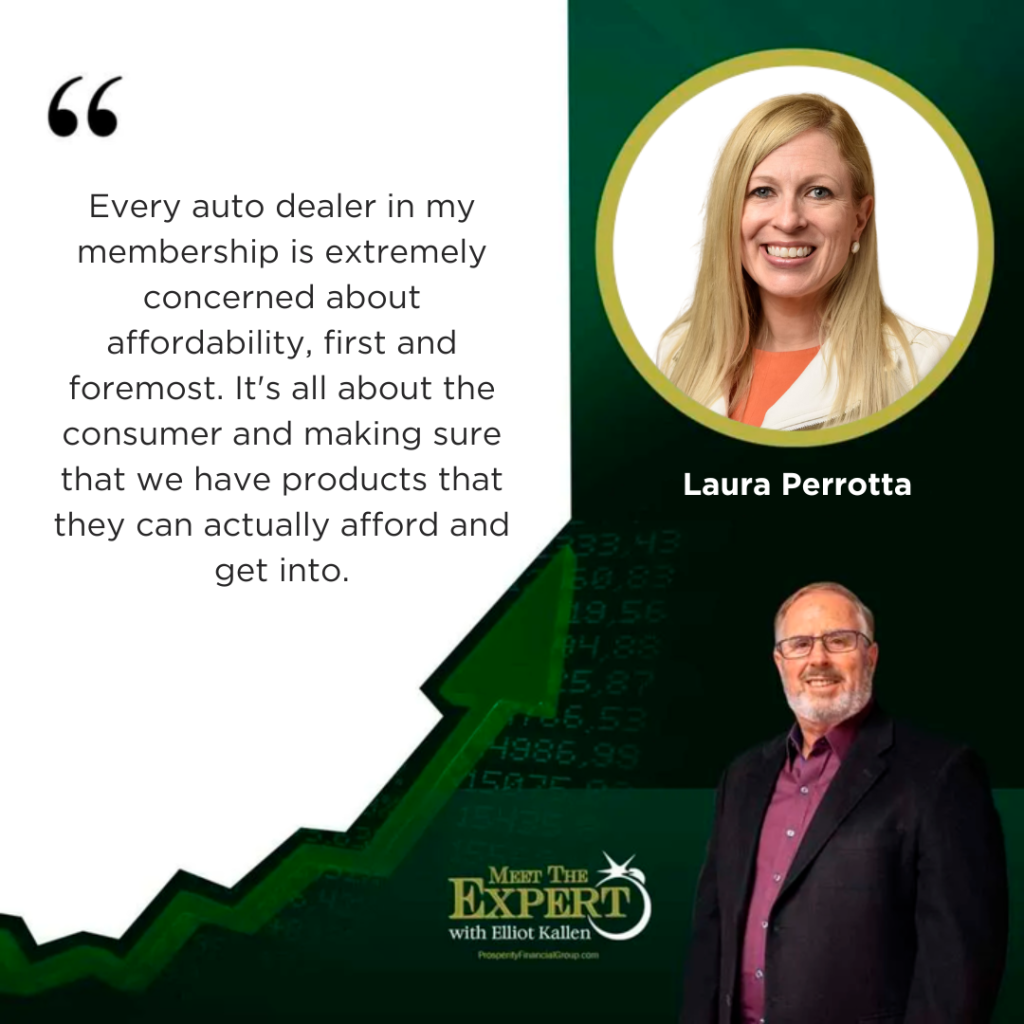
Laura Perrotta: Yeah. Well, I think every auto dealer in my membership is extremely concerned about affordability, first and foremost. It’s all about the consumer and making sure that we have products that they can actually afford and get into. And overall, we’re seeing a huge uptick in the cost of vehicles. The average now new vehicle goes for roughly $50,000, which prices a lot of Americans out of the market. So do we have a really strong stance on the tariffs at this point? No. I mean, it’s changing by the minute. All I know is we’re concerned, and our biggest concern is affordability. We’re not going to go out there storming the White House at this point saying we need X, Y, Z. We are really trying to let things play out, let the dealers talk to their individual manufacturers and see how they’re going to handle it and how it’s going to impact the affordability. But it’s not just tariffs that are causing an affordability issue. We’ve got an across-the-board affordability issue, and prices are accelerating higher and higher at a really fast rate. And a lot of that has to do with electric vehicle mandates as well.
Elliot Kallen: So let’s talk about those mandates. And we’re talking with Laura Perrotta here, a MECTI expert with L.A. Accounting. She’s president of the New Jersey Automotive Retailers Association. Just really has her act together and her nose, such a terrible phrase, your nose to the grindstone. But your finger on the pulse is maybe the better phrase of what’s happening in the automotive industry. Let me talk about state mandates before we talk about the challenges of electrification and are we really still in, now that Elon Musk got himself tarnished a little bit, the brand tarnished, are we still in that electrification revolution and so forth? But let’s talk about state mandates. I’m in California. I don’t think California has ever met a state mandate that it hasn’t liked. We just have everyone, and I know that your Governor Murphy, not to take a political stand on him because I’m in California and who cares about what I think, but has mentioned publicly that he wants to be the California of the East Coast. I think that was his phrase that I heard on TV one day. So that means that you’re going to get more and more government mandates, state mandates coming down on you on fleets and what dealerships are allowed to sell. So that’s got to be raising the price too.
Laura Perrotta: Oh, yeah. It’s a serious problem. And there are so many prongs to this. But basically, we have adopted a California mandate in the state of New Jersey, along with a dozen other states called Section 177 states, if you really want to get in the weeds. And this mandate says that for New Jersey, by model year 2027, which starts next year, 43% of our vehicle sales in the dealerships in New Jersey have to be electric. Right now, roughly we’re at 11%, and it’s taken us quite some time to get there. So that’s quite a jump. But by 2035, 100% of the new vehicle sales in the state of New Jersey are required to be electric. So that means the banning of gas-powered vehicles. And you can imagine that that is not going to go over well with the average consumer. If someone, the government, the state government is telling you what is available for you to buy, and that it’s going to be more expensive, because obviously, when you mandate Technology, it’s going to get pushed to the entire platform of vehicles in the brand, because electric vehicles are more expensive to produce. And so, you know, you have to push, shift the costs onto the gas-powered vehicles and hybrids. And even a hybrid will be outlawed by 2035. It has to be pure electric. So this is a serious problem.
Elliot Kallen: Oh, no, I’m driving a Lincoln hybrid, and so is my wife. Here we are, buy American, be American, and I’m going to get outlawed right out of… Well, I know in California, because I know we came up with these band-aids by 2035 or 2032, that there’s already a move by a number of people to reverse that. That’s just an unrealistic date. It would be like saying, you know, you’ve got blonde hair, I’ll give you until May 1st to become a brunette, or you’re outlawed. I mean, it’s just an arbitrary date. It doesn’t really have value. And that’s probably what’s going to happen at the same time. But that is disconcerting, because, you know, none of us… I mean, they’re talking about cars are going to be gone the way we think of them today. I know there is a Love affair with electrification of automobiles. I know that. I think the dirty little secret, and it is a dirty little secret, is that the major electrification source in the batteries of energy is lithium. Lithium is not currently mined, for the most part, in the U.S. The largest lithium mine is underneath a national park that Bill Clinton declared a national park in Utah. So we’re not mining. It comes from third world countries and a lot from China. These are what Trump calls critical minerals. When you hear that phrase, it can be part of the critical mill. It’s a very dirty mining process. It’s actually dirtier than mining coal. And there isn’t an American today that doesn’t understand, maybe outside West Virginia, how dirty coal mining is. So just imagine that tenfold more of a lithium. Aren’t we potentially doing more harm for good causes by promoting the electrification so hard instead of looking for alternatives over lithium? Or is that just a different conversation?
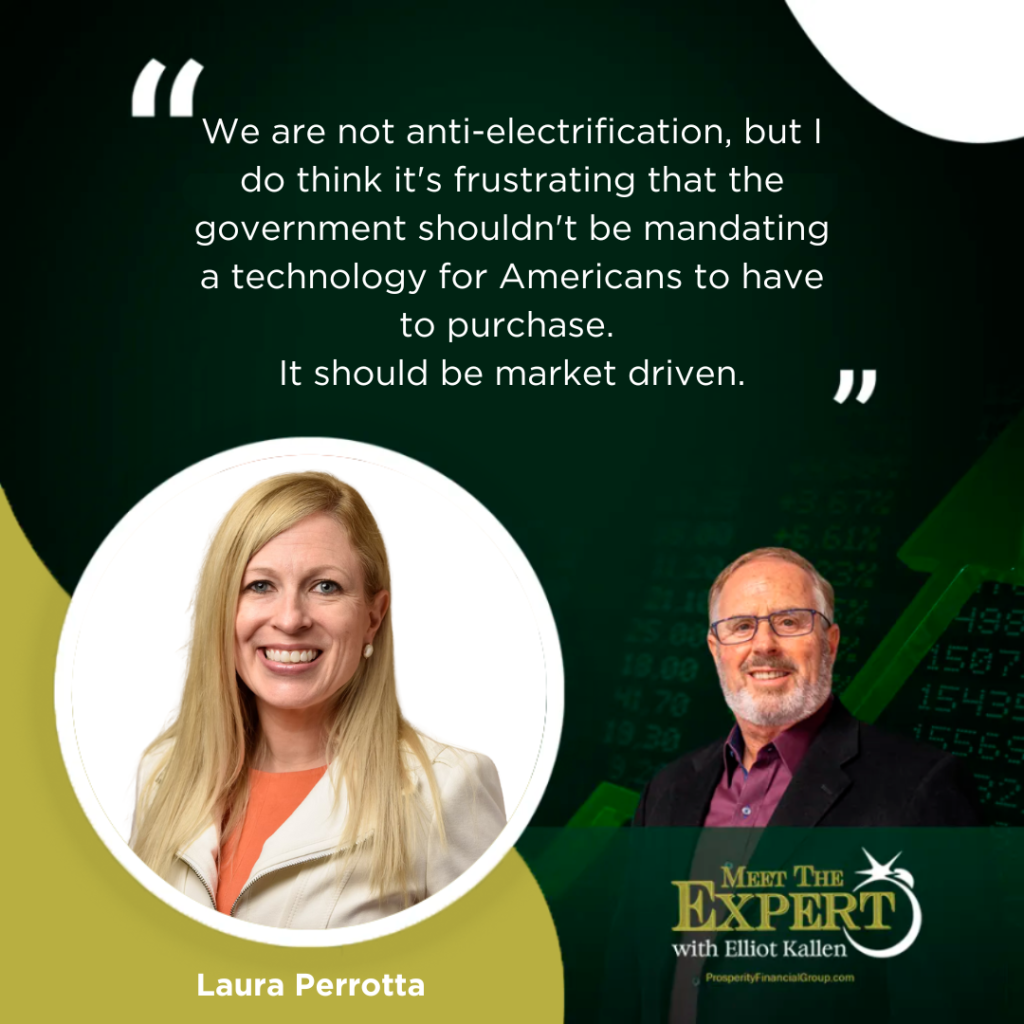
Laura Perrotta: Yeah, no. I mean, I’ll just… I will say that obviously the dealers are all in on electrification. You know, we haven’t… We’re not anti-electrification, but I do think it’s frustrating that the government shouldn’t be mandating a technology for Americans to have to purchase. It should be market driven. Everyone wants to drive a cleaner car. There’s no one who wants to drive an old, dirty car. That’s just natural. And all the OEMs have been striving, the manufacturers have been striving to develop cleaner cars for many a year before there was a mandate. But yes, these electric vehicles, unfortunately, this technology to do the battery production is not clean. The carbon footprint is pretty massive, unfortunately. Like you said, they’re mining in China and Africa, third world countries, and you need a lot of minerals. And now with the trade tariffs on top of this, it’s going to get harder and harder to produce these vehicles, and they’re going to become more and more expensive. And just one fact that I threw out to you at one point earlier today, we represent the truck dealers as well. And the carbon footprint, there was research done by Attree, which is a trucking research group. And they were looking at the carbon footprint from well to wheel of an electric Class 8 versus a diesel Class 8. And they found that the electric Class 8’s carbon footprint was bigger than the diesel Class 8. So today’s clean diesel has come so far that it’s here right now, it’s affordable, and you can put someone in a clean diesel truck at any second. We have an abundance of them, whereas the electric Class 8’s are really hard to make work as a tool for business. They’re just charging range. And then also, again, the carbon footprint. So it’s kind of, I just wish that the folks who are setting these policies would dig into the issues and really look at the ramifications of soundbites.
Elliot Kallen: Or you’re putting a wet blanket of common sense over the conversation. You’re ruining it.
Laura Perrotta: Yes, I am.
Elliot Kallen: Again, we’re talking to Laura Perrotta, who’s president of the New Jersey Automotive Association, because it’s a really fascinating topic of what’s going on with affordability and tariffs and electrification. If you want to reach me, it’s 925-314-8503 or elliot, E-L-L-I-O-T at prosperityfinancialgroup.com. And the website is prosperityfinancialgroup.com. You know, I want to talk a little bit about Tesla for a moment without getting into the politics of Elon Musk, because I know that’s a polarizing conversation and doge. But Elon Musk has been maybe single handedly the driver of electric cars in the U.S. He has. He has been the difference in the United States. And his brand is tarnished right now. And it’s a shame for him. And whether he deserves it or not, again, that’s a different conversation to have. But he’s going to go back in about a month and start rebuilding Tesla. But he was the darling of the environmental movement. He was the darling of the left, the darling of people under the age of 40 years old, the Albert Einstein of his time, of this time. Lots of great phrases. Now he’s got a lot of negative phrases about him. But if he doesn’t rebuild his brand, if he’s unable to do that properly, where does the electric car industry go? Because you can’t defer to China when we’re in an economic war with China not getting any better in a year. So what happens here?
Laura Perrotta: Well, Tesla has suffered a lot of brand damage in recent months. And I was just reading an article this morning about how their stocks have fallen and how Elon is trying to calm the investors. And it’s all very, very interesting. A self-induced struggle, of course. But I’ll say that EVs are now part of the mix for every traditional manufacturer of vehicles. Like I said, some people want to drive an EV, and that’s wonderful. And they should have that choice and that opportunity. So the manufacturers have actually really been expanding their EV portfolio. So even if Tesla kind of drops off in market share for electric vehicles, I think we have a lot of manufacturers, your traditional manufacturers, whether it’s GM or Ford or Honda, whoever it is, they’ve really broadened their product base to try and be competitive in that space. And they’re also Investing in hybrids and plug-in hybrids. So I think that void will be filled. But I do think there’s still, as I’ve mentioned before, a lot of demand for gasoline product, hybrids. We need to make sure that, and I think the manufacturers realize this, too, in announcements they’ve made this year since Trump did get elected, that they need to make sure that there’s gas-powered vehicles in the future.
Elliot Kallen: Yeah. I drove down to LA not too long ago with a friend of mine who had an electric car. He said, you’ve got to try this. It was a great riding car. It was beautiful, lucid. It was just gorgeous. It’s maybe the most beautiful sedan I’ve ever sat in, like being in a spaceship within a car. Couldn’t feel a thing on the road. It was just a glide. He said, okay, I got to go fill up with power halfway down, and then I’m going to fill up again when I’m down there. And so he plugs it in on a dashboard, and it says, get off at this exit. And it’s a 30-minute, 45-minute, one-hour fill-up in power. But it was a two-hour wait to get it. And I thought, wow, what happens if you’re… And I asked that question. He didn’t know the answer. What happens if I don’t have two hours of power in my car left to just sit there not moving while I’m waiting on line to get a 45-minute power charge? There’s a real problem out there, and infrastructure isn’t there.
Laura Perrotta: Oh, it’s huge. New Jersey’s in a lot worse shape, unfortunately, than California as well, which is really challenging. We, you know, we, the government is mandating these sales. So the manufacturers are producing and we’re pushing the sales of the dealerships because, that’s what’s required of these mandates. But unfortunately, the charging infrastructure just is not there, especially in New Jersey. I mean, I’ve been in a car recently where we were on a way to a meeting and the electric vehicle had to stop. There were seven chargers, charging points. I think it was charge point was the vendor who had the station. One of them was operating. There was a car there charging for an hour. We were sitting there for an hour, but we couldn’t leave and get to the meeting because we had to get the charge. This is, it’s unsustainable. If the government wants to require electric vehicle purchases, they have to put their money where their mouth is. They have to invest in the charging stations. They have to invest in updating the power grid. And then if you get into electric trucks and the power needs there, that is massive. We’re talking megawatt chargers. There was a study done by Ruhlenberger last year that looked at the total cost. If you were to electrify 100% of the fleets, the electric truck fleets across the country, the cost of infrastructure that the American government would need to invest is roughly $1 trillion.
Elliot Kallen: And so, you know, that’s not happening.
Laura Perrotta: Yeah, it’s not.
Elliot Kallen: It’s not.
Laura Perrotta: It’s impossible.
Elliot Kallen: Yeah. I’ve been a proponent of hydrogen power for a really, really long time. I saw what was done with a car that, went out of business in Poland where, he put hydrogen tank on the roof just to show it how it would work. And, of course, he went to jail for, obviously, other things went wrong there. But he, and then water vapor came out the trunk, I mean, came out the exhaust pipe. And I thought, why can’t we do that? I mean, gasoline is pretty volatile and you’re going to blow up if it hits a spark. Hydrogen is just as volatile, more volatile, obviously. But, again, maybe not in my lifetime. It’s a sad thing. But, if you ask for my vote, I’m voting for hydrogen. But I’m going to be a lone wolf if I get it on that one.
Laura Perrotta: Yeah, hydrogen is getting, gets a lot of buzz. And I do think it could be a very viable option in the future. But, again, I think the market has to decide. Because if you rewind a few years in the truck world, the government was pushing natural gas. So all the fleets were told they had to go out and make and buy natural gas trucks. Only pockets ever really got off the ground in the United States. And so now when the electric vehicle mandates came by, the same fleets for the trucks were like, wait a minute, a few years ago, it was natural gas. Now you’re telling me I have to buy electric and invest in it. And then tomorrow, it’s going to be hydrogen. You can’t keep moving the needle and the bar on these industries that, are vitally important for the United States and to get your products to your doorstep. It just doesn’t work.
Elliot Kallen: Let me talk about a legitimate economic issue here. And that is self-driving trucks. So they’re coming. In some form, they’re coming. I don’t know if they’re going to be long haul trucks or they’re going to be local delivery trucks. I’ve heard the conversation go both directions. So I really don’t know the right answer there. But we have roughly three million plus truck drivers in the United States. It’s a legitimate economic force that stands to be put out of business. I feel like I’m listening to a country song that I heard not too long ago that the last truck driver on the last interstate is rolling down the road, getting his last cup of coffee at the last drive-through truck stop. There’s actually a song from that, Bobby Baird, from the 70s on that. But legitimately, we could have the end of, if this works, the end of the truck driving, the truck driver, if we go to all truck self, I’m getting tongue-tied, all self-driving truck out there, what do you hear about what’s going on with that? Short haul, long haul, is it going to be in your local town until we have a monster accident that stops all the technology? But we have monster accidents every day on highways and in cities. So they just don’t get the advertising and the front page that Tesla would get in a truck car, explosion of people Dying. But what do you hear about that? Because New Jersey, like California, has a lot of highways and has a lot of open road. You got 80, you got 78, you got the turnpike. The parkway doesn’t take trucks, but 95 and 295 definitely do. And then you got the shore routes, where you got delivered to all those shore communities on Route 1, and then within North Jersey with oil and gas and plastics.
Laura Perrotta: Right. Well, you know, autonomy and autonomous vehicles, I’d say I wouldn’t bet the farm that it’s going to be here tomorrow. I think it’s going to be a slow roll. I mean, it’s been, I was in Washington, D.C. until I moved to New Jersey this past fall, and they’ve been talking about autonomous vehicles for years, at least a decade, and how it was coming tomorrow. But full autonomous vehicles, level five autonomy, is extremely risky. It really is, because you got, you know, safety concerns are the first and foremost situation. And then, I mean, can you just imagine driving next to a Class 8 truck that’s fully autonomous? How disconcerting that would be. You have to, and on top of that, you have the interaction of the autonomous vehicle with the traditional regular vehicle and human drivers. And it’s just fascinating how, how much interaction has to occur and how they’ll work together or won’t work together. But I would say it’s coming. I think it’s going to be slow, as it has been. But, we are seeing pretty standard now, level, two, three autonomy helping us with safety, which is a good thing. I think lane departure, it took me a while to get used to, but now I do like it.
Elliot Kallen: Think about that. You’re in New Jersey. You got Route 80. You want your company, a company, your client is shipping a long haul truck, a full truckload to California, whatever it is. All right. So, it’s on Route 80. Normally, all the way, or it dips down to LA, wherever it goes. And normally, they got to stop every eight to 10 hours and Sleep for X hours, and it gets scales and weights. And you got issues. You got a human being back there that could get tired. Now, I could have that there in three days. No sleeping, no anything. It’s all cameras. It’s all sensitive. It’s going to have, 8,000 cameras on it and sensors on it, whatever the number is. I’m exaggerating a little bit, but maybe not at the end of the day. It’s going to have that there. It’s going to probably be safer than a human because it doesn’t get tired or have to use a bathroom. It doesn’t get cold in the winter, but it does hit ice, and it’ll have to react to ice and snow and bad weather. It’s got to be coming. It has to be.
Laura Perrotta: Oh, I’m not saying it’s not coming. I just think it’s going to take longer than you would imagine. While the technology is going to come quick, and it is basically almost here, it’s the government regulations, the state, the federal, the NHTSA, the National Highway Traffic Safety Administration. It’s lawyers. It’s, all these things making it profitable for a company and an investment that is actually accepted by society. I’m just saying, I don’t, it’s going to take a little bit longer than, you know, I think there’s certain aspects that will come in like Ubers that might be autonomous and your taxis at the airports. They’re already running those and testing those. And maybe some areas where a truck might be just going on more of a closed circuit highway, that could happen right away. But having it out in the general population where I could go in and buy a level five autonomous vehicle tomorrow, it’s not going to happen for a while.
Elliot Kallen: OK, good. We were talking with Laura Perrotta, who’s the president of the New Jersey Automotive Retailers Association. And let me ask you one more question as we wrap this up. This has been great. For people that are listening to it, we meet, we do this actually more than once a week now. We’ve been really cranking out these Meet the Expert with Elliot Cowan episodes with interesting people like Laura, who’s not from the financial industry. We started this off in the financial industry. Now we just branched out. So many interesting directions here. But I want to give you a lot of credit because you’re in a high position, although the painting on the back of the wall reminds me of an NCIS episode in orange there. But you’re in a high position. The automotive industry, the trucking industry, notoriously male forever. A lot of bad reputations with that when you go in to buy something and you’re talking to the salesman, not the saleswoman, and he has to go back and ask his sales manager for a lower price. And, you never knew if you’re getting ripped off and a lot of bad things. But it was very macho machismo for a very long time and actually condescending towards women for a very long time. The stereotype from women was, even my wife has said to me many times, don’t make me go into the dealership by myself. I get a totally different answer than when you’re with me. So it’s been like that forever. But you’re obviously breaking that glass ceiling or breaking that barrier down, whatever we call it. That doesn’t happen without a certain level of resistance and tenacity. So kudos to you for doing it. Congratulations. But let’s, in the last few minutes, let’s just talk about what you’ve encountered on those tenacity, on those words, tenacity, resilience, whatever you think are the right words to use there, because the people that are listening to this can grow from you.
Laura Perrotta: Oh, thank you, Elliot. I think I’ve always been in male-dominated industries, working on Capitol Hill. I came from transportation. I was in roadway safety, trucks, and now autos and trucks. So I’ve always been the outlier. But that being said, it’s actually been an advantage to me because people remember you. When you’re one of a few women in a room, they tend to remember you because you stand out a little bit. So if anything, it’s been an advantage for me personally. But the other thing about me and personally has always been in me is risk-taking. My mom actually is staying with me, and she was laughing that I, when I was a little, little kid, she would say, what do you want to do when you grow up? And I’d say, I want to be the boss. And she’s a nurse. She thought it was… I love that. She was like, where did you get that from? But it’s always been in me that I wanted to make the decisions. I didn’t want to answer to anyone. I still have to answer to people, boards, and everything else. We know that there’s no real boss ever. But, I wanted to run things, and it was just in me, and that’s just who I am. But yeah, but I do think risk-taking. If I have any advice to anyone listening, if you’re a woman and you want to climb that ladder, take risks. Hey, I chucked it all, lived in D.C. my entire adult career, and a few months ago moved to New Jersey to run the auto and truck dealers in New Jersey. Never lived in New Jersey, you know, learning the legislature, learning my members, got to take risks.
Elliot Kallen: Well, good for you. Congratulations. We’ve been talking with Laura Perrotta. This has been great. Laura is the president of the New Jersey Automotive Retailers Association, which also includes over-the-road trucks, electronic vehicles, state mandates. They’re in New Jersey, but New Jersey and California are very parallel states when it comes to mandates and tariffs and what’s going on. Laura, if people want to reach you or get more information about things we’ve talked about, how do they do that? Yeah,
Laura Perrotta: I would just encourage you to visit our website, the New Jersey Coalition of Automotive Retailers. We’re NJCAR. Please just check us out, and you can always email me, too. If you have any questions or want to learn more, it’s LPerrotta, it’s L-P-E-R-R-O-T-T-A at njcar.org. So, thank you for listening, and thanks, Elliot.
Elliot Kallen: You’re welcome. And if you want to get a little lesson on resilience and breaking some glass ceilings and, being an entrepreneurial boss from the time of the lemonade stands, she can give you some advice about that, too.
Laura Perrotta: Exactly. Yeah, who knew? Who knew? My mom still laughs.
Elliot Kallen: So, if you want to reach me again, it’s Elliot, E-L-L-I-O-T, at prosperityfinancialgroup.com. The website is prosperityfinancialgroup.com. These and about 125-plus episodes are on our website. And if you want to talk to me directly, I’m at 925-314-8503. We’ve enjoyed having you on here. Have a great day, everybody. Laura, thank you so much.
Laura Perrotta: Thanks, Elliot. Have a good day.
Elliot Kallen: Thank you. See you soon, everyone.
The post The Future of the Automotive Industry with Laura Perrotta appeared first on Prosperity Financial Group | San Ramon, CA.