It seems as if I’ve been seeing more and more articles advising us to avoid electronic devices in bed or at bedtime. Because I’m a word-game junkie, because I play Zen Word in bed on my i-Phone to help me relax before falling asleep, and because after I complete a level in the game, I cork off immediately, I wanted to know what all the fuss was about. Wow! Am I glad I looked.
It turns out the chief offender is the blue light emitted by electronic screens. Blue light contains peculiar photons known as photocrons that enter through the cornea, traverse through the lens to the optic nerve, and follow the optic nerve to the brain. (See Figure 1 below.)
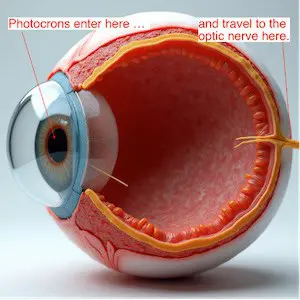
Figure 1
Photocrons suppress the production of melatonin, a hormone that regulates Sleep. As a result, you don’t fall asleep as quickly, your circadian rhythms are disrupted, the quality of your sleep is reduced — particularly REM sleep — leading to less restorative rest. This could cause daytime fatigue or Advanced Grouchiness. Also, photocrons can trick the brain into thinking it’s daytime, further disrupting sleep patterns. And having electronic devices in the bedroom can reduce the association between the bedroom and sleep, making you think the bedroom is a game room, a newsroom, your office, your garage, a gym, a local park, or the bathroom, which can get messy.
That kind of dissociation can lead to things like:
In addition, playing games on your phone in bed or at bedtime, scrolling through social media accounts, reading emails, looking at websites, reading blog posts, texting, checking sports scores, looking at your news feeds, or anything else you might be doing with your phone, your tablet, or your computer keeps the brain active. In some cases (apparently not mine), it can increase alertness when your brain should be winding down, which delays sleep still more. Looking at contents like news or work-related messages — or losing at word games — can elevate Stress levels, making relaxation difficult. And prolonged screen use in bed can cause eye strain, neck strain, headaches, poor posture, or serious beefs with your spouse or your significant other, contributing to physical breakdowns or relationship breakups.
But it gets worse.
Danger, Will Robinson!
Using electronic devices in bed or at bedtime can actually destroy your brain by displacing it. That’s because chronic exposure to photocrons causes them to be stored in the hindbrain, a region of the brain that comprises the medulla oblongata, the pons, the cerebellum, and most of the brainstem. (See Figure 2 below.)
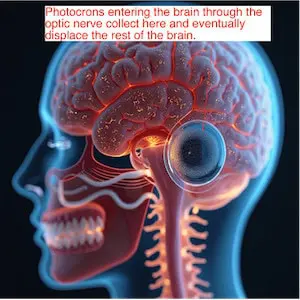
Figure 2
In fact, studies were conducted by the National Sleep Foundation (NSF), the National Sleep Foundation Workshop (NSFW), Sleep Normalization and Function Union (SNAFU), and the National Apnea Partnership (NAP). After just six months of exposure to photocrons, 98 percent of the 12,647 people who participated in the studies — all of whom had been rational thinkers with IQs of 120 or higher — had become political liberals, which is all you need to know about the dangers of blue light.
Put down the electronic devices at night, kids.
‘Nuff said.
Originally Published on https://www.bizcatalyst360.com/category/lifecolumns/notes-to-self/