
Ever thought about how you guest when you go round someone else’s house?
Formal settings encourage performance.
Relaxed environments reveal patterns.
And when you start hosting regularly, those patterns become impossible to ignore.
Whether it’s a dinner party at your boss’s house, Christmas cocktails with acquaintances, a weekend staying with Family, or a casual catch-up with a close friend, the contexts may differ — but one thing stays constant: you are a guest in someone else’s space. How you show up speaks volumes.
Do you arrive empty-handed or thoughtfully prepared?
On time, or “fashionably late”?
Looking to contribute — or expecting to be waited on?
Ironically, while we tend to be most self-conscious in formal settings, it’s in informal ones that a person’s true behavioural defaults tend to emerge.
This year, after buying a new apartment and dramatically increasing my hosting frequency, I found myself unintentionally conducting a live social experiment. Watching lots of people move through my home — how they helped, didn’t help, communicated, disrupted, vanished or leaned in — made one thing abundantly clear:
Hosting doesn’t create behaviour. It reveals it.
So, in true analytical fashion, I started taking notes. As the festive season approached, I also turned the lens inward and asked myself: What kind of guest am I? One people enjoy inviting back — or quietly tolerate once a year?
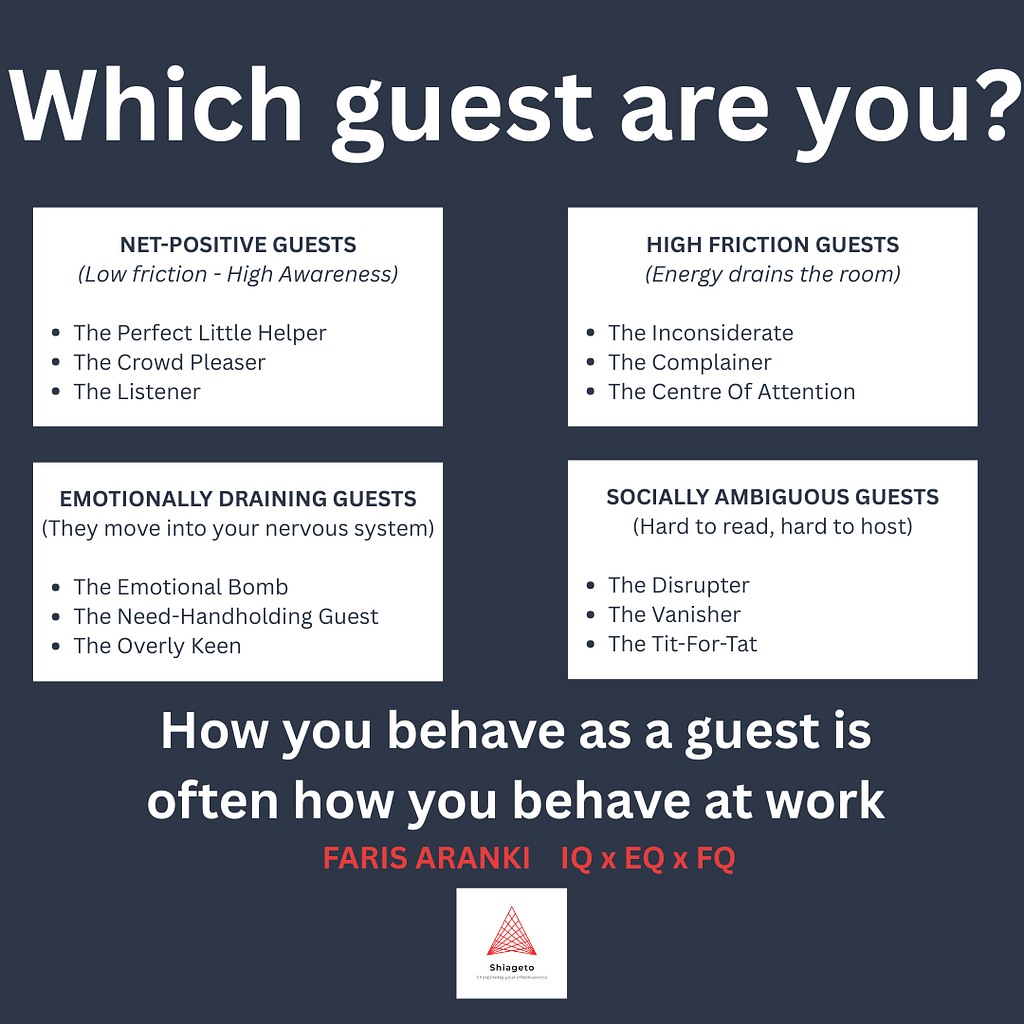
When I reviewed my observations, a pattern emerged. Almost everyone I hosted fell into one (or more) of twelve recognisable guest archetypes. And strikingly, each one mirrored a broader personality trait that showed up well beyond the living room.
They regularly check in with the host, ask thoughtful questions, and support exactly to the level requested — no more, no less.
Trait revealed: High emotional intelligence, strong boundary awareness, low ego.
They intuitively sense what’s needed — helping in the kitchen, telling a story to lift the room, or offering a listening ear.
Trait revealed: Social attunement, adaptability, and a strong prosocial instinct.
They must help. Cooking, cleaning, fussing — often whether you want it or not.
Trait revealed: Anxiety disguised as usefulness; control masquerading as kindness.
They arrive late, bring nothing, and expect everything.
Trait revealed: Entitlement, low reciprocity awareness, and poor perspective-taking.
Nothing quite meets the mark — the drinks, the food, the temperature, or the week they’ve had. Complaints often arrive via passive-aggressive delivery.
Trait revealed: Chronic dissatisfaction and indirect communication.
They’re present but passive — happy to listen and respond, rarely leading or initiating.
Trait revealed: Low assertiveness; sometimes reflection, sometimes withdrawal.
Their stories are bigger, louder, longer — and always need topping.
Trait revealed: Validation-seeking and a need to dominate shared space.
They bring curveballs: extra guests, broken house rules, or unsolicited rounds of shots.
Trait revealed: Poor boundary respect and thrill-seeking at others’ expense.
They arrive carrying a problem and unpack it fully — oversharing, creating tension, or pulling focus from the room.
Trait revealed: Low emotional regulation and difficulty containing personal distress.
They’re lovely — but without direction they’re lost. What to do, where to sit, when to eat.
Trait revealed: Low self-efficacy and reliance on external structure.
Here one moment, gone the next — no heads-up, no goodbye.
Trait revealed: Avoidant tendencies and discomfort with social signalling.
A pleasant guest, but one who keeps a quiet ledger of favours given and received.
Trait revealed: Transactional thinking and difficulty with unconditioned generosity.
These archetypes aren’t fixed identities. The same person might be a Perfect Little Helper in one setting and a Vanisher in another. Mood, power dynamics, familiarity, and psychological safety all influence which behaviours surface.
At my parents’ house, I default to my most natural state. In formal environments, I consciously manage my behaviour. Most of us do.
That’s why this list isn’t a judgement — it’s a mirror.
Used retrospectively, it’s a useful diagnostic: How do I typically show up?
Used prospectively, it’s even more powerful: How do I want to show up tonight?
A small amount of pre-determined intention — call it awareness, call it manifesting — can radically change how you experience social situations.
The longer I sat with this list, the more familiar it felt — not socially, but professionally.
These guest archetypes strongly resemble the team dynamics I encounter in organisations every week. The helper, the disruptor, the emotional load, the scorekeeper — they show up at work just as reliably as they do around the dinner table.
My working hypothesis is this: how you behave as a guest socially is often how you behave as a team member professionally.
While I continue to explore this idea, one thing is certain — becoming more aware of my own guest behaviours has noticeably strengthened my emotional intelligence. And, hopefully, made me someone people actually enjoy inviting back.
Feel free to stand on the shoulders of giants — and become the guest you always knew you could be [Take the test below to find out more].
Faris
— — — — — — — — — — — — — — — — — — — — — — — — — — — — — — — — — — — — —
Before your next social engagement, take a moment to reflect honestly. For each statement, ask yourself: “Is this typically me?”
There are no right or wrong answers — just patterns worth noticing.
Most of us rotate between guest types depending on:
Awareness doesn’t make you perfect — but it does make you intentional.
And intentional guests, like intentional colleagues, partners and friends, tend to get invited back.
Faris
Faris is the CEO and Founder of Shiageto Consulting, an innovative consultancy that helps firms and individuals sharpen their effectiveness. Connect with him here
Success = IQ x EQ x FQ
Want to assess your levels of IQ, EQ and FQ? click here
Originally Published on https://farisaranki.medium.com/