
We live in an attention Economy. Most people think that battle is happening on social media.
It isn’t. The biggest competition for your attention is inside your workplace and even your home.
I have dispensed a lot of advice in my 230 newsletters. From tools to behaviors, you’ve read guidance on:
The list could go on.
If it is not me, it is someone else providing you with a software option to help you reclaim more time. A technique to help you get more work done quicker. Ways to crowd out the noise in life to let you have better work/life balance.
All viable and beneficial. Yet, why don’t more people take the time to invest the time to create more quality time in life?
My answer: it is because we have lost the ability to pay attention, especially in the workplace. In an age of incredible change and opportunity, our professional lives are dominated by attention fragmentation. Many of us justify this behavior and try to call it multitasking. Instead, it is really a constant switching between apps, messages, and meetings. The real constraint is not hours available but continuous attention capacity, which few management systems address.
Therefore, I am not going to ask you to consider trying another tool or picking up a new technique. I want you to challenge you to pay better attention at work through the environment, the people, and your attitude.
Environment dictates their attention. Surrounding can rob you of focus.
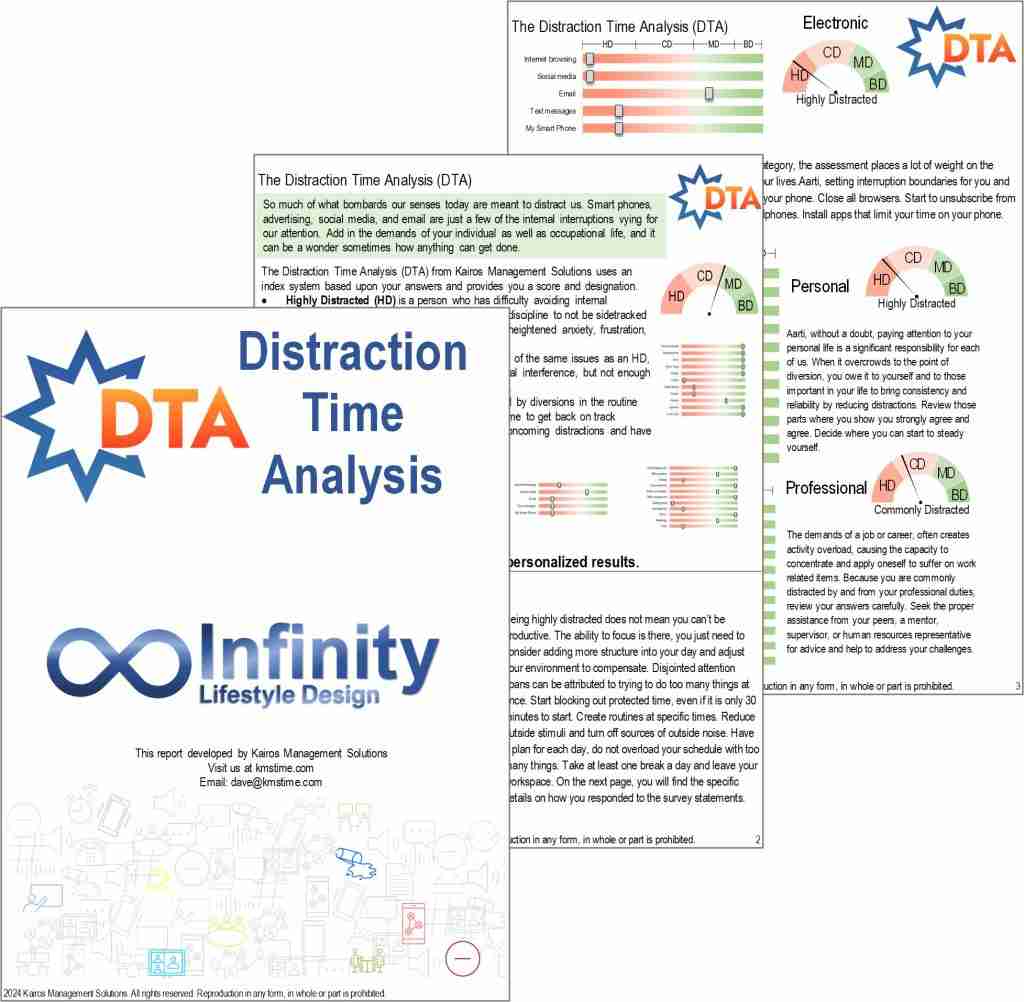
The Distraction Time Analysis shows that attention is constantly under assault. Emails, text messages, meetings, background noise, and even office culture create a steady stream of interruptions. The average person does not lose time because they are lazy; they lose time because their environment is engineered for distraction.
Think about your own workplace. Open office concepts, constant notifications, and back-to-back meetings create a system where deep work is the exception, not the standard. You are not immune from this if you work remotely.
In the Time Management Analysis, focus is consistently the weakest category across participants. Not because people don’t care but because their environment makes sustained attention nearly impossible.
Your environment either compounds your concentration …or consumes it. What can you do to move your environment economy to more background noise and not attention grabbing?
Every day, small interruptions quietly influence how you work, think, and make decisions. Some distractions come from your environment. Others come from the people around you. Still others are habits that have gradually become part of your daily routine.
The Distraction Time Analysis (DTA) is a free self-assessment that helps you identify the hidden factors affecting how you use your time. In just a few minutes, you’ll discover which distractions have the greatest influence on your focus and receive personalized insights to help you create a more intentional and productive use of your day.
When you better understand your distractions, you can make better decisions about your time.
In a professional setting, access has become confused with priority. Just because someone can reach you does not mean they should interrupt you.
Expectations of instant response become normalized. In the workplace we are bombarded by too many connections, too many touchpoints, too many inputs. Attention becomes diluted across too many directions.
There is also a deeper issue. Many professionals still derive their identity and value from responsiveness rather than effectiveness. Over 78% of those who took the Retirement Time Analysis, their career provides a strong sense of worth.
In a workplace people economy people want to be viewed as being engaged and active. Because of that, time at work becomes more reactive to others. Many times, this is not productive. It is simply attention spread too thin.
Therefore, challenge yourself. How can I honor those around me while I still honor my own time?
I’ve had wonderful comments about how the results of a self-assessment from the Time Management Analysis highlighted that individual’s personal struggles with time. In spite of that, they do nothing.
The attitude economy lends to the status quo of “good enough”. Since appointments are met and due dates are completed (many times in chaotic and reactive ways), there are no incentive structures to change.
The mindset does not change because the environment and people economies remain the same as well.
Incremental changes can alter attitudes significantly. What is one “good enough” behavior you can adjust to improve your time attitude?
I live these struggles every day in the workplace. I ask and re-ask these questions frequently.
When I look back and reflect on a period of focused work or understand I had a good day, I find it is because I paid attention. I took steps to use the environment around me to propel my productivity. I proactively engaged with people to address their needs or mine. I checked my attitude and pushed back against being just “good enough.”
When I recognized and improved on the time economics, I brought more value to myself and those around me.
Productivity is rarely determined by how much time you have. It’s determined by how much attention you can protect.
David Buck is the author of the book The Time-Optimized Life, coauthor of The Retirement Collective, and owner of Kairos (Time) Management Solutions, LLC. Learn how to apply the concepts of proactively planning and using your time. Take the Time Management Analysis (TMA), the Retirement Time Analysis (RTA), or all the other free resources offered to help bring more quality time into your life.
The post The Attention Economy Inside the Workplace first appeared on Infinity Lifestyle Design.