

You can advertise in Superpowers for Good. Click to learn more about our affordable options.

The mechanisms of early-stage funding are undergoing a profound shift, moving power from traditional gatekeepers directly into the hands of the crowd. Over the past two weeks, a dynamic and highly diverse cohort of impact-focused startups and Main Street businesses successfully crossed the finish line, closing their Regulation Crowdfunding (Reg CF) campaigns and finalizing over $1.25 million in Retail investments.
It is crucial to clarify a mechanical nuance of the industry: these companies did not necessarily raise this entire sum over the past fourteen days. Rather, they successfully completed their campaigns and closed their offerings during this period, securing the capital they had diligently accumulated over the lifespan of their respective raises.
From AI-driven wealth management platforms and overwater villa resorts to neighborhood LGBTQ+ bars and brownfield solar projects, the sheer variety of these offerings underscores the expanding appetite of the retail investor. In this comprehensive analysis, we will dissect the data, evaluate platform dynamics, compare Security structures, and explore the underlying psychology driving both founders and investors in today’s crowdfunding ecosystem.
Before diving into the data, it is essential to understand the lens through which these campaigns were evaluated. Each week, Superpowers for Good shares a list of new impact-related offerings added to FINRA-registered crowdfunding portals and by broker-dealers. Using our classification methodology, we highlight offerings with social impact, women in leadership, and underrepresented founder leadership. The companies analyzed in this report represent the culmination of that rigorous filtering process, showcasing ventures that align financial potential with tangible societal benefit.
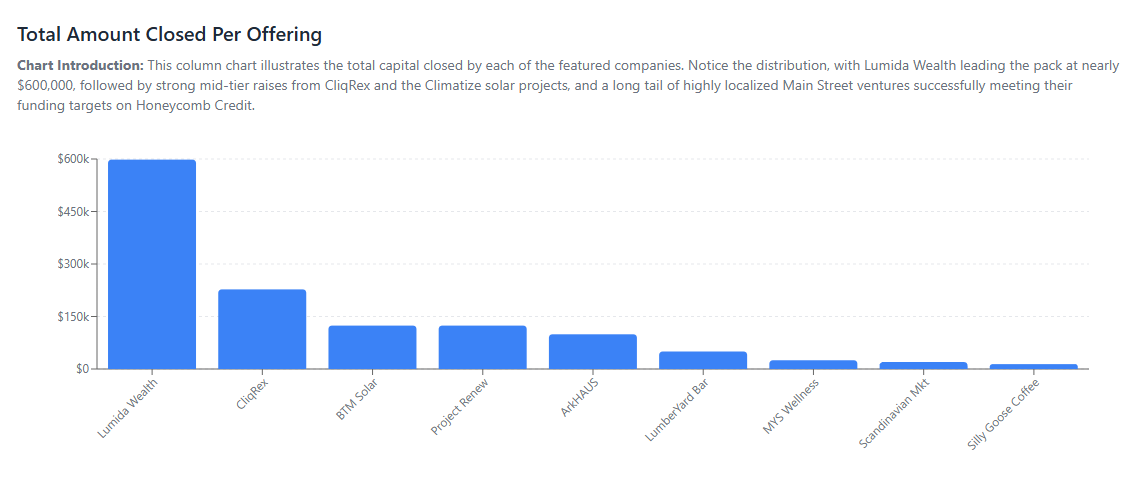
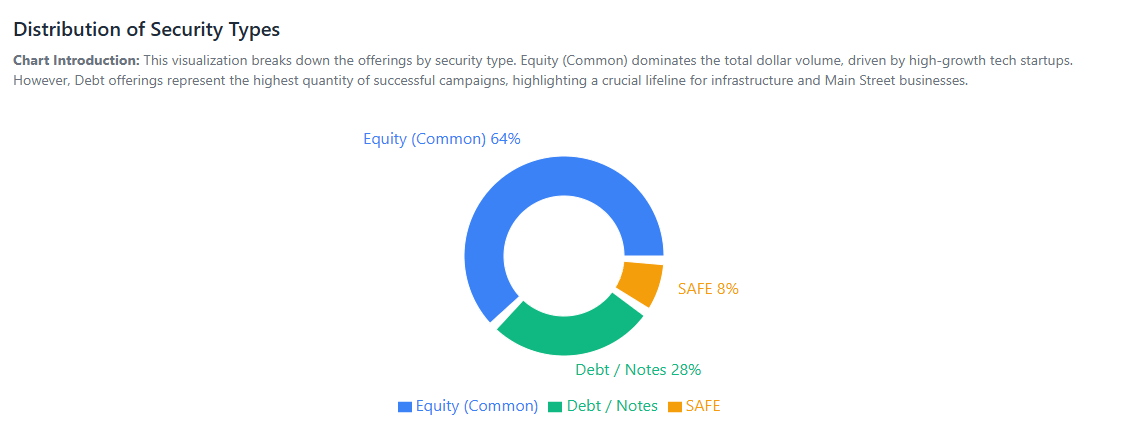
To better understand the distribution of capital across these successfully closed campaigns, we have prepared the following visual breakdowns.
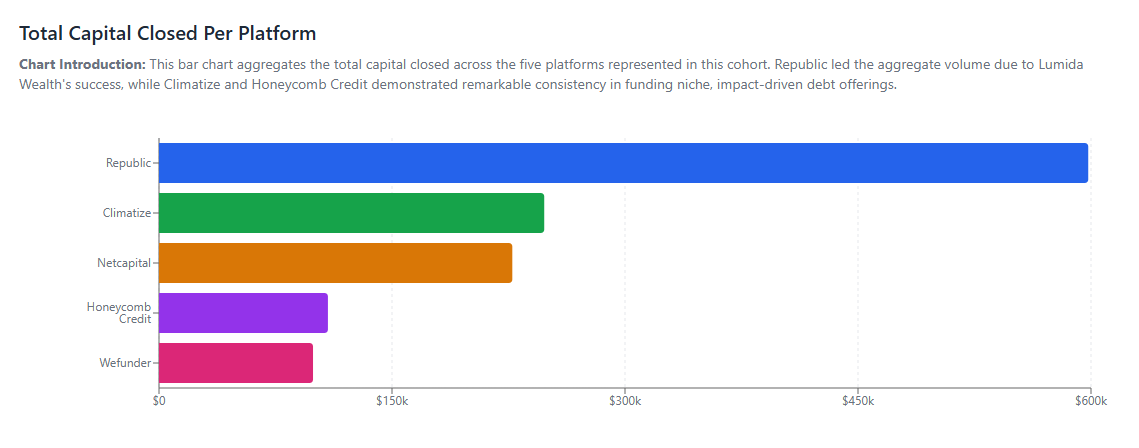

The platform a founder chooses is often as critical as the pitch itself. Today, crowdfunding portals have highly differentiated user bases, positioning strategies, and sector strengths. The $1.25 million closed across these campaigns was distributed among five distinct platforms, each serving a unique function in the capital ecosystem.
Republic hosted the largest single close in this cohort with Lumida Wealth ($598,221). Republic has long positioned itself as a premium destination for high-Growth tech, fintech, and Web3 startups. Their investor audience is typically more accustomed to venture-style risks and is actively seeking the next unicorn. For founders in the AI or fintech space, Republic offers a built-in audience of early adopters who are willing to write slightly larger checks for common equity in highly scalable models.
Netcapital facilitated CliqRex’s $227,452 close. Netcapital has carved out a strong niche by offering a highly integrated secondary transfer feature and focusing on companies that have strong, organic digital communities. CliqRex, an Entertainment curation app, is a perfect fit for this platform. Netcapital’s audience responds well to consumer-facing applications where the investors can also be active users and brand ambassadors.
Climatize is a standout example of platform specialization in the current market. By focusing exclusively on climate tech and renewable energy projects, they have cultivated an audience of hyper-targeted impact investors. The successful closures of the BTM Solar Portfolio ($124,000) and Project Renew Kentucky ($124,000) demonstrate the platform’s strength. Climatize investors are not necessarily looking for 100x venture returns; they are looking for stable, debt-based yields tied to tangible environmental outcomes. For solar developers and green infrastructure founders, Climatize provides an unparalleled, mission-aligned capital base.
Wefunder remains the volume leader in the broader Reg CF space, known for its “fund your friends” ethos. ArkHAUS successfully closed $99,153 on the platform. Wefunder’s strength lies in its massive, generalized user base and its seamless user interface. It is highly effective for consumer brands, Lifestyle companies, and ambitious hardware/Real Estate crossovers like ArkHAUS. Wefunder investors are drawn to compelling narratives and visually stunning pitches.
Honeycomb Credit continues to dominate the localized, small business debt market. Facilitating the closures for The LumberYard Bar, MYS Wellness Blends, Silly Goose Coffee Company, and Scandinavian Market, Honeycomb proves that community capital is thriving. Their platform is engineered for brick-and-mortar businesses looking to borrow from their own customers. The investor audience here is highly localized—they are funding the coffee shop down the street or the inclusive bar in their neighborhood, prioritizing community vibrancy and fixed-income returns over massive equity multiples.
The choice of security—SAFE, Equity, Debt, Revenue Share, or Convertible Note—dictates the long-term relationship between the founder and the crowd. The campaigns that closed over the last two weeks utilized a fascinating mix of these instruments, reflecting the diverse stages and industries of the raising companies.
The Mechanics: Investors purchase actual shares in the company at a set valuation.
Founder Incentives & Risks: Selling priced equity provides clean capitalization but requires setting a firm valuation ($5M for CliqRex). It dilutes ownership immediately but aligns investors perfectly with the long-term growth of the company.
Investor Perspective: Retail investors Love priced equity because it is easy to understand—they own a piece of the pie. However, they bear the ultimate risk of illiquidity and total loss if the company fails. This structure is best for companies with clear traction and a defensible valuation, like Lumida Wealth’s demonstrated 330% revenue growth.
The Mechanics: Investors provide capital now for the right to equity later, usually triggered by a future priced funding round, often with a valuation cap or discount.
Founder Incentives & Risks: SAFEs are incredibly founder-friendly. They allow startups to raise capital quickly without setting a hard valuation today (though ArkHAUS lists a $25M valuation cap). The risk for founders is “SAFE stacking,” where multiple unpriced rounds lead to catastrophic dilution when they finally convert.
Investor Perspective: SAFEs carry high risk for retail investors. They do not hold equity, they hold a contract. If the company never raises a subsequent priced round or is acquired, the SAFE may never convert. However, for ambitious, capital-intensive projects like ArkHAUS’s overwater villas, SAFEs provide the necessary early-stage runway.
The Mechanics: Investors lend Money to the business, which agrees to pay it back with interest over a set term.
Founder Incentives & Risks: Debt is non-dilutive, meaning founders keep 100% of their equity. For cash-flowing businesses like cafes (Silly Goose) or infrastructure projects with predictable revenue (BTM Solar), debt is ideal. The risk is the legal obligation to make fixed payments, which can choke a business if revenues dip.
Investor Perspective: Debt offers a clear timeline for liquidity and a predictable return profile. It is vastly less risky than early-stage equity. This is why platforms like Climatize and Honeycomb are thriving right now—retail investors are increasingly seeking yield and capital preservation alongside impact, rather than just chasing unicorns.
While not utilized by the companies closing this week, Revenue Share agreements (where investors take a percentage of top-line revenue until a multiple is paid back) remain a powerful hybrid. They are excellent for seasonal businesses or high-margin consumer goods where fixed debt payments might be too rigid, but equity dilution is unnecessary.
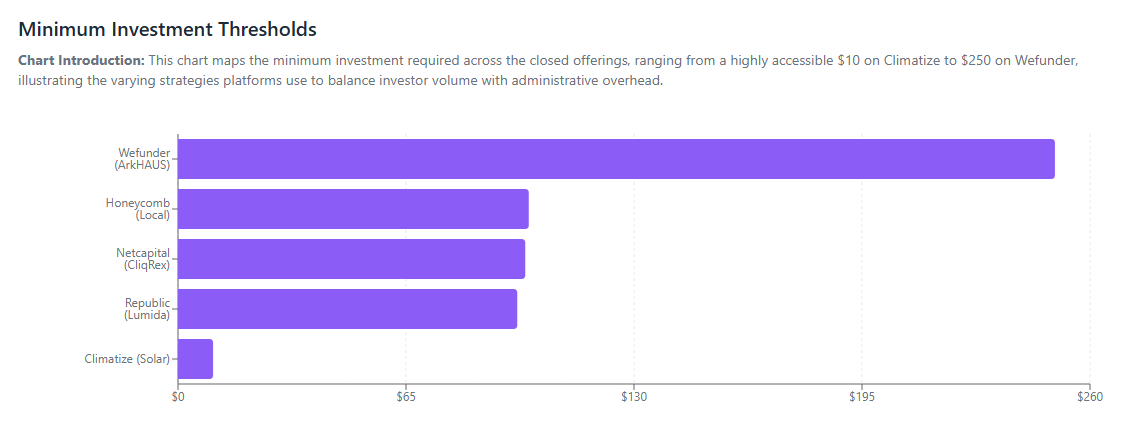
One of the most striking data points from this cohort is the variance in minimum investment thresholds. This metric is a delicate balancing act for founders and platforms: how do you maximize accessibility without drowning the cap table in administrative overhead?
Climatize ($10 Min): By setting the minimum at just $10, Climatize and its solar developers (BTM Solar, Project Renew) are optimizing for maximum democratization. This allows literally anyone to become a climate investor. The strategy here is volume and political capital—having thousands of local investors makes it easier to navigate municipal permitting and community relations.
Republic & Netcapital (~$100 Min): Lumida Wealth ($96.72) and CliqRex ($99.00) sit at the industry standard. A ~$100 minimum is low enough to be an impulse allocation for a retail investor, but high enough to weed out entirely uncommitted participants.
Honeycomb Credit ($100 Min): For local businesses like The LumberYard Bar, $100 is the perfect price point. It is roughly equivalent to a nice dinner out, making it an easy ask for loyal customers who want to support their favorite neighborhood spot.
Wefunder ($250 Min): ArkHAUS set a higher minimum of $250. Because they are building premium, luxury overwater resorts, a slightly higher minimum aligns with their brand positioning. It filters for investors who have a bit more disposable income and reduces the sheer number of K-1s or cap table entries the company will have to manage.
The Verdict on Minimums: Modern Technology has made managing massive cap tables easier (often utilizing Special Purpose Vehicles or SPVs). Therefore, the trend is leaning toward lower minimums ($50-$100) to maximize the marketing and community-building benefits of crowdfunding.

Why did these specific companies successfully close their rounds while hundreds of others languished on the portals? The answer lies in the intersection of founder credibility, narrative storytelling, and investor psychology.
Today’s retail investors are highly skeptical of traditional advertising. They invest in what they know and who they trust. CliqRex tapped into this exact psychology not just in their product (an app for inner-circle recommendations), but in their raise. Founders who can mobilize their existing users, newsletter subscribers, or local patrons always win. The LumberYard Bar didn’t just pitch a business; they pitched the preservation of a vital LGBTQ+ community space. Investors funded it because the psychological ROI of keeping their community hub alive was just as valuable as the financial return.
Lumida Wealth capitalized on the massive current tailwinds surrounding Agentic AI. Ram Ahluwalia presented a bold vision: replacing traditional financial advisors with AI. Retail investors are acutely aware that AI is reshaping the Economy. The psychology here is FOMO (Fear Of Missing Out). Investors see Lumida’s 330% revenue growth and 60,000 followers, and they want a ticket on the rocket ship. The founder’s credibility, backed by deep industry knowledge and impressive traction metrics, provided the necessary trust to close nearly $600,000.
The Climatize projects (Haley Pike Solar and BTM Solar) succeeded because they turned abstract climate goals into hyper-local, tangible realities. Adam Edelen’s Project Renew Kentucky isn’t just “saving the planet”; it is transforming a specific 357-acre closed landfill in Lexington into a power plant for 7,000 homes. Investors love tangibility. They want to point to a map and say, “I helped build that.” This psychology flips the traditional NIMBY (Not In My Backyard) narrative into YIMBY (Yes In My Backyard) through financial inclusion.
Let’s look closer at the mechanics of why a few of these standout campaigns successfully crossed the finish line.
The Hook: Democratizing elite wealth management via AI.
Why it Resonated: Lumida is solving a problem most retail investors feel acutely—being locked out of top-tier financial advice and private deals. By offering a “SuperApp” that acts as a hedge fund analyst, they are selling financial empowerment.
Traction: 47 million impressions and massive revenue growth proved this wasn’t just an idea; it was a scaling enterprise. At a $74,998 minimum target, closing at almost $600k shows massive oversubscription and high investor confidence.
The Hook: Luxury overwater lifestyle clubs.
Why it Resonated: ArkHAUS is pure lifestyle appeal combined with real Estate Innovation. The partnership with Pininfarina (the designers behind Ferrari) elevated the brand instantly. Retail investors rarely get to invest in luxury hospitality development.
The Strategy: By utilizing a SAFE, founders Sam Payrovi and Nathalie Paiva secured nearly $100k in flexible, early-stage capital to fund vessel construction without giving up immediate priced equity in a highly capital-intensive hardware/real estate play.
The Hook: Preserving and expanding local culture.
Why it Resonated: The LumberYard Bar, Scandinavian Market, MYS Wellness Blends, and Silly Goose Coffee Company represent the backbone of the American economy. These campaigns succeeded because they offered debt. Investors knew exactly what they were getting: a fixed return while supporting a founder they likely know personally. For example, Silly Goose Coffee raising $13,749 for space buildout is a perfect use-case for Reg CF debt—it bypasses predatory merchant cash advances and builds deep customer loyalty.
Impact Investing via Reg CF has evolved dramatically in recent years. It is no longer just about charitable intent; it is about funding the infrastructure of the future.
Climate and Infrastructure: As seen with the Climatize projects, retail capital is stepping in where municipal budgets and traditional banks are too slow. Transforming brownfields into solar farms is capital intensive. Crowdfunding democratizes the financial upside of the green transition, ensuring that the wealth generated by renewable energy stays within the communities hosting the infrastructure.
Food Systems and Health: MYS Wellness Blends and Scandinavian Market highlight a shift toward conscious consumption. Investors are funding supply chains they believe in—whether that is botanical-based healing or authentic, high-quality culinary experiences.
The Next Frontier: Looking ahead, we predict a massive surge in crowdfunding for localized AI infrastructure (community-owned data centers) and climate resilience projects (flood mitigation, localized grid storage). Impact crowdfunding will increasingly blur the lines between civic duty and private investment.
Based on the data from these successful closures and broader macroeconomic indicators, several trends will define the immediate future of the Reg CF space:
AI-Assisted Due Diligence: Just as Lumida Wealth is using AI for wealth management, retail investors are increasingly using AI tools to scrape SEC filings, analyze founder backgrounds, and model financial projections. This will force founders to be hyper-transparent and financially rigorous in their Form C filings, as the “crowd” is now armed with institutional-grade analytical tools.
The Rise of Community-Driven Debt: While venture capital remains tight, community debt is exploding. Platforms like Honeycomb will see record volumes as Small Businesses realize that paying 9% interest to their own customers is infinitely better than paying 9% to a faceless commercial bank. It turns a liability into a marketing asset.
Flight to Quality and Revenue: The era of funding pre-product, pre-revenue ideas on a napkin is largely over in Reg CF. Investors now demand traction. Companies like Lumida (revenue growth) and the local cafes (existing customer bases) prove that the crowd wants to pour gasoline on a fire that is already burning, not hand out matches to see if a spark catches.
For Founders looking to launch a Reg CF campaign in the coming months, the lessons from last week’s closures are clear: build your community before you ask for capital. Choose a platform that aligns with your sector, and structure your security to match your cash flow (use debt if you have steady revenue; use equity/SAFEs if you are a high-growth tech play). Above all, craft a narrative that makes the investor the hero of the story.
For Investors, this cohort proves that you no longer have to choose between making money and making a difference. Whether you are seeking high-risk/high-reward equity in AI, or stable, impact-driven debt in local solar projects, the Reg CF ecosystem has matured to offer a diversified, institutional-grade menu of options. The cap table is open; the choice of what future to fund is yours.

We’ve created a new perk for our Impact Members: a searchable directory of live offerings. To be clear, the database isn’t yet complete, but already includes almost 300 offerings, including a bunch that met the screening requirements to be chosen as one of “Devin’s Impact Pick of the Week” selections.
Each investment offering on the list is open to all investors with no wealth or expertise test. We’ve also prepared a due diligence review—either preliminary or detailed as one of my weekly impact picks. Check it out and let us know what you think.
Disclaimer:
This article is for informational and educational purposes only. It does not constitute financial advice, investment advice, or a recommendation to buy or sell any securities. Crowdfunding investments are speculative, illiquid, and carry a high degree of risk, including the total loss of principal. Past performance is not indicative of future results. Investors should conduct their own due diligence and consult with financial advisors before making investment decisions.
Our generous sponsors make our work possible, serving impact investors, social entrepreneurs, community builders and diverse founders. Today’s advertisers include PurposeBuilt100™, Climatize, SuperCrowd26 Live Pitch. Learn more about advertising with us here.
(We’re grateful for every one of these community champions who make this work possible.)
Brian Christie, Brainsy | Cameron Neil, Lend For Good | Carol Fineagan, Independent Consultant | Hiten Sonpal, RISE Robotics | John Berlet, CORE Tax Deeds, LLC. | Justin Starbird, The Aebli Group | Lory Moore, Lory Moore Law | Marcia Brinton, High Desert Gear | Mark Grimes, Networked Enterprise Development | Matthew Mead, Hempitecture | Michael Pratt, Qnetic | Mike Babbit | Coledger Solutions | Mike Green, Envirosult | Nick Degnan, Unlimit Ventures | Dr. Nicole Paulk, Siren Biotechnology | Paul Lovejoy, Stakeholder Enterprise | Pearl Wright, Global Changemaker | Scott Thorpe, Philanthropist | Sharon Samjitsingh, Health Care Originals
If a location is not noted, the events below are virtual.
Join the SuperCrowd Impact League! You can be recognized for making impact investments via Reg CF. See how your activity compares to your peers. It’s free. Win valuable prizes. Start now!
SuperCrowd Impact Member Networking Session: Impact (and, of course, Max-Impact) Members of the SuperCrowd are invited to a private networking session on July 14th at 8:00 PM ET/5:00 PM PT. Mark your calendar. We’ll send private emails to Impact Members with registration details. Upgrade to Impact Membership today!
SuperCrowd26 featuring PurposeBuilt100™️: This August 25–27, founders, investors, and ecosystem leaders will gather for a three-day, broadcast-quality global experience focused on disciplined capital formation, regulated investment crowdfunding, and purpose-driven growth. We’re bringing together leading voices in impact investing, compliance, digital marketing, and circular economy innovation to deliver practical frameworks, real-world case studies, and actionable strategies. The event culminates in the PurposeBuilt100™️ Showcase, recognizing 100 of the fastest-growing purpose-driven companies in the U.S. Register now to secure your seat and get all the details. August 25–27, Streaming worldwide.
SuperCrowd26 Live Pitch: Apply to pitch at SuperCrowd26 if you now have and anticipate having a live Reg CF offering on August 26, 2026. This is a completely free opportunity to expose your offering to a large audience.
Successful Funding with Karl Dakin, Tuesdays at 10:00 AM ET – Click on Events.
Register Now! October 20th and 21st will be the Crowdfunding Professional Association Regulated Investment Crowdfunding Summit for 2026. This is the event of the year for everyone in the crowdfunding ecosystem.
If you would like to submit an event for us to share with the 10,000+ changemakers, investors and entrepreneurs who are members of the SuperCrowd, click here.
We utilized AI to efficiently gather data and analyze key success factors, enabling us to deliver an overview of these successful crowdfunding campaigns.
We share educational information—not investment advice. Some links may generate compensation. See our full disclosure.
Originally Published on https://www.superpowers4good.com/