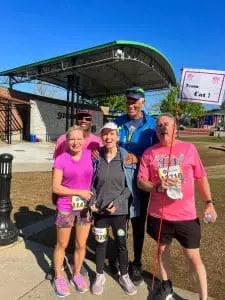
Most people slow down after a serious Health scare in their fifties. A heart-valve diagnosis, a partner’s life-altering illness, the weight of it all. The reasonable response is to rest, to recalibrate, to let the world shrink a little.
Anthony Copeland-Parker did the opposite.
When Anthony and his partner Catherine received back-to-back diagnoses, including a heart-valve replacement for him and Early-Onset Alzheimer’s for her, they sold their home, retired from their jobs, and became nomads. They ran marathons and half-marathons across the world for years. That story is the foundation of Running With Cat and the two memoirs Anthony has written about the experience.
But beyond the extraordinary personal details, there is something genuinely useful here for anyone who loves running and is navigating a health challenge in midlife. What does it actually take to keep going?
Running in your fifties is not the same as running in your thirties, and pretending otherwise sets you up for disappointment. Recovery takes longer. Joints carry more history. Sleep, nutrition, and Stress management matter more than they ever did.
At the same time, something shifts in your relationship with the sport. Most people who are still running at fifty are running because they Love it, not because they are chasing a personal record or trying to impress anyone. That change in motivation tends to make training more consistent and more honest.
For Anthony, running became something deeper still. It was a way to stay present with Catherine, to give structure to days that could easily have collapsed under the weight of Grief and uncertainty. Every race they finished, they finished hand in hand.
If you have had a heart-valve replacement or any other cardiac procedure, getting back to endurance running requires patience and medical guidance. There is no shortcut here. But returning to running is a goal many people achieve after cardiac surgery, often with more intention and care than they brought to the sport before.
A few things matter more than anything else when you are rebuilding fitness after a heart procedure:
Anthony’s experience as an endurance athlete before his surgery gave him a foundation to build from. That history helped, but it did not eliminate the need to rebuild carefully.
Not every marathon is the same. Altitude, terrain, heat, and course design all affect how hard a race will be on your cardiovascular system. If you are returning to racing after a health event, course selection is a real training decision, not just a Travel preference.
Some things worth considering when picking a race:
Running the Great Wall of China or racing through Madagascar sounds romantic, and it is. It is also a logistical reality that requires honest preparation.
There is a version of this conversation that focuses entirely on the physical, but that misses half the picture. Running through a health challenge, whether it is your own diagnosis or a loved one’s, is as much a mental act as a physical one.
Anthony has written with honesty and vulnerability about the highs and lows of life as a nomad caregiver. The fast pace of foreign races eventually gave way to a slower rhythm as Catherine’s condition progressed. Adapting to that shift without losing the meaning behind it took something that no training plan can give you. It required a decision, made and remade every day, to stay present and find purpose in the pace you can actually run.
For caregivers especially, that lesson translates directly. You do not have to run a marathon in Antarctica to apply it. You just have to keep moving, at whatever speed makes sense today.
The goal is not to run the same race you ran at thirty-five. The goal is to stay in the race at all. That might mean walking a half-marathon in the Australian Outback weeks after breaking an ankle, as Catherine did. It might mean finishing every race hand in hand with someone you love, regardless of the clock.
Running With Cat is built around the idea that endurance is not just physical. It is the decision to keep going when the circumstances are genuinely hard, not inconveniently hard but life-alteringly hard.
If you are in your fifties and dealing with a health challenge, either personally or as a caregiver, the two memoirs from Running With Cat offer something rare. Not inspiration built on sanitized highlight reels, but an honest account of what it looks like to keep moving through something real.
‘Running All Over the World’ covers five-plus years of nomadic racing across destinations like Madagascar, Bhutan, and Antarctica. ‘One Footstep at a Time’ follows the second five years, as the pace slowed and the work of Caregiving deepened. A portion of proceeds from both books is donated to organizations that support Alzheimer’s patients and their caregivers.
If any part of this resonates, start with the books. They will meet you where you are.
The post Running Marathons in Your 50s With a Heart Condition first appeared on Running With Cat.