
Photo by Planet Volumes for Unsplash+
Time flies when you’re having a good time.
People have been remarking on time’s aerodynamic qualities for centuries, so there is reason to believe there must be some truth to it. There is also a persuasive case, backed by both anecdotal evidence and scientific experiments, that most older adults experience time passing more swiftly than when they were younger.
Or at least, that is their perception. Whether time is really moving faster is another matter. But then, there is even a debate among leading lights of the philosophical, neurological, and metaphysical realms as to whether time is real or merely a construction of the human mind. I’m not going anywhere near that one – it’s way above my pay grade. If you’re curious, read Stephen Hawking.
My interest is in learning why older adults perceive time accelerating as it whizzes past them. My research confirms that there are no simple explanations.
French philosopher Paul Janet speculated in 1877 that it was strictly a matter of lived experience. A year to a 10-year-old is 10% of their life, obviously of greater significance than a year to a 70-year-old.
Nearly 150 years later, scientists think there’s a bit more to it than that.
Unlike sight, smell, hearing, or taste, we of the human persuasion have no sensory organ dedicated exclusively to registering the passage of time. Neuroscientists believe the timekeeping function is distributed among different areas of our brains. For intervals of milliseconds to seconds – the fast, precise actions such as speech, music, or quick movements – the cerebellum and sensory cortices act as the brain’s short-range stopwatch. Intervals from seconds to minutes – the middle range when we stay focused for short durations and make decisions – are managed in the prefrontal cortex and basal ganglia. For intervals of hours, days, or years, the hippocampus and precuneus store and recall events, allowing us to remember and reflect.
Scientists confirm that our experience of time is totally subjective, shaped by what we’re doing and how we’re feeling. “Some of the brain areas involved in the regulation of emotional and physiological arousal are also involved in the processing of time,” notes Ruth Ogden, Professor of the Psychology of Time at Liverpool John Moores University. “When we experience fear, joy, Anxiety, or sadness, emotional processing and time processing interact.” The result is the perception of time speeding up or slowing down.
Neuroscientists have offered several hypotheses to explain why we can recall childhood experiences vividly while decades of adulthood pass us by with little to write home about.
Let’s start with what scientists call “the oddball effect.” Basically, our brains are selective about what gets recorded into memory. They encode new experiences – the unusual, or oddball – but not familiar, routine ones. “As children we have so many new experiences, and so process a massive amount of perceptual information,” writes psychologist Steve Taylor. By adulthood, we have fewer new experiences and “we grow progressively de-sensitized to our surroundings,” so we absorb less information. The more information we process, the more time seems to slow, and the reverse is true. So, we tend to remember childhood experiences in vivid detail, while routine and unexceptional years seem to go by in a flash. Our brains do not process memories as verbatim recordings, in other words, but more like highlight reels.
Then there is the Holiday Paradox, coined by psychology writer Claudia Hammond. She posits that, yes, time flies when you’re having fun, such as when you’re on an enjoyable vacation, yet in retrospect the experience seems to last longer than it actually did. This illustrates again that our perception of time is totally subjective, and that our own perception differs between when we are in the moment and when we look back retrospectively.
And let’s not forget fear. In the moment of a near-death experience, such as an automobile collision or a fall from a great height, we may perceive time slowing or even freezing.
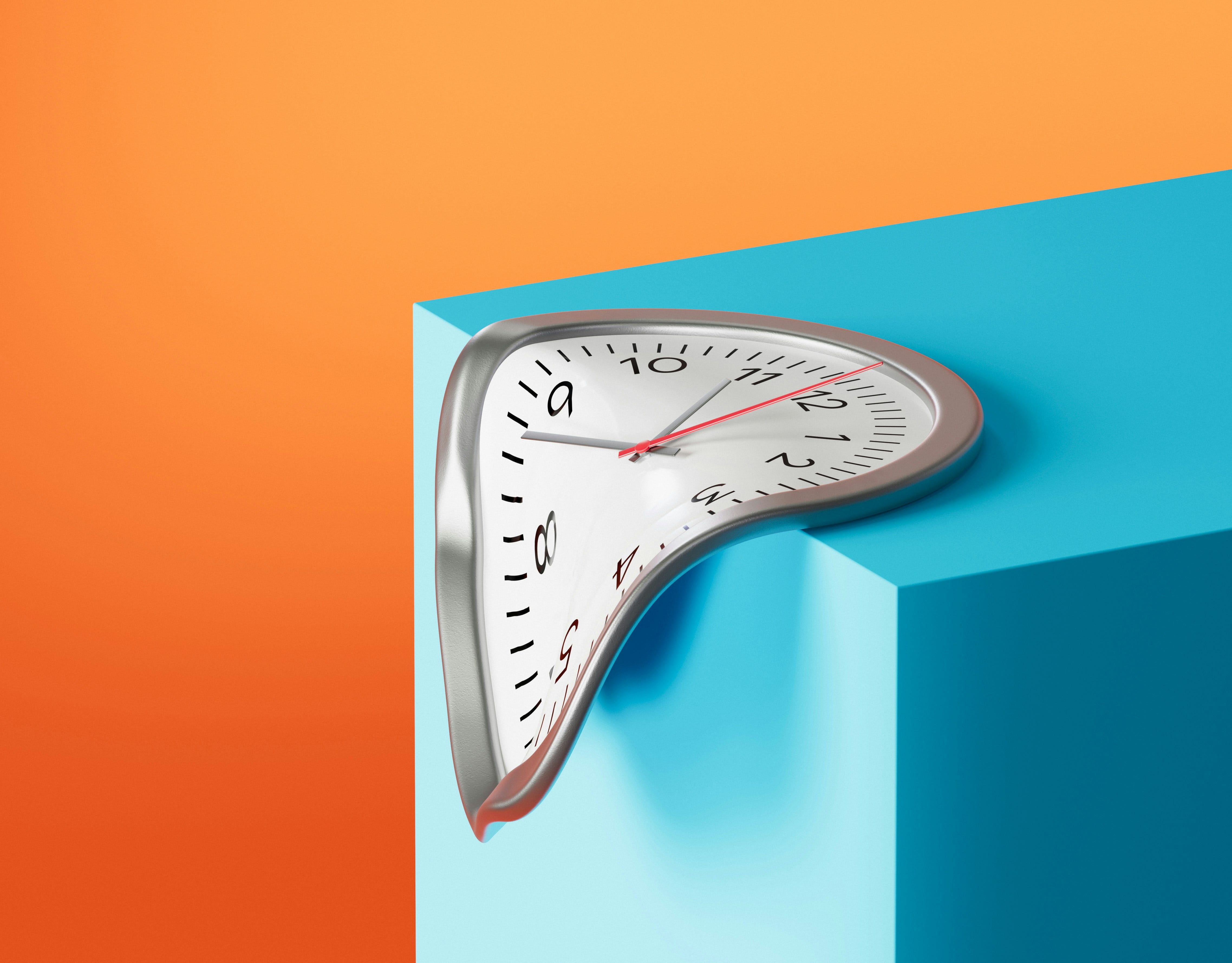
What these gleanings from science imply is that we actually have the power to alter our perception – to warp time, if you will. And it doesn’t require having more near-death episodes. One way is by making the effort to experience the world through child-like eyes, noticing details we routinely overlook and registering more everyday occurrences as new discoveries.
Another way to view that is to try living more mindfully – aware of the beauty and novelty of what is around you. Experiencing “awe” in its classic sense (as opposed to labeling everything as “awesome”) also tends to lengthen time. A Meditation practice, which seeks to quiet the mind’s routine chatter in favor of conscious awareness, can have a similar effect.
So, we can actually slow down our perception of time by constantly seeking out the new and different in daily experience. Although it is common to experience time speeding up in our latter years, it is not inevitable.