

Picture this: You’re driving down a busy highway when suddenly traffic starts backing up ahead. What do you do? You observe the situation, orient yourself to understand what’s happening, decide on the best lane to switch to, and then act by making your move. Congratulations – you just used the OODA Loop without even knowing it.
This same mental process that helps us navigate everyday challenges is also the secret weapon that separates great leaders from the rest. Developed by U.S. Air Force Colonel John Boyd, the OODA Loop has become one of the most powerful decision-making frameworks in business, military strategy, and leadership development.
John Boyd wasn’t your typical military strategist. Known as “Forty-Second Boyd” for his standing bet that he could defeat any pilot in air-to-air combat in under 40 seconds, Boyd was a maverick who thought differently about warfare and strategy. After his flying days, he became a military theorist who revolutionized how we think about conflict, competition, and decision-making.
Boyd developed the OODA Loop in the 1950s and 60s while studying aerial combat, but its applications extend far beyond the cockpit. The framework explains why some people and organizations consistently outmaneuver their competition while others get left behind.
OODA stands for Observe, Orient, Decide, Act – four stages that form a continuous cycle. Think of it like a washing machine that never stops spinning, constantly processing information and generating action.
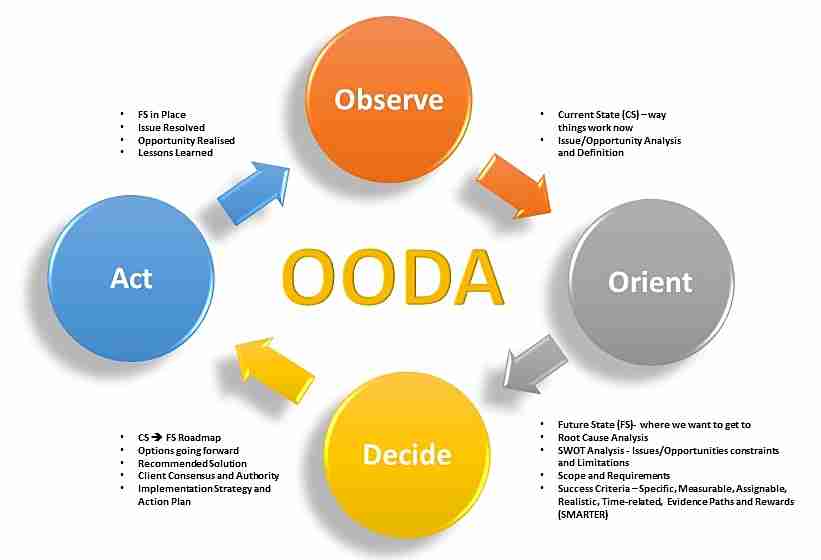
The first step is observation – gathering raw information about what’s happening around you. In aerial combat, this might mean scanning for enemy aircraft. In business, it could be monitoring market trends, customer feedback, or team performance.
The key here is to cast a wide net. Great leaders don’t just look at the obvious stuff; they pay attention to weak signals and subtle changes that others might miss. It’s like being a detective who notices not just what’s there, but what’s missing or different from before.
This is where the magic happens, and Boyd considered it the most critical phase. Orientation is about processing all that raw information and turning it into understanding. It’s where your experience, culture, knowledge, and intuition come together to create meaning from the mess.
Think of orientation like being a translator. You take all the facts you’ve observed and translate them into a story that makes sense. This story then becomes the foundation for everything that follows.
Boyd understood that we all have mental filters – our background, beliefs, and biases – that shape how we interpret information. Smart leaders recognize these filters and actively work to challenge their assumptions. They ask themselves: “What am I not seeing? What story am I telling myself that might be wrong?”
Once you understand the situation, you need to decide what to do about it. This isn’t about making perfect decisions – it’s about making good decisions quickly. In a rapidly changing environment, a decent decision made fast often beats a perfect decision made too late.
The decision phase is where leaders earn their stripes. It’s one thing to understand a situation; it’s another to commit to a course of action when the stakes are high and the outcome is uncertain.
The final phase is action – actually implementing your decision. But here’s the crucial part: action isn’t the end of the loop; it’s the beginning of the next cycle. Every action creates new information that needs to be observed, which starts the whole process over again.
This is why Boyd called it a loop rather than a linear process. It’s a continuous cycle of learning and adapting that never really ends.
Boyd’s key insight was that whoever can cycle through the OODA Loop faster gains a decisive advantage. In aerial combat, the pilot who could observe, orient, decide, and act more quickly than their opponent would win. The same principle applies in business and leadership.
When you can process information and make decisions faster than your competition, you don’t just respond to change – you create it. You force others to react to your moves instead of the other way around. It’s like being the person who sets the pace in a dance rather than the one trying to keep up.
But speed isn’t just about moving fast; it’s about moving smart. The goal is to compress the time it takes to cycle through the loop while maintaining the quality of your decisions.
Let’s look at how this plays out in real leadership scenarios:
Crisis Management: When a crisis hits, leaders who use the OODA Loop don’t panic. They quickly observe what’s happening, orient themselves to understand the implications, decide on immediate actions, and act decisively. Then they immediately start the loop again, observing how their actions are playing out and adjusting accordingly.
Innovation and Change: Companies that consistently out-innovate their competitors often do so by cycling through the OODA Loop faster. They observe market trends and customer needs, orient themselves to understand the opportunities, decide on new products or services, and act to bring them to market. While competitors are still figuring out what’s happening, these companies are already three steps ahead.
Team Leadership: Effective team leaders use the OODA Loop constantly. They observe team dynamics and performance, orient themselves to understand what their team needs, decide on Coaching approaches or resource allocation, and act to support their team’s success. They’re constantly adjusting their leadership style based on what they’re seeing.
Even with the best intentions, leaders can fall into OODA Loop traps:
Analysis Paralysis: Some leaders get stuck in the observe and orient phases, gathering endless information but never moving to decision and action. They become like a person who studies the menu for so long that the restaurant closes before they order.
Skipping Orientation: Others rush from observation straight to decision, skipping the crucial orientation phase. They see something happening and immediately react without taking time to understand what it really means. This leads to solutions that miss the mark.
One-and-Done Thinking: Some leaders treat the OODA Loop like a checklist – observe, check; orient, check; decide, check; act, check; done. They forget that it’s a continuous cycle and fail to observe how their actions are playing out.
To become more effective at using the OODA Loop, focus on these key areas:
Develop Better Observation Skills: Train yourself to notice more. Ask team members what they’re seeing. Create systems that help you gather information from multiple sources. The more comprehensive your observation, the better your decisions will be.
Challenge Your Assumptions: In the orientation phase, actively question your interpretations. Seek out different perspectives. Ask yourself what story you might be telling yourself and whether there are other ways to interpret the same information.
Practice Decisive Decision-Making: Work on making decisions with incomplete information. Perfect information is a luxury leaders rarely have. Get comfortable with making the best decision you can with what you know right now.
Embrace Continuous Learning: Remember that action isn’t the end – it’s the beginning of the next cycle. Pay attention to the results of your actions and use that feedback to improve your next trip through the loop.
In today’s fast-paced business environment, the ability to cycle through the OODA Loop faster than your competition isn’t just an advantage – it’s often the difference between thriving and merely surviving. Organizations that master this framework can adapt to change more quickly, innovate more effectively, and lead rather than follow.
The beauty of the OODA Loop is its simplicity. It’s not a complex framework that requires extensive training or expensive consultants. It’s a way of thinking that any leader can adopt and improve upon over time.
The OODA Loop isn’t just something to read about – it’s something to practice. Start by paying attention to your own decision-making process. Notice when you’re observing, when you’re making sense of information, when you’re deciding, and when you’re acting. Look for places where you can speed up the cycle or improve the quality of each phase.
Remember, like John Boyd’s aerial combat skills, mastering the OODA Loop takes practice. But once you develop this capability, you’ll find yourself making better decisions faster, adapting to change more effectively, and leading with the kind of agility that sets great leaders apart from the rest.
The question isn’t whether change will come to your organization – it’s whether you’ll be ready to cycle through your OODA Loop fast enough to stay ahead of it.
The post The OODA Loop: A Fighter Pilot’s Secret to Lightning-Fast Leadership appeared first on Business Advisor and Executive Coach | Doug Thorpe.