
In this insightful episode of Meet the Expert with Elliot Kallen, Elliot welcomes Mike Reed, Senior VP at Franklin Templeton and a leading voice in digital assets and blockchain Innovation. Together, they dive into what Crypto really is, how blockchain Technology is transforming traditional Finance, and why companies like Franklin Templeton and BlackRock are going all-in. Whether you’re a cautious investor or a tech-savvy early adopter, this episode helps bridge the gap between curiosity and smart allocation.

Mike Reed is the Senior Vice President of Partnership Development in Digital Assets at Franklin Templeton, a $1.6 trillion global investment manager. With a background in fixed income and now a driving force behind Franklin’s blockchain innovation, Mike is helping position Legacy finance firms at the cutting edge of crypto and decentralized technology.
What Are Digital Assets, Really?
Mike Reed explains that digital assets are not simply internet currency. Unlike a photo you can copy endlessly, digital assets on the blockchain are uniquely identified and traceable—more like rare baseball cards than JPEGs. Tokens such as Bitcoin and Ethereum have distinct use cases, from programmable smart contracts to transactional gas fees.
Bitcoin’s Role in a Diversified Portfolio
While volatile, Bitcoin’s historical returns have shown strong risk-adjusted performance. Reed explains that even a small allocation to Bitcoin can shift a portfolio’s efficiency frontier upward, enhancing overall returns. Yet due to its volatility, its inclusion should align with an investor’s age, risk profile, and financial goals.
Why Franklin Templeton and BlackRock Are in Crypto
Despite being known for conservative investment strategies, Franklin Templeton entered blockchain early, driven by former COO and current CEO Jenny Johnson’s understanding of distributed ledger efficiencies. Franklin has since built its own blockchain infrastructure, including on-chain mutual funds and multi-coin portfolios. Unlike many firms, Franklin builds and operates blockchain technology in-house.
The Rise of ETFs and ‘Easy’ Access to Crypto
Franklin Templeton has created low-cost, SEC-compliant exchange-traded products (ETPs), such as:
These tools are ideal for Retail investors and advisors seeking simplified crypto exposure.
How Regulation Will Shape the Market
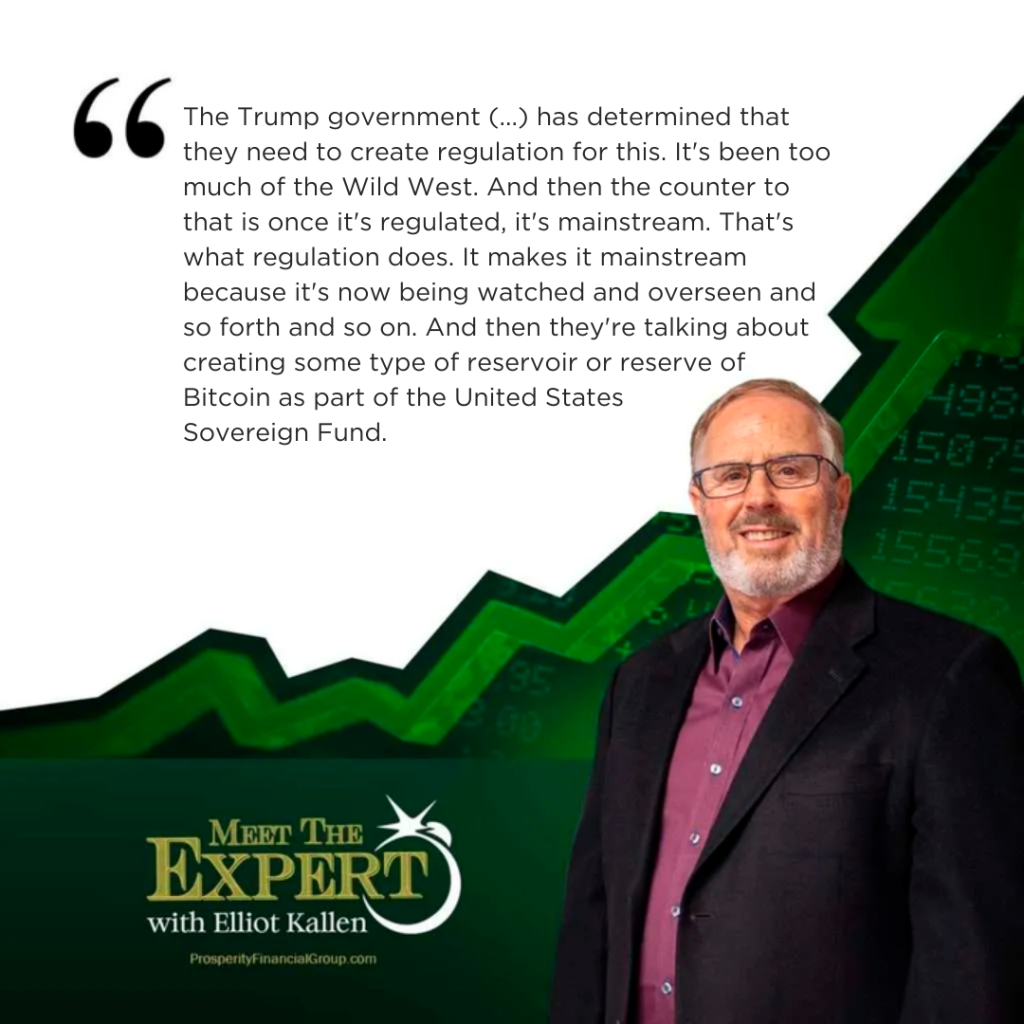
Reed underscores the importance of regulation in legitimizing digital assets. A more crypto-friendly U.S. regime may reverse the trend of offshore development. As SEC rules evolve—especially around custody—access, Security, and adoption will grow. Central Bank Digital Currencies (CBDCs) may also emerge but are unlikely to crowd out decentralized platforms like Bitcoin or Ethereum.
Elliot Kallen raises a key investor concern: will a U.S. crypto dollar make Bitcoin obsolete? Mike Reed’s answer: probably not. The strength of crypto lies in decentralization and innovation—not just currency. Technologies built on Ethereum and Solana are redefining industries, including telecom, through real-world applications like Helium’s decentralized 5G network.
For listeners seeking exposure, Mike advises working with a financial advisor and starting small. Fractional exposure through regulated ETFs offers a practical, manageable entry point without overcommitting capital.
Want to understand how digital assets fit into your financial plan? Let Prosperity Financial Group help you navigate crypto and blockchain’s role in modern portfolios.
Visit ProsperityFinancialGroup.com
Contact: [email protected]
Phone: 925-314-8503
Explore over 120 expert episodes and discover how cutting-edge Investing meets smart strategy.
Elliot Kallen: Good morning, and good afternoon, everyone. I’m Elliot Kallen. Welcome to another exciting episode of Meet the Expert with Elliot Callan. Today, we are talking about a hot topic, crypto, blockchain. What’s going on? We’ve got the Senior VP of Partnership Development of Digital Assets here from Franklin Templeton. It’s a $1.6 trillion entity here in Northern California. Just amazing what we have. Mike, welcome to the show.
Mike Reed: Thanks for having me. I appreciate it.
Elliot Kallen: That’s great. So we’re going to talk about digital today. So if you Love digital and everything about it, you want to learn more about it. And what the heck is blockchain? Because I can’t find it anywhere. And I feel like I should be buying blockchain at Home Depot because it’s a shame, you know, things like that. And why is it transparent and not transparent? I’m so confused on this. That’s what we’re going to talk about today and how Money is being made on that. You might call it programmable money. That’s another term for what we’re going to talk about today. We’re going to spend some time on that. And the reason why that’s a hot topic is because we have an administration today, the Donald Trump administration, and this isn’t about whether you love him or hate him, but who is apparently so far friendly to crypto and probably open to regulating it in a way we’ve never seen. And we’re going to talk about that regulation. And the more the government regulates it, the more it becomes legitimate. So that’s what we’re going to talk about. If you want to reach me, it’s 925-314-8503. Go ahead and give us a call. If you want to send us an email, it’s Elliot, E-L-L-I-O-T, at prosperityfinancialgroup.com, and a website with about 120 of these on the website, because it’s the top 2% of all financial podcasts in the world right now, is meettheexpert at prosperityfinancialgroup.com. So it’s www.prosperityfinancialgroup.com. Let’s get going with Mike. Let’s talk crypto. Let’s talk currency. First, crypto is not really a currency, is it? It’s the term currency, but it’s not currency. I hear that. What is it exactly?
Mike Reed: Yeah, I mean, you can tell from my shirt, we prefer the term digital asset. And really, they’re these unique assets with unique identifiers that can move all around at super, super fast speeds. So think about it like if I were to take a picture on my phone and send you a copy of that picture, and then you sent that picture to a few of your friends, and they send it to a few of their friends, all of a sudden, all of us have the same picture. Every single one is just as good as the original. But that’s not the same for other things. Like, for example, I used to collect baseball cards when I was a kid. And I was obsessed with the T206, the Honus Wagner card, which is like the most expensive baseball card on the planet. You can buy that baseball card for millions of dollars, or you can buy a replica of it for, a few bucks on eBay. And the replica, you can tear it up or crumple it or touch it with your hands or whatever. But it’s not the original. And I think when we think about digital assets, we think about assets with unique identifiers that are the original thing.
Elliot Kallen: Okay. So crypto is, in essence, a bartering system. Like everything is, it’s a bartering system out there. It’s a form of, I trade X crypto, X coins, digital coins for a product or a service. So it’s a bartering, works like money. Correct?
Mike Reed: Well, sort of. Some of them do, but some of them don’t. So when you think of Ethereum, for example, when I want to record a transaction on the Ethereum blockchain, I pay for that in ETH, which is the native token of that chain. So that starts to feel a little bit different, not so much like a bartering tool, that feels more like a payment or almost like they call it gas, actually gas fees, those fees that you get charged to record a transaction on those blockchains. And the blockchains have their own native tokens. In the case of Solana, it’s Sol. In the case of all of these blockchains, Stellar has Lumens that people use. All these blockchains have tokens that are native to them. And when you record a transaction, you pay for that service in the native token. And then there’s other assets that are totally different, right? There’s meme coins out there. There’s stable coins, which are assets where a stable coin provider takes your money, gives you back an asset that hopefully holds a $1 par value. And you can use that to spend in the digital asset ecosystem. So stable coin is completely different from ETH, for example, but they’re both digital assets or tokenized assets.
Elliot Kallen: Okay, well, let’s talk about the most popular one out there and one that everybody knows and everybody’s asking about all the time. And that’s, of course, Bitcoin. So let’s talk about that. So when I started looking at Bitcoin, and by the way, I’m not a raving fan of either Bitcoin or Ethereum, although I think Ethereum is a really interesting play because it’s much more of a platform versus a product. So I think that’s an interesting thing, and we can talk more about that. But the Bitcoin, when I started looking at it, it was about $55,000. Then it went up to $69,000. Then it dropped to $17,000 per coin. And now it’s back hovering around between $90,000 and $101,000, maybe $82,000 yesterday. I mean, the movement of this is tremendous. I had the people from Grayscale in my office not too long ago, who are one of the biggest players in Bitcoin in the world. And they said, look, we’re really convinced that the value of Bitcoin is going to go to $250,000. We’re just not convinced that it’s not going to go to $30,000 before it does that $250,000. And if it does that, that’s a 66% correction before it goes up eightfold. And so that’s a lot of volatility. And that’s why it’s hard for me to push that into the average consumer’s pocket, because this is toy money, play money that you can make a lot of money with. But if you’re risking your Retirement savings on it, you could blow up. So what do you think? Volatility, use, Longevity? Is Bitcoin around to stay, or does it get replaced with the next cryptocurrency?
Mike Reed: Boy, this is a massive can of worms. And I’m not sure we have enough hours left in the day to totally address all of that. So I first learned about Bitcoin because the person who leads our digital asset effort at Franklin Templeton, Roger Basin, he came in one day and he said, my son just got paid in an asset called Bitcoin for playing Call of Duty on YouTube. And he was like, does anyone know what this thing is? And this was maybe 15 years ago. And so we started learning more about it and researching it. And it was really interesting. And then 2014 hit, we started learning about Ethereum programmable money, like you said, and then kind of off to the races from there. When we look at Bitcoin today and think about where it could fit in an investor’s portfolio, I mean, the market cap of all stocks and bonds, like basically all investable assets in the United States, like all things that you would want to put into fund vehicles and stuff like that, it’s somewhere, it’s a little bit over $100 trillion. I think it’s $108 trillion approximately as the end of December. And the market cap of Bitcoin is somewhere today around $1.7 trillion. That would indicate to you that that’s a pretty important asset that you might want to think about including in your portfolio and not having an allocation is an active decision as well. The issue with it is exactly what you pointed out is volatility. And I came from a mortgage background. I worked in high quality fixed income before I did crypto. And we were obsessed with the idea of risk adjusted returns in those assets in mortgages because the volatility of mortgages is so low that the returns don’t have to be that high to give you really superior Sharpe ratios or risk adjusted returns. So it was really the denominator that was driving the risk adjusted returns in mortgages. In Bitcoin, it’s the opposite. It’s the numerator. It’s the returns that are driving that. So your volatility is very high, like you pointed out, but the returns have also been extremely high historically. So the risk adjusted returns that you’ve received from these assets historically has actually been very, very good. And so we built these scenarios, which I can share with you later that talk about what different allocations to Bitcoin in a portfolio would look like and the impact they would have on overall risk returns, like a risk return, you know, from a risk return standpoint. And if you look at just like a Markowitz efficiency frontier, if you add just a sliver of Bitcoin to your overall portfolio, your whole efficiency frontier shifts up and to the right, but much more up than it does to the right. So you don’t have to add a massive amount of this asset for really, really strong, positive impact on overall portfolio performance and risk metrics.
Elliot Kallen: So this is what he just said in English. We build portfolios for a living. That’s great. We built, it’s funny, I laugh about this, Mike, because I know you really know what you’re doing. And I try to, when I talk to speakers all the time, I try to remind them that we’ve got people that listen to it, listen to this broadcast. They think that Dow, the Dow is a plastics company that makes saran wrap. And the NASDAQ is a NASCAR track in Charlotte. So we try to make it so this is in English here, but really, we build portfolios, we’re a 500 plus million dollar entity, prosperity financial group, another company here, prosperity wealth management, about the same. That’s a billion dollars coming out of the San Ramon office in California. And we build portfolios and those portfolios go from income based on up the scale of risk to aggressive Growth and growth. And I think that especially growth deserves some exposure to these. And that’s why I own it in my own portfolio. But yeah, I have, there’s a big warning up there that you have to do that, but you’re right. It could be parts of everything.
Mike Reed: I think it’s also like, where are you in your investment life cycle? I have a friend who has, he’s in his twenties, he’s a hundred percent of his life savings in crypto. So he can stomach the round trip volatility because he doesn’t have mortgages to pay or 529 plans to fund or anything like that. But me, I have three kids who all are hoping to go to college. I own a house. And so we have steady payments that need to be made. So we can’t accept those. The round trip vol that you talked about, the folks at Grayscale were predicting. I can’t stomach that for my overall net worth. I need to have more stable cash flows. So I have parts of my portfolio that are dedicated to those more stability types of ideas and then parts where I get a little bit more aggressive. And for me, when I look at the whole digital asset marketplace, I get really excited about the technology play. You’re investing in brand new technology platforms that are developing really, really cool things that are only possible because of power of blockchain. And that type of stuff gets me really excited from an investment standpoint to be involved in something like that.
Elliot Kallen: Good. I do want to talk about blockchain and technology in a moment, if that’s okay with you. So we’re talking with Mike Reed. He’s a senior VP over at Franklin Templeton. That’s a $1.6 trillion entity from 1948. They were founded. We’ll talk about Franklin in one moment too. It’s a behemoth out there. It’s a monster company. Call it a blue chip investment company. They’ve been around a really long time. And they have obviously sunk massive amounts of money into this developmental digital asset world that Mike is part of over there at Franklin. And I want to ask you, why would Franklin do this? Because like I said, they’re a blue chip company. They don’t need this. And not only did they do it, but BlackRock, which is just a behemoth, but not necessarily a blue chip. As I look at them, they’re just put massive amounts of money into the whole crypto world. And they’re trading their stuff on Coinbase, I believe. I think you’re all over the place. You’re not on one particular place. Where are you guys compared with BlackRock? Explain to people what I just said, what BlackRock is out there and you’re out there, what you do that’s similar and what you do that’s different.
Mike Reed: Sure. Maybe I’ll go a little bit into our origin story into this space. I mentioned earlier about how I first started learning about all of it. But in the mid to late 20s, Jenny Johnson, who’s now our CEO, our present CEO, Jenny ran operations for the firm. And before these were called blockchains, they were called distributed ledgers. And that idea of ledgers really resonates with people. It should resonate with you if you’re in finance, because we have ledgers all over the place. Think about a mutual fund. You have a ledger of the holdings of the fund, a ledger of the holders of the fund and all the transactions they make. There’s just ledgers everywhere. And so the idea of gaining ledger efficiency at our firm is something that Jenny was really interested in because she was involved in that the operations piece of it. I often tell people our secret sauce of why we’ve been able to be so successful in space is because of Jenny’s support. And I had someone who works at another large asset manager say to me, we have everyone on board except for our chief risk officer and our CEO. How did you do it? And I said, well, Jenny was running ops and she understood it all ledgers right away. So we were thinking about ways to use ledgers in a more efficient way in our overall business. And we thought it would be really fun and cool to put a public security on blockchain rails. And we started with a money fund because money funds have long been involved in the transactional Economy. Some money funds have check writing and debit card capabilities on top of them. So we thought if we did a money fund, we’d be able to have a lot of ledger entries into these distributed ledgers. And we so we looked around at all the blockchains that were available, we chose the stellar blockchain is the first one we were going to develop on. We hired a team of developers, we built a digital wallet infrastructure built an on chain transfer agents, and then began authentically minting a product on blockchain rails. In the beginning, no one cared because yields were at zero. And so it wasn’t really a big deal. But what happened was, as rates started to creep up, and then Silicon Valley Bank failed, there were a lot of blockchain native enterprises that kept their corporate treasuries at Silicon Valley Bank. And they wanted to park it have a place to park that cash, but they didn’t want to do it another small regional bank, they want to do it at an investment house like ours. Since we were debbing in the space, they were like, we know what you’re doing, can we get in, and we started getting a lot of money in that way, kind of through reverse inquiry. But what came out of that was a couple things. First of all, I mentioned efficiencies of ledgers, the cost of running your transfer agent function, which is what we primarily use blockchain for using that if we’re running that on chain, the costs are dramatically lower than using traditional transfer agent. I think stellar charges something like six hundredths of a penny or something like that per transaction to record so that your transfer agent function, the cost of it, like I said, goes down a lot. So that was one thing we learned was that there’s real cost savings there, there’s real money to be saved by doing this. But the second thing that we learned is that there’s a whole bunch of blockchains out there. And they all have different communities, they all have different cost structures. There’s different feedback loops, there’s different minting schedules of the underlying tokens themselves. And then we learned that on these blockchains, there are all of these different new enterprises starting to sprout up businesses that are being built on top of that code that are novel. And like I said, totally unique in the way they’re built because of the underlying technology. And so we thought, OK, if we look at these businesses and there’s real cash flows associated with them, can we come up with a price and vol target for all of these assets and then start assembling portfolios of them? And so then we built an investment management unit. We built our own kind of portfolio risk management and trading system and began running portfolios with multiple coins in them. And then we also began a venture effort, a VC effort in the space because we know that a lot of the early the value capture for new ideas happens in those early days. And then we kept building things out. We have a node operations group as well that operates, I believe we operate 30 nodes across 11 blockchains. So we’re deep in the space and we build on blockchain and we invest in blockchain technology. I just sorry, let me take I just realize as I’m rambling on, I’m like not talking English anymore. I’m like talking crypto. So to take it, take another step back. But when you open up a web browser, before you type in your WWW, you type in HTTP. And what HTTP is, is it stands for is the hypertext transfer protocol. It’s the protocol or the coding rules on which Google was built, Netflix was built, Facebook was built, all these massive enterprises were built using HTTP as their set of coding rules in the same way. So that’s HTTP is a protocol in the same way. Ethereum is a protocol. Solana is a protocol. Bitcoin is a protocol. And on top of these protocols, there’s really cool businesses being built, the likes of which we’ve never seen before. And it’s really, really quite fun to be in that space. You asked about our friends over at BlackRock and how we do things a little bit differently. They have some products that overlap with us, and some that don’t. And they’re doing really good work over there. I contend that there’s nobody quite like us in this space, in terms of building authentically on chain and investing directly in the blockchains themselves the way that we do.
Elliot Kallen: Okay, but you’re not buying any, you’re not going to buy any part of the Panama Canal, are you? No plans right now. None that I know of. Anyway, so we’re talking with Mike Reed, senior VP, head of at Franklin Templeton, partnership developer of crypto and digital assets. Do you need to reach me? I’m 925-314-8503. If you want to send an email to me, it’s Elliot, E-L-L-I-O-T at prosperityfinancialgroup.com. And the website is prosperityfinancialgroup.com. We’ve got about another 120 of these podcasts out there, and they’re great. So let’s talk about regulation, Mike, because the Trump government, let’s call it the current administration, has determined that they need to create regulation for this. It’s been too much of the Wild West. And then the counter to that is, okay, once it’s regulated, it’s mainstream. That’s what regulation does. It makes it mainstream because it’s now being watched and overseen and so forth and so on. And then they’re talking about creating some type of reservoir or reserve of Bitcoin as part of the United States Sovereign Fund. And don’t let that scare people who are listening to that. Lots of countries in the world have sovereign funds. Sovereign just means it’s a country fund, Saudi Arabian Sovereign Fund, a French Sovereign Fund. There’ll be a U.S. Sovereign Fund, and that would invest in companies or invest in assets as well, whatever they decide to do. So what is going on? What has to happen for this to become more legitimate or mainstream or basically everybody’s portfolio at 3% to 5%?
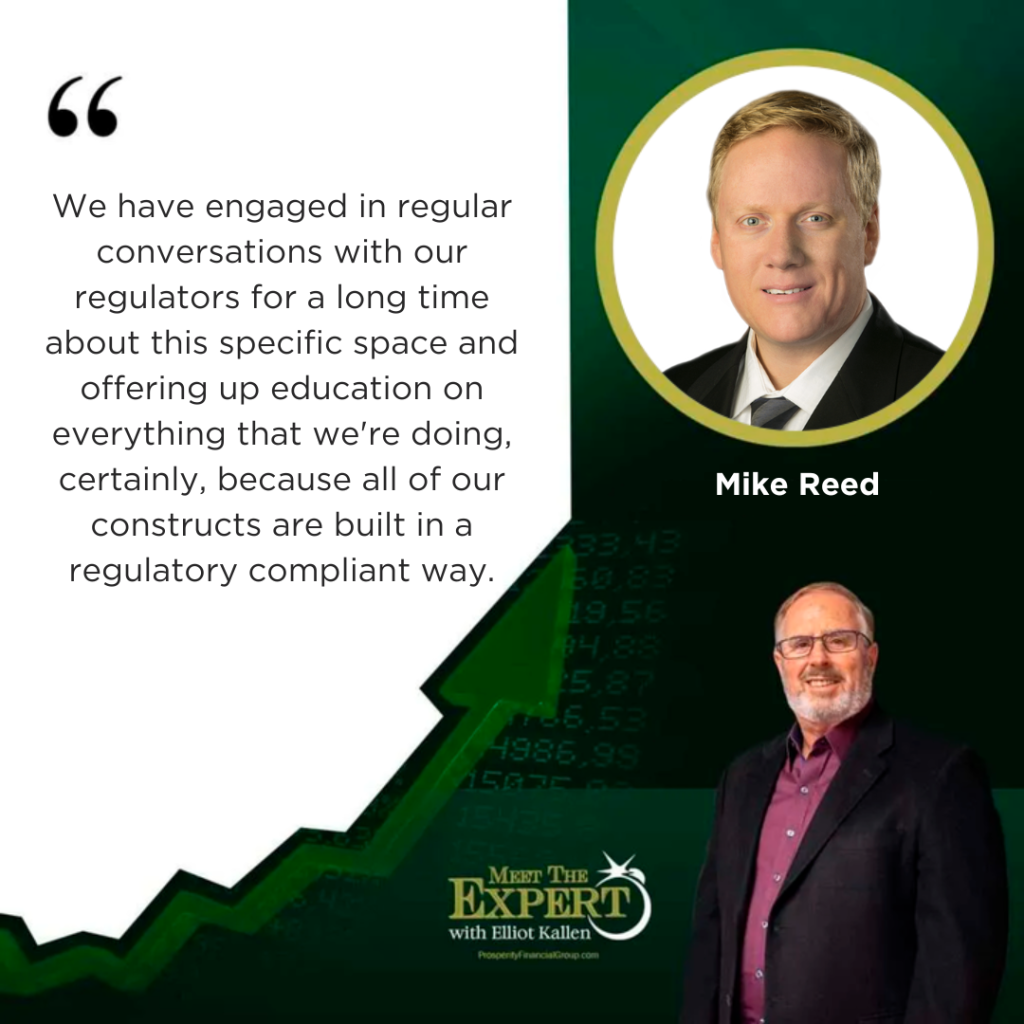
Mike Reed: Yeah, I think just to level set, our strategy with the regulators has always been to be more collaborative than combative. So we have engaged in regular conversations with our regulators for a long time about this specific space and offering up Education on everything that we’re doing, certainly, because all of our constructs are built in a regulatory compliant way. So we want to make sure the regulators understand exactly what it is that we’re doing. I think that it’s an apolitical statement to say that we have entered a more crypto-friendly regime. And I think that in the past, the SEC, for example, is designed to protect American shareholders. And so as they’ve thought about this asset class in this space and have taken time to be able to come up with a comprehensive set of rules around it, what’s happened is that a lot of the development in this space has actually moved offshore and moved to other markets where there’s certain other regulators who’ve been super fast to adopt new regulations. But it feels to us like right now we’re entering this kind of transformative time. You mentioned the crypto reserve. It’s not just Bitcoin. It’s also Ethereum, Solana, XRP, a couple other assets. There’s a lot of other things happening. And there’s things happening, I think, that are beneath the surface that people don’t really talk enough about. For example, there was this accounting bulletin that came out called Saab 121, which basically said that anybody who custody crypto had to one for one that asset in dollars on their balance sheet, which basically makes custody and crypto a really difficult business to make money in, makes it borderline non-economic and, like I said really hard to step into. Well, a lot of those rules are starting to change. And I think as the rules around custody change, I think that’s going to be a huge, huge change in the overall way that we think about this space in this market and in this country.
Elliot Kallen: So let me give you a disrupter here while we still have time. I think that at some point from what I hear, what I read. I’m a well-read guy, but I don’t have an insight track here. You probably have a much more insight track than I have. China wants the world to run around their currency and they want to have a crypto currency in China. The response from the United States will be probably to have a crypto dollar of some kind. And if we have a crypto dollar, doesn’t that, a crypto yen, oh yeah. And doesn’t that crowd the market out for everybody else? Just those two alone?
Mike Reed: Go through that a little bit more. So these are called, in our space, they call these CBDCs, Central Bank Digital Currencies, CBDC, Central Bank Digital Currencies. And the closest thing we’ve seen, which aren’t affiliated with the government, are stable coins, which I mentioned before, which are kind of like money funds a little bit, only they don’t pay yield. But it’s basically, like I said, you pledge dollars, traditional dollars, and then the stable coin provider takes those dollars, puts them in a pool, invests them, and then turns around and gives you an asset that hopefully holds that par value. But we haven’t seen a digital dollar come out of the U.S. as of yet. So explain to me maybe a little bit more about what you think.
Elliot Kallen: So I’m just wondering if the U.S. decides that we need to compete on the world market in crypto, let’s come up with our own currency, our own coin, we’ll call it the crypto dollar, and people can understand a crypto dollar because it’s a dollar. It’s got coins, it’s got addition, everybody who’s listening to this can understand the U.S. dollar, but now it’s crypto. Doesn’t that crowd the market out for products like Bitcoin?
Mike Reed: Um, maybe. I think the more likely scenario if the U.S. wants to become the center for blockchain technology and crypto development is that regulation is set up so that it’s a lot more easy for companies to come and develop here in the United States. And candidly, we’ve talked to some people who are operating entities in other countries who’ve told us they’ve already either executed on or are considering executing on business plans to move their nexus to the U.S. So I think probably the way that we see greater adoption and greater focus around that is through regulation here in the United States than through the development of a U.S. dollar currency, like a digital currency, but that’s my gut.
Elliot Kallen: Okay, so if somebody wants to invest, Mike, in this world of currency, they want to get started, or they’ve already got things going, and you’ve talked about real-world digital technology, how that’s changing in front of us. What are some good strategies here, good scenarios?
Mike Reed: Yeah so first of all and I’m not just saying this because this is your business I always think you should be partnering with a financial advisor for your goals. And I’ve been in investing my whole career, and I have a financial advisor as well, because there’s certain parts of the market I understand really well, and other parts I don’t get at all. So I think people should be partnering with financial advisors for that help. But, I think the, right now, what we’ve seen is a massive adoption of the ETPs, or ETFs that have come in. People call them ETFs, but they’re ETPs. So in our case, we run a Bitcoin product called EZBC, and the reason we named it that is because we want people to think of this as an easy way to allocate to Bitcoin. We also have a product called EZET, which is an Ethereum product. And then we just launched, a couple of weeks ago, a product called EZPZ, which is a product that invests in a basket of assets. So it adheres to an index, and what’s in that index is assets where there’s value accrual that have been approved by the regulators. So today, there are potential for value accruals. So today, it’s only Bitcoin and Ethereum, but as the market changes, that index can change, and then the portfolio of our EZPZ product can change as well. It’s kind of a set it and forget it product for crypto investing. And those products generally are pretty affordable ways from a fee standpoint to be able to get access to crypto beta.
Elliot Kallen: All right, can we end with a good digital story that gets everybody excited about the changes in the marketplace? Do you have one off the top of your head that you think people could relate to?
Mike Reed: Yeah, I’ll tell you. I think that something I’ve done in my own life is I use a company called Helium as my personal cell phone provider. And Helium, the way you subscribe to it is the same. And whatever I’m supposed to say here from a legal standpoint, this isn’t investment advice or whatever, but Helium, if you wanna become a Helium subscriber, you just log on their website and you become a subscriber. I think they cost about 20 bucks a month, maybe a little bit more for cell phone coverage. And that cell phone coverage is provided by the Helium network. And then if you’re in an area without Helium coverage, you flip over to, I think, T-Mobile. So the network coverage is actually very strong nationwide. That’s 20 bucks a month, unlimited talk, text, and data. Super competitive in that space of cell phone plans. So that’s me as a user, and I am a retail user of that product. But on the investment side of things, you can really access this idea in three ways. One way is you can actually buy a 5G wireless node and run it out of your home. So imagine instead of being a share of a telecom provider, you’re buying the 5G tower and operating it. That’s what this provider allows you to do. You can buy the 5G wireless node and run it out of your house. And then as people use it, you earn tokens as a reward for doing that work, which you can then trade in, sell for whatever the value of them is and stuff like that. So that’s one way you can access that investment opportunity. Another way is you can buy the Helium token itself, which is affiliated with the overall business. And then a third way is you could buy Solana, Sol, which is the blockchain on which Helium was built. And I think this idea of a distributed 5G wireless network is a really, really cool idea. And then as a practical user of the product, I found it to be excellent so far. That being said, my wife is like, she’s still like, give it some time before you move all of us in the Family over to Helium. But so far, my experience there has been pretty great.
Elliot Kallen: We’ve been talking with Mike Reed. You’ve been listening to Meet the Expert with Elliot Kallen. It’s all about blockchain, crypto, Ethereum, a couple symbols. We build models for people. We manage between both companies about a billion dollars. So if you’re listening to this and you want somebody to take a look at your portfolio, look at how digital assets can fit in and what we’re talking about, this is what we do for a living. We’d love to have a conversation with you. We talk to people like Mike who are super smart in super creative areas of the market all the time. He happens to work with Franklin Templeton, a $1.6 trillion, basically a 67-year-old company or so. And it’s just 70 or so, 77, whatever. It’s significant. It’s a blue chip company and they’ve been doing it for a while and their department, which he’s running now with senior VP, it’s just on cutting edge. So we’d love to talk to you about that. Mike, this has been great. I want to thank you for being part of this.
Mike Reed: Yeah, thank you for having me. I really appreciate it.
Elliot Kallen: And as Mike said, the best thing you can do is reach out to us at 925-314-8503 or Elliot, E-L-L-I-O-T at prosperityfinancialgroup.com. Get a feel for what we’re doing. Get to listen to some of these broadcasts and we’d love to invite you to become our client and learn about how these and other products, blockchain and crypto can fit in with your long-term goals. Mike, thanks again.
Mike Reed: Thank you.
Elliot Kallen: Have a great day, everybody. We’ll see you real soon.
The post Investing in Crypto: The Future of Bitcoin with Mike Reed appeared first on Prosperity Financial Group | San Ramon, CA.