“I give my dancers their lives in dance and they give me mine. I want to spread my passion for dance across the world.”
— Jen Blackwell
As CEO/ReImaginator for 360° Nation and Chief Encouragement Officer of 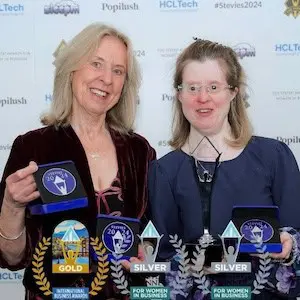 ouraffiliated pro bono social impact enterprise, GoodWorks 360° Foundation, I was delighted to have the opportunity to get better acquainted with Dr Jen Blackwell BEM and Sue Blackwell, co-founders of DanceSyndrome, a charity dedicated to transforming lives, creating change, and opportunities and joy for people with and without Down’s syndrome and other learning disabilities, using inclusive dance as a vehicle in a unique, ground-breaking way which doesn’t exist anywhere else.. Learn more as you enjoy my recent interview below.
We’d like to hear about your personal story BEFORE launching DanceSyndrome.
Sue: Jen was born with Down’s syndrome. Health professionals wrote her off at birth and we continued to be met with ‘You can’t’ throughout Jen’s childhood. My husband Malcolm and I always had the outlook of ‘What’s possible?’. Until we’ve explored all the options we can and learnt for ourselves, only then will we consider that we may need to find alternative paths.
As Jen grew up one thing became clear: she needed to dance. It’s who she is first and foremost. From dancing down the aisles in the supermarket or the DIY store, to dancing around the kitchen table, dancing putting the shopping away and her unusual habit of dragging up the stairs before bed, turning the music up, 5 minutes of dynamic dance making the floorboards bounce. 10 minutes later she was sound asleep. Dance is in every fiber of Jen’s being. She had to dance to be herself. She danced to tell us how she felt. Her speech improved through her ability to dance. She let out her frustrations through dance. Her language is dance. It’s her absolute passion. When the dance stops, it’s a sign to be concerned.
Jen left mainstream school with mainstream aspirations to be a dance leader and a dancer and a determination to spread her passion for dance worldwide. Together we searched the UK but we couldn’t find appropriate training to meet Jen’s needs. We came up empty handed.
Jen: I mainly enjoyed school. Most important, I went to dance classes. I also went to Xylosound (a music group where I played my flute). We had fun as a Family. I just wanted to dance. I just needed support in life to help me be a dance leader. A careers advisor told me I could do a drama course. I told him, ‘I want dance, not drama’. Aged 21 I told my Mum, ‘I have the right to a life of my choosing. My future lies in dance.’ We tried and tried to find training but no-one listened or believed in me.
Tell us about DanceSyndrome and the inspiration behind it.
Jen: After 10 years of searching and not finding the support I needed to be a dance leader, in my bedroom with my advocate Sarah K we came up with a plan to get together with  other people with and without learning disabilities to dance. It all started from there.
Sue: Jen was outside of the system, yet beholden to it in so many ways, trapping her and us in ways we could never have imagined. She’d become an adult and was ready for her next step, but the system couldn’t cope with her mainstream aspirations to be a dance leader. No one understood or was able to support the needs of a dancer who happened to have learning disabilities. With no gainful daytime activity, no dance training or dancers in her life, and in spite of a huge number of acquaintances, not one real friend, Jen was hurting badly.
That’s when we knew things had to change and we had to take responsibility for making change happen. Out of pure frustration we set up DanceSyndrome, putting a call out locally for other dancers with and without learning disabilities to join Jen in what we called Dancer Search Days to dance, smile and talk through dance together.
We were overwhelmed by the response, showing us there were many more people searching for support to do things they loved. After seeing the smiles on everyone’s faces and feeling the joy in the room in those first five sessions, we knew we had to take the next step.
What’s unique about your charity?
Jen: Everybody is welcome. It’s a dancing family. I’ve got so many friends now, friends who accept me for who I am. I had been to so many places where I didn’t feel welcomed or I couldn’t get the right support.
At DanceSyndrome everybody feels like they belong. We have the right support to be ourselves and to dance in ways and in places that many people didn’t think was possible.
We are all part of a dancing family. It’s very special. We show people what’s possible for people with learning disabilities by who we are and what we do.
Sue: Everything is co-created between people with learning disabilities and those without, at every level of the organization and in the dance. The foundations are based on the principle that everybody matters and has something to contribute.
All of our dance activity is delivered using a unique co-production model, with Dance Leaders with learning disabilities working in equal partnership with professional Dance Artists to create high quality, inclusive dance activities.
We’ve created a place that develops opportunities for people with and without learning disabilities to have the right support for them to pursue and develop their potential feeling valued and fulfilled in their work, opening up possibilities that still amaze us every day.
At DanceSyndrome we’re growing a community that listens, nurtures, encourages and responds to the individual needs of diverse groups with and without disabilities.
As Jen says: “With the right support at the right time, you can go further and further and further.” This goes for us as parents/carers and workers as well as those with learning disabilities. We all need appropriate support to get through the day. Finding opportunities with the right support enables each of us to feel fulfilled, expressing ourselves openly in our own language, thriving in our own life – whatever that means for each of us.
When did you launch and what’s been the biggest challenge?
Sue: We started in 2009 and became a charity in 2013 when it became obvious that the financial resources we needed for everyone to have the support they needed was hugely different from other organisations. I think that’s been our main challenge – people don’t realise that for one person with a learning disability to be an empowered dancer or dance leader they need a carer/supporter to facilitate the logistics, and who understands them inside out as well as a dance artist to work alongside.
But it’s also been a challenge to describe the incredible outcomes that have happened. Those 3 people are all impacted by co-creating and valuing each other as individuals. They each take that learning into different parts of their lives and everyone is richer from the experience of enabling people with learning disabilities to find their voice and be involved in something they are passionate about.
The foundations for each person in every family are so important and what we’ve learnt to be true is that when each individual is supported to contribute in their own language, be listened to, they light up and feel that they matter. The impact on the families of those who are engaged individuals with something to get out of bed for is enormous. “Seeing a family member with additional needs, happy and achieving impacts the whole family and eases worry” said a parent recently.
Jen: There are other people who organize things for the charity. I know that it’s not been easy to find the right people to be dance artists. Not everyone is like Donna, my lead support. When I went to her for ballet lessons she saw me as a dancer first. Our connection, friendship and support started through dance.
Any noteworthy surprises or ‘A-ha’ moments along the way?
Sue: So many! There is palpable excitement around winning awards, being invited as VIPs, embraced in public spaces by highly respected others, being in demand, sought out for TV and radio appearances, and appearing in national advertising for The National Lottery when Jen seemed to make an appearance almost every day in 2020! ‘there I am again’ she would say!
For me personally, in June 2010 I witnessed Jen co-leading her very first workshop during Learning Disability Awareness Week. Over the previous 4 weeks she had been given a work experience opportunity brokered by an insightful Community/Leisure Co-ordinator in the Adult Learning Disability Team of our local NHS Foundation Trust. In addition to our 5 hours prep behind the scenes, it was wonderful to watch Jen learning over those weeks with support afforded by the Arts Partnership ahead of her 15 minute delivery, and debriefing afterwards. The result was magical. Not only was Jen well prepared, she was focused, confident, was able to share information in a clear concise way, and encourage everyone to join in. Not only was Jen doing what she had told us for years that she wanted to do, but she was being a role model for many others offering them hope and belief that they too could follow their dreams. Even then, Jen was held up as a role model. Salaried staff appeared in order to witness her at work, doubters became believers. Now I understood my 29 year old daughter so much better. There could be no denying where Jen’s heart and where her future lay.
In the earliest days trialing our thinking/methodology internally and externally was a resounding success – connecting through dance with every person having equal validity, being heard in their language of choice. There was laughter, smiles, interactions, connections being made for people whose experience of life before was social exclusion.
The winning of numerous awards from 2015 beginning with Inspirational Woman at the Enterprise Vision Awards Jen Blackwell’s EVA acceptance speech (video below)to the latest cache – being nominated in 6 awarding bodies including the Stevies International Awards resulting in a haul of 10 awards in 2024 for both Jen, DanceSyndrome and Sue crossing the divides from music and culture, thought leading, charity, national and international.
Being in demand is a heady experience for Jen and others like Jen. It isn’t usual. But the more that she does, the more she enjoys it, and the more accomplished she becomes – no real surprises there, but very few people with learning disabilities are ever afforded such opportunities. On occasion I become concerned as to whether this is one challenge too far, but Jen loves it, she rises to every opportunity like a pro. Fundamentally the bigger the opportunity, the better she likes it!
‘Don’t expect much of her’ – an educationalist – Jen aged 7
Jen: Going to Buckingham Palace twice! And winning lots of awards.
But through DanceSyndrome I’ve got my friendships. I’ve met Becky, who’s my lifelong best friend. I asked Donna to get involved with DanceSydrome and we have a lovely time together.
Being able to perform at the Edinburgh Fringe three times has been amazing. But dancing at Blackpool Tower Ballroom with Donna last year was really cool.
Oh and dancing on the flight deck of HMS Prince of Wales was amazing! Then going into the officers mess. We were treated like royalty!
I can’t believe I’ve been honoured by the King and Salford University. King Charles gave me a British Empire Medal in 2023 for my services to disabled people and The University of Salford gave me an honorary degree in 2024 for my services to dance for all the work when I co-lead workshops for students.
What about the impact/outcomes of your charity so far?
Jen: DanceSyndrome has given me my life, it’s my everything. It’s my family. It’s given me my best friend.
Sue: Every minute of every day spent in the presence of DanceSyndrome is joyful. It’s like that big hug that envelopes your entire being. DanceSyndrome demonstrates equity. It is a family, a community where every person is a contributor to the whole and a recipient of Love and support. It is the society I choose to embrace. In the 21st century in the western world it is both unusual but replicable.
Hope is the foundation of opportunity. I’ve always been a glass half full person as without that mindset I’d have jumped off that proverbial short plank long ago.
Lives are transformed out of all recognition. People now have something positive to get up for in the morning, something that we all need. Jen and the other dancers all love the limelight
People with learning disabilities are no different to the rest of society, we all have something within ourselves, our nugget of gold, but people with learning disabilities need us to be tuned in, to be astute to their needs, to listen intelligently, to meet them where they are and walk by their side.
DanceSyndrome demonstrates that systemic change is possible. It is an illuminating journey of positivity for all involved. It is true social care.
What’s the next big thing/challenge for DanceSyndrome?
Sue: DanceSyndrome is growing fast. Demand far outstrips our ability to deliver but we’re working hard to resolve that! We’re passionate to spread the methodology and the impact further and wider, but to thrive we must find and influence people who can help create true sustainability. We need to become more commercially saavy.
We need to find better ways to help others understand the enormity of the value and the outcomes when you work in this way.
Jen aspires to see DanceSyndrome in every town in the UK and ultimately across the world affording opportunities to every person, in particular people like Jen to embrace dance in a way that works for them.
We’re challenged to unlock the world of professional dancing for some of our inspiring dancers.
This methodology cuts across boundaries. It allows businesses to become better versed with the people they employ – to uncover their hidden talents. It allows schools and educationalists to recognize there are numerous ways to embrace people, to liberate and empower them whether marginalized or not.
For those numerous organisations entrenched in systems which are broken DanceSyndrome offers an alternative way of working which is driven by the passion of the individual enabling them to become leaders in their own lives.
DanceSyndrome is creating role models where there were none before. Rather than be shy and retiring, and disregarded, DanceSyndrome Dance Leaders want to be seen, valued, embraced first and foremost as dancers. Their learning disability is just a part of their makeup, a part of their DNA, of what makes them unique.
Jen: My dream is to have a private jumbo jet so we can take dancing all around the world. We’ve already started by running workshops in Japan.
As a humanitarian, what’s non-negotiable for you?
Jen: Everybody matters and with the right support at the right time we can go further and further and further. If you come across a challenge, know that it’s possible to knock it down with the right support.
Sue: Every human being deserves to be seen. In our world, DanceSyndrome is a safe space built on a foundation of inclusion, it is underwritten by an ethos of equity, our leaders have learning disabilities making diversity a given. Thinking differently and acting differently creates different outcomes. Where true belonging exists people with learning disabilities are celebrated as catalysts for change.
With training in both leadership skills and dance vocabulary from the off for all dancers together, learning disabled and non-disabled all learn the art of communicating with people with diverse needs through the vehicle of dance.
How can our readers learn more about and support DanceSyndrome?
Every person can help in numerous ways. We can all highlight that you must never presume or assume what a person can do or will achieve in life. Everyone can offer help, expertise, or exposure.
Share with us your favorite quote related to all that you do.
Jen: My mantra is: “Dream, Believe, Achieve.”
“I do have Down’s syndrome but my disability doesn’t define me for who I am.”
“With the right support at the right time we can go further and further and further.”
Sue: Jen has been my most valuable teacher. Some of her quotes over the years include:
“I give my dancers their lives in dance and they give me mine.”
“I want to spread my passion for dance across the world.”
“The best thing of all is friendship. I didn’t have friends in my life before DanceSyndrome, and now I do.”
But if I’m to look elsewhere, I would say that when Terry Snowdon said, “If it needs doing just do it”, I felt affirmed in taking the steps to create change.
What’s one thing people would be surprised to learn about you?
Jen: I love to ski, play the flute and do Krav. I’ve just got my green belt! I love watching WWE wrestling and I enjoy watching Wigan Warriors rugby league and support Manchester City football club.
Sue: I am nomadic at heart, never staying in one place for long. Living on board Sukama for half of each year along with my trusty harp nurtures this need.
Originally Published on https://www.bizcatalyst360.com/author/dennisjpitocco/