


Michael Hyatt is a well-known leadership expert, former CEO of Thomas Nelson Publishers, and creator of the Full Focus Planner. He’s widely recognized for teaching high achievers how to set goals, avoid Burnout, and manage their lives with Clarity. His main premise is to design your year–or your year will design itself. At this point in his life, he’s created a lot of freedom. Hyatt’s yearly goal-setting method revolves around intentional, holistic planning that recognizes all domains of life—not just career.
James Clear is another influential leader and the author of Atomic Habits, one of the best-selling personal-development books of the past decade. If you haven’t read it or re-read it recently, now is a good time to do so. His work focuses on the psychology of habit formation and long-term achievement. His main premise is that you don’t rise to the level of your goals but you fall to the level of your systems. Clear believes that you must build systems that make goal achievement automatic and sustainable. I outline some of my simple systems in my book Power of After. They work!
I continue to be inspired by both of those leaders and believe strongly in the power of planning, especially as we face the year ahead. Every strategic plan begins with vision. The big picture answers the deeper questions such as: Where am I going? What kind of life do I want? Who am I becoming? What matters most this year? Use the free download-brainstorming worksheet that comes with this (podcast and article ) to make a note of your answers. This doesn’t have to be a difficult task, but you should put some time aside to think carefully about the year ahead. It will pay off! We focus here on four main steps to help you move ahead.
Before you set new short-term goals for the year, evaluate the year behind you. Reflection ensures you don’t repeat mistakes and helps you build on momentum that already exists.
Here are some good questions to ask:
Here are four takeaways from those questions: First, identify the main activities, people, and projects that energized you. These should point toward alignment with your purpose and strengths.
Second, identify what felt draining or misaligned. This is your warning light. Anything that consistently drains you may need adjustment, delegation, or elimination. This can include projects and people. There are those individuals who will drain our energy if we let them. They don’t need to be in our close circle of contacts, even if they are a colleague. We can keep them emotionally distanced.
Third, what did you learn? Growth often hides in challenges. Identify key lessons so they become strategic tools, not forgotten experiences. This involves adapting a healthy mindset with a lifelong learning focus.
Then lastly, what on this list deserves to continue? Carry forward what is working well—systems, rhythms, habits, relationships and commitments that support your next chapter. Taking the time to do this will be one of the best uses of your time for the coming year.
Quarterly planning is the bridge between big-picture direction and weekly execution. Instead of overloading January with unrealistic expectations, divide your year into four focused segments. Quarterly planning is a good place to determine short-term goals, which are the building blocks of long-term success. These steps are designed to be achieved in a relatively short timeframe. They should be immediate and actionable, providing a sense of focus and direction.
Here are some reasons why Quarterly Planning Works:
Here are some ideas for a Quarterly Breakdown. If this is new to you, a great way to get started is to identify a “theme” for each quarter. For our example here, the quarterly breakdown I have defined starts in January.
Q1: Foundation & Focus Theme: Ideal for establishing systems, routines, health goals, or beginning new projects. With this focus, create very small steps that are measurable. Tiny Habits by BJ Fogg is a great resource for implementing this.
Q2: Building & Momentum: This can be a strong season for expansion—launching programs, developing deeper work, and executing projects. This can be a great month of accomplishment, especially if building on what has been strategically defined in Q1.
Q3: Renewal & Strategic Creativity: This quarter often includes travel, rest, and creative resets and that stems from our background of planning travel during time off of school in the summer months. It’s perfect for reflection, reading, planning, and slower development work.
Q4: Completion & Celebration: Here is where we close open loops, finish projects, refine systems, and prepare for the next year with new and renewed goals and objectives.
Quarterly rhythms ensure your goals match real life rather than a fantasy schedule of starting “someday.”

Once your big-picture vision is clear, and your previous year has been evaluated, it’s time to choose measurable goals. These goals become the milestones that turn your vision into reality. Make sure you download our free goals worksheets that provide helpful reminders.
Your goals should be:
Examples for Step-by-Step Goal Setting per Quarter aligned with the previous quarterly breakdown:
Q1 Goals: Focus on strong starts with systems, routines, health goals, or new projects:
Q2 Goals: Build on Q1:
Q3 Goals: Shift into creativity and renewal:
Q4 Goals: Finish strong:
I encourage you to spend some time thinking through your main quarterly goals. Without thinking time, most people drift instead of lead their own life.
I’ve included this in a downloadable guide with the article. Here is a brainstorming worksheet to get you started: (Get free download here)
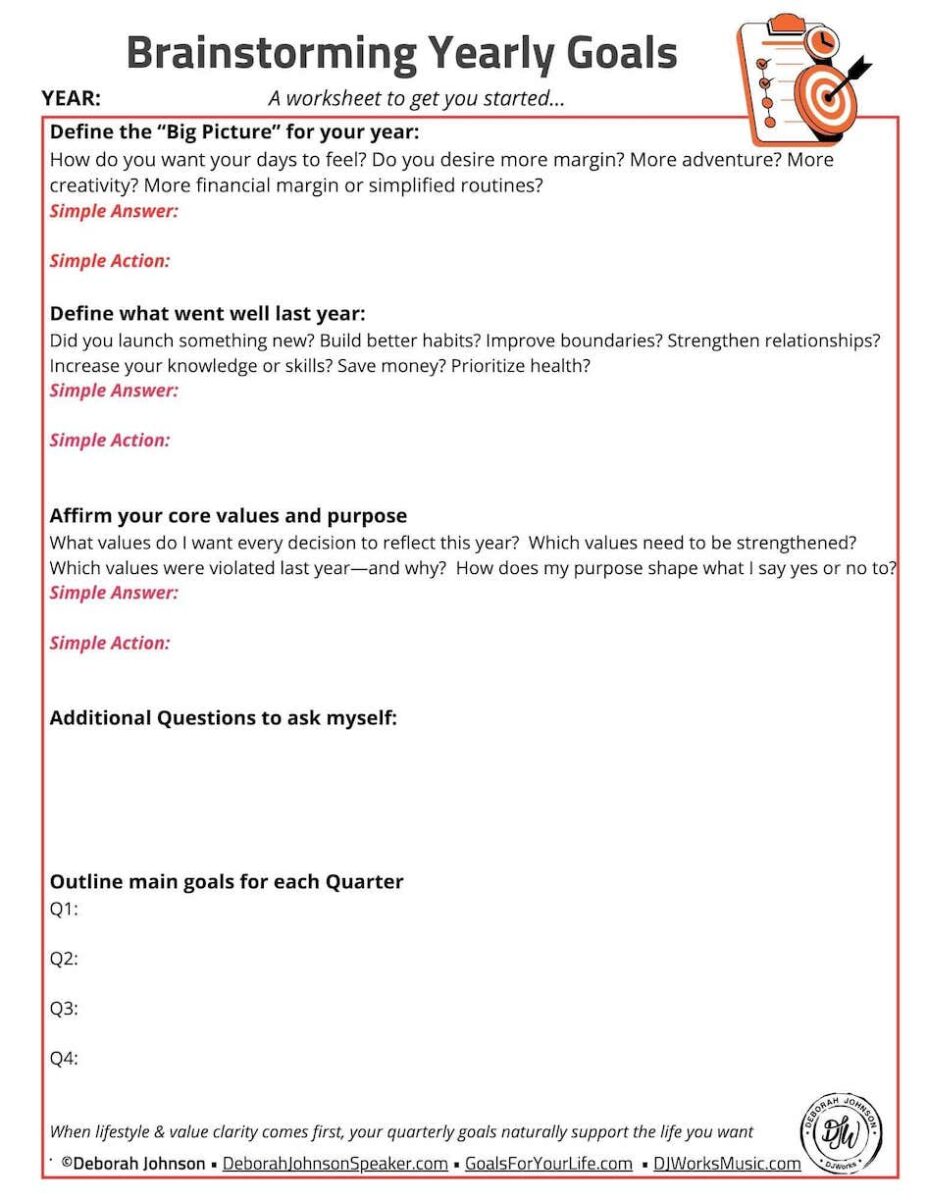
A new year doesn’t automatically create new outcomes—your choices do. With a clear big picture, meaningful quarterly goals, purposeful reflection, and alignment with your values and lifestyle, you create a year built with intention instead of reaction.
This framework helps you design a life you want, not merely manage the one you have. It is an important step to take as most of us don’t want to look back with regrets. As you step into this year, commit to clarity, focus, alignment, and consistent evaluation. Your future self will thank you.
Goal Setting Worksheets-free download!
Atomic Habits: An Easy & Proven Way to Build Good Habits & Break Bad Ones by James Clear
Power of After: What’s Next Can Be Your Most Purposeful Chapter by Deborah Johnson
Stop Circling: Steps to Escape Endless Roundabouts by Deborah Johnson
Tiny Habits: The Small Changes that Change Everything by BJ Fogg PhD
When you know the overarching direction with a big picture, the smaller goals you set have purpose and intention.
Thought Leader, Keynote Speaker, Author
If you are interested in growing and learning, check out our Online Courses here: Online Learning
2,568 words
The post Setting Goals for the New Year appeared first on Deborah Johnson.
Originally Published on https://goalsforyourlife.com/