When it comes to credit card processing, one of the most important decisions a business makes is choosing the right merchant account pricing model. The way your fees are structured has a direct impact on your profitability. Unfortunately, many business owners sign up for merchant services without fully understanding the pricing models—and end up paying more than they should.
At Nationwide Payment Systems (NPS), we believe in educating merchants so they can choose the best fit for their business. In this guide, we’ll break down the most common models, explain how they affect your costs, and highlight which options deliver the most transparency and savings.

Examples: Stripe, Square, PayPal
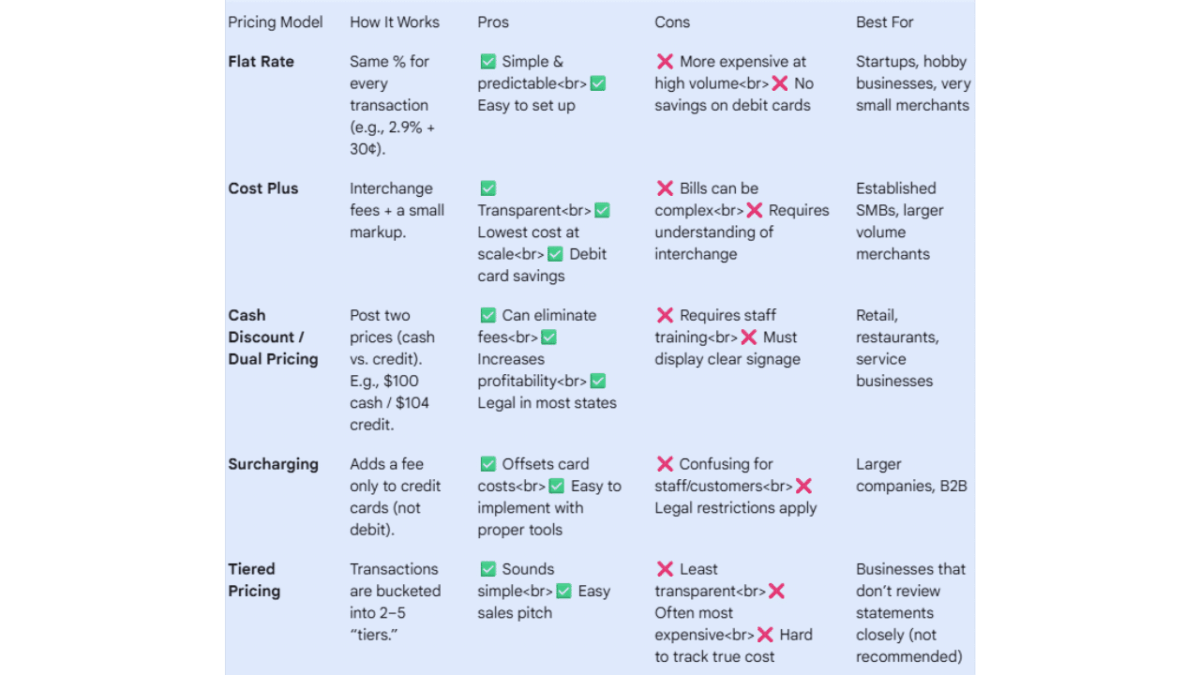
Flat rate pricing means you pay the same percentage for every transaction (like 2.9% + $0.30), regardless of the card type.
 Pros: Simple, predictable billing, easy to understand.
 Cons: Often more expensive for businesses processing higher volumes.
This model passes along the true interchange fees set by Visa/Mastercard plus a small markup.
Pros: Transparent and often the lowest-cost option, especially with debit cards. Cons: Monthly statements can be confusing because interchange varies.
This model allows merchants to post two prices: one for card and one for cash. For example:
Pros: Can eliminate credit card processing fees entirely. Cons: Requires clear signage and employee training.
Surcharging adds a fee to credit card transactions only. Debit cards cannot be surcharged.
Pros: Offsets the cost of accepting credit cards. Cons: Can be confusing for customers and employees. Must follow strict rules.
Tiered pricing groups transactions into categories like “qualified” or “non-qualified,” with each tier having its own rate.
Pros: Sounds simple at first glance. Cons: Lacks transparency and is often more expensive.At NPS, we’re not fans of tiered pricing—it usually benefits the processor, not the merchant.
Regardless of which model you choose, always review your statements. Some processors add unnecessary charges like:
These hidden fees can add thousands to your yearly costs.
The right pricing model can save you thousands every year. Flat rate works for very small merchants but cost plus and dual pricing usually provide the best savings and transparency. Avoid tiered pricing and watch out for junk fees.
At Nationwide Payment Systems, we help merchants find the best solution for their business—whether it’s dual pricing, cost plus, or a custom approach.
 Take Control of Your Processing Costs Today Book a call with Allen Kopelman, CEO of Nationwide Payment Systems, and get a transparent review of your current merchant account.
 Schedule Your Call Now
CLICK HERE TO FIND MORE ABOUT OUR PROGRAMS
Usually cost plus or dual pricing, depending on your volume and card mix.
Dual pricing shows two posted prices (cash vs. card). Surcharging adds a fee only to credit cards.
Yes, with dual pricing.
It’s the wholesale cost of every transaction—processors can’t change it, only mark it up.
It hides true costs and often inflates fees.
The post Understanding Merchant Account Pricing Models appeared first on Customized Payment Processsing Solutions.