

What’s Inside
Can AI agents boost efficiency without erasing jobs?
Guardrails that prevent costly mistakes and legal risk
How to avoid the AI efficiency trap (speed ≠ progress)
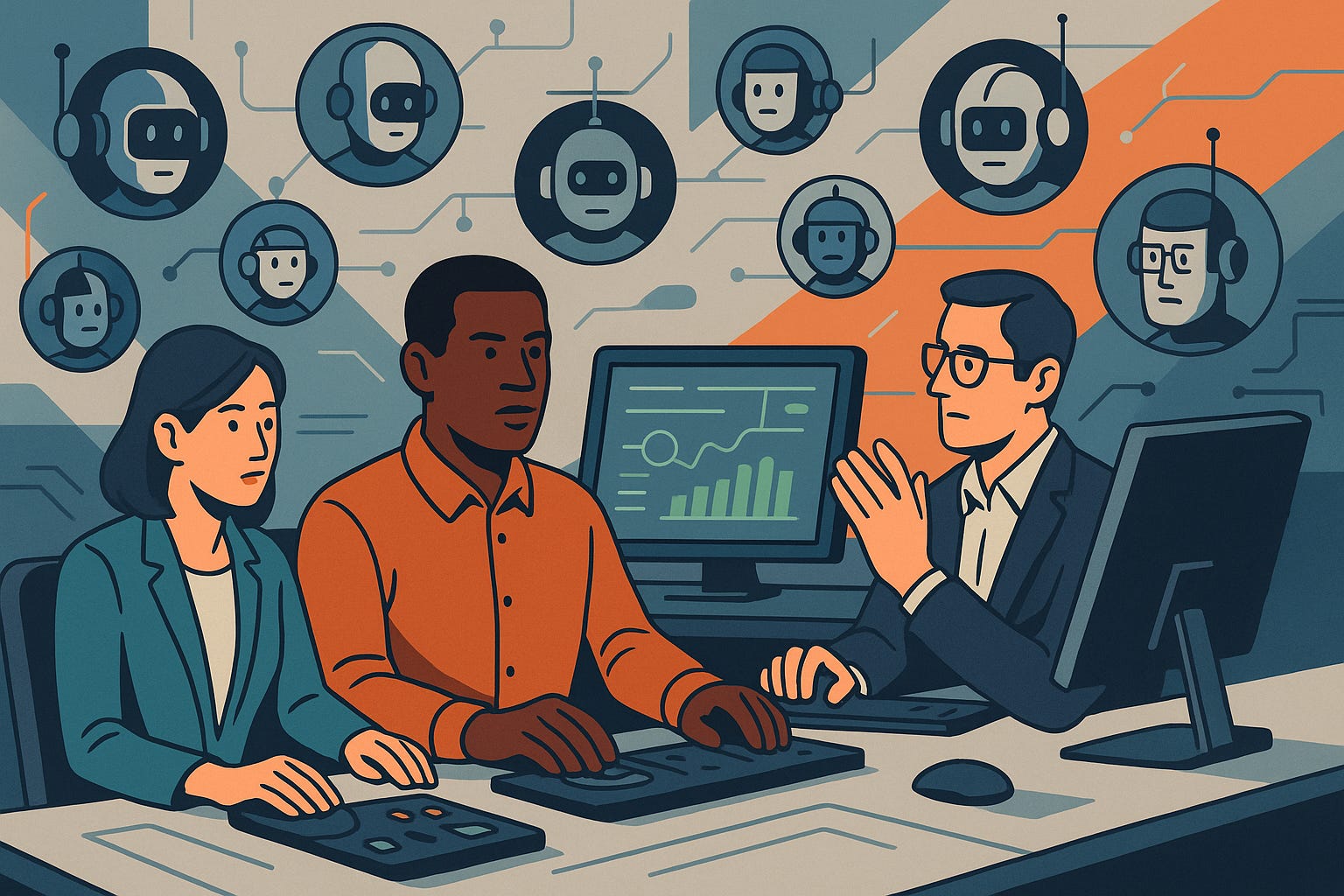
The appeal of AI agents for startup founders is obvious.
They quickly sort through information, handle repetitive tasks without complaint and work 24/7 without overtime. For early‑stage teams under pressure to move quickly and stay lean, that kind of output can be a lifeline.
But as Seattle attorney Kelly Lawton-Abbott told me for my previous post last week (Who’s Left Holding the Bag When AI Agents Go Rogue?), too much autonomy can expose founders to legal risks, especially when agents act without oversight.
That’s what I asked Tarun Raisoni, CEO of Gruve, about in our recent conversation. Gruve (pronounced “groovy”) is a fast‑scaling startup that provides agentic AI for enterprise workflows.
In his view: AI agents should support judgment, not replace it. The idea is to keep humans in charge.
At Gruve, the goal isn’t to hand control to machines. Instead, Raisoni’s team designs agents to operate like co-pilots: they monitor patterns in real time, recommend actions and flag risks humans might miss.
The agent will improve workflow and operations. He cited client examples: ~85% productivity gains in QA testing; ~40% faster development cycles; and cutting Security alerts by ~60%.
The point is efficiency, but within guardrails.
And Raisoni was blunt: the minute you let a system operate without context or constraints, you open the door to mistakes that can cascade fast.
“That’s when things go wrong fast,” he said.
This co-pilot approach keeps operations lean as humans make the final calls, whether it’s reallocating resources, adjusting a marketing campaign or deciding how to respond to a customer.
Legal protection is one reason to keep people in the loop, but not the only one. In practice, AI agents can only work with the information and instruction that they’re given.
They lack lived experience and broader context, as Raisoni said. A pattern that looks like a problem in the data might actually signal an opportunity, and only a human can make that distinction. At least for now.
Pulling people out of the loop may save time in the short run, but it also risks missed opportunities, poor decisions and damage to the brand.
AI’s efficiency promise also comes with a tradeoff: jobs.
CEOs are predicting more layoffs to come from adding AI, particularly among white-collar employees. And they’re announcing cuts, as well, with at least one who revels in it.
Meanwhile, Salesforce slashed 1,000 roles earlier in the year, with CEO Marc Benioff saying increased use of AI was a factor in the company’s decision.
In early 2024, Duolingo announced it was offboarding about 10% of its contractor workforce as the company pivoted to using AI for translation work.
But for startups, the default temptation is to replace expensive headcount with always-on agents.
Raisoni cautioned against this.
He said AI is already slowing hiring and will likely eliminate many entry-level roles. “The current IT pool has to upskill,” he noted.
But Gruve’s approach is to sharpen teams, not shrink them. Agents handle monitoring so people can focus on strategy, creativity and customer Relationships.
So founders who lean on agents to justify layoffs may see short-term savings, but risk long-term cultural and reputational costs.
Founders sometimes hand off responsibilities to agents simply because they can. That’s the AI efficiency trap: productivity tools create pressure to do more with less, raising expectations without necessarily improving outcomes, as Wharton’s Cornelia C. Walther notes.
Speed isn’t the same as progress. Moving faster in the wrong direction just multiplies cleanup later.
Raisoni recommends guardrails to avoid this:
Define decision boundaries — clarify which actions require human sign-off
Audit agent output regularly — catch errors early before they scale
Pair automation with feedback loops — let systems learn from both wins and mistakes
For Raisoni, success isn’t measured by whether Gruve’s agents can run without humans. It’s whether they help humans make better, more confident decisions.
While that may not fit the Silicon Valley fantasy of replacing people outright, it reflects a more responsible approach.
In an era when AI is being used to reduce labor costs, keeping humans in the loop helps to preserve some jobs, protect brand trust, and navigate a regulatory environment that’s still catching up.
Where does this leave us?
We’re almost in the fourth year of the ChatGPT era. And Raisoni admits we have a long way to go.
“But I have a pretty positive, optimistic outlook,” he said.
The real question for founders isn’t whether agents can work. It’s whether they’ll use them to amplify human judgment or just to cut corners.
Thanks for reading. This is part of my ongoing series on how AI agents are reshaping startups, from day-to-day operations to founder–VC communications.
Stay tuned for the next story in the series.
If you’ve used AI agents in your own operations — whether to streamline workflows or free up your team’s time — I’d Love to hear what’s worked and what hasn’t.
Hit reply or leave a comment below.