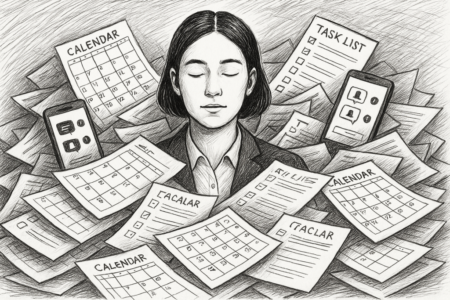


Time management quietly collapses when your energy runs dry.
Have you ever flown internationally? The battle of jet lag is real. As your body and mind acclimate to the time change, it is more about energy than it is time.
For many, Travel or not, time management is about the clock. Yet time alone doesn’t determine productivity, energy does as well. Two people may both have eight hours in a workday, yet one accomplishes far more than the other. The difference often isn’t skill, intelligence, or effort. One has better alignment between energy and activity than the other.
In The Time-Optimized Life, I emphasize that time management is not simply about filling hours. It is about preparing, executing, and controlling the way you invest your energy throughout those hours. When your most important tasks are scheduled during your highest energy periods, productivity accelerates. When they are not, time gets wasted through friction and fatigue.
The problem is most people schedule their days around obligations, not energy.
The Time Management Analysis (TMA) consistently reveals a common pattern. People understand the importance of planning, but struggle with focus and consistent execution when energy drops. When distractions, interruptions, and fatigue increase, productivity falls sharply.
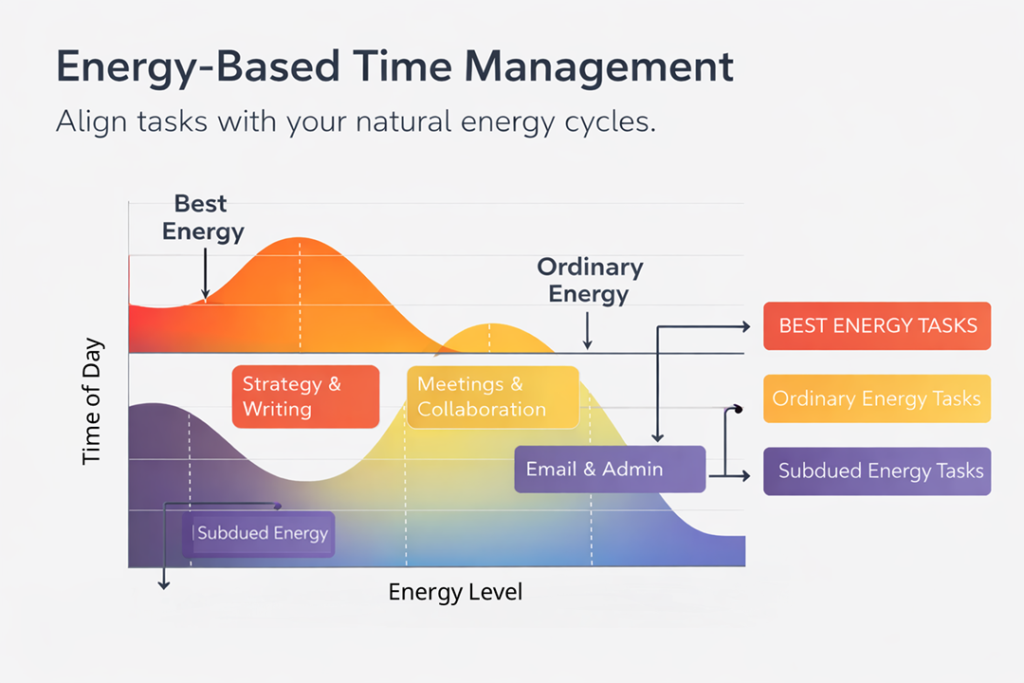
Depending on your circumstances, this is not a discipline issue as much as it is a biological one. Every person operates within natural energy cycles throughout the day, times when they are more productive than others. These cycles typically move through three phases:
When I look at the calendars of business professionals, the most demanding work seems to get scheduled during ordinary and subdued times. Best energy gets wasted with less important things.
Theory and practice can be two totally different realities. I am about to take you through an Exercise to help you define your productivity zone. At the end you might say, “Great, my zone is during the worst time of the day for me.” Got it. Keep in mind, your zone is not static. You can change life behaviors to realign.
Energy-based time management begins with a simple observation exercise. For one week, pay attention to three questions:
Most people will discover patterns like: In the morning that is the best time for strategic thinking. Midday is suited for collaboration and meetings. The end of the workday is left for routine tasks and light follow-up.
Identify your time opportunities for a more productive and time quality life.
Going back to our energy cycles, plan your calendar around those phases to enhance your productivity and increase your quality time. If you have a hard time getting started, then simplify with a process I call bookending.
Best Energy Tasks: strategic planning, creative work, problem solving, writing and deep thinking.
Ordinary Energy Tasks: meetings, collaboration, decision reviews, and communication.
Subdued Energy Tasks: administrative work, email, scheduling, and routine updates.
Notice how the best and subdued energy sequences are more about alone time. Whereas ordinary energy is about engagement and interaction with others. Does your calendar reflect that?
Yes, I did take you through an application in scheduling. However, time management should not be treated like a scheduling exercise. It is better understood as energy investment strategy.
You are not simply filling a calendar. You are allocating your most valuable mental resources throughout the day. When the right work meets the right energy moment, effort decreases and results increase.
That is the foundation of a time-optimized life.
David Buck is the author of the book The Time-Optimized Life, coauthor of The Retirement Collective, and owner of Kairos (Time) Management Solutions, LLC. Learn how to apply the concepts of proactively planning and using your time. Take the Time Management Analysis (TMA), the Retirement Time Analysis (RTA), or all the other free resources offered to help bring more quality time into your life.
Content development for this article involved human expertise supported by AI-generated analysis and formatting.
The post Why Managing Energy Can Beat Managing Time first appeared on Infinity Lifestyle Design.