

‘When one teaches, two learn.’ –Robert Heinlein
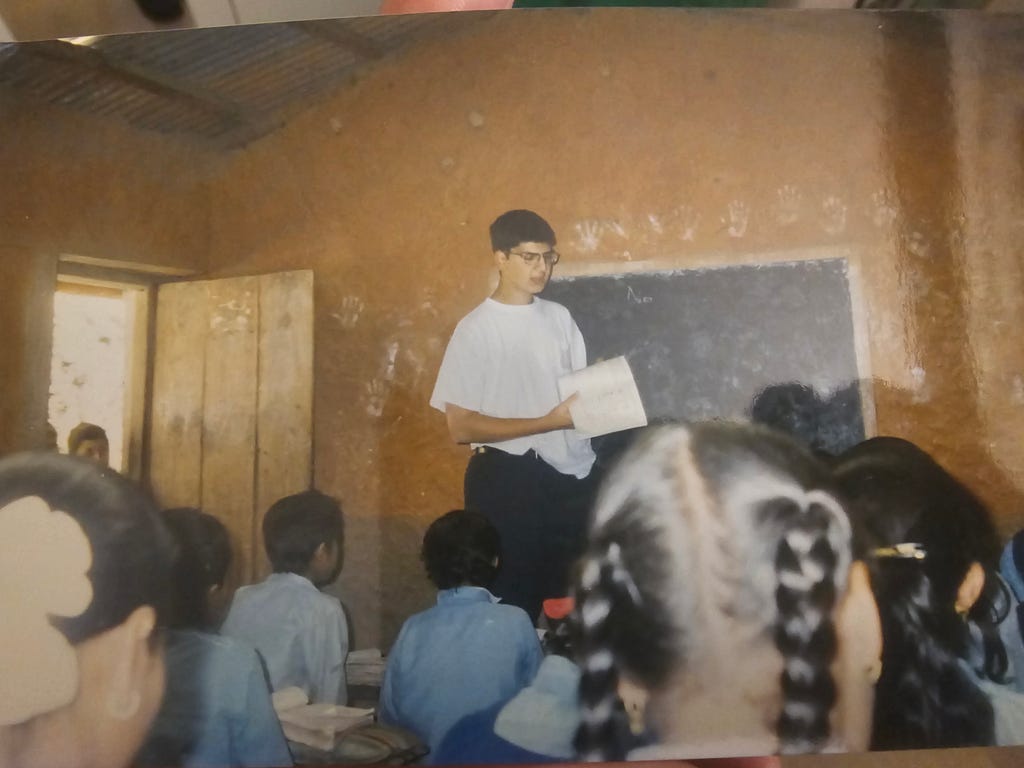
Of all the different parts of my professional life to date, I am probably most grateful for having been a school teacher at the start of my career — for six years I taught Maths and Economics to students around the world and I honestly do not know how I would have handled the subsequent 20 years without all I learned by doing it.
Sure, I went on to have a successful career in industry, then consulting and now as the founder of a start-up but none of that would have been possible without having had those teaching experiences first.
Being a teacher can be incredibly painful [just the memory of marking sends a judder down my back] and full of unexpected challenges [a good teacher is also part coach, therapist, social worker and more] but it can also be incredibly rewarding too [that moment you help a student unlock something they have been grappling with is unparalleled].
Little did I know at the time how formative those experiences would be in terms of developing the IQ, EQ and FQ skills that I would use later on in life to navigate the corporate world.
The thing about teaching Maths in particular [Economics was fine because it was usually taught to older kids who had elected to study the subject] is that it is one of those subjects that is obligatory for everybody but not enjoyed by everybody.
This meant that, particularly in the younger years, you get students who absolutely hate it or even if they don’t hate it they’re not very good at it.
This wouldn’t be too much of a problem if you were teaching these kids on their own but invariably there was always 20–30 other learners in the room at the same time and as the old saying goes: “A herd of buffalo will only run as fast as the slowest buffalo”.
Which means that unless you can learn how to get the best out of those students who are resistant or slower at learning, the entire group is really going to suffer.
‘The mediocre teacher tells. The good teacher explains. The superior teacher demonstrates. The great teacher inspires.’ ― William Arthur Ward
I remember vividly my first year of teaching; I was terrible.
I didn’t know how to handle a class; I was trying to stay one page ahead of the smart kids each day and generally I was shouting a lot to try and get discipline into my classroom.
Needless to say things did not go well and not only did I have a miserable year, the kids and their grades all suffered too as a result.
The turning point came for me when my department head, observing one of my classes, pulled me aside after the session and said: “What exactly was going on in that room?”
I explained to him that I had been trying to teach the unruly kids and he said: “No, all I can see was you shouting at the students and going into battle with them.”
He continued, “Which of you is the adult in the room?”
When I sheepishly answered: “That would be me”, he said, “So which of you should have the emotional maturity to flex and adapt for the other person’s benefit?”
Again, I sheepishly said, “Oh, that should be me.”
He said, “Well I recommend you work on that” and so began the foundation of the skills that I would carry through into the rest of my career.
‘If a child can’t learn the way we teach, maybe we should teach the way they learn.’–Ignacio ‘Nacho’ Estrada
I’ve taught in Nepal, El Salvador, Palestine and the UK.
While each of those countries were culturally very different and I had to learn how to adapt, one thing was consistent in each of them: namely that there was always a percentage of any class that were resistant to school, your subject and/or your teaching.
When it comes to Maths as much as 20 to 30% of the class will tell you, on day one, that they either don’t like Maths or don’t get Maths. This is a subtext for “Hey Sir, you’re never going to teach me” or “I’m going to be a thorn in your shoe.”
The fact is: good teaching, if you want the whole class to succeed, is not about how well you handle the good students; it’s about how well you engage and get the best out of those tough students.
One way to do that would be to argue with them, debate with them, shout at them and push them into being better mathematicians and better students.
Trust me; that is incredibly slow, painful, and most likely not to be a success — even Coaching can only take them so far.
By far and away the more impactful way is to draw those students in without them even realising.
Which meant that if a student said they didn’t like maths but they did indeed like football, then instead of talking to them about maths I talked to them only about football — let’s count how many corners are happening in this next game (statistics), let’s talk about the amount of time the star striker spent on the pitch compared to how much time he could have spent on the pitch (percentages), let’s work out the likelihood that your favourite team will win the league (probabilities).
If you can find the right topic; you can translate anything into something else. As such, engagement and reframing became a key part of my teaching as a result.
On top of that that I discovered gamification made such a big impact.
Bringing more fun into the classroom became my go to and the best way to do that was to turn things into a game; we played bingo, we played cards, we played run to the board, we played stand up/sit down, we draw pictures, we did kung fu and more. You name a game and I probably played it with the students.
In fact, over time, my first instinct became to look for a way to teach every new maths theory in an engaging, gamified way.
In addition, I would simplify everything that we were talking about; I realised that simplifying not only helped the kids but helped me understand things to the next level.
The skill that really brought it all together was the ability to read a room; for me this was the key to checking that everything was going to plan. It no longer became about did I manage to get through X pages during that class or did I manage to get them to do Y number of exercises; far more important was were people engaged, did people ask questions, were people having fun.
I would perpetually scan the room to see who was looking frustrated, who was looking only at the clock, who was doodling, who was shuffling from side-to-side; all the little tells that I had lost their engagement.
Unbeknownst to me, I was developing a set of super skills over those 6 years — an ability to engage anyone, simplify anything, observe the slightest emotional changes and motivate the previously resistant.
Really putting these all together, as I slowly got better and better at them, the results for the kids began to improve quite drastically, as did my enjoyment for the sessions.
‘A good teacher affects eternity: they can never tell where their influence stops.’ –Henry Adams
I didn’t realise it at the time but the skills I developed when teaching would be the skills that made me stand out in the corporate world.
Once I started working, I quickly realised that anyone sat in any meeting or learning new stuff appreciates when you simplify the discussion, when you link the topic to their world, and when you make it fun — basically every worker (even the CEO) was just a big version of a student.
This really came home to me as I moved into a consulting career and began to get more senior. I found I was using these skills more and more with senior clients to get them engaged in the work that we were doing, be it a developing a new strategy project, delivering a large-scale transformation or any project.
That ability to engage, simplify, and entertain became vital and it’s what began to put me heads and shoulders above my peers.
‘In a completely rational society, the best of us would be teachers and the rest of us would have to settle for something else.’ –Lee Iacocca
I genuinely believe that whatever you are trying to achieve, applying more of the engagement skills found in teaching will serve you well.
Who wouldn’t want to be able to lead any group through discomfort, creating psychological safety while also insisting on standards and accountability, and turning messy human behaviour into productive progress?
If you want to be able to do this, adopt these 10 behaviours:
Most importantly of all, enjoy it; when you’re having fun then, more than likely, so are your “students”.
Whatever goal you want to achieve: Go teach — you won’t regret it
Faris
Faris is the CEO and Founder of Shiageto Consulting, an innovative consultancy that helps firms and individuals sharpen their effectiveness. Connect with him here
Success = IQ x EQ x FQ
Want to assess your levels of IQ, EQ and FQ? click here
Originally Published on https://farisaranki.medium.com/