
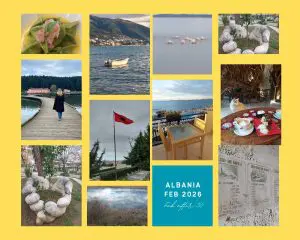
 Albania
 A Travel diary — hills, history, honesty & heart
Suddenly everyone was talking about Albania, I was curious so Olivier and I set off on a four day self-arranged taster from the Netherlands.
Alarm at 05:30 out the door by 06:20, drove to Eindhoven Airport for a 10:20 flight with Wizz Air. The deal still feels unreal: €250 per person for flights plus four nights with breakfast. A small delay, nothing dramatic.
We landed just after 13:00 at a state-of-the-art airport — sleek, modern, efficient and went looking for our car rental company Surprice. Small practical and efficient Hyundai, €30 for four days + €30 insurance.
The drive into Tirana took nearly 50 minutes — traffic heavy, beeping constant, and an unwritten rule that the middle lane is actually a parking lane (Olivier handled it like a hero) but it felt wrong not to at least see the capital for a few hours before driving South.
We parked near Skanderbeg Square (actually in a breath-taking glamorous shopping centre Topani), stepping straight into Tirana’s beating heart. Sixteen degrees, light drizzle, and suddenly… space. A vast, open square surrounded by history and ambition.
We wandered past the monument to Skanderberg ( 15th century nobleman, and hero of the nation for resisting the Ottomans, soaked in first impressions, then entered the Et’hem Bey Mosque — shoes off, head covered, women to one side, men to the other. Inside: quiet, beauty, peace. A pause in the noise.
Did you know?
The mosque survived Albania’s atheist communist era largely because it was declared a cultural monument — faith preserved through art.
Then came Bunk’Art 2 — and with it, the emotional gut punch. Surveillance, repression, informants, torture. Albania’s communist past is not sugar-coated here.
Albania’s history is intense: Ottoman rule for centuries, Italian occupation during WWII, independence in 1912, then decades of extreme isolationist communism. First aligned with the Soviet Union, Albania broke away in the 1960s, leaving the country paranoid about invasion from both East and West. Enva Hoxha’s dictatorship ended inl 1991.
Following up on our visit to Auschwitz a few months ago, I do not cease to be aghast and man’s capacity to torture..And yet — the museum exists. Truth told openly. That matters.
Back on the square, coffee in hand, I messaged home to say we’d landed — only for Mummy to share her book club had just finished reading “ Free” by Lea Ypi (Coming of age at the end of history) . I bought it immediately. The timing felt symbolic and it hugely added to my understanding of the country.
By 17:00, we decided to drive south to Vlorë. Two hours and twenty minutes, rain, darkness — but the roads were good. Thank you EU grants. Albania has official EU candidate status (blue background and circle on numberplates but no stars (yet). And there are state-of-the-art petrol stations everywhere.
Arrival (19:30) felt like a reward.
Our small hotel sat right on the coast. Sea view. Warm welcome. Quiet. Heaven.
This is out of season but even though we are at the end of the huge boulevard there are a few restaurants open around us. We chose “Riviera” and dinner was perfect: seafood risotto, mixed grill, hot salty focaccia, and a (huge) “glass” of Albanian white wine. Italian influence everywhere — no surprise after history with Italy. Paid cash in Leks, so cheap.
Exhausted. Grateful.
Woke to sun (16 degrees) and sea, a dream. Did our usual routine of buddhist chanting (me) and Gi Gong (both of us)
Breakfast was just us — omelettes made to order, pastries, cheese, olives, oranges so juicy they attacked my clothes, lovely cappuccino, took it easy, chatting with the staff.
Today we are discovering things around us, mostly nature.
We drove 30 minutes towards Narta Lagoon, part of the Vjosa-Narta Protected Area. Wetlands, light, space — and then: pink flamingos. Dozens of them, reflected in still water.
Did you know?
Flamingos migrate here seasonally — Albania’s wetlands are among the most important bird habitats in the Balkans.
We parked and walked across a wooden walkway to St Mary’s Monastery — tiny, serene, mirrored perfectly in the lake. No photos allowed on the mini island itself, the monastery is still active. Some places ask you simply to be present.
From there we were to drive to the bunkers but the road was atrocious — rain-filled potholes you couldn’t judge. Insurance fears kicked in. We turned back and parked to convene… only to realise the bunkers were a 20-minute walk away.
So we walked.
And it was so much better. Sun and mild temperatures, smells and sounds and gentle breeze.
Sheep with their affectionate guard dogs, a few cows, a horse all wandering around freely, silence, and finally — four massive communist bunkers clinging to cliffs, tunnels stretching impossibly deep, walls covered with technical army pictures and now also colourful graffiti. It felt very special being there alone
Did you know?
Albania broke with the Soviet Union early 60s. Hoxha was a great Stalin fan as he had greatly helped rebuild after WW2. When Krushev came to power and started destalinisation, Albania broke all ties leading the regime to fear invasion from both East and West. Hence the bunkers — paranoia poured into concrete.
Walking instead of driving felt symbolic somehow.
Back in Vlorë old town, we explored the mosque area, clock tower, WW2 cemetary and stopped for coffee and cake in a wildly decorated café — orange blossom biscuits, chocolate sponge, second cappuccinos because why not.
We visited the Museum of Independence, where Albania declared independence in 1912. A young woman working there told me she dreamed of moving to Europe. That quiet ambition stayed with me.
Stopped at a local supermarket to get some bottled water, black chocolate and divine dried apricots, here you can pay with a card.
Evenings always end by the sea. This time we decided to try the fancy one we didnt feel up to the first night and my, it blew our minds.”Gjurma by Aldo Mehmeti”. Top notch service, decor, table setting, the most tender octopus I have ever eaten, then we each had a variety of their homemade ravioli (Fagoti Kuq Esi with carbonara cream and octopus ragout was to die for) and so was the black Tortino (fondant 75% cacao and hazelnut icecream). Olivier had a soft drink, two glasses of pinot grigio for me, we shared the starter and dessert and it all came to EUR 35pp. They are hoping to get the first Michelin of Albania!
After another gentle breakfast (the scrambled eggs were even better!) and yes, it turns out we are the only guests at the moment. Berat is on the agenda today.
It feels so free having a car, a GPS and just discovering. A different road for us today and the scenery shifted — olive groves, snow-capped mountains, roadside sellers with oranges, leeks, cabbages. People walking directly on the road. Donkeys. Tractors. Once outside the cities it is like going back to a previous era, families or couples working the land by hand, women with kerchiefs around their heads. We have also noticed a lot of smaller round bunkers everywhere. These were for families and it is estimated there are still around 700.000 of them over the country.
History is never far away.
Lots of police everywhere checking cars, not sure if driving licences or speeding.
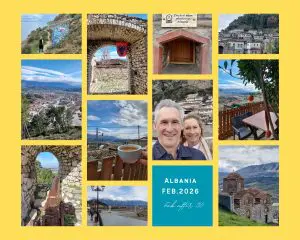
Berat rose dramatically: stone houses stacked above one another on two escarpments separated by a river, earning it the nickname “the city of a thousand windows.”
We started with the remains of the castle up on high offering spectacular views, the sky was blue and you can see far with this glorious weather, beautiful little Holy Trinity church hanging on for dear life. Abrupt drive down (with my heart in my throat), then negotiated a parking space with an entrepreneurial soul at the bottom. Started with the Mangalem (muslim side). Pebble stones, atmospheric little alley ways against the snowcapped mountains and over to the historic side via the picturesque bridge.
Did you know?
Berat has been continuously inhabited for over 2,400 years (Roman times) and became a UNESCO site in 2008.
Coffee, wandering, quiet conversations.
Drove back again via Lushrije and split off at Fier to visit the archeological site of Appollonia, established 7th Century BC and probably housed 50.000 inhabitants. Julius Cesar, Cicero and many more visited. It rained — softly, then steadily — but that only added atmosphere. We had the place to ourselves apart from one other couple and loved wandering and day-dreaming of how it once was.
Grateful for our beautiful day. Happy to dry off and chill in our room before indulging today in anchovies and seafood risotto and I even tried an Albanian raki, made with grapes, less sweet, smooth, I loved it!
This wasn’t a “tick-the-box” visit. It was a feel-the-place day.
In the car today with a goal: Gjirokaster via Tepelenë and into the mountains — dramatic, wild, breathtaking.
We Love driving around even though each time we need to go back up to come down again as there are not that many modern roads). In this area they are already selling strawberries by the roadside (cultivated in little plastic covered shelters), cherry trees in bloom and beautiful raddegy views as we climb into the mountains through the gorge created by river Vjosa.
And today we got a taste of the police ourselves as we were pulled over for overtaking where we should not have been, fair enough. It also turned out that our rental car already had two other fines to its name so they took it seriously, friendly but stern.
What struck us most: no bribe (I suggested we pay the fine directly to yhem instead of needing to go to a post office), no negotiation. Just a procedure. Fine issued. Official receipt.
Did you know?
Albania’s anti-corruption reforms are a core requirement for EU accession — and they’re enforced.
Pulled over in Tepelenë – famous with nature lovers – as we were in need of a coffee after our adventure, walked down along the waterfall and enjoyed our coffee with a delicious baclava and pistachio filled croissant. Oliver is very worried we are going to fly back with 50 dogs as there are many strays here. No aggression, friendly, often in groups and I think well looked after as we see blankets and bowls here and there.
They seem to fish a lot here and there are aquariums with trout they are selling on the roadside.
In Gjirokastër, rain followed us. Another UNESCO recognised site.
The castle loomed above — immense, heavy with history.
Founded centuries before Christ, later expanded by Ali Pasha, then used as a political prison in the 1970s and 80s — this place has seen it all.
Inside: weapons, tanks, a beautiful clock tower, a captured Lockhead plane from 1957 (how on earth did they get it up there?). Outside: views you know would be spectacular on a clear day.
Serious to take responsibility (and part of the adventure) we went looking for a postoffice and dutifully paid our fine (10 EUR + 1 EUR commission) and had coffee in an old very local cafe with an older generation. We got a lot of looks but they were lovely.
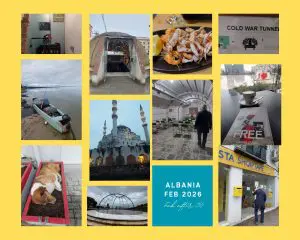
We also visited the Cold War tunnel once we had driven up on hairpin narrow cobbled roads — dark, eerie, built in 1965 for municipal officials to survive a nuclear attack (never used). We were alone then joined by a German couple. It stretches on and on with fortified doors (four chambers to enter). In some rooms you could still see beds and desks with phone and meeting room but most of the content had been looted. Walking through it in silence with phone torches felt unsettling, intimate, sobering.
This country doesn’t hide its scars.
We were going to drive back to Vlore via the scenic riviera route (via Sarande) but it is an additional 1,5 hours and in this weather it does not seem worth it. It did mean that we drove back via teppelene and my lovely wet, 4-legged friend with his huge brown soulful eyes was still there and stared after me reproachfully.
Back at the hotel, time to pack and enjoy a last delicious meal and wine and early bed. Up at 2.15!!!
Up at 02:15. Out by 02:45. Two-hour drive back to Tirana in darkness and drizzle.
The airport was surprisingly busy. Efficient. Calm.
Back home in the Hague by lunchtime. It all feels surreal. We loved our mini trip and feel richer for it. (Drove 1000 kms but super relaxed).
Final Thought
Albania is a country that doesn’t just show you its beauty—it invites you to feel its layers. In just four days, we walked through centuries: from the quiet resilience of its people to the stark reminders of its past, from the pink flamingos of Narta to the brooding bunkers clinging to cliffs. It’s a place where history is not just preserved, but lived—where the weight of communism, the echoes of empires, and the dreams of a European future all coexist in the same breath.
What struck us most was the honesty. Albania doesn’t hide its scars or its ambitions. It offers them up with a warmth and openness that’s rare. The food, the landscapes, the conversations—all were rich with authenticity. And in a world that often feels curated, that honesty is a gift.
We left with a sense of gratitude, not just for the places we saw, but for the way Albania made us pause, reflect, and connect. It’s a country on the move, but it hasn’t forgotten where it came from. And neither will we.
The post Albania in Four Days: Where Every Step Tells a Story appeared first on The Kennedy Connection.