
Part 1 of a 3-part series highlighting some of the key insights from the 2025 Year-End RTA report. Download your copy today for free.
Ahhh…Retirement life. The time in one’s life where the cares and worries of career are replaced with carefree post-career living. You see it all the time in advertising.

Ask someone in their 50s or early 60s what they want post-career, and you’ll hear a familiar list:
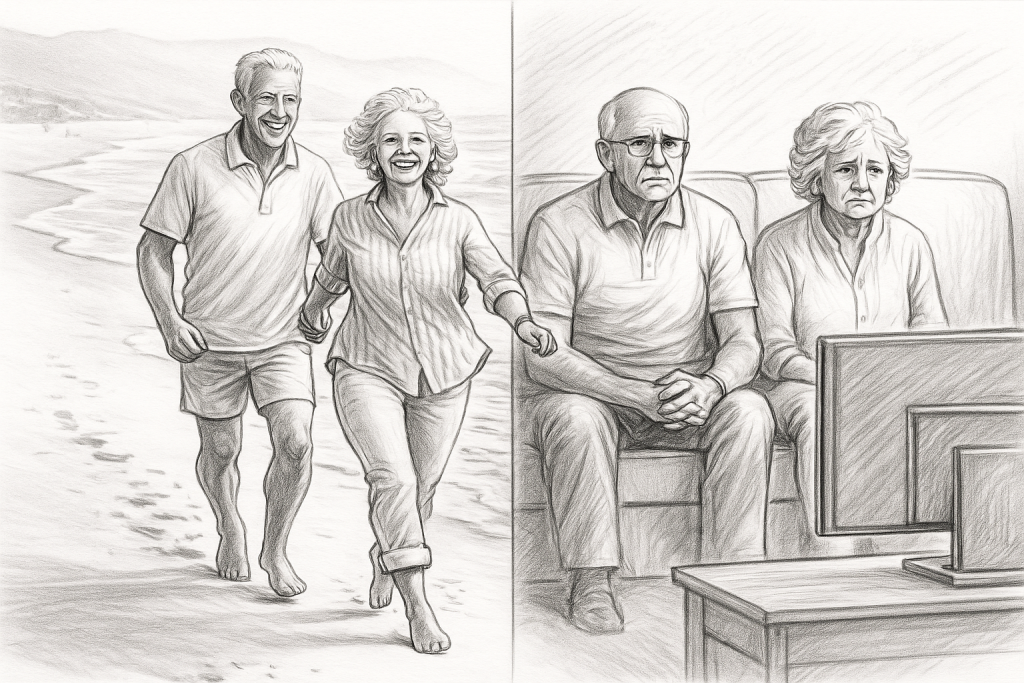
But here’s the problem – most people’s current Lifestyle doesn’t even remotely reflect the one they say they want.
According to data collected from the 2025 Retirement Time Analysis (RTA), there’s a consistent pattern: high expectations for retirement… but little in the way of structured preparation or behavior to support it.
Let’s break it down.
One of the most striking findings in the RTA data was the gap between anticipated lifestyle activity and current time use. Over 70% of respondents indicated a desire for an active and engaged retirement. That includes travel, fitness, learning, mentoring, and relationship-building.
But when we looked at how people are spending their time today?
The truth? Most people aren’t building the muscles—mentally or physically—for the life they say they want.
The 2025 RTA Year-End Report combines data from all Retirement Time Analysis assessments in 2025 to highlight areas of time vulnerability when career ends and retirement life begins and what can be done.
There’s a dangerous assumption built into how most people approach retirement lifestyle planning: “Once I retire, I’ll have time. Then I’ll get serious.”
Yet, behavior doesn’t work that way.
Retirement doesn’t magically deliver motivation, focus, or structure. If anything, it removes the external anchors (like meetings, deadlines, and performance reviews) that kept you moving.
Without intentional effort now, many retirees find themselves:
They don’t need more time. They need a plan for how to use time with purpose.
Want to know what your retirement will look like?
Look at your Tuesday.
Not a vacation. Not a holiday. Just a regular weekday.
How much of it is driven by your values vs. your obligations? How much space is blocked off for personal Growth, health, fun, or contribution?
If your schedule today is reactive and fragmented, retirement won’t fix that. In fact, it might expose it.
Here’s how you start shifting from the life you talk about to the one you’ll actually live:
The retirement you want doesn’t start at 62, 65, 67, or 70. It starts with how you use your time now.
If you’re not practicing today, you won’t perform tomorrow. If you don’t define your purpose post-career, someone—or something—else will.
Take the first step. Asses yourself with a free RTA summary report or take the full assessment to get your personalized insights.
Want additional insights into participants who took the RTA? download the 2025 Year-End TMA report and then take your own Time Management Analysis assessment. Compare the two and then get on a program that adapts to your unique circumstances.
David Buck is the author of the book The Time-Optimized Life, coauthor of The Retirement Collective, and owner of Kairos (Time) Management Solutions, LLC. Learn how to apply the concepts of proactively planning and using your time. Take the Time Management Analysis (TMA), and the to help bring more quality time into your life.
Content development for this article involved human expertise supported by AI-generated analysis and formatting.
The post The Retirement You Want vs. The Life You’re Living Now first appeared on Infinity Lifestyle Design.