About 70% of heirs switch advisors. Keeping the “kids” should be on your mind from Day One when your new clients’ children are adults.
This article first appeared in Rethinking65.
My mom collaborated with a financial advisor for close to 20 years. When he retired, a much younger wealth manager, John, assumed responsibility for her portfolio. It did not seem like a good fit, so she moved her funds to another institution with a more “mature” advisor — someone older with more experience. Yet after about a year, my mom felt she had made a mistake. The established investment advisor was not responsive and lacked customer service skills.
Unsure what to do, Mom went back to the “young” portfolio manager. It was a great move. In the years that followed, John took great care of her needs and helped her transition into Retirement with a solid strategy and plan. He even took the time to get to know her beneficiaries (me and my siblings). John wanted to ensure we were aware of his approach. It gave us confidence in him and planted the seeds for future opportunities.
When my mother passed away and we began to settle her Estate, John was ready to make the transition as easy as possible. He was so attuned to our needs that my brother and sister still rely on him as their advisor. The only reason I did not keep my portion of my inheritance with John is that I have a great long-standing relationship with another advisor team. John retained 66% of mom’s portfolio and gained even assets more as my siblings moved their financial plans to him.
John bucked the trend. Multiple studies have concluded that somewhere around 70% of heirs switch financial advisors after wealth is transferred to them from a parent or spouse. This threatens the customer base of the average financial advisor, particularly as more clients age and move into retirement.
Therefore, it’s important to consider adopting a variety of Lifestyle strategies to build trust with heirs before a wealth transition occurs. These strategies should go beyond traditional financial planning and position the advisor as a multi-generational life strategist, not just a Money manager. Here are some suggestions:
Most advisors gather beneficiary information from clients during the onboarding process. However, advisors tend to lack curiosity about the people who will receive the balance of any wealth plan. If you can, ask your clients early on why they chose their heirs. The better you know their motivations, the better you can establish Relationships beyond the initial generation.
If you miss that opportunity, it is never too late to ask your clients to introduce you to their fund recipients. Expanding your understanding of the Family tree increases the likelihood that the next-generation heirs will ask you to continue to manage the portfolio.
Build trust with the next generation by inviting adult children to sit in on their parents’ financial planning meetings — with the parents’ full consent, of course. These sessions don’t have to be overly formal or financially dense. The goal is not to involve heirs in every technical detail but to give them visibility into the planning process and your approach.
Whether it’s an annual review, a retirement income update or a values-based Legacy conversation, heirs’ participation allows them to observe firsthand how their parents’ advisor operates, makes recommendations and guides major life decisions. Like John did with us, it could plant seeds for future business opportunity.
This concept of “financial shadowing” builds a foundation of confidence through exposure. It demystifies the advisor-client relationship and shows adult children that their parents are in capable, thoughtful hands. When the broader family feels included and sees the care their parents receive, they are far more likely to consider maintaining that relationship after a wealth transfer.
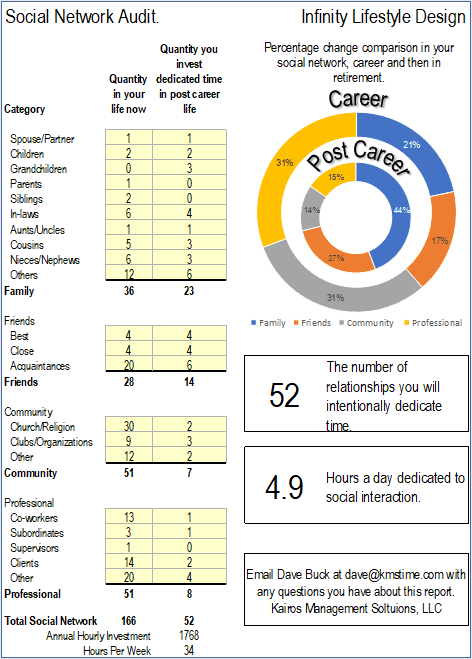
You will see a decline in your social interactions when you retire. The Social Network Audit is a quick way for you to understand the number of relationships you have now, and the ones you will want to invest time in post career to maintain, nurture, and grow.
If the geographical or emotional distance separating parents and children a factor? Try deepening multi-generational relationships by helping clients create a “legacy interview.” This can take the form of videos, audio messages or written letters that capture your client’s core values, life lessons and intentions for the future. This isn’t about financial details but about passing down the Wisdom and perspective that often mean more than money.
Advisors can guide the process by offering thoughtful prompts or interview templates, then helping clients shape their reflections into a meaningful keepsake for their heirs.
Involving the next generation in the process makes it even more impactful. Adult children might contribute questions, join a joint reflection session or simply be present (physically or digitally) when the legacy message is shared. This emotional bridge builds continuity and trust across generations and positions the advisor not just as a financial planner, but as a steward of the family’s story. It’s a memorable experience that families associate with care, thoughtfulness, and lasting value — all qualities that make heirs more likely to stay engaged.
I don’t think John had a formal approach. His interactions with me and my siblings combined instinct, strong customer service and business acumen. He took care of my mom and then was ready to take care of us. He now manages more money under our family tree.
David Buck is the author of the book The Time-Optimized Life, coauthor of The Retirement Collective, and owner of Kairos (Time) Management Solutions, LLC. Learn how to apply the concepts of proactively planning and using your time. Take the Time Management Analysis (TMA), the Retirement Time Analysis (RTA), or all the other free resources offered to help bring more quality time into your life.
The post 3 Ways to Close the Generational Loyalty Gap first appeared on Infinity Lifestyle Design.