

In this inspiring episode of Meet the Expert with Elliot Kallen, Elliot sits down with Alexa Starks, founder and chief strategist of Executive Moms, to discuss how companies can better support parents—especially mothers—returning to work after maternity leave. They explore leadership momentum, Burnout prevention, and reframing Motherhood as a leadership skillset that benefits corporate performance.
Alexa Starks is the founder and chief strategist of Executive Moms, a company dedicated to helping organizations design re-entry blueprints for employees returning from maternity or paternity leave. With a Master’s degree in Organizational Leadership and experience as a published author on authentic leadership, Alexa blends personal motherhood experience with corporate Coaching expertise. She works internationally, serving both U.S. and European clients.
Listener Q&A / Final Thoughts
Elliot shares personal experiences that shaped his awareness of this issue, while Alexa underscores that corporate support for parents is not just an HR issue—it’s a business imperative. By normalizing conversations about parenthood in the workplace, companies can retain talent, reduce burnout, and increase loyalty. Both agree: what’s often seen as a problem is actually an opportunity for stronger leadership and workplace culture.
Contact Elliot Kallen & Prosperity Financial Group
[email protected]
925-314-8503
prosperityfinancialgroup.com
Connect with Alexa Starks, Executive Moms
executivemoms.co/workshops – Book a free discovery call
Elliot Kallen: Well, good morning, good afternoon, everyone. I’m Elliot Kallen, CEO of Prosperity Financial Group, and I want to welcome you to another exciting episode of Meet the Expert with Elliot Kallen. All right, this is something you’re going to want to listen to, especially if you’re a mom or you’re somebody connected to a mom, because there’s a big issue out there in moms getting back in the workforce and leadership. And we’re going to talk about that. I’m not eminently qualified to talk about that. I’m a guy. I didn’t have to stay home with my kids. I was the breadwinner. But I experienced my wife who felt like she had no value in the marketplace. And unfortunately for me, I’m divorced and remarried. Unfortunately for me, that carried over to my personal life. And I know for hundreds of thousands of families, they experience this every single year. So we’ve got somebody on here, very exciting, who’s going to talk about changing the thought process, leadership, and changing the dynamics of women back in the workforce. And welcome, Alexa Starks. Thanks for being here.
Alexa Starks: Thanks so much, Elliot. Very happy, very excited to be here and talk all about leadership, motherhood, leadership, and honestly redesigning the system and the workplace to actually support working parents, especially right as they’re returning from maternity or paternity leave. And this affects nowadays men too. A lot of fathers and men get paternity leave. And so it is a system redesign and it’s almost a culture reset and thought process reset and a lot of Education. It’s changing.
Elliot Kallen: I’m with you. I actually brought your subject up yesterday in my office and we had a long talk about it, how exciting it is that because they all said, they all had kids and they said, and I’m a small business, so they didn’t lose any ground with me, but they thought they lost six, you know, my office manager took off for six weeks and then had to come back to work. I got one day off when I, that was it. That was my paternity leave was one day and they didn’t want to pay me for that. We had to negotiate that one day. Now, of course, I have people all the time, friends who are, who get six weeks off also, or 12 weeks off as men. So that is a change in a larger company and even our company, we don’t even have a policy because you just go on disability in California, which is not different than Family leave. You can apply for that. It’s kind of goofy that screwed up, but there’s no doubt about it. When you lose 12 weeks, six weeks, 26 weeks, or four years, you lose momentum. And so, yeah. So let me tell you, if you want to reach us, 925-314-8503, it’s elliot, E-L-L-I-O-T at prosperityfinancialgroup.com. The website is prosperityfinancialgroup.com. We’ve got 150 plus episodes of Meet the Expert. Every one of those exciting, some you’re going to Love, some don’t pertain to you. That’s okay. That’s what the delete button is for, but we’ve got a half a million people that have watched these. And I’m just in awe of that I’m waiting for Coca-Cola to give me a call and be our sponsor. That’s when I know we’ve officially arrived. Coke, if I just mentioned your name, you didn’t pay me to do it. So no sponsorship required there, I know.
Alexa Starks: I mean, I think you could go more Dunkin’ Donuts with coffee.
Elliot Kallen: Well, that would be more me.
Alexa Starks: They might be a good sponsor.
Elliot Kallen: Donuts would be more me. Thanks for the plug. And Dunkin’, if you’re listening, give us a call, please. So much for sponsorships. I had to change my shirt this morning because it was too pronounced. It said a name of a financial company on there that does not allow for live interviews at all. It would not come on my show. So I imagine if they got hold of that and said, you’re advertising us without permission, you wouldn’t get on. I’d have to re-record the whole thing. I’m glad that was pointed out to me this morning. So let me tell you, I want to ask your background and how you even evolved at this point, because I know you’ve got something published. I know you’ve got a master’s degree from Claremont McKenna. You are a globally based person because you’re dealing in both Europe and the United States. Different cultures. And in Europe, you’ve got lots of countries and therefore you’ve got lots of cultures. And in the U.S., even California is a very different culture than New York or Chicago or Florida. We’ve got our own issues and we’ve got our own laws and acceptabilities. Let’s call it that, Annette, because I don’t really know a better word for that. So how did you get into this role? And what is the role exactly of executive moms? And I know you’re the founder and chief strategist of executive moms. I’m going to ask you at the end, give everybody how to reach you because it’s pretty fantastic where you’re doing it. And it’s cutting edge, grassroots, and it’s paving a new road. None of which are easy to do.
Alexa Starks: Thank you.
Elliot Kallen: Otherwise you’d be following somebody else.
Alexa Starks: Yeah. So a little bit about me. I do have a master’s degree in organizational leadership and I am a published author. I have a book about developing your authentic leadership skills. And that is my background in leadership. And so I’ve loved being able to develop my own leadership skills. I’ve done coaching of other working moms, developing their leadership skills and transitioning their motherhood skills into career leadership skills. But my real business right now as founder of executive moms is a re-entry blueprint workshop, corporate workshops for businesses on how to create a re-entry blueprint, a ramp up plan for employees returning from maternity or paternity leave. And the way this came about was I have two children. I have a two and a half year old son and a one year old daughter. So I’m in the middle of toddler land. But both of my maternity leaves, I had no return plan, no ramp up plan. So when I came back from three months, which I was grateful for three months off, but when I came back from leave, there was no ramp up. It was check 10,000 emails and you’re back to normal, right? Like day two, everything’s back. You’re back. Everything’s back. You’re back to normal. Everything’s, you’re full back, full on with meetings. Let’s get you all your projects again and go back to work as if nothing changed, as if I didn’t just have this massive identity shift that moms go through. And, you know, at three months returning, you’re still breastfeeding. You have these hormone fluctuations and you’re just navigating who you are. And now you have to juggle your, maybe your baby’s away from you for the first time ever they’re in daycare or someone’s watching them. And you have to learn how to compartmentalize your new mom brain and constantly thinking about your baby with, okay, let me get back into project mode. And that’s really difficult. And managers very often lack the tools to have these hard conversations where they’re actually supporting their employees. And I’m not talking about policy change, right? Businesses have their own policies. The United States doesn’t have a mandated maternity leave or paternity leave. So it’s just up to companies to say, we’ll give you two months off. We’ll give you three months off, paid, not paid, go on disability, whatever the state offers. And so, but that’s the policy I’m talking about afterwards. I’m talking about the culture and the managers and employees and how to have this hard conversations. And so when I had my second baby, my daughter had really awful reflux. Like I’m talking about, she was throwing up on me five, six times a day. And I would be crying in between meetings, trying to feed her. She’d be crying. I’d finally get her down. I’d be covered in puke. And then I’d hop on a zoom meeting and pretend as if nothing just happened, right? I’d wipe my eyes. No one could see from here down. And then it would just happen again an hour later. And I didn’t have the language to say to my manager, Hey, I’m struggling right now. I need more time to ramp back up. I’m on week two of being back. And I just need a little bit slower of a re-entry. I need to have some flexibility in my time. Can I start work at 7am when my daughter has her first nap? Can I finish wrapping up work in the evening? And these are just conversations. And so my job is to host these corporate workshops that give managers and HR and employees, these conversational scripts, these guides, these checklists of how to help prepare for leave, prepare for coming back for leave and set these clear expectations of what returning from leave should be and how managers can actually support their employees. And it’s hard because these emotional conversations we’re not used to. I’m not used to talking about Emotions, especially in the workplace.
Elliot Kallen: Alexa, they’re great conversations to have. And I can see no one’s really doing that out there right now. And maybe I’m handicapped running a small business here. And as a man, I got my own handicaps. But I know from personal experience that moms that have made decisions take off. You took off for whatever the company’s policy was. You took off. And then you had personal challenges with a baby that wasn’t 100%. And it gets even worse if your baby is even worse than that. Some parents have it worse than you. Some parents have it easier than you. Just how random life is on that. But there are also parents that say that some very, very talented people, and we’re talking about women now, very talented people like you, and they make decisions. I’m going to be a stay-at-home mom for the first three years or so of their life until I put them in preschool because I want to give them the hugs and the love that I feel is needed and deserved. And I’m making that decision. Now we’re not talking about what happened to you, which is you missed 12 weeks or six weeks. We’re talking about three years or three years of, I mean, if you think about Technology in three years, it’s just passed you right by and you got to catch up to it. How does that happen? Because I know more women that have made that decision and they never get back to making the Money on the path they were on and they’ve been frustrated with that for a lifetime. So how do you change that culture and how do you change this whole thing?
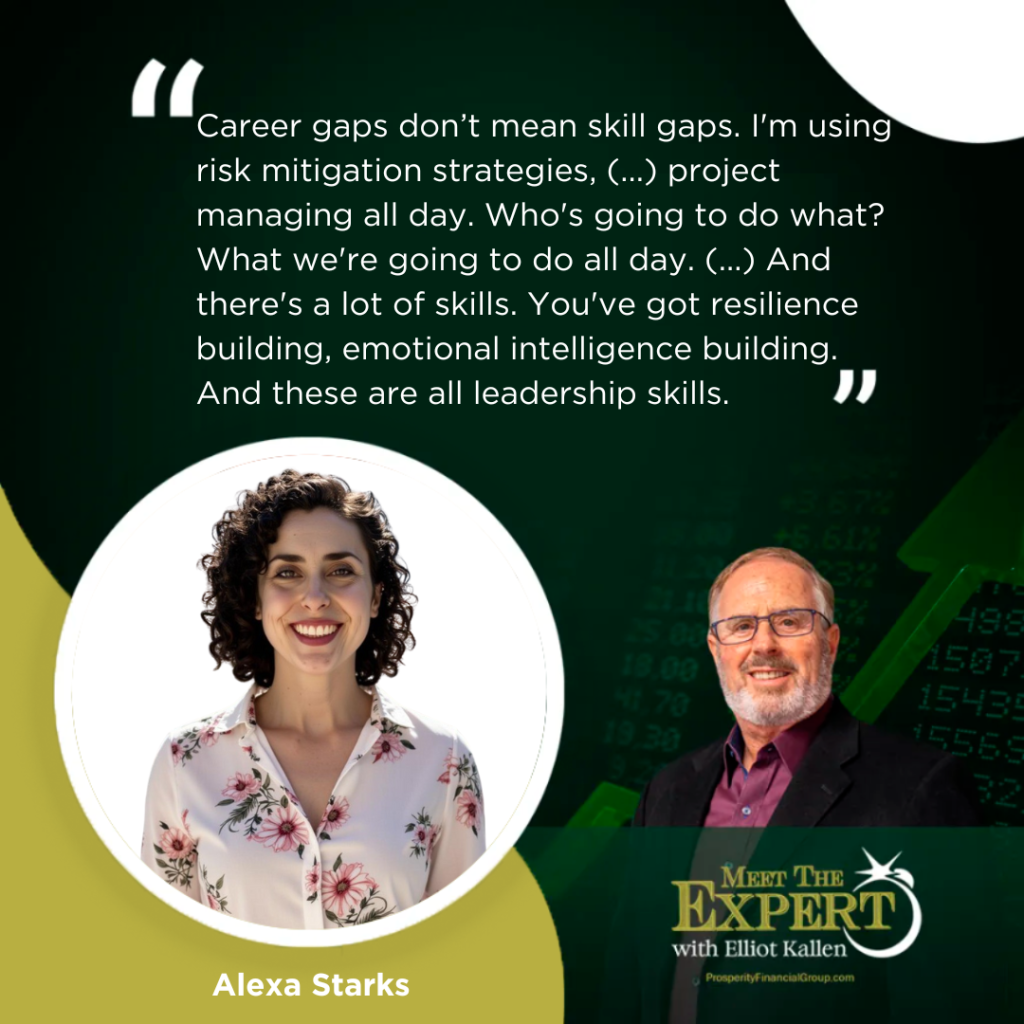
Alexa Starks: Yeah, that’s a big one. And it really comes down to, again, a mindset shift. If you’re a mom taking off time, you’re not doing anything. You’re crisis management, crisis negotiator all day. I’ve got two toddlers. I’m navigating, hey, don’t pull his hair. Don’t take her toy. And it’s mitigating crisis. So there’s a lot of skills that you’re developing in motherhood. And it’s a mindset shift of, okay, how can I use these in the workplace? How can I position myself as, okay, I’ve been a mom, but I’m not just sitting around watching TV all day for three years. I’m using risk mitigation strategies. I am project managing all day. Who’s going to do what? What we’re going to do all day. Got to get back for a nap. Who’s going to nap at what time? And there’s a lot of skills. You’ve got resilience building, emotional intelligence building. And these are all leadership skills that any, if you wanted to open up LinkedIn, type in resilience, type in emotional intelligence, you’ve got hundreds, thousands of leaders talking about how important these are as skills for good leadership. And yet they’re things that moms are doing every day. So if you take three years off to be a parent, to be a mom, to give your kids all the love that they deserve, it’s a culture shift. It’s a mindset shift that needs to happen. But it is a huge, a huge wall that women face trying to go back to work after, because unfortunately you have missed years that you have now, you have a career gap. And a lot of employers don’t look kindly on career gaps.
Elliot Kallen: We’re talking with Alexa Starks here. She’s the founder and chief strategist of Executive Moms. And it’s a fascinating conversation because we’re talking about women post giving, having children and taking off for 12 weeks, six weeks, three years and having to get back to work. But she, and she’s not consulting just women. She’s trying to develop with companies a game plan. And so if you want to reach us again, we’re at 925-314-8503. Make sure it’s 8503. I hope I said it properly earlier. And it’s Elliott, E-L-L-I-O-T at prosperityfinancialgroup.com. And the website is prosperityfinancialgroup.com. And we’ll give Alexa’s information out shortly. It’s fascinating because I, you know, I have to speak from the male perspective because that’s the only real perspective I have. I’m empathetic and I could understand it other, but I’m still who I am. And I did not as a man, and maybe because my dad was the greatest generation, World War II, big Depression, his job, he had one major job and that was, you are the breadwinner. And of course, as a role model, he was the breadwinner and his message to me was pointingly with his finger out, theoretically pointing at me, always be, always take care of your family. You are the breadwinner. You are the, take care of their safety. You are the chief person in charge of what doesn’t happen day to day in the house. And that’s your big picture. And if you fail at that, you fail at everything. And so if I actually married, let’s say someone who, a woman who married, made 500,000, my dad would have pointed me and saying, great, why aren’t you making 600? Because that was the generation he came from. And so that’s really hard for me to have a different perspective than that. But the value was for mom, you articulated this in a way that I’m not used to hearing. And that is you learned from being a mom, negotiating skills and emotional quotient that went up. But then no one understands that because if I don’t understand, other people don’t understand that either. And I’m the guy hiring. I really don’t understand that because I think you’ve been home dealing with nonsense all day feeding and, baby bear and whatever has been done. Just totally different on that. So I don’t know it either. I have to be educated on this. And I don’t think I’m, I think I’m pretty normal and mainstream and I don’t know it. So you have to do, so how do you do that? How do you get guys like me, men like me, managers, CEOs, and I’m a CEO to listen to this predisposition that I have about motherhood and things that I didn’t even know were going on.
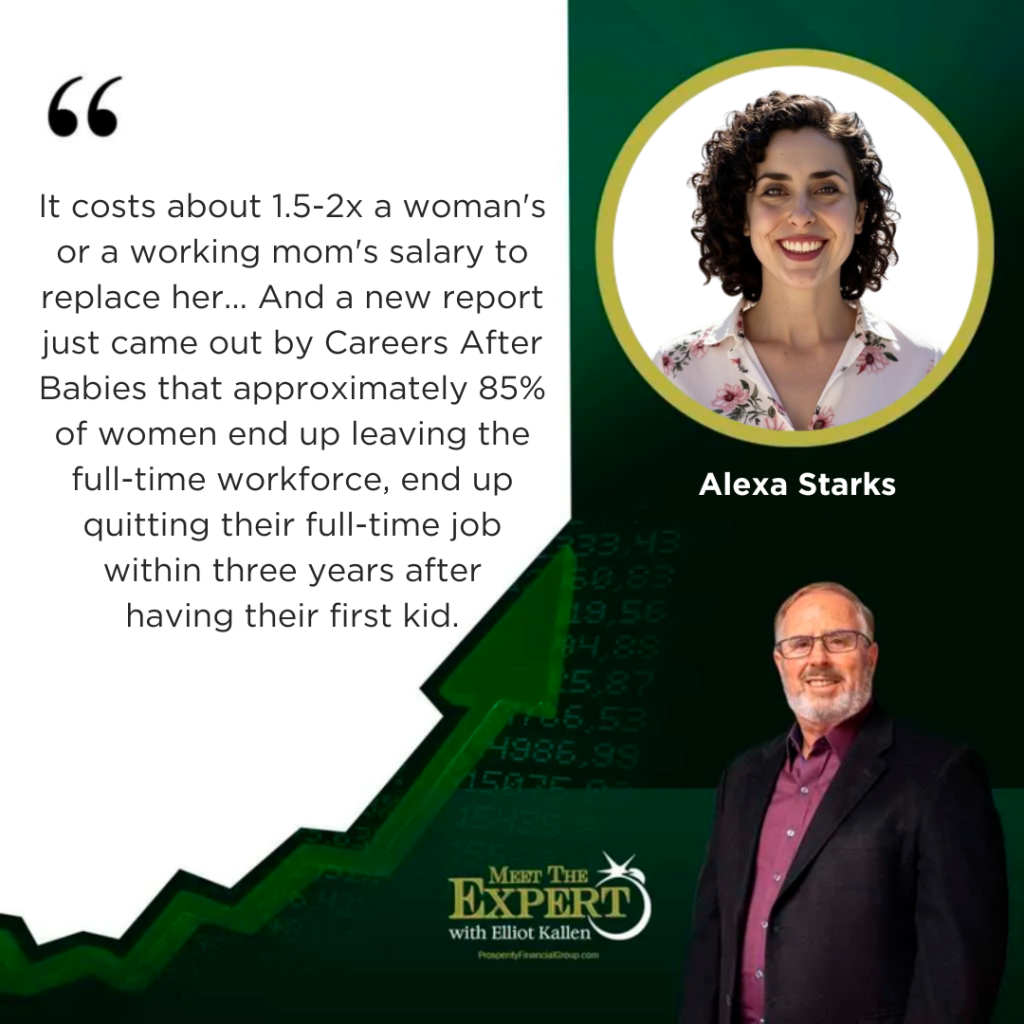
Alexa Starks: Yeah. So this is a two part answer. One is talking more about this and normalizing it. So I am all over LinkedIn talking about what’s going on, what women actually go through as new moms, working moms to normalize this conversation and to get it in front of men, male CEOs, hiring managers who are like you said, not used to that. So that’s the first part of this. The second part of this is making it a business imperative for you as a man, you don’t have to necessarily understand. You have empathy, you can empathize, you can sympathize. But if we make it about what’s important to you as a business owner is the financial aspect of this, right? It costs about 1.5 to two times a woman’s or a working mom’s salary to replace her. Everything from the lost productivity, from when she’s burning out and not performing, not being as efficient to when she quits. And now you have the gap between when you can hire someone, you have hiring costs, hiring bonuses, onboarding time, ramp up time. All of this costs almost two times a woman’s salary just to hire someone to replace her because she had no support when she came back from maternity leave. And a new report just came out by Careers After Babies that approximately 85% of women end up leaving the full-time workforce, end up quitting their full-time job within three years after having their first kid. That’s a staggeringly high number and they don’t return. Almost 20% never return, they just quit. The rest go to part-time, go to some sort of freelance or entrepreneurial thing to get that flexibility that they were looking for in the first place. And so if you have a staggering amount of women leaving the workforce and it costs two times their salary just to hire someone else, this is a company problem. This isn’t just a mom problem and a family problem, this is your problem. As a small business owner or any business owner, you want to retain your employees, right? And that’s why we have bonuses, that’s why we have salary increases, to retain employees and make sure they feel valued, make sure they feel heard and seen. And this is part of it, making sure that they feel supported when they return from maternity or paternity leave. And so this, if you talk about it in the financial sense, a lot more men and business owners can start to understand it in those terms rather than just, oh, you can’t understand because you aren’t a mom.
Elliot Kallen: Well, I want to bring up one of the words that you just brought up and kind of do a follow-up question, and that was the burnout word. Because I know that being a mom, it’s an all-encompassing job. It doesn’t get a lot of credit in society. Some societies are better, but for the most part, it really doesn’t get a lot of credit for it. But you’re doing that, I’m asking you to do that, the mom thing that you need to do, and I’m asking you to do the job that I hired you to do. And neither one of those is 40 hours a week. It’s 100 hour a week commitment to doing this. And inherently, you want to be a great mom because I think 99% of everybody wants to be a great parent, and then there’s the 1% that just can’t get it. And maybe it’s higher, but you just inherently, you want to be a great mom. You’ve learned from growing up how to be a mom, and then you’ve incorporated your own personality that makes you the best mom you could be. And in a very imperfect world, you’re trying to be a great mom. And then you’re trying to do a great job at what you do. And we have some leadership opportunities in front of you. We have some raises in front of you. We have some hierarchy that you have the opportunity to go up to if you so desire. All of these things compete with time and energy. Everything competes with itself. And you only have so much time and energy in your life before you’re simply just going to fall asleep on a couch and you can’t move like three straight days. How do you not get burnt out? Because you’ve got to, as an employer, I don’t want you to get burnt out because then I lose you and I lose productivity. As a mom, you definitely don’t want to be burnt out. As a spouse, that will change your life if you become a burnt out spouse. I experienced that in my own Marriage where she was just really burnt out of being a mom and a spouse and couldn’t handle both. And she just couldn’t do it. It wasn’t going to change no matter what we did. And that’s a bad place to be because nothing productive comes out of that short term. Long term, that’s another discussion. But short term, it’s a really hard place to be. So what do you advise companies to avoid burnout and advise women? Because it’s hard. I mean, you have to experience this yourself.
Alexa Starks: Yeah. I’ve personally experienced it and it is very difficult. But again, this is where, this is something I teach in my workshop. And it comes down to one, self-awareness of the working mom or working parent, recognizing when they’re starting to feel burnt out or starting to feel overwhelmed and being able to have that conversation with their manager. So having the psychologically safe space to go to their manager and say, hey, let’s say my baby was up crying all night. I didn’t Sleep at all. I know we’ve got three meetings today. Can we push two of them to tomorrow or next week, early next week? Because I need to just rest and reprioritize. And they need to be able to have the tools, knowledge, the education to recognize that this is normal and flexibility is so supportive and helpful and say, yes, absolutely. Let’s off board whatever is not essential for today and shift to other days, right? Or work or projects. And so being able to recognize those symptoms of burnout and talk to your manager about it is really crucial. Having those scripts and knowing how to ask and knowing what to say as a manager to be supportive. Because burnout’s very, very real for so many women. And it comes down to just being able to talk about it with your manager, which is hard.
Elliot Kallen: So I want to end on this note. This has been great. We’ve been talking with Alexis Starks. She’s the founder of Executive Moms. We’ll tell you how to reach her in a moment. If you need to reach me again, elliottprosperityfinancialgroup.com. There are 150 episodes plus on this. You see over my left shoulder a book that I’ve written called Driven. And if you love it, we’ll send it to you. I’ll send it signed. Let me know. Just pop me an email. We’ll send you a signed copy out there. We’re thrilled to do that. I don’t know how many thousands of copies were sold. We’re excited. And if you like leadership of any kind, I’m somebody that has had a not straight line of leadership in my life. I’ve got a lot of backwards things that have happened, including personal tragedy. I am a person that doesn’t believe that everybody’s Mark Zuckerberg. Where you start a company and five years later, you’re a billion dollar billionaire. There’s a lot of life that goes backwards. And I wrote a book to show that you could succeed on any level if you have perseverance, integrity, and so many more traits. We’re really talking about those same kind of traits right now. And leadership is what I want to talk to you about since I wrote a book about that. And that is we’ve talked about moms getting back into the workforce, but we’ve not talked about moms taking leadership positions within companies. And that’s out there too. And when you begin to leave, you lose momentum as a leader. The second you’re not around, you have to… That’s for anybody, by the way. You disappear, you lose momentum. I don’t care who you are. Even if you get transferred, you lose momentum. And so there are people in our world that have degrees like you, they have masters, their leadership, they wake up every day and they say, I’m a leader inside. So how do we preserve that leadership and how do we motivate people to continue on their leadership path?
Alexa Starks: Yeah. So again, it’s tough when you take three, four, five years off and try to return back. But the more we can normalize the motherhood skills and how to translate them into the workplace, the more working moms we can get into leadership positions to even further normalize that conversation. And the more we can normalize what it looks like to have healthy work-life boundaries, to say, hey, I’ve got kids drop off at school until 9 a.m. So I’m not going to be online until 9.30 or I’m a hard stop at 4 p.m. to go pick up my kids from school or daycare. And normalizing that, that routine that your family life comes first before your work life and you’re not working 7 a.m. to 10 p.m. every day. And so leadership is character skills. It’s not necessarily the position that you’ve held before. And so the more women can, I mean, I think there’s a great company out there that talks about putting motherhood as like on your resume, CEO of my household or CFO of my household or chief operating officer, chief strategy as like an actual role on your resume, because you have been doing all of those things as a mom. And so the more we can just normalize these conversations, the more we can redesign the system to support working parents, because this is the company problem, corporate problem, business problem. And it’s a working mom and dad problem as we start to see more men taking paternity leave as well. So this impacts 360 all sides everywhere.
Elliot Kallen: Well, you know, as a leadership and we’re going to end it on a second. As an entrepreneur, we take the word you just said problem and we switch that word to opportunity because we always think that’s what it is. That problem is that opportunity. And so for corporate America, and I think your target market is corporate America, corporate Europe, whatever it is, and probably companies much bigger than mine. I’m, you know, I just don’t have enough employees here, but you know, companies in the top two, 3000 in their marketplace, versus small business owner like myself, you’re going to find that I think, and I’m going to find that this opportunity creates will make my company much stronger because I’m in touch with 51% of the workforce in a way that they know that I’m in touch with 51% of the workforce. I’m a better leader if I am, because I’ve shown empathy and I’ve addressed this.
Alexa Starks: Absolutely. And when parents, working moms feel supported, when employees in general feel supported, they are more productive. They’re more efficient. They give more, they’re more loyal to their company as well. So the more that we can create this opportunity for working parents to thrive and have sustainable ramp ups from maternity or paternity leave, the better they can even contribute to your business or to their company.
Elliot Kallen: If you want to reach Alexa, which if you’re running corporate America, corporate Europe, whoever is listening to this, and we’re in four countries now, if you’re listening to this and work for an entity, you know, this is an issue. And if you’re a husband, your spouse has this issue and you want the best for your spouse. There are so many factors that you could have an impact by changing the culture and of your workforce and how to do it. So Alexa, this is fantastic with Executive Moms. How do people reach you?
Alexa Starks: Thank you, Elliot. You can reach me at my website, executivemoms.co forward slash workshops. I have on there a place that you can just click a button and schedule a discovery call with me directly. And that’s executivemoms.co forward slash workshops.
Elliot Kallen: Okay. And there’s no charge for having that conversation, right?
Alexa Starks: Nope. It’s a free discovery call.
Elliot Kallen: Oh, it’s fabulous. That’s great. I guess I know where website I’m going to this afternoon. Thanks for being on the show, Alexa. I wish you the best of luck here. I think it’s exciting what you’re doing. It’s necessary what you’re doing for personal experience for someone who was married to someone that had, that felt like she was worthless in society after being a stay-at-home mom for five years. And what a waste. It doesn’t have to happen. And corporate America can figure out how to fix this and make it right. So thank you for being on the show. Yep. Thank you, Elliot. Have a great day, everybody. We’ll see you again on beat the expert with Elliot Kallen.
The post Rebuilding Workplaces for Working Parents with Alexa Starks appeared first on Prosperity Financial Group | San Ramon, CA.