
Tuesday - June 23rd, 2026
Apple News
×

What can we help you find?

Open Menu

The 12Cs of Work Motivation

If you want to understand how to truly motivate someone in a work context (including yourself) and get much greater engagement, this article is for you

Engagement is the most fascinating thing in the world; if we could learn to turn it on and off (I think most people are more interested in how to turn it on) then we would potentially maximise all our achievements.

Instead, particularly in a work capacity, we often just hope that the conditions will all come together so that we achieve our goals — this is fine if it involves something super exciting (such as going into Space) but think back to the last major transformation programme you may have been involved with (let’s say an SAP implementation); were most people actually motivated by that?*

What makes people tick in a work context

Whilst you can use positional power or incentives and punishments to make someone do something, if you really want success, ultimately nothing beats getting them truly engaged to do it of their own volition.

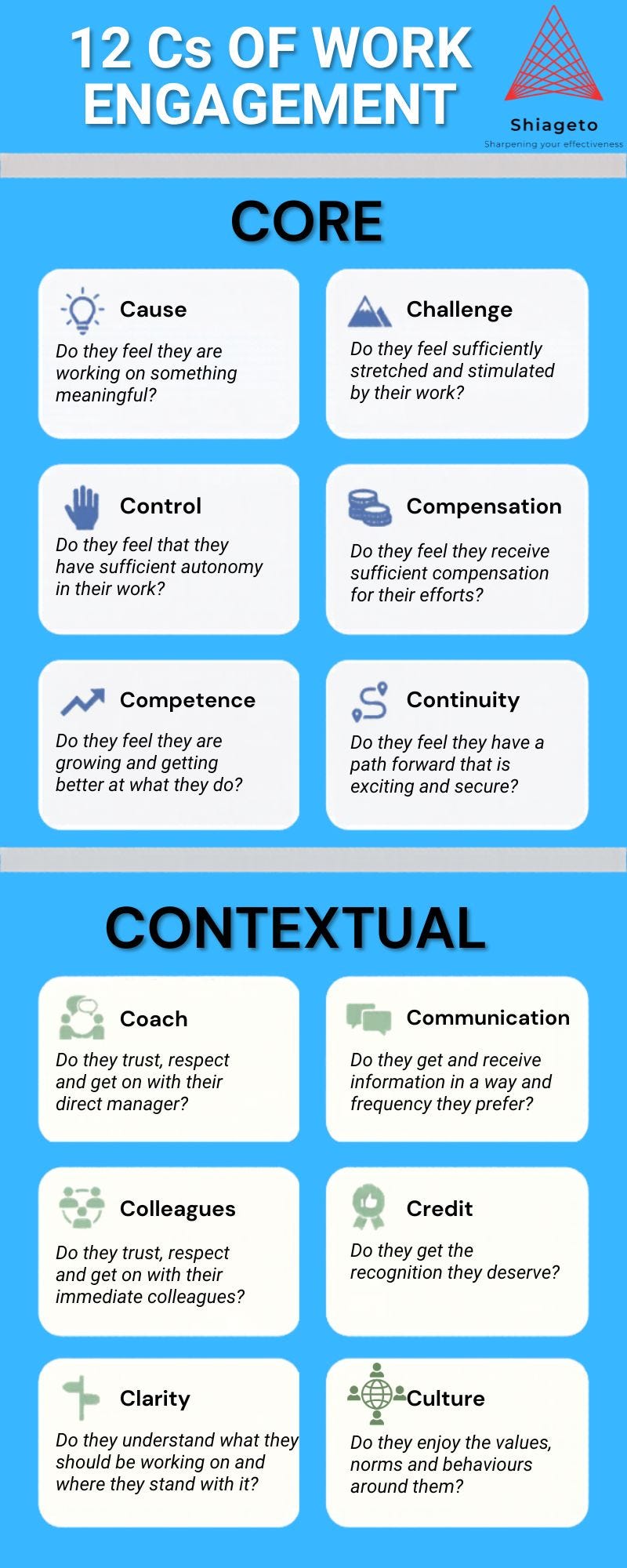
Through my work with 100s of different teams over countless projects, I came to the conclusion that there are in fact 12Cs of motivation that influence an individual when it comes to engagement; 6 are core motivators (why they engage) and 6 are contextual (whether they sustain that engagement).

Core Motivators:

  1. Cause — Do they feel they are working on something meaningful? [It makes a hell of a difference if you are passionate about the purpose]
  2. Control — Do they feel they have sufficient autonomy in their work? [Nobody likes to be told what to do all the time]
  3. Competence — Do they feel they are growing and getting better at what they do? [Life is about evolving and growing]
  4. Challenge — Do they feel sufficiently stretched and stimulated by their work? [If it was too easy we wouldn’t value it, if it’s too hard we’ll get frustrated; you need the Goldilocks amount of challenge]
  5. Compensation — Do they feel they receive sufficient compensation for their efforts? [This doesn’t just have to be Money]
  6. Continuity — Do they feel they have a path forward that is exciting and secure? [It makes a difference if you see a stable career ahead of you]

Contextual Motivators:

  1. Coach — Do they trust, respect and get on with their direct manager? [Nothing puts people off more than a bad boss]
  2. Colleagues — Do they trust, respect and get on with their immediate colleagues? [Second only to a bad boss are colleagues that you don’t get on with]
  3. Clarity — Do they understand what they should be working on and where they stand with it? [If the goalposts keep changing or there is confusion to start with, then engagement gets harder]
  4. Communication — Do they get and receive information in a way and frequency they prefer? [Talk to a person in the wrong way and you may well lose them forever]
  5. Credit — Do they get the recognition they deserve? [It’s about fairness as much as enjoying the limelight]
  6. Culture — Do they enjoy the values, norms and behaviours around them? [Is this a place they are passionate about and fits in with their identity?]
The 12Cs Of Work Motivation &Raquo;
How about making this into a game of Bingo with your team?

Whilst this list may seem daunting, it’s not a case of needing to have absolutely every one of these in place to get some level of engagement.

In my experience though, the more of these you have in place, the more likely you will increase the amount and magnitude of the engagement around you.

Similarly, you can use this in the opposite manner.

Treat this as a go-to checklist when you discover a person or a team are not engaged; through some quick detective work and open questions, you can always unearth which of these is the biggest de-motivator.

Bringing this to life

Whatever you are working on individually or collectively, here is a good way to diagnose the levels of engagement.

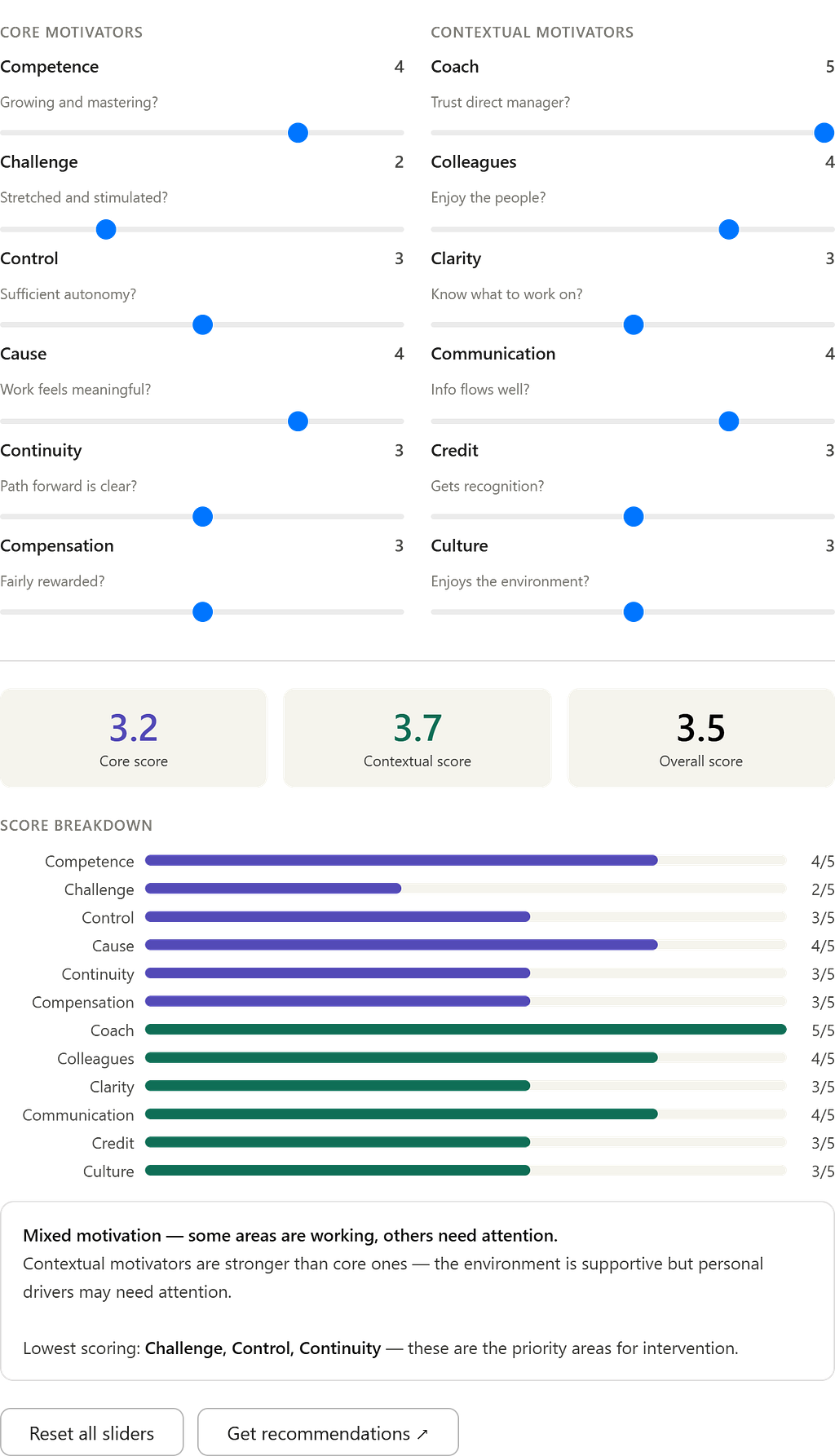
Get all those involved to score each C on a scale of 1–5 [1 being the lowest score and 5 being the highest]; you can then use these to make hypotheses around which are most important to the situation and what solutions you might want to put in place to address the most important ones.

I find this is where Generative AI can really help out
The 12Cs Of Work Motivation &Raquo; 1*Ku70H2Rtsv7Bbj3Ptbuslq
An example of a engagement diagnostic tool

In my experience, having conversations in an open manner about the 12Cs is a great way to begin to get greater engagement and gives a common language to begin to make changes but sometimes it is best to conduct the initial assessment in an anonymous manner to allow people to be more honest.

Don’t forget a diagnostic like this applies just as much to a team of 1 (i.e. when you need to increase your own engagement); sometimes breaking it down in a methodical, structured way can make you see what has been previously eluded you.

The key to any diagnostic is not to be defensive when you get the results; it’s sometimes too easy to dismiss things because you don’t like what they infer. As soon as you do, you will more than likely be contributing to the problem

As ever, I highly recommend giving it a go and if you need some help getting the best out of this then just drop me a line 🙂

Faris

*Generally for most SAP implementation projects, the answer is a resounding NO!

Faris is the CEO and Founder of Shiageto Consulting, an innovative consultancy that helps firms and individuals sharpen their effectiveness. Connect with him here

Success = IQ x EQ x FQ

Want to assess your levels of IQ, EQ and FQ? click here

The 12Cs Of Work Motivation &Raquo; Stat?Event=Post

Originally Published on https://farisaranki.medium.com/

Faris Aranki Strategy & Emotional Intelligence

Having spent over 20 years delivering strategic change for the corporate and non-corporate worlds, Faris has experienced first-hand the fine differences between strategic success and failure.
His work has spanned numerous companies (from global behemoths to small start-ups), in numerous countries, across a range of sectors, supporting them all to unlock strategic success.

He came to realize that often what hinders institutions from achieving their goals goes beyond the quality of their strategy; it is their ability to engage effectively with others at all levels and remove barriers in their way. This has led to his passion for improving strategic effectiveness within all businesses and individuals and the foundation of Shiageto Consulting.

Over time, Faris has worked to distill his knowledge of how to solve complex problems in a structured manner combined with his skill on engaging effectively with others and his ability to quickly determine the barriers to a strategy's success. This knowledge has formed the foundation of Shiageto’s workshops, courses and methodologies. Faris believes that any firm or team can adopt these improvements; all it requires is a little of the right support -something Shiageto provides!

On top of leading our business, Faris is now an accomplished speaker and contributor for a variety of outlets.

Posted in:
Faris Aranki
Tagged with:
0 Comments
Oldest
Newest Most Voted