

How much Money should you save for Retirement?
It’s a question that millions of people ask themselves, and there’s no one-size-fits-all answer.
Retirement should be a time of relaxation, not regret. But what if, after decades of hard work, you realize your savings won’t stretch as far as you thought?
It’s a financial nightmare that many retirees face!
So, how can you make sure this doesn’t happen to you?
Don’t worry! We’ve uncovered one popular strategy that promises to help you simplify retirement planning – the $1,000-a-month retirement saving rule.
The idea is simple – you need approximately $240,000 in savings to benefit yourself with a $1000 monthly income in retirement. Sounds great, doesn’t it?
But does this rule actually work for everyone?
To give you a complete understanding, we have this blog loaded with much-needed information – what it is, how it works, its pros and cons, and whether it’s a realistic strategy for your retirement goals.
A straightforward retirement saving plan, the $1,000-a-month rule, suggests that for every $1,000 in monthly retirement income you aim to have, you should try to save around $240,000!
This figure is based on two key assumptions:
A 5% annual return on your investments while you’re saving.
A 5% annual withdrawal rate once you start drawing from your savings in retirement.
The idea behind this strategy is that consistent, monthly contributions to a retirement savings account, such as a 401(k) or an IRA, can grow your savings significantly over time through the power of compound interest.
As explained earlier, if your goal is to have $1000 per month after retirement, you’ll need to save $240,000, assuming a 5% annual withdrawal rate and a 5% annual return on your investments.
But what if your Lifestyle demands $2,000 or even $3,000 per month? Let’s understand with the following table:
| Desired Monthly Retirement Income | Required Savings | Annual Withdrawal Rate | Estimated Monthly Withdrawal (5%) |
| $1000 | $240,000 | 5% | $1,000 |
| $2000 | $480,000 | 5% | $2000 |
| $3000 | $720,000 | 5% | $3000 |
Let’s say you need $3000 per month in retirement income. That means:
You’ll need $36,000 per year.
Using the 5% withdrawal rate, you should aim for $720,000 in savings before retiring.
Understanding this connection allows you to more accurately plan your savings to match your desired monthly retirement funds.
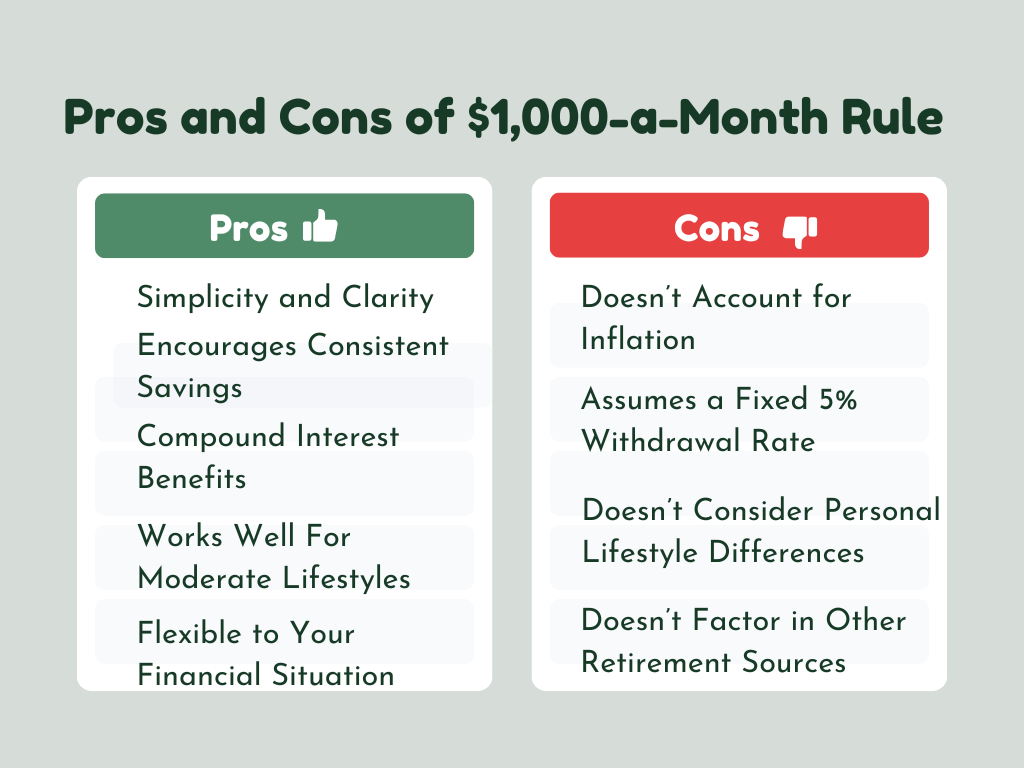
The $1,000-a-month rule is praised for its simplicity and effectiveness; however, is it truly a realistic strategy for everyone?
To determine if this rule is meant for you, it’s important to evaluate the benefits and challenges it presents.
 Pros
Pros
Unlike complex retirement plans, this rule gives you a clear target– save $1000 per month, and you’ll be on your way to a secure retirement. This plan is straightforward to understand and implement for those new to Retirement Planning.
By following this rule, you develop the habit of saving regularly, which is the key to building long-term wealth. Automating your contributions makes it even easier to stay on track.
The rule leverages the power of compounding, where the money you invest grows exponentially over time. The only key to benefit from this effect is to start as early as possible.
If you have minimal expenses and don’t plan on extravagant spending, this rule can help you achieve a comfortable retirement.
One of the strengths of the $1,000-a-month rule is its ability to be tailored to your unique financial situation.
While the rule sets a target of $1000 per month, you can adjust it accordingly depending on your goals, income level, and financial capabilities.
 Cons
Cons
We all know a fixed amount today won’t have the same purchasing power 20-30 years from now.
Inflation reduces the value of your savings, meaning the $1000 per month you plan to save today may not be enough to provide the same standard of living in the coming times.
The rule is based on withdrawing 5% annually from savings, which may not always be guaranteed.
Markets can be volatile; unexpected downturns or expenses might force you to withdraw more, eventually depleting your funds faster.
A retiree in a low-cost city might be fine with this rule, but someone living in an expensive area or with high medical expenses might struggle with the suggested savings.
The main assumption of this rule– your entire retirement income will come from savings– might not be realistic for everyone!
Many individuals rely on Social Security, pensions, or other forms of income in retirement, but the rule doesn’t consider these.
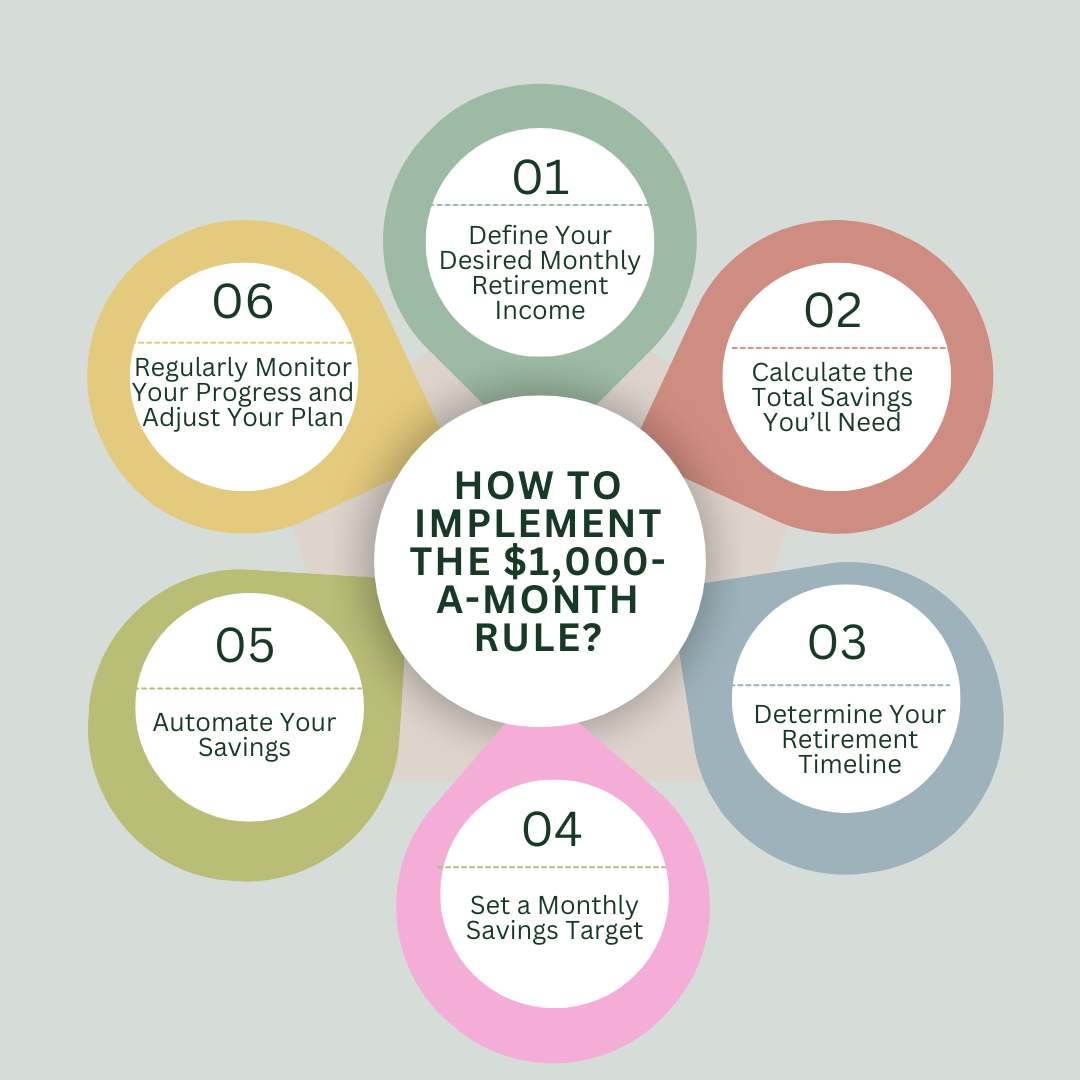
If you are aiming for a predictable income using the $1,000-a-month rule, here’s a simple breakdown of how to implement it effectively:
Start by assessing how much you’ll need in retirement. Consider all expenses you expect to incur during your retirement years:
Based on the rule, for each $1000 of monthly retirement income, you should aim to save 240,000 by retirement, assuming a 5% annual withdrawal rate.
You can use this formula to calculate your total savings goal:
| Total Savings Needed = (Desired Retirement Monthly Income ÷ Target Monthly Income) × Required Savings |
For example, if you want $1,000 per month, the calculation is:
To get a clearer picture of how much you should set aside, try a retirement calculator —it helps estimate the savings required for your ideal retirement lifestyle.
The longer you have to save, the less you need to contribute each month due to the compounding effect. Decide when you plan to retire and determine the number of years you have left to save.
The earlier you start, the easier it is to reach your retirement goals!
For instance, starting at age 25 gives you 40 years to save. Starting at age 50, you have only 15 years to save.
Decide wisely!
Once you have a gist of your total savings and timeline, calculate how much you need to save each month to reach your savings goal.
Here’s a table to give you a very general idea of how much you need to save monthly for your target of $240,000 based on your age:
| Starting Age | Years Until Retirement (Age 65) | Required Savings for $1,000/month Income | Monthly Contribution Needed |
| 25 | 40 | $240,000 | $500 |
| 30 | 35 | $240,000 | $600 |
| 35 | 30 | $240,000 | $700 |
| 40 | 25 | $240,000 | $800 |
| 45 | 20 | $240,000 | $1000 |
| 50 | 15 | $240,000 | $1300 |
The best way to stay consistent with your savings is by setting up automated contributions from your paycheck or bank account into your retirement account.
Most employers allow you to directly contribute a portion of your paycheck to your 401 k retirement plan. If you don’t have access to a 401(k), you can set up automatic transfers to an IRA or another retirement account.
This way, you won’t have to worry about forgetting to save each month.
Once you have set your monthly savings plan in motion, tracking your progress is crucial to achieving your target. If you are falling behind, consider increasing your monthly contributions with the help of the following practical ways:
While the $ 1,000-a-month rule offers a great starting point, its effectiveness depends on your financial circumstances, lifestyle, and location.
 It could provide a comfortable retirement if:
The biggest advantage of this rule is its simplicity, giving savers a clear target. But, solely depending on it shouldn’t be your only strategy. To enjoy a Stress-free retirement, have a plan that works for you!
If you are unsure where to start, Prosperity Financial Group is here to help! Our experienced financial advisors offer strategic, personalized retirement planning tips and guidance to help you confidently build a secure financial future.
The post Is the ‘Rule of $1000’ the Key to a Secure Retirement? appeared first on Prosperity Financial Group | San Ramon, CA.