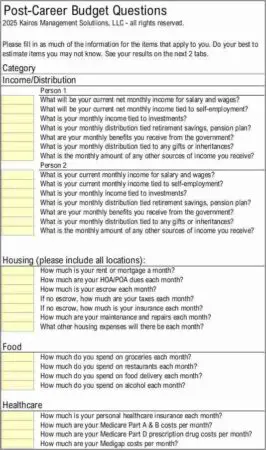

I Love a good budget and financial tracking spreadsheet. I have one that tracks my monthly expenses and gives my wife and I a solid understanding of our spending. I have become more disciplined because I feel I need to be very disciplined when I hang up the work mouse and replace it with the personal mouse.
In my 55-plus community, I see it every day: the difference between a vibrant Retirement and an isolated one often comes down to one factor—Relationships. Some neighbors are always out—playing Pickleball, Volunteering, meeting friends. Others rarely emerge. I’ve caught myself scanning for trash cans just to confirm a neighbor is still around.
The truth is sobering: we spend decades building relationships through work—and then, almost overnight, we lose many of them. If you’re within five years of retirement, now is the time to prepare for this invisible shift. It’s time to create your connection plan.
Money funds retirement, but relationships fuel it. Start Investing in both—today—so the day you clock out for good, you’re already surrounded by the connections that make the next chapter thrive.
Do a quick inventory of your own network. How many of your social interactions are tied to work—clients, coworkers, vendors, professional events?
For most, 50% or more of their social interactions disappear with retirement.
If you don’t replace them with meaningful alternatives, the risk is real:
Financial advisors can’t solve this alone—and neither can you—unless you start planning now.
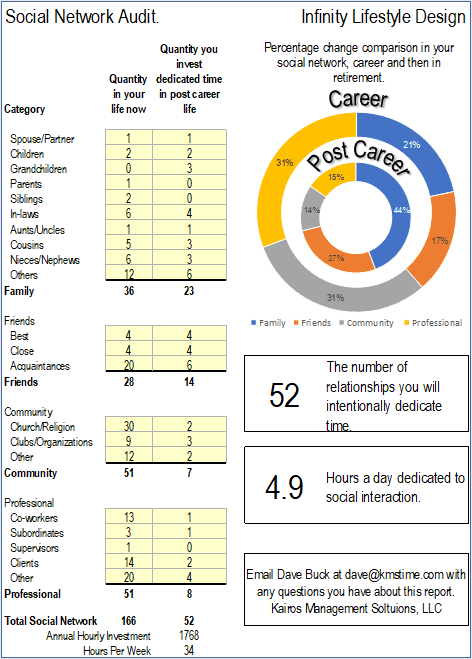
You will see a decline in your social interactions when you retire. The Social Network Audit is a quick way for you to understand the number of relationships you have now, and the ones you will want to invest time in post career to maintain, nurture, and grow.
The best way to make relationships a priority is to make them a line item. Just as you fund healthcare, Travel, and housing, your connection plan should be built on three intentional budget categories:
1. The Travel Budget – Funding Shared Experiences
Everyone budgets for travel in retirement—but most think too generally. Don’t just guess a number. Create a 3-year rolling plan with specific destinations and people in mind.
2. The Family Unit Fund – Making Time for Your People
We often assume we’ll see family more in retirement. That’s not always the case—especially if they live far away or are busy with their own lives.
3. The Friendship Capital Fund – Investing in Non-Family Bonds
Friendships fade fast without proximity. Retirement often means losing daily contact with coworkers and acquaintances who kept you socially afloat.
I must admit, my wife practices this a lot better than I do. She is diligent about meeting with friends and connecting in ways that bring her a lot of relationship value.
One of the most effective ways to prepare socially for retirement is to practice “connection rehearsals” before you leave the workforce. Begin by taking one vacation day each month and using it as a retirement test drive. Schedule a midweek coffee meet-up, visit a museum, or volunteer for a few hours. The goal is to simulate the rhythm of retired life and see how it feels when your calendar isn’t dictated by work.
So while I track my budget and understand the impact of life choices tied to the budget, I need to work better on the emotional side. There is a budget for that as well. How does yours look?
David Buck is the author of the book The Time-Optimized Life, coauthor of The Retirement Collective, and owner of Kairos (Time) Management Solutions, LLC. Learn how to apply the concepts of proactively planning and using your time. Take the Time Management Analysis (TMA), the Retirement Time Analysis (RTA), or all the other free resources offered to help bring more quality time into your life.
The post Strengthening Your Social Life Before You Hang Up the Work Mouse first appeared on Infinity Lifestyle Design.