
First they came for the socialists, and I did not speak out—
Because I was not a socialist.
Then they came for the trade unionists, and I did not speak out—
Because I was not a trade unionist.
Then they came for the Jews, and I did not speak out—
Because I was not a Jew.
Then they came for me—and there was no one left to speak for me.
The United States is still a constitutional republic governed by the rule of law. While most of us watch one cable news channel or another— moderates, right leaners, or left—we don’t often hear stories that feature the writ of habeas corpus. That’s because the writ is settled law, a sacred protection, not bipartisan, not controversial, perhaps the most profound and ancient guarantees of liberty in the history of Western civilization.
The Guardian and other news outlets are reporting that President Donald Trump is exploring the idea of suspending the writ of habeas corpus for undocumented immigrants. In doing so, Trump isn’t just testing a legal loophole — he is openly challenging the foundations of American democracy. That a sitting American president would even consider such a thing should alarm every citizen in this country.
Habeas corpus predates the U.S. Constitution by centuries. Enshrined in English common law in the 15th century and later adopted by the framers of our republic, habeas corpus is the mechanism by which individuals may challenge unlawful imprisonment. Without it, the government has unbridled power to detain people indefinitely without cause, charge, or trial. It has roots in the Magna Carta, became central to English common law in the 17th century, and was embedded in the U.S. Constitution with only one very narrow exception permitted— “in cases of rebellion or invasion.”
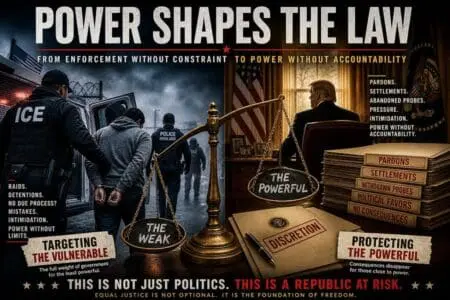
Trump’s willingness to even consider suspending habeas corpus — and for a targeted group based on immigration status — reveals not just his ignorance of American legal history, but his contempt for it. His inclination toward autocracy has never been subtle. From his early declaration that Article II of the Constitution gives him “the right to do whatever I want as president,” to his deployment of federal agents in American cities, to his attempts to overturn a democratic election, the theme is consistent. Authority, in his view, is not derived from the consent of the governed, but from the force of his office.
This is not about national Security. This is not about law and order. This is about raw, unchecked power. This is what authoritarians do. They don’t declare the death of democracy with grand pronouncements. They chip away at its foundations, one by one, until it collapses.
We are neither rebelling nor being invaded. Yet the Trump administration’s interest in circumventing fundamental guarantees of liberty reflects a pattern: the systematic erosion of institutional norms in pursuit of a more consolidated, less accountable presidency. When a sitting president flirts with removing our most critical protection against tyranny, the time for polite disagreement is over. It is time for outrage.
To tamper with habeas corpus — especially in a selective, discriminatory fashion — would cross a Rubicon. It would mark the rejection of the constitutional order in favor of something closer to a monarchy: Trump would enjoy power unchecked by law, insulated from review, and unaccountable to the public.
What makes this moment especially perilous is not just Trump’s ambition, but the passivity of citizens, public officials, and institutions (are you reading this, Congress?) who were once presumed to be bulwarks against precisely this kind of overreach. If a president can arbitrarily detain people — even non-citizens — without judicial oversight, what limits remain?
Trump’s obsession with “total authority,” his use of executive orders to bypass Congress, his demonization of the press, his attempts to control the Justice Department, and now, this — these are not isolated incidents. They are a blueprint for an autocracy. History is littered with republics that fell to strongmen who promised order and delivered oppression.
The American people cannot afford to shrug off this warning sign. Trump’s obsession isn’t just about immigrants. Like the 1930s Germany that Martin Niemoller’s haunting poem warned about, today it’s undocumented individuals; tomorrow it might be political opponents, protesters, journalists — anyone who becomes inconvenient to power. It might be you and your religious, ethnic, or political group.
The genius of the American system has always been its commitment to rights that transcend the passions of the moment. Habeas corpus is one such right. It is not a technicality. It is the line between liberty and tyranny. That line is now under threat.
To every American who claims to care about liberty: If you stay silent now, don’t be surprised when Donald Trump comes for you. The writ of habeas corpus is the last firewall between us and the abyss. Your president is trying to set it on fire.
We, the People, cannot allow this to happen.

Mark M. Bello is an attorney and author of 9 Zachary Blake Legal Thrillers and other legal themed novels and children’s books. For more information, please visit https://www.markmbello.com.