
 The Roberts Court is likely to use the 14th Amendment — drafted to protect Black political rights — to undercut the Voting Rights Act.
A fight over Louisiana’s congressional map has the potential to reshape American voting rights. With Black residents making up a third of the state’s population, lawmakers, for the first time, created two majority-Black districts. Civil rights groups called it long overdue. The Fifth Circuit Court of Appeals called it unconstitutional racial gerrymandering.
The Supreme Court now stands ready to decide: Can states consider race when drawing districts to comply with the Voting Rights Act — or must they ignore it in the name of “colorblind” equality?
Before we answer, let’s provide some historical context:
In 1868, Congress adopted the 14th Amendment’s Equal Protection Clause. The Civil War was over and newly freed Black Americans required civil and political rights. Congress recognized that proactive, race-conscious measures were necessary to under centuries of exclusion. And that’s how things stood for almost a century and a half.
Over the last few decades, however, the Supreme Court has developed a rather colorblind approach to 14th Amendment protections. Cases like Shaw v Reno (1993) and Miller v Johnson (1995) made it harder to justify race-conscious gerrymandering. Furthermore, Shelby County v Holder (2013) ended the concept of “preclearance” in voting rights cases, Brnovich v Democratic National Committee (2021) gave states more leeway to impose voting restrictions even if they disproportionately affected minorities, and Students for Fair Admissions v Harvard (2023) struck down the use of race as an explicit factor in public college admissions under the Equal Protection Clause and private colleges under Title VI of the Civil Rights Act.
One side sees race-conscious measures as a necessary corrective to centuries of exclusion while the other sees them as unconstitutional racial favoritism. But a clear pattern is emerging, suggesting that race-conscious remedies will no longer pass constitutional muster. These days, even if the aim is to ensure minority representation under the Voting Rights Act (VRA), the courts will strike down a map if race appears to have driven the line-drawing more than traditional redistricting principles (compactness, contiguity, respect for political boundaries).

Supreme Court to rule on Louisiana Congressional Map and Voting Rights Act
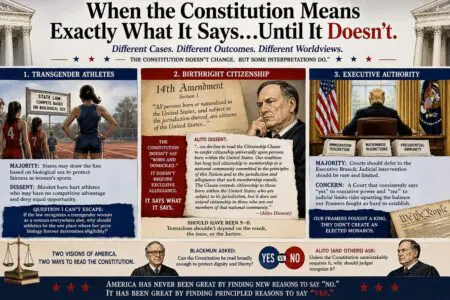
As the above graphic illustrates, this spells trouble for the Louisiana map at issue in in this latest case. My prediction? The Conservative majority on the United States Supreme Court will likely strike down the Louisiana map and make it far harder to create majority/minority districts anywhere in the country. Section 2 of the Voting Rights Act will likely be rendered almost pointless.
If struck down: Expect fewer minority-majority districts, more litigation against them, and a redefinition of “equal protection” that works against the very communities it was meant to shield.
If upheld: The VRA would live for now, but only narrowly, and likely with a ruling so specific to Louisiana that it offers little nationwide protection.
Either way, the ruling will echo far beyond Louisiana — setting the terms of racial representation in Congress for a generation. The 14th Amendment was written to protect Black voters. The Trump Supreme Court will now use that same amendment to take their voting power away.
That’s what you voted for, America. Proud of yourselves?

Mark M. Bello is an attorney and author of 9 Zachary Blake Legal Thrillers and other legal themed novels and children’s books. For more information, please visit https://www.markmbello.com