
During my 40+ years in the boating world, I’ve seen my share of memorable yachts. I never grow tired of seeing classic racing sloops’ beautiful lines. The vessels’ yacht club race wins, and their victories in the Annapolis-Bermuda Races, are a testament to their world-class design and construction.
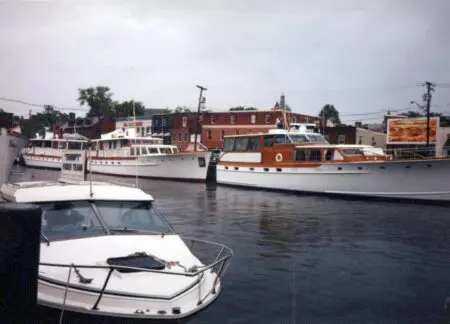
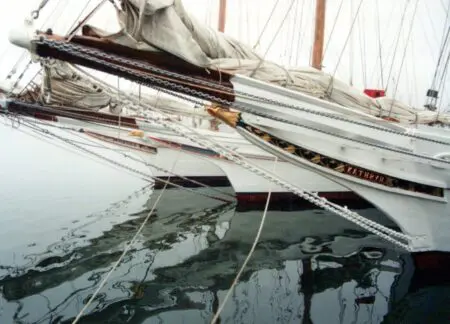
In 1990, the J-class America’s Cup yacht Endeavour briefly visited Annapolis and Baltimore. My husband and I dropped everything to pay this grand old lady a visit (and that’s a topic for another column). And I still remember the early-20th-century Trumpy motoryachts that occasionally cruised into Annapolis. The wooden vessels’ majestic lines and gleaming brightwork (wood trim) were truly a feast for the eyes.
But as much as I Love fine yachts, I respect the countless workboats that troll the coastal waters, searching for seafood. The local captains who stalk those crafty fish, and the crabbers who cruise the bays and creeks, continue a tradition that’s endured for generations. And the shrimp trawlers have their own rugged character. I enjoy seeing them chug along, followed by seagulls and pelicans hoping to snag a free meal. Here are four salty workboats I have seen in my travels on the water.
The increasingly rare Hoopers Island Draketail is the first Chesapeake Bay boat built around engine power. The pre-World War I design came from Hoopers Island on Maryland’s Eastern Shore. Until the 1950s, the 35-to-45-foot Draketails were often used for oystering and crabbing.
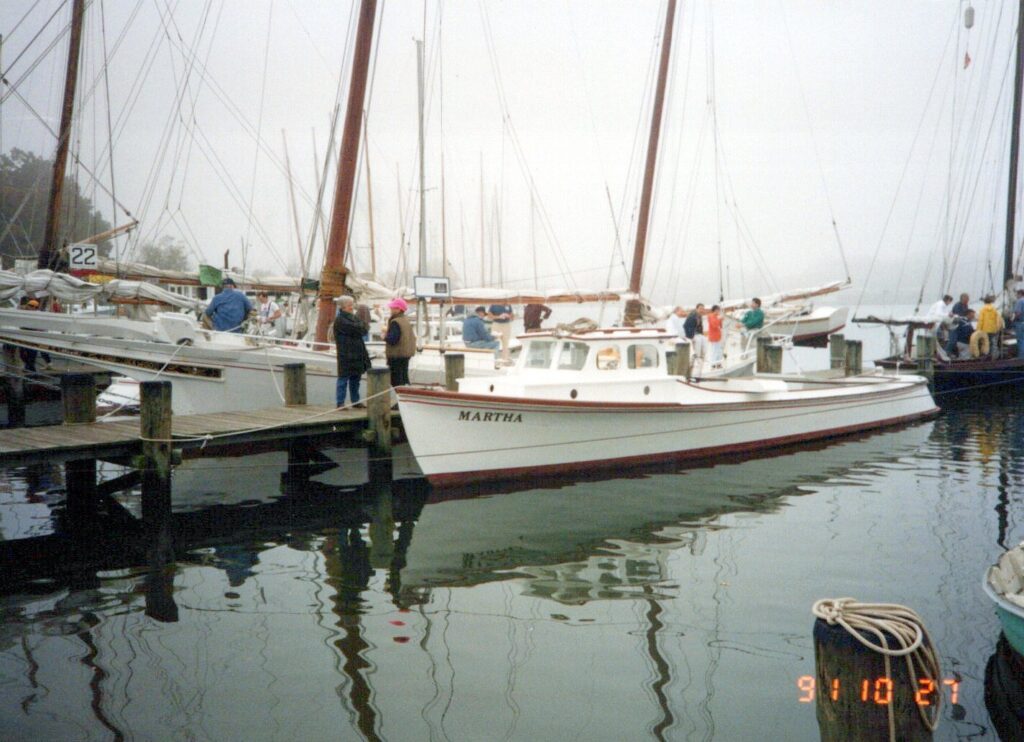
The term “draketail” pertains to the vessel’s reverse-raked stern, shaped like a duck’s back end. This stern configuration gives the boat pleasing lines, but it makes the vessel inefficient (and somewhat slow) in the water. The Draketails also tended to leak and were tougher to maintain, making other workboat designs more popular.
Today, fewer than 20 Hoopers Island Draketails survive. In 1989, the 1934 Draketail Martha was donated to the Chesapeake Bay Maritime Museum in St. Michaels (see photo). We felt fortunate to see lovely Martha at Chesapeake Appreciation Days.
Living just outside Baltimore, my Family often crossed the Chesapeake Bay Bridge to reach our Ocean City, Maryland summer vacation spot ─ right on the Atlantic Ocean. Getting to “The Beach” was the important goal, so I didn’t pay much attention to the boats passing under the Bay Bridge’s soaring span.
That all changed when my life began to revolve around the Chesapeake Bay. Back in the mid-1980s, I joined a very large sailing club that sponsored weekend and weeklong cruises to the Bay’s creeks and rivers. After I met my husband Mark, he joined me on many adventures. Each cruising weekend, our captain’s boat would navigate dozens of crab pot floats, each connected to a metal crab pot on the bottom.
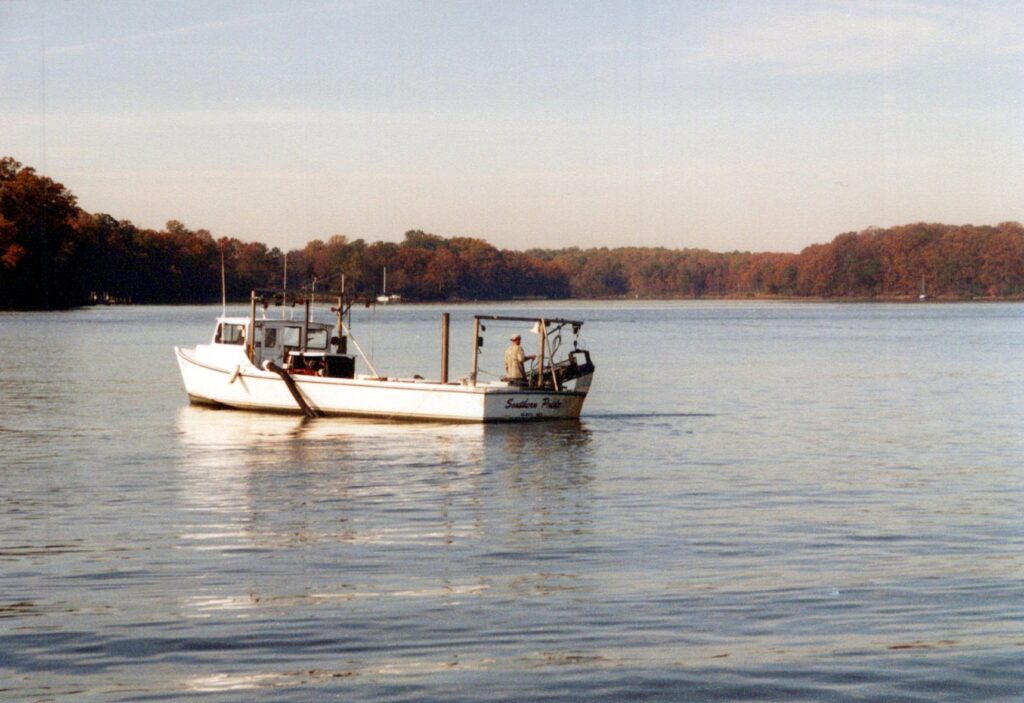
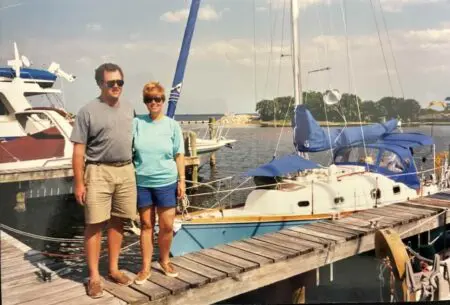
When we purchased a house in an old fishing village south of Annapolis, and bought our Bristol 30 sailboat, we focused on spending more time on the water. Living a mile from an old-school local marina, we were fascinated by the traditional workboats docked near our sailboat. We got an up-close-and-personal look at several Chesapeake Bay deadrises (and one boat’s very salty captain).
Beginning in the late 1800s, and lasting through much of the 20th century, most crabbers and oystermen owned a Chesapeake Bay deadrise workboat. Usually between 35 and 45 feet in length, and generally with a wooden hull, these shallow-draft vessels can chug along just fine in two to three feet of water.
Each deadrise has a knife-edge bow, transforming into a flat-looking “V” going toward the back of the boat (bow to stern). The deadrise’s front section has a compact cabin, allowing the captain to escape the Chesapeake Bay’s often-nasty weather (see photo).
But the Chesapeake Bay deadrise’s focal point is its spacious cockpit and rear work area. Deadrises have historically used either gasoline or diesel engines, but deep-throated diesels have proven more reliable.
The crab dredger Old Point is a great example of a purpose-built boat. In 1909, this venerable vessel was constructed from seven pine logs fastened together and carved into the desired hull shape. Old Point joined a fleet of Hampton, Virginia crab-dredging boats that patrolled the lower Chesapeake Bay during the first half of the 20th century. The vessel’s rear wheelhouse steering and low deck gave the captain great visibility while offering plenty of deck space for crabbing operations.
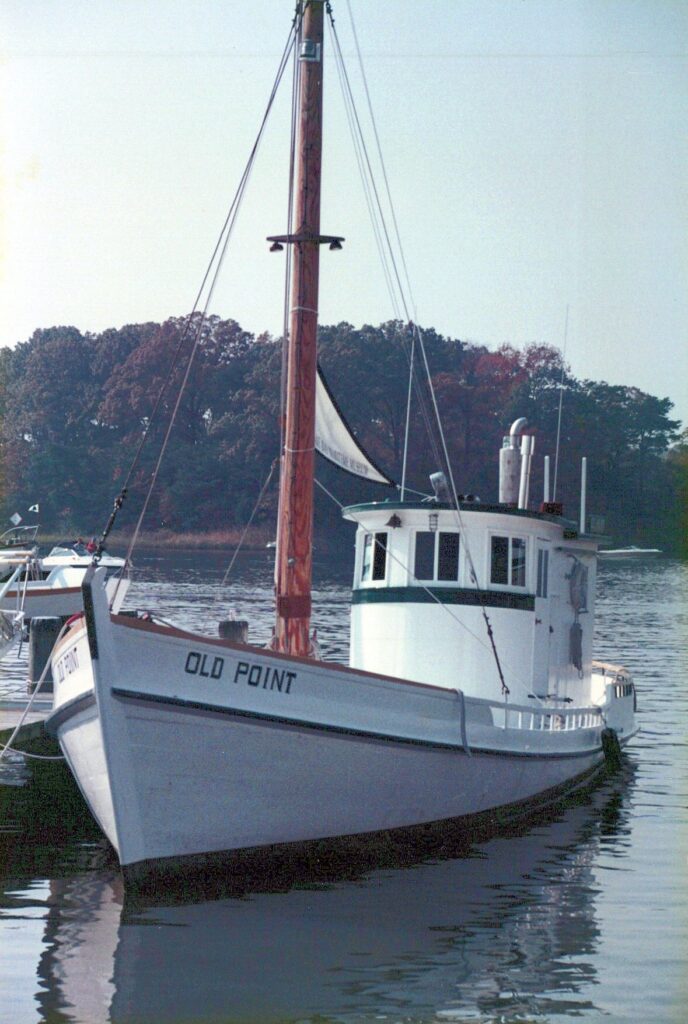
Old Point was well equipped to dredge crabs during the winter season (December through March). Her captain and crew stayed on the boat for weeks at a time, giving them more time for Money-making dredging work. During the warmer months, Old Point functioned as a buyboat, transporting other vessels’ fish and oysters to market or to packing houses. We saw the beautifully restored Old Point at the Chesapeake Bay Maritime Museum in St. Michaels, Maryland (see photo).
If you enjoy feasting on wild-caught shrimp, you might thank the shrimp trawler captains and their crews. During the shrimping season, these beefy diesel-powered workhorses trawl the Atlantic Ocean from their coastal Southeastern ports. Many shrimp trawlers are also based in Gulf of America harbors. During our Maryland to Florida sailboat cruise, we saw shrimp trawlers in coastal ports and rivers (see photos). And here in Florida, we recently saw several working trawlers at a backwater marina just off the Gulf.
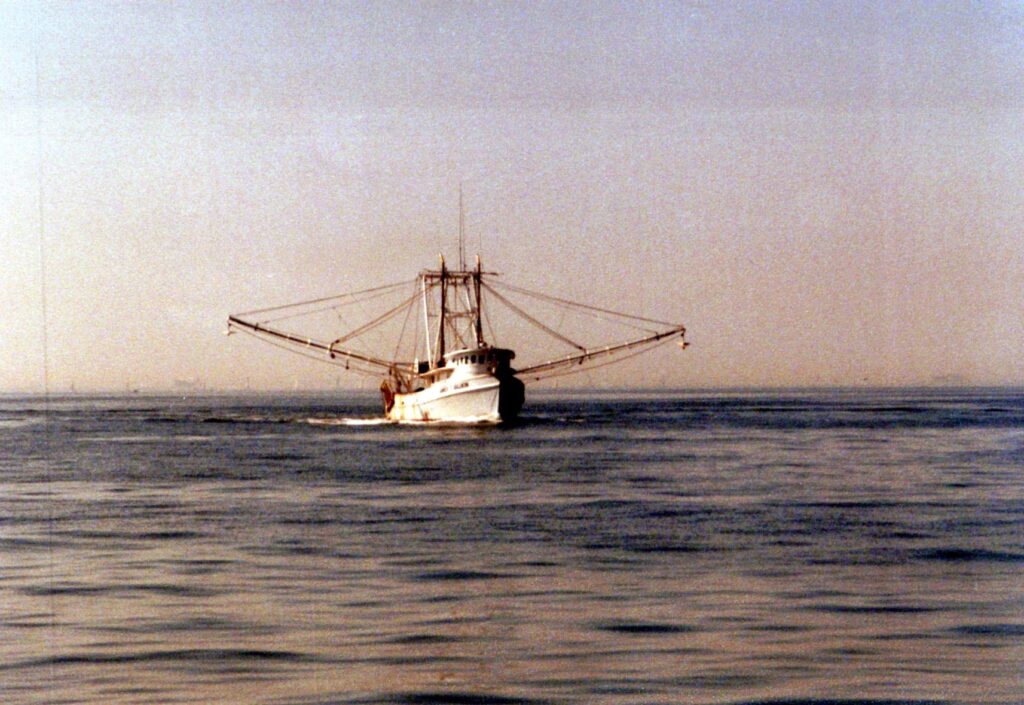
Built for punishing seas and strong winds, most metal-hulled shrimp trawlers average 55 to 78 feet in length. These vessels boast high bows that can withstand constant crashing waves. The hard-working shrimp trawlers are rarely in pristine condition, and they often need cleaning and a new coat of paint. However, the captain must still provide all required safety gear and follow accepted safety protocols.
Next, here’s how shrimp trawling works: Once a vessel reaches the shrimping grounds, the boat executes low-speed runs (or drags) across the ocean swells. The boat pulls a net (or trawl) through the water behind the stern. The trawl scoops up shrimp from the bottom or mid-layer of water. The entire process can take 30 minutes to three hours, depending on the sea conditions and the shrimp harvest.
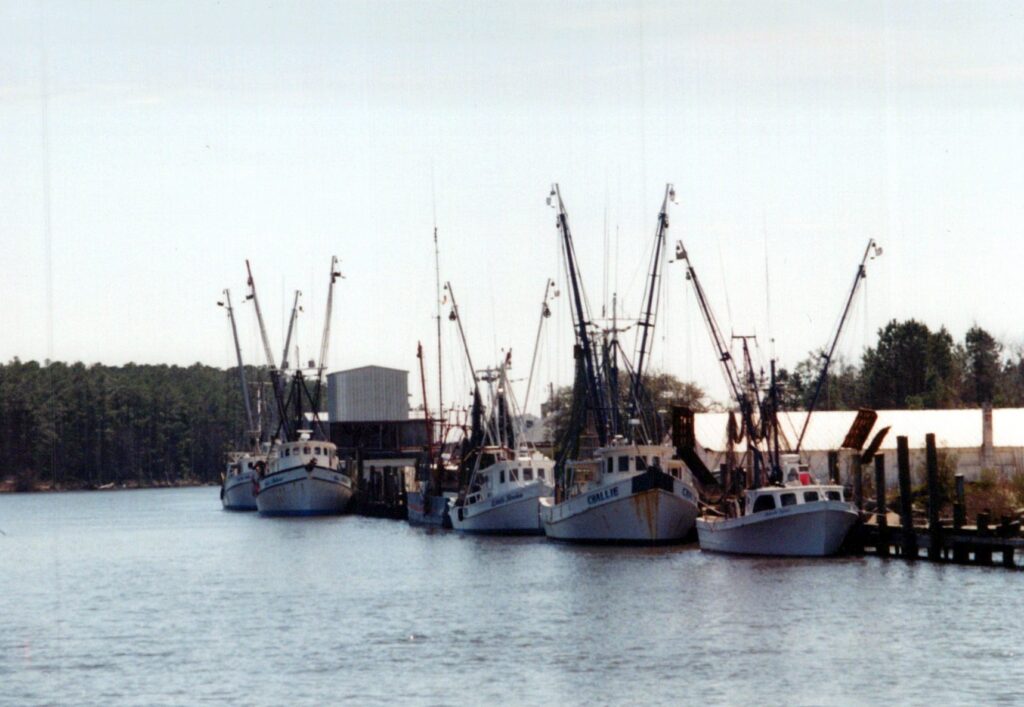
Not surprisingly, running across the ocean swells causes the trawler to pitch and roll. To mediate this uncomfortable motion, the boat’s tall, mast-like outriggers lower hydrofoil stabilizers into the water. With less pitching and rolling, the crew can work more efficiently and safely.
Each drag produces “bycatch” (or sea creatures other than shrimp). By law, each trawler must employ a Turtle Exclusion Device that keeps large sea turtles out of the net. The Bycatch Reduction Device enables small fish to simply swim away.
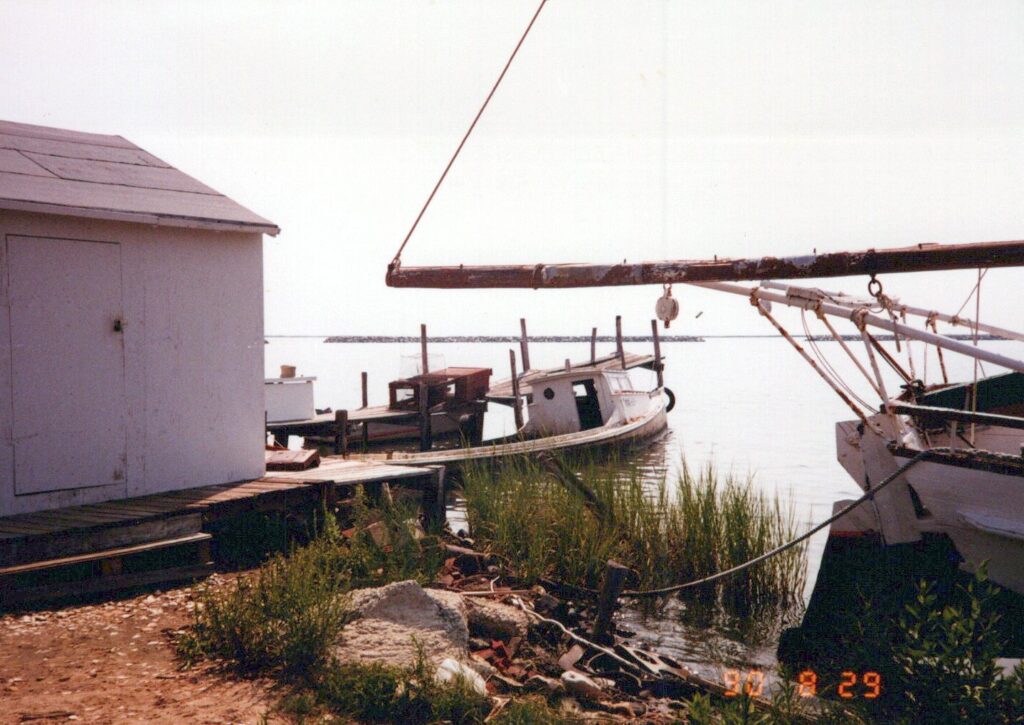
I’m always happy to see a well-cared-for wooden workboat bobbing at her dock. To me, this salty girl is waiting for her captain to fire up the engine and head out to tend his crab pots. However, many wooden workboats aren’t this lucky. They sit abandoned and forlorn, and many eventually sink at the dock (see photo). But in any condition, these trusty workhorses provide a window into an era where hauling a full hold of seafood is the proof of a job well done.