

I bought The Timetables of History, the book pictured above, in 1982. Written by Bernard Grun, Czech historian, philosopher, composer and musicologist, the book began as a translation of the German Kulturfahrplan (The Culture Timetables), first written by German physicist Werner Stein in 1946.
Both books show what is going on at any point in history across several domains. The “American version” I own looks across seven categories:
It makes for fascinating reading. For instance, 500 BCE was a busy time. You can marvel at the fact that within 50 or so years in either direction you find Lao-Tse, Confusius, Buddha, Zoroaster, many early Jewish prophets, the first references to the Torah and the five books of Moses, Persian leaders Darius and Xerxes, the founding of the Roman Republic, Periclean Athens, Pythagoras, Heraclitus, Hippocrates, Socrates, La Tene Celtic culture with all those swirling designs, “Hanging Gardens of Babylon,” the invention of the turning lathe and carpenters square, and on and on.
In contrast, a thousand years later, in 501 CE, apparently nothing happened across all seven domains. In fact, there were a lot of years like that in the 500s and the 700s.
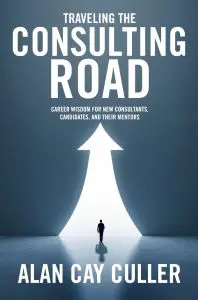
In my book, Traveling the Consulting Road: Career Wisdom for New Consultants, Candidates and Their Mentors, I trace the history of the profession as we know it from the late 1800s through the early 2000s. I think it is important for consultants to understand where they came from. I describe two primary streams of consulting, content consultants and process consultants, which developed separately but in parallel.
Many have argued that “there have always been advisors.” Some quote the story of Joseph advising Pharoah in the Bible, (“seven fat and seven skinny cows mean good harvests followed by famine; it’s time for an inventory management and warehousing strategy,”).
I take this point, but still believe that business consultants as a profession started with Frederick Taylor, Arthur D. Little, Edwin Booz, James O. McKinsey, and Marvin Bower on the content side, and Frank and Lillian Gilbreth, and Elton Mayo on the process side.
I picked up The Timetables of History this morning and I flashed on my career and the mind-shaking events and influences on the field over the last 50 years.
I started looking at the consulting industry about the time my copy of this book ends, 1978. (There is an updated version published in 2005.) This is after the early Bruce Henderson/Boston Consulting Group (BCG) led “strategy revolution,” and the publication of Michael Porter’s Competitive Strategy, but just before McKinsey consultants Tom Peters’ and Bob Waterman’s book, In Search of Excellence, which encouraged business leaders to focus on culture, “loose-tight” and “close to the customer.”
I was so enamored with the glamour around strategy, and the expert answers of content consulting that I completely ignored the new culture work by Dr. Edgar Schein. I thought consulting was about information, research, analytics and advice.
Of course, I now know business consulting is about helping people change, do things differently, or do different things, to increase revenue or profit, or both. My frame change for consulting over my early career, has been mirrored in the field. “Change management” used to be looked down upon; now in the age of Artificial Intelligence, (AI), it’s a hot discipline.
As I look at the consulting industry during the time I have been following it, I am struck by the impact of technological Innovation and social change on client projects and how the industry worked. Here are some changes I experienced firsthand:
In the spirit of The Timetables of History I could go on to other domain events that had a huge impact on consulting, e.g., Y2K, the attacks on 9/11, the 2007-9 financial crisis, the global pushback to globalization, the COVID-19 pandemic, etc. There have been and will be more, but I see technology, specifically artificial intelligence as having the next biggest impact.
As I look over The Timetables of History, it becomes clear that we humans have lived through periods of intense change, often followed by some resistance and regrouping. During the period of my almost forty-year consulting career, the changes were huge. I think we are facing still more huge change, and I’ve hypothesized what some of those changes might be and how to approach them in the short term.
Consultants will adapt, some faster than others. What I think is useful preparation is:
One more thing, in coping with tremendous change, keeping an eye out for absurdity and a finely tuned sense of humor helps.
Technology is our friend. Our chat-bot overlords have our best interests at heart. Soylent Green is rich in protein. Technology is our friend, (?).
What could possibly go wrong? … go wrong… go wrong….
The post The Timetables of Consulting History appeared first on Wisdom from Unusual Places.
Originally Published on https://wisdomfromunusualplaces.com/blog/