

The most powerful thing at ATD this year wasn’t on any slide. It was in the space between people.
I had a problem at the International Association for Talent Development Conference last month. A good one.
I couldn’t get people to stop playing.
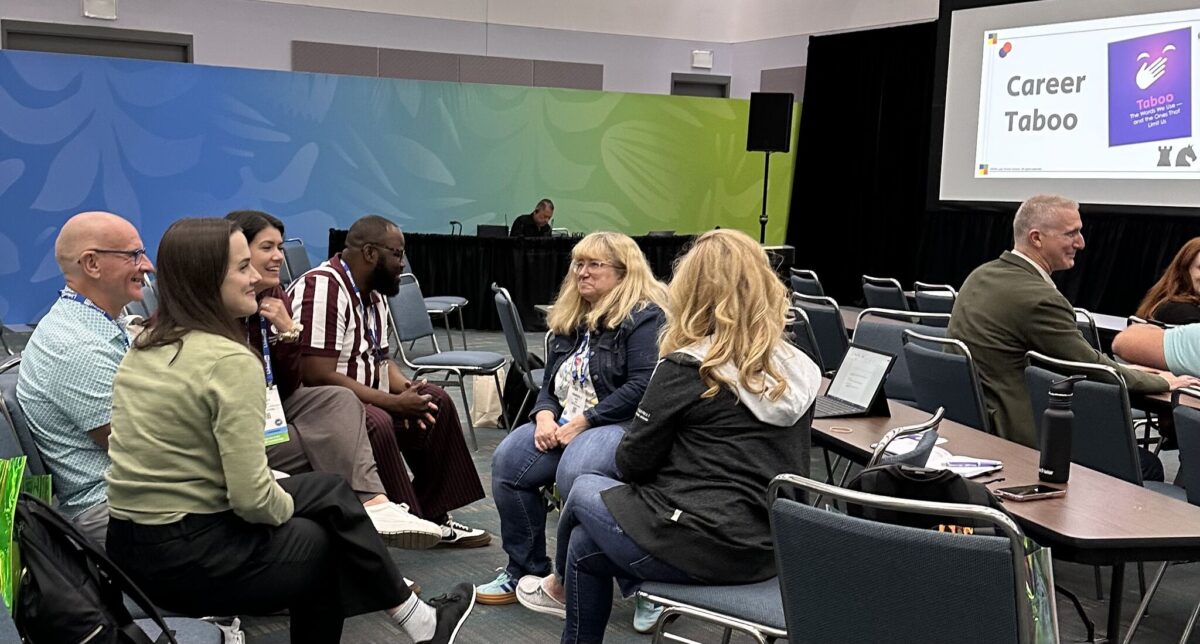
In my session on using games for career development, participants dug into each Exercise with an intensity I genuinely didn’t anticipate. Pulling them back for debrief felt almost rude — the conversations were that alive. One attendee actually interrupted the session to share that every game, he said, would work across his entire organization — from frontline to executive — and spark the kind of cross-level conversations that most development programs never manage to produce.
In another session on career agency, the energy was different but equally unmistakable. The idea that landed hardest? Ownership is dead. The expectation that employees simply “own” their careers — static, solitary, self-directed — is no longer sufficient in a world where roles shift, skills evolve, and the path forward has to be designed in real time. People wanted something more agile. More iterative. More honest about what Growth actually requires today. Several told me it was the best session they’d attended all week.
I share this not to brag — but because I think something important was happening in both rooms. Something worth paying attention to.
“We’ve spent years optimizing learning for efficiency. Faster. More scalable. Available anywhere, anytime, to anyone. What we optimized away, quietly and without much fanfare, was friction. And friction, it turns out, is often where the real growth lives.”
Technology has given us extraordinary tools for delivering content. AI is accelerating that further. These are genuine capabilities — and smart organizations are wise to use them. But there’s a category of learning that doesn’t happen through a screen, at your own pace, alone. It happens in the presence of other people. When someone across a table challenges your assumption. When a game forces you to say something out loud that you’ve never quite put into words. When you realize — mid-conversation with a stranger who’s now not a stranger — that you’ve been thinking about something all wrong.
That’s not nostalgia. That’s neuroscience. That’s organizational development. And in a moment when so much of work is becoming more automated, more asynchronous, and more isolated, it’s becoming more valuable — not less.
The hunger I saw at ATD isn’t a conference phenomenon. It’s a workplace phenomenon. Your people are feeling it too. They’re not lacking content. They’re lacking context — the human, relational context in which learning actually takes hold.
“Your people aren’t lacking content. They’re lacking context — the human, relational context in which learning actually takes hold.”
The good news: you don’t need a conference in Los Angeles to create it. You need the right ideas, the right experiences, and a room — physical or virtual — where people can think alongside each other. And that’s still entirely within reach.
If career development, employee agency, or making learning more human are challenges your organization is grappling with, I’d Love to talk. Both of these sessions — and more — are available as onsite and virtual workshops. Reach out and let’s explore what’s possible.
The post What the Room Knows appeared first on Julie Winkle Giulioni.