
Even though I am in my sixties, I still consider myself blessed to have a mentor who has played an important role in my career development. Ben has assisted me in many ways, and he has been so helpful sharing with me how he makes the most of Retirement life.
On one occasion, Ben counseled me on planning important activities at the front end of post-career life.
“I went back to our advisors on three separate occasions and asked them to rerun our models to increase our yearly allocated budget for the next three years.” Ben told me. “Paula and I want to take a lot of trips we have been putting off. We both sense we have limited time before we may not be able to Travel because of our age and Health. We feel after a few years, we’ll then be spending less Money and want to take advantage of the opportunity.”
Ben shared that his advisors were on board with his request because the plan supported it, but they also cautioned him that expenses could rise again during the last part of life. Without using the terminology, he was describing what researchers call the retirement spending smile.
The Retirement Time Analysis (RTA) provides time benchmarks to help you understand the the impact that retirement will have on your approach to life should you choose to stop working.
If you have read any of my work here on Rethinking65, you know I am not a financial professional. So, when I became aware of the principle of the spending smile, I was curious.
Data suggests that real (inflation-adjusted) retirement spending tends to follow a U-shaped pattern. Travel, hobbies and experiences tend to push spending higher in early retirement. Then routines tend to set in and fewer larger purchases occur. However, expenses rise again in later years, primarily driven by healthcare.
For many of you reading this, I am not telling you anything you don’t already know. Financial advisors are increasingly comfortable modeling this spending curve. The numbers are manageable. What is less frequently modeled is whether the client’s Lifestyle aligns with that curve.
Data from my 2025 Retirement Time Analysis (RTA) suggests a disconnect between financial readiness and lifestyle Clarity.
For context, the average RTA participant:
In addition, a significant portion of respondents still report that career identity remains important as retirement approaches. That creates friction.
Advisors may model a spending smile, but clients may not yet have designed a lifestyle to match it. This is where the lifestyle smile becomes a practical planning tool.
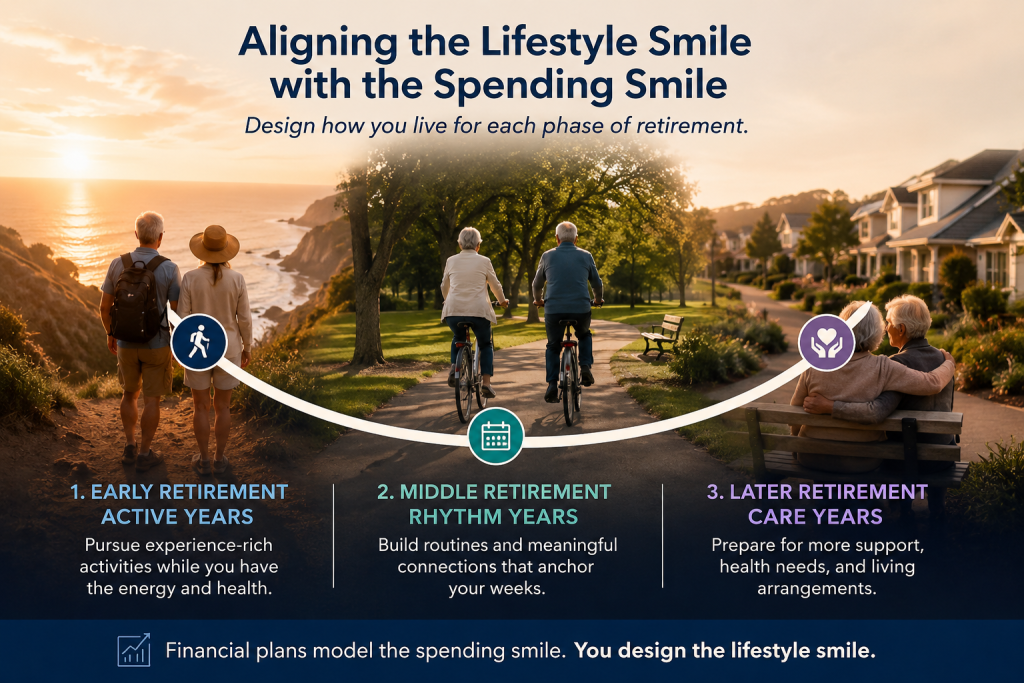
By applying the principles of a financial smile, instead of a level and ordinary life throughout retirement, advisors can coach clients to run lifestyle models aligned to three phases.
The early years of retirement are often the most active phase of post-career life.
Data from the RTA shows that many participants anticipate traveling three to four times per year, alongside renewed engagement in hobbies, continuing Education, and volunteer exploration. It is the stage of retirement where energy and opportunity tend to intersect.
Advisors can help clients use this window intentionally by asking focused questions: “What experiences require your current health and energy?” and “What is on your three-year lifestyle plan?” Encouraging clients to front-load meaningful activity during these years aligns lifestyle design with financial modeling.
Mid-retirement often settles into a more predictable rhythm. Travel tends to moderate, large bucket-list items diminish, and daily routines become more established. At the same time, social circles can gradually narrow as peers relocate, face health challenges, or become less active.
The questions to ask in this segment shift from experience accumulation to rhythm creation. Instead of asking, “Where are you traveling next?” the conversation becomes, “What anchors your week?” Encouraging weekly social commitments, recurring volunteer roles, and disciplined health and wellness routines can create durable structure.
Later retirement often shifts toward increased medical oversight, potential housing transitions, and greater reliance on support systems. The RTA data notes that being financially ready on paper and feeling ready are often two different experiences. This stage requires both technical preparation and emotional foresight.
Advisors should align healthcare projections, Estate planning, and living arrangement contingencies while also preparing clients for lifestyle adjustments like community continuity, proximity to Family, and simplified routines. When the lifestyle smile anticipates these realities, healthcare-driven spending increases feel planned rather than destabilizing.
When Ben increased early withdrawals, it was not emotional spending. It was intentional alignment.
Advisors who connect the lifestyle smile with the spending smile align portfolios to life-stages. Clients gain more clarity on lifestyle options and withdrawals feel more purposeful and less fearful. Healthcare costs feel anticipated or even expected. Transitions feel less abrupt and accepted as reality and not reactionary.
The spending smile is already widely discussed in financial planning circles. The competitive advantage now is helping clients design the corresponding lifestyle curve. When both curves align, retirement becomes not just sustainable but coherent and real.
This article originally appeared in Rethinking65.
David Buck is the author of the book The Time-Optimized Life, coauthor of The Retirement Collective, and owner of Kairos (Time) Management Solutions, LLC. Learn how to apply the concepts of proactively planning and using your time. Take the Time Management Analysis (TMA), the Retirement Time Analysis (RTA), or all the other free resources offered to help bring more quality time into your life.
Content development for this article involved human expertise supported by AI-generated analysis and formatting.
The post Aligning Your Lifestyle Smile with Your Spending Smile first appeared on Infinity Lifestyle Design.