

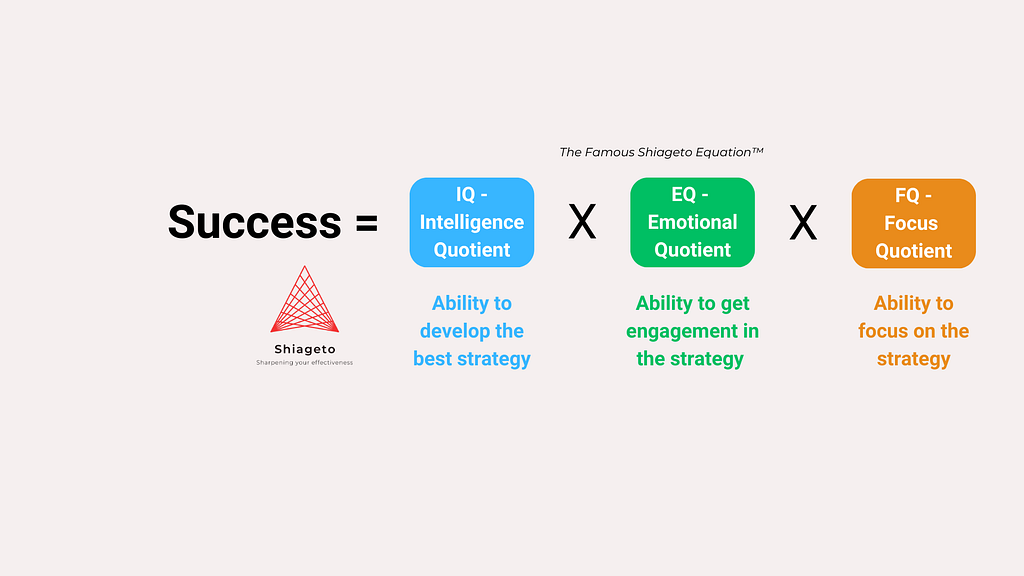
In theory, we are at the best time in human civilisation for each and every one of us to be outperforming our own goals and stretching our own effectiveness.
Thanks to the internet, AI and the fact that most of us walk around with far more computing power in our back pockets than the equivalent used by NASA to put humans on the moon in the 1960s, we shouldn’t be short of smart ideas (IQ) on how to achieve most goals.
Throw in the fact that our current age is the safest, (even with the current shenanigans in the Middle East), healthiest and most connected that humans have ever had; which means we should be able to take more risks and be more supported than ever.
So, why isn’t this translating into far more of us succeeding at work and in our personal lives?
Lack of focus is a big factor!
I don’t know about you: I may have access to the combined knowledge of humankind but I still find myself spending way too long doom scrolling on social media.
Not only does this minimise my focus (FQ) but it also impacts my thinking (IQ).
Even when we put the cat videos aside; it’s hard to achieve one’s goals when we are awash with a tsunami of choices, distractions and interference from others/organisations that prioritise and push their own goals onto us.
In many situations it’s far too easy to choose inertia or a sub-optimal option because of these pressures — again a negative impact on our FQ and IQ.
Lack of collaboration and higher stakes is another real problem
Whilst being more connected allows us to communicate more easily than ever with many more people, unfortunately it also means that we are each subjected to more opinions than ever and more pressure.
Increasingly these manifest in the forms of greater polarisation and resistance making the necessary collaboration and alignment harder — thus negatively impacting EQ.
In a time when AI is removing the need for conversations between us, the ability to collaborate effectively will get even harder.
I’ve been long fascinated with this topic of effectiveness; initially for my own life but increasingly for clients and connections too.
As someone who has written many strategies at the highest level for some of the biggest companies in the world, I wanted to understand why 90% of those strategies never reached full success.
It always boiled down to a problem of IQ (thinking and creativity), EQ (collaboration and alignment) or FQ (focus and efficiency) — sometimes it was a problem with all three.
When working with teams to design or deliver these strategies, these problems would often manifest in behaviours like:
Put even a small combination of these together and no wonder performance was down and goals never got achieved.
For the most case, these are not intentional behaviours, nobody actively wants to be this way. However, we live in a time when we are inundated with too much noise and we are intentionally forced to make decisions and act quickly, trading more controlled thinking for short bursts of dopamine — that’s why we take shortcuts and the behaviours above pop up as a result.
The purpose of these IQ, EQ and FQ guides is to be an Antidote to that.
I realised that most of the teams I worked with already had access to the solutions that would help them progress past these behaviours (it’s not like they were stupid); in the fast pace of life, they just failed to grasp them in time.
I regularly am in rooms full of senior leaders who are more successful than me and yet, I am the one tasked with improving their effectiveness.
How can this be? Especially in the times I enter a room where I know next to nothing about the topic; I’m not the content expert but still I am invited to help them succeed.
This is a common phenomenon for me; across a standard month I’ll work with teams of scientists, lawyers, bankers, engineers, teachers, humanitarians, retailers, supply chain practitioners, consultants, HR leaders, strategists, manufacturers, hospitality professionals and more.
In most of these rooms, I’m not even in the top half of intelligence; the people there already know most of the things I will show them — the problem is they are just not doing them.
I have a hypothesis that most of us have 99% of the knowledge we need to be successful in life, we are just not applying it.
But knowing something, and doing something are two completely different things. When it comes to knowledge, we absorb a lot of it but rarely use most of it when making decisions — what if we could?
My job nowadays is to unlock that key knowledge at the right moment, unlock that crucial change in behaviour, unlock that immediate improvement in performance — to bring about instant IQ, EQ and FQ improvements; this is the Antidote.
When I first started addressing this performance challenge, I looked to the literature and gurus who work on strategic effectiveness to see what they were saying.
I discovered that the majority of this advice focuses on mindset and motivation (the inner game) rather than providing actual practical steps to make change happen (the outer game).
This is all good and well but motivation can ebb and flow; genuine mindset change needs long-term Coaching and support.
The work I do needs to be more immediate; big corporates aren’t going to park the strategy process until such a point that every member of the team has “worked on themselves”.
And the nucleus of the answer came from an unexpected source: my previous career as a school teacher.
At the start of my career, I had spent 6 years teaching students in different countries Maths and Economics; the beauty of teaching Maths in particular is that anywhere in the world there will be a healthy subset of each class that hates/doesn’t understand Maths. That meant their participation each lesson was slow, resistant and always with less than 100% of IQ, EQ and FQ.
Unfortunately for them (and me), Maths was mandatory so they had to be in the room.
In my first year as a teacher, I tried working on their Inner Game to get them to embrace the subject; things like trying to light a spark around maths, trying to reason with them, shouting at them, etc. All these had minimum actual impact.
It was only when I started using Outer Game techniques like gamification, reframing, simplification, flexing my style that I began to see amazing leaps in progress.
It was these techniques that I “lifted and shifted” into my corporate work when I realised that I was surrounded by the same patterns; we are all just big kids after all and we all capable of falling into the same behaviours of resistance as those Maths-hating students.
Partly by design and partly by chance, I found these techniques brought great success across the spectrum of clients I worked with.
Instead of giving them a powerful speech about why they needed to do things differently, I found using one of my teaching techniques at the right moment led to improvements.
Eager to make more of an impact, I doubled down on looking for other techniques that would work to nudge or change behaviours in the moment rather than wait for some epiphany — I call these: Super Interventions.
I mastered a way to deliver them predominantly through Facilitation of groups but Training and Keynote Speaking became other ways to make a Super Intervention.
To expand my portfolio of Interventions, I read research papers and books on human behaviour. I listened to hundreds of performance podcasts and watched videos with recognised Experts. I attended a plethora of conferences to hear leadership speakers from the world of sport, psychology, medicine, Finance, science, Education, professional services and more discuss how to make organisations highly effective.
There were plenty of ideas: some novel, some mainstream, some wacky, some extreme. Everything I discovered, I treated as a hypothesis (one person’s sure-fire way is merely an experiment to test because every situation has different variables) and went and trialled it on myself and/or the next team I was working with.
If the Intervention was a success I would continue using it; if it was a dud I would refine or abandon it.
Over time, this led to my own proprietary toolkit of Super Interventions growing and growing; until I reached a point that I could confidently walk into any situation and be fairly certain that I could enhance the IQ, EQ and FQ of whatever I faced.
I became a sort of Effectiveness Personal Trainer. Similar to how if you wanted to get fitter you could train on your own but if you hired a personal trainer, they would watch you as you train and make changes in real time to how you are doing things so you get more out of your workout; I began doing this for the teams I worked with and instantly they became more effective.
Often when people talk about performance they recommend playing to strengths to get further ahead but ultimately situations will always be held back by their weaknesses so that is where interventions are better focused — if a strategy isn’t sharp enough then an IQ intervention is introduced, if an event lacks EQ then that’s where we double down, if an organisation lacks FQ then that’s the fix we need.
Similarly individual superstars are fantastic to have but ultimately they can only go so far alone. That’s why at Shiageto we focus on teams; get them performing and even more amazing things can happen. Also, the problem, as every high-achiever will tell you, is that it doesn’t matter how good an individual becomes, if they then have to operate in a sub-optimal environment, their performance will be muted.
As such: “Focus on cleaning the pond over cleaning the fish” and “Raise the floor not the ceiling” are the mantras to follow when it comes to effectiveness.
Whilst the Super Interventions are the key, you must also provide copious amounts of feedback so that poor behaviours are visible.
Generally, most people don’t get enough feedback in life (particularly not in some cultures) and this can feed into the overconfidence or lack of awareness that generates some of the behaviours listed above.
By combining feedback and Super Interventions the goal is to nudge more positive behaviours so that they begin to happen automatically — the equivalent of turning people’s brains into an LLM where they retrieve the best response to a situation not just the first.
I appreciate this might still sound difficult to comprehend and “too good to be true” but I will be bringing them to life with 12 playbooks you can use in any situation; first stop will be how to increase the IQ, EQ and FQ in any team.
Make sure you don’t miss it — sign up for the newsletter, save the articles.
Crucially whatever you read, treat it as a hypothesis and start experimenting with the new techniques.
I hope you find them useful and look forward to hearing how you all get on 🙂
Faris
Faris is the CEO and Founder of Shiageto Consulting, an innovative consultancy that helps firms and individuals sharpen their effectiveness. Connect with him here
Success = IQ x EQ x FQ
Want to assess your levels of IQ, EQ and FQ? click here
Originally Published on https://farisaranki.medium.com/