No matter how good a financial advisor claims to be, no one can predict the market. Yet it’s hard not to be worried when a steady drumbeat of Experts spews conflicting opinions; some warn we’re headed for a correction, while others confidently claim there’s Growth ahead. But here’s a clue: it’s not who you should listen to, but what. That what is the S&P 500 price to earnings ratio.
What is the S&P 500 Price to Earnings (P/E) Ratio?
Let’s break it down. The S&P 500 is comprised of the 500 largest companies. The price to earnings ratio is a calculation that’s used to understand whether those companies’ stocks are currently undervalued or overvalued. For the S&P 500 index, that’s calculated by taking the market cap of all 500 companies and dividing it by the sum of their earnings. The resulting number is your P/E ratio.
A lower P/E ratio can mean stocks are currently undervalued (sort of like buying on sale), while a P/E that’s too low can be an indicator of trouble. A higher P/E may be indicative of growth, but if it’s too high that could mean stocks are overvalued. And when stocks are overvalued, a correction might not be far behind.
How Has the S&P 500 P/E Ratio Been Trending?
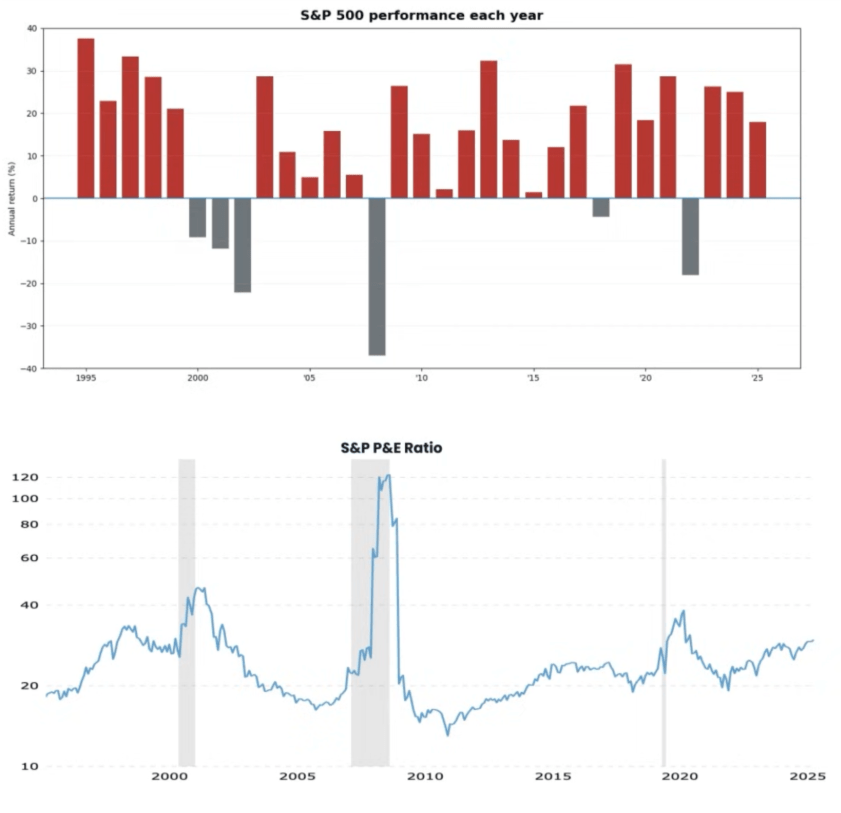
As of this writing, the S&P 500 P/E has consistently been at or near 30 for several months. That’s significant for a couple reasons. First, ratios above 25 are considered historically elevated, suggesting there may be overvaluation. In plain English: investors are paying a pretty penny for stocks. Federal Reserve Chair Jerome Powell flagged this in September of last year, as did the Fed’s semiannual financial stability report in November.
Which brings us to the second reason why a sustained ratio at or near 30 is significant: that key phrase, “historically elevated.” During the Dot Com bubble, the ratio exceeded 30 for 10 consecutive quarters. During the 2008 Global Financial crisis and COVID pandemic P/E similarly exceeded 30, but only because corporate earnings collapsed. And while some may argue there is a case to be made for high P/E being indicative of optimism for future earnings growth, history shows us there’s only so high we can go before a correction arrives.
Should You Be Worried?
The answer is no. But should you continue to pay attention to this indicator? It’s not a bad idea, with some caveats. First, consider how your Money is currently invested. If you haven’t yet shifted your nest egg to lower-risk Retirement appropriate investments, you may be unnecessarily gambling with your savings. In that case, you should act expediently. Our Market Risk Report, part of your personalized Roadmap for RetirementSM will help you identify the hidden dangers, so you can shift into safer investments that will continue to earn a good return.
And finally, it’s always important to examine P/E ratios in the context of larger chunks of time—think 3-5 or 10-year periods. At this stage, no one can say for certain how this higher P/E trend will shake out. But we do know that it’s a warning light we should keep an eye on.
Disclaimer: Numbers are for illustrative purposes only. Consult a professional for personalized advice.