Currently there are roughly a dozen blood tests (known as Blood-Based Biomarkers, BBBM) that can detect amyloid or tau proteins accumulating in your brain, the cause of Alzheimer’s disease (AD). Only one such test, Fujirebio Diagnostics’ Lumipulse G pTau217/ß-Amyloid 1-42 Plasma Ratio, has been approved by the U.S. Food and Drug Administration (in May of 2025) “for the early detection of amyloid plaques associated with Alzheimer’s disease in adult patients, aged 55 years and older, exhibiting signs and symptoms of the disease.”[Emphasis added] [1]
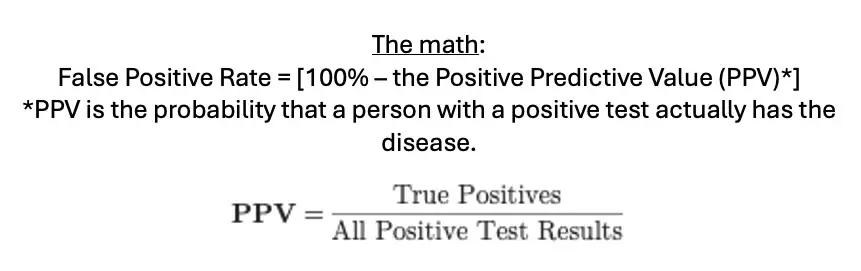
The use of these easy-to-order blood tests is rapidly expanding beyond specialty clinics and research settings. Unfortunately, test-specific characteristics (such as false-positive rates) severely limit the suitability of their use in primary care, where the frequency (“prevalence”) of the target disease is low, and variability (in average patient age, underlying medical problems, patient concerns, and AD risk factors) is high. When compared with populations at risk for AD (age >54 with cognitive concerns), the same test result has widely different predictive values in settings where disease prevalence fluctuates so widely. The FDA notes that the risks associated with the Lumipulse test are mainly the possibility of false positive and false negative test results. Hence, their limiting its approved use to “adult patients, aged 55 years and older, exhibiting signs and symptoms of the disease.”[1] The lower the prevalence in the tested group the more false-positives. In low-prevalence settings, and even with very sensitive tests, the chance that a test-positive individual actually has the disease can be as low as 47%, a coin-toss.[5]
Additional confirmation of the failures of BBBM testing in a low-prevalence population comes from an ongoing Swedish study of over 2000 dementia-free older adults followed for up to 16 years. Six tests for AD showed good negative predictive value. Those with a negative test did not develop dementia in 10-years of follow-up. However, the ability of a positive test to predict dementia in this same population ranged from less than 30% for single-biomarker tests to just 43% with tests combining different biomarkers.[7]
The Guardian reached this conclusion[8] from the results of a four-decades-long study of over 120,000 Norwegian adults published in December 2025: ”Prevalence of Alzheimer’s Disease Pathology in the Community”.[9] Those researchers tested blood samples from a cohort of 2537 participants over the age of 57 for elevated plasma pTau217 levels, considered to be evidence of Alzheimer’s disease. Those 70 or older also had a standardized clinical assessment for dementia or Mild Cognitive Impairment, (MCI) an early stage of Alzheimer’s.
The findings: Among those over age 70, blood-based biomarkers of Alzheimer’s disease were present in 60% of people with dementia, in 32.6% of those with Mild Cognitive Impairment and in 23.5% of the cognitively unimpaired group.”[9]
The Guardian’s “Breaking News” was their extrapolation to the UK population of the percentages reported for this sizable Norwegian cohort: the calculation that more than 1 million UK “over-70s” would meet clinical criteria for anti-amyloid Therapy – “a stark contrast to the 70,000 people the NHS has estimated could be eligible if funding were available . . . for treatment with anti-amyloid drugs”.[8]
Before contributing to an NHS Go-Fund-Me page, reasonable questions would be:
Of Interest,
The phrase “FALSE POSITIVE”did not appear in either document, even though the overall (23%) and age-specific (40% for ages 70-74) false-positive rates could be easily calculated from their data.
Neither the Nature paper’s 18 authors, nor the Guardian mentioned the significant implications of this false-positive rate for their conclusions and their readers.
Such rates likely reflect the fact that all of the study participants were from an unselected “community” population with no identified risks for Alzheimer’s disease other than their age. Mentioning that a quarter of the Guardian’s predicted one million new NHS Alzheimer’s patients were likely falsely positive might have added Clarity to the narrative.
The Guardian article also notes that “The p-tau217 blood test used was recently cleared by regulators. ”One can only hope that Great Britain’s Medicines and Healthcare products Regulatory Agency (MHRA) and their National Health Service will follow the US FDA[1] and the Alzheimer’s Association[6] in reducing false positive AD diagnoses by limiting testing to those at risk: age 55+ with cognitive impairment.[10]
Testing for AD has advanced to a point where spinal fluid analysis, PET scanning, and some BBBM testing in at-risk individuals, can definitively establish a diagnosis of “Preclinical Alzheimer’s Disease”, the asymptomatic stage preceding any measurable cognitive decline and defined by biomarker evidence of amyloid or tau proteins in cognitively normal individuals.[11] Benefits of identifying AD at such an early stage include opportunities for planning and preparing, consideration of genetic testing for Family members, Lifestyle change, early access to existing interventions, and chances to participate in research seeking to limit, delay, and even potentially prevent the development of symptoms.
On the other hand, the predictable and observed risks of learning that one has preclinical Alzheimer’s disease include life-changing Anxiety and emotional distress, often associated with suicidal thoughts or acts, necessitating careful informed consent prior to biomarker testing and the availability of counseling after. The challenges presented to asymptomatic, but biomarker-positive, patients and their families in processing the associated information are described as overwhelming, like drinking from a fire hose. Insurance is an example. While health insurers are prohibited by law from denying coverage for Alzheimer’s disease, there is nothing to prevent those writing long-term-care policies and life insurance from declining coverage to someone who is positive for an AD biomarker. Persons aware of an AD diagnostic label (and its prognosis) report a lower quality of life than those unaware of these facts about themself.[12,13,14]
These risks are the same if your test is falsely positive. In its approval of the Lumipulse test the FDA noted “False positive results, in conjunction with other clinical information, could lead to an inappropriate diagnosis of, and unnecessary treatment for, Alzheimer’s disease. This could lead to psychological distress, delay in receiving a correct diagnosis as well as expense and the risk for side effects from unnecessary treatment.[1]
A screening test is only as relevant as the members of the group on which it was developed. If you have risk factors, you can rely on the test; if you don’t you cannot. If you are not in the risk group (Age ≥ 55 with diagnosed evidence of cognitive decline) the accuracy of a positive result from a BBBM for Alzheimer’s disease (AD) is essentially a crapshoot, and absolutely requires confirmation by expensive, invasive, and often difficult-to-obtain brain or spinal fluid testing.
Based on the extensive recently published Norwegian data, 40% of community-based subjects aged 70-74 who are tested without consideration of their AD risk factors will have a false positive result. i.e.,
In low-risk patients:
Four of every ten “Positive” BBBM AD tests will be wrong!
Any low-risk individual who accepts an un-verified positive BBBM result (i.e., with a 40% risk of being FALSE) will be at risk for the same “life-changing anxiety and emotional distress, along with suicidal thoughts or acts” as anyone with the disease.
Therefore, a universal recommendation is that
All Low Risk Patients (under age 55 without memory loss or other cognitive deficits) With A Positive Screening Blood Biomarker For Alzheimer’s Disease Should Undergo Confirmatory Testing. [6,17]
So, don’t get the BBBM test unless you’re prepared to undergo specific interventions to rule out a false positive. If the BBBM is negative you’re OK.
On a more positive note:
“Among cognitively unimpaired individuals with amyloid pathology (preclinical AD), lifetime risk of progressing to Alzheimer’s dementia is approximately 25–30%, implying about 70–75% will not progress“[16] Nor can progression be predicted for any individual worried senior.
[2] Fagan, T Trouble with Fujirebio’s FDA-Cleared Blood Test? Or a Lousy Lot? Alzforum, 06Dec 2025, Retrieved December 9, 2025 from https://www.alzforum.org/news/conference-coverage/trouble-fujirebios-fda-cleared-blood-test-or-lousy-lot
[3] https://www.cancer.gov/about-cancer/screening/hp-screening-overview-pdq#0c0547cc
[4] Pepe MS, Feng Z, Janes H, Bossuyt PM, Potter JD. Pivotal evaluation of the accuracy of a biomarker used for classification or prediction: standards for study design. J Natl Cancer Inst. 2008 Oct 15;100(20):1432-8.
[5] Hazan J, Liu KY, Isaacs JD, Howard R. Cut-points and gray zones: The challenges of integrating Alzheimer’s disease plasma biomarkers into clinical practice. Alzheimers Dement. 2025 Mar;21(3):e70113.
[6] Palmqvist S, Whitson HE, Allen LA, Suarez-Calvet M, Galasko D, Karikari TK, Okrahvi HR, Paczynski M, Schindler SE, Teunissen CE, Zetterberg H, Carrillo MC, Edelmayer RM, Mahinrad S, McAteer MB, Kahale LA, Pahlke S, Tampi MP. Alzheimer’s Association Clinical Practice Guideline on the use of blood-based biomarkers in the diagnostic workup of suspected Alzheimer’s disease within specialized care settings. Alzheimers Dement. 2025 Jul;21(7):e70535.
[7] Grande G, Valletta M, Rizzuto D, Xia X, Qiu C, Orsini N, Dale M, Andersson S, Fredolini C, Winblad B, Laukka EJ, Fratiglioni L, Vetrano DL. Blood-based biomarkers of Alzheimer’s disease and incident dementia in the community. Nat Med. 2025 Jun;31(6):2027-2035.
[8] Hill, A 10% of over-70s in UK could have Alzheimer’s-like changes in brain. The Guardian, December 17, 2025.
[9] Aarsland D, Sunde AL, Tovar-Rios DA, Leuzy A, Fladby T, Zetterberg H, Blennow K, Tan K, De Santis G, Yakoub Y, Arslan B, Huber H, Pola I, Grötschel L, Di Molfetta G, Skjellegrind HK, Selbaek G, Ashton NJ. Prevalence of Alzheimer’s disease pathology in the community. Nature. 2025 Dec 17.
[10] Jack CR Jr, Andrews SJ, Beach TG, Buracchio T, Dunn B, Graf A, Hansson O, Ho C, Jagust W, McDade E, Molinuevo JL, Okonkwo OC, Pani L, Rafii MS, Scheltens P, Siemers E, Snyder HM, Sperling R, Teunissen CE, Carrillo MC. Revised criteria for the diagnosis and staging of Alzheimer’s disease. Nat Med. 2024 Aug;30(8):2121-2124.
[11] Epelbaum S, Genthon R, Cavedo E, Habert MO, Lamari F, Gagliardi G, Lista S, Teichmann M, Bakardjian H, Hampel H, Dubois B. Preclinical Alzheimer’s disease: A systematic review of the cohorts underlying the concept. Alzheimers Dement. 2017 Apr;13(4):454-467.
[12] https://ouragingbrains.com/a-suicidal-reader-seeks-advice/
[13] Claessen T, Visser FCW, van Munster BC, van der Flier WM, Jiménez-Mausbach M, van Harten AC, Teunissen CE, Visser LNC. General practitioners’ perspectives on blood biomarkers for Alzheimer’s disease. Alzheimers Dement (Amst). 2025 Oct 17;17(4):e70186.
[14] https://ouragingbrains.com/im-worried-about-alzheimers-should-i-undergo-biomarker-testing/
[15] Frumkin, K. Aging or Alzheimer’s? A Doctor’s Personal Guide to Memory Loss, Cognitive Decline, and Dementia, Skyhorse Publishing, November 2024.
[16] Brookmeyer R, Abdalla N. Estimation of lifetime risks of Alzheimer’s disease dementia using biomarkers for preclinical disease. Alzheimers Dement. 2018 Aug;14(8):981-988.

The post Blood Tests for Alzheimer’s Disease: The Alarming False-Positive Rate! appeared first on ouragingbrains.
Originally Published on https://agingoralzheimers.com/
Kenneth Frumkin, PhD, MD, FACEP studied physiological psychology (the interaction of the body’s basic biologic mechanisms with behavior) in college and graduate school. He earned his Masters and Ph.D. degrees from McGill University for his work on the relative contributions of nature and nurture to the ingrained survival mechanism of poison-avoidance in rats. After two years of research at the U.S. Army’s Biomedical Laboratories, Ken went on to medical school and a residency in emergency medicine. His 36-year medical career was split between community hospital emergency departments and teaching, research, and practice in military academic medical centers.
Board-certified in his specialty, Dr. Frumkin is the author of over three dozen peer-reviewed publications and textbook chapters in psychology and medicine. His article “How to Survive the Emergency Room” published in the AARP Bulletin, was a 2022 National Mature Media Merit Award winner. A complete list of publications and complete resume are at www.linkedin.com/in/KennethFrumkinPhDMD . A Fellow and Life Member of the American College of Emergency Physicians and their Geriatric Emergency Medicine Section, Dr. Frumkin is also an Emeritus member of the Society for Academic Emergency Medicine and their Academy of Geriatric Emergency Medicine. Having retired as a civilian employee of the Department of the Navy in 2017, Dr. Frumkin is currently a volunteer member of the academic faculty at the Emergency Medicine Residency, Naval Medical Center, Portsmouth, Virginia.
Dr. Frumkin writes from the perspective of a practiced author and researcher and, most importantly, as a fellow boomer with “skin in the game.” He, too, is seeking the answers to nearly every older-person’s questions about their fluctuating memories and the possibility of progressive cognitive decline. His book "Aging or Alzheimer’s? A Doctor’s Personal Guide to Memory Loss, Cognitive Decline, and Dementia" comes out November 5, 2024. (AgingOrAlzheimers.com)
BabyBoomer.org is an online membership community created by and for the Baby Boomer Generation. Boomers, and those who service and support them, are welcome to join our community accessing all general topics.