


Helping create an onboarding plan for Retirement can boost life satisfaction and strengthen personal and professional Relationships.
This article first appeared in Rethinking65.
Many moons ago, I was interviewing for an internal promotion at work. I wanted to come up with something that would set me apart from the competition and help demonstrate I was the one for the job. A life-long buddy of mine suggested a 90-day outline.
“I don’t know, those things are usually done when you are interviewing with a new company. I’m not sure that will work when I already work there,” I retorted.
“Dude (yes, he did say that), the manager only knows what you have done by your work record and reputation. He knows nothing about what you are thinking about doing. Give him something,” my friend countered.
It was great advice, something I have continued to do throughout my career.
Most 90-day onboarding plans talk about how candidates will learn the business, build relationships and set early wins. Yet when people “retire” — stepping into the most significant transition of their adult life — few ever think to build a similar plan. The first 90 days after leaving full-time work are formative. They set patterns that can influence a retiree’s Health, happiness and sense of purpose for years to come.
Advisors can play a crucial role in helping clients treat this phase, intentionally linking Money, time and meaning into a cohesive Lifestyle strategy rather than leaving it to chance.
Whether the “first sunrise of retirement” is literal or metaphorical, it can be a jarring experience for many — just like the first day on a new job. Suddenly, there’s no Monday meeting, no urgent email, no boss to report to, no direct reports to coach. The shift from hyper-structured time to unstructured days can be exhilarating — or unsettling.
Research from my Retirement Time Analysis (RTA) shows that over 70% of participants still tie their identity and sense of worth to their career. When that structure disappears, it can lead to what I call a “retirement time vacuum.” Without a plan, even financially prepared retirees can feel disoriented, anxious or guilty for not being “productive.”
That’s why the first three months are not a vacation — they’re an orientation to an entirely new life.
Financial advisors already guide clients through market volatility; a 90-day plan helps them guide through emotional volatility. Before you dive into the decumulation or withdrawal strategy with clients near retirement, frame a conversation around four core dimensions of post-career living.
Typical workplace 90-day designs revolve around onboarding, contributing and taking initiative. Using this same approach is a way for advisors to help clients formulate an early structure to life without a career.
As simple as this may sound, encourage clients to relax a little. Suggest a “light launch” into retirement. Encourage them to dedicate the time to reflection and preparation, affirming their goals in retirement or creating them. The objective is to shift from a mindset of “I used to …” to “I will …”
Retirement starts by establishing new rhythms. Developing a typical week in retirement is not easy, but the process can reveal opportunities to create a life with more quality time. Financial advisors can help model cash-flow patterns to ensure discretionary spending aligns with this new structure.
Many times, in the hustle and bustle of a new job, the back third of a 90-day strategy never gets done. The same can happen with retirement.
By now, patterns have emerged. Remind clients to finetune their calendar and budget based on what feels fulfilling versus draining. Advisors can help translate insights into practical actions — better understanding income distributions, travel funds or healthcare contingencies.
You will see a decline in your social interactions when you retire. The Social Network Audit is a quick way for you to understand the number of relationships you have now, and the ones you will want to invest time in post career to maintain, nurture, and grow.
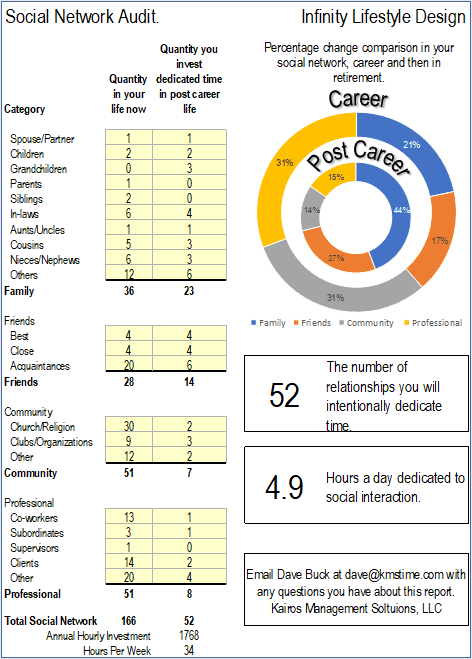
I reflected on some of my old 90-day onboarding plans and saw there were instances that what I did during the first part of that job positively stayed with me through the duration. These attributes were the foundation to a successful performance.
Behavioral science tells us that early habits in any transition tend to stick. The same applies to retirement. Individuals who spend their first months drifting often remain in that fog. Those who start with a clear vision and balanced schedule adapt more confidently.
Advisors who guide clients through this intentional “onboarding to retirement” differentiate themselves. They’re not simply managing returns; they’re managing life satisfaction.
David Buck is the author of the book The Time-Optimized Life, coauthor of The Retirement Collective, and owner of Kairos (Time) Management Solutions, LLC. Learn how to apply the concepts of proactively planning and using your time. Take the Time Management Analysis (TMA), the Retirement Time Analysis (RTA), or all the other free resources offered to help bring more quality time into your life.
Content development for this article involved human expertise supported by AI-generated analysis and formatting.
The post Mapping Out the First 90 Days of Retirement first appeared on Infinity Lifestyle Design.