
Last week we discussed Personal Care Is the Weak Link in Corporate Performance – the concept that taking care of yourself means better and more quality time in life. The data was compiled from the Time Management Analysis (TMA), an assessment that looks at our use time from 5 main areas: organization, focus, planning, task management, and personal care.
Part 2 of a 3-part series highlighting some of the key insights from the 2025 Year-End TMA report. Download your copy today for free.
| Attribute | Category | Max Index | Average Index | % of Optimal |
| Finish what I start | Organization | 100 | 65.4 | 65% |
| Use a calendar consistently | Organization | 100 | 84.1 | 84% |
| Stay generally organized | Organization | 100 | 66.5 | 66% |
Once of the many interesting data points to come out of the report is a dichotomy that people are generally organized but not focused. Consider how the facts line up based on the 2025 TMA responses.
| Attribute | Category | Max Index | Average Index | % of Optimal |
| Avoid procrastination | Focus | 100 | 46.3 | 46% |
| Stay motivated | Focus | 100 | 74.6 | 75% |
| Talk less, act more | Focus | 100 | 61.1 | 61% |
| Avoid distractions | Focus | 100 | 33.2 | 33% |
| Limit interruptions | Focus | 100 | 33.4 | 33% |
| Say no when necessary | Focus | 100 | 49.4 | 49% |
Source: Time Management Analysis (TMA)
The 2025 Year-End Review combines data from all Time Management Analyses (TMA) assessments in 2025 to reveal where individuals and teams lose time — and how they can regain control.
You’ll see how real professionals scored across the five core categories:
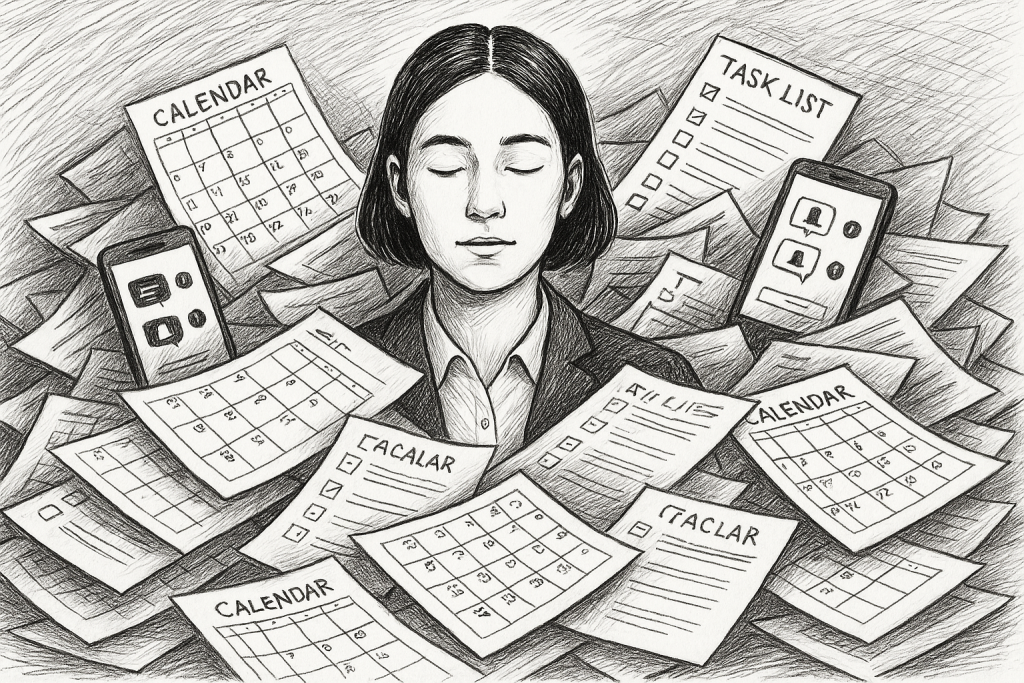
Modern teams are drowning in structure — calendars, dashboards, task boards, and endless notifications. The TMA results show teams are highly organized (84% for calendar use) but struggle with procrastination, distraction, and task completion.
The fix isn’t more systems; it’s fewer, simpler ones. Leaders should reduce redundant meetings, consolidate platforms, and define “focus blocks” on the calendar that are as protected as client calls. When systems serve Clarity instead of complexity, people stop managing time and start mastering it.
With “interruptions” and “saying no” indexing below 50, most professionals operate in a constant state of distraction. The solution lies in cultural permission. Teams need clear norms for when to connect — and when not to.
Shorter, purpose-driven meetings with defined action outcomes create accountability without overload. Likewise, empowering people to decline or delay requests protects cognitive bandwidth.
Boundaries aren’t barriers to collaboration; they’re the framework that keeps collaboration from collapsing into chaos.
Procrastination, multitasking, and motivation dips are symptoms of fragmented attention — not poor effort.
Reclaiming focus begins with auditing your environment. Leaders can model time optimization where email and chat are silenced, and major tasks are allowed to be completed without interruption.
Recognizing progress, not just activity, helps retrain teams to value flow over busyness. Pairing structure (organization) with recovery (focus and breaks) creates rhythm — and rhythm is what turns well-organized plans into quality time.
I am encouraged that people take organization seriously. I am not surprised that 2025 participants are challenged to stay focused (it is the trend since I began collecting data on the TMA). There is a wonderful opportunity to take the strength of organization and migrate into focused attributes to empower team to raise their productivity levels.
David Buck is the author of the book The Time-Optimized Life, coauthor of The Retirement Collective, and owner of Kairos (Time) Management Solutions, LLC. Learn how to apply the concepts of proactively planning and using your time. Take the Time Management Analysis (TMA), and the to help bring more quality time into your life.
The post Organized but Overwhelmed first appeared on Infinity Lifestyle Design.