
As CEO of Prosperity Financial Group, Elliot Kallen continues to bring high-level expertise to his audience with another powerful episode of Meet the Expert. In this conversation, he speaks with Paul Hiltz, CEO of Naples Comprehensive Healthcare System (NCH), about the future of community healthcare—and how it’s rapidly evolving with AI, preventive care, and the consolidation of medical systems.
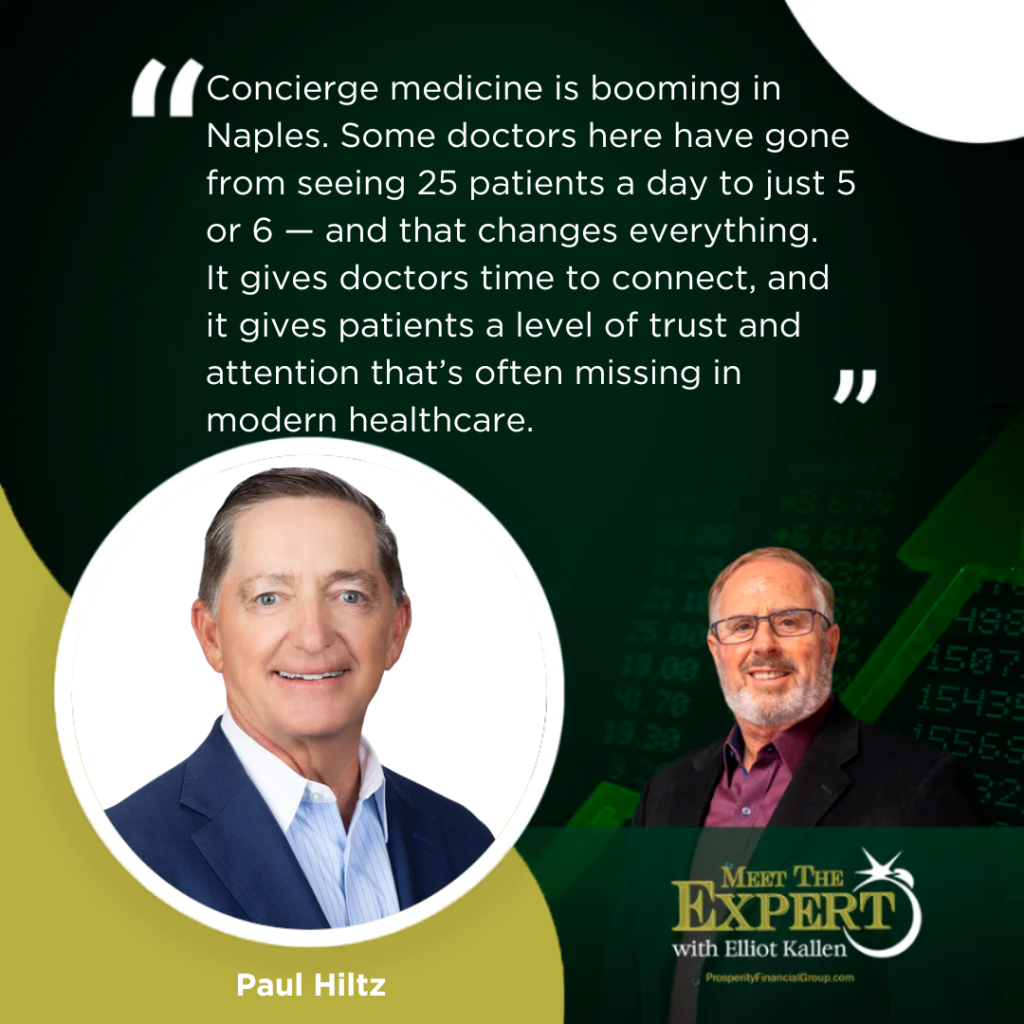
Paul Hiltz is the President and CEO of Naples Comprehensive Healthcare System in Florida. With a long-standing executive background in hospital leadership, Paul is championing a patient-first model that prioritizes comprehensive care, community independence, and cutting-edge diagnostics.
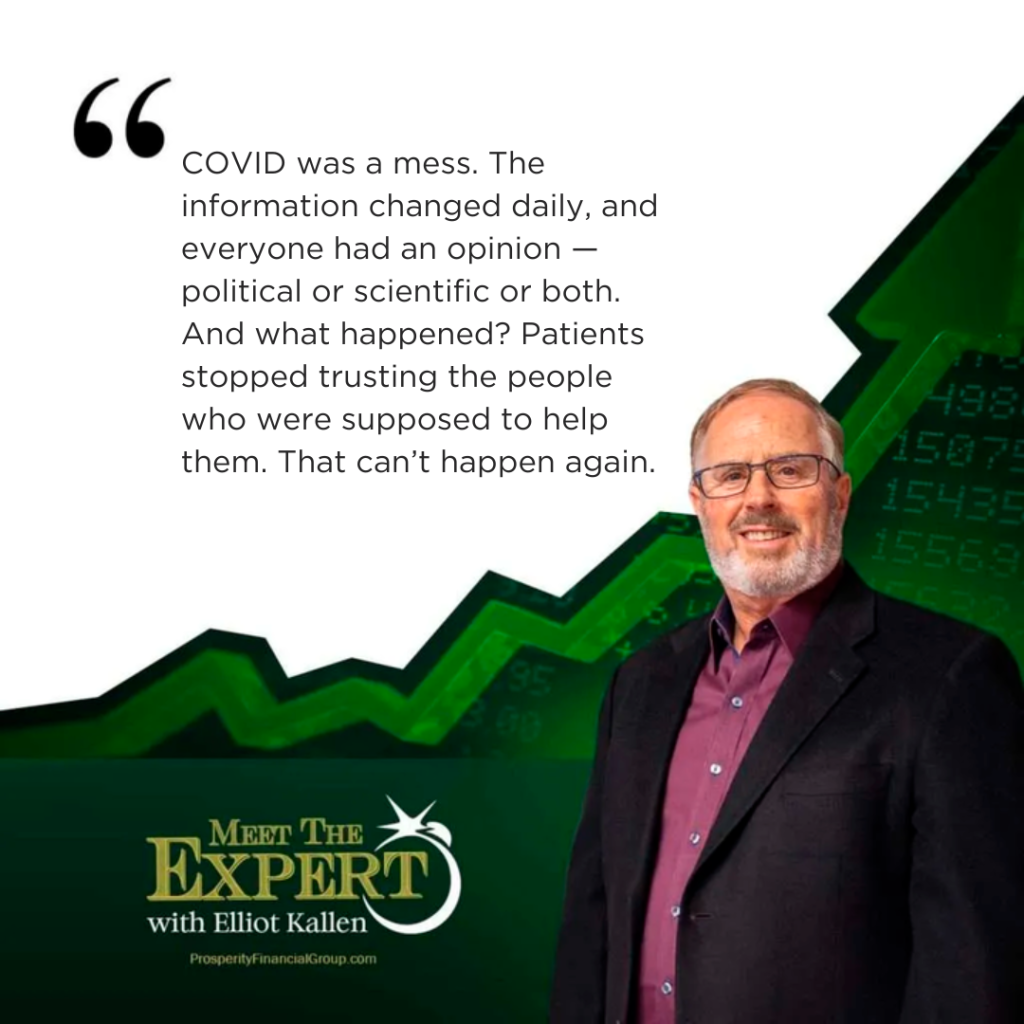
Elliot and Paul tackled pressing questions from a consumer lens: Will AI and tech really make healthcare better? How do patients balance cost versus care in a concierge model? And most critically, can the U.S. rebuild trust in its healthcare system?
Paul emphasized the importance of evidence-based medical practices and involving physicians—not just politicians—in policy decisions. He highlighted that hospitals must be both technologically advanced and emotionally intelligent in their care delivery.
Elliot’s closing note: “I just want to be healthy while I’m alive and figure it out.” This sentiment captures the core of what modern healthcare must deliver—Longevity with quality of life.
To learn more about this episode or get in touch:
Stay informed. Stay healthy. Stay connected.
Elliot Kallen: Good morning, good afternoon, everyone. I’m Elliott Kallen, CEO of Prosperity Financial Group, and welcome to another terrific episode of Meet the Expert with Elliott Kallen, top 2% worldwide of financial publications and podcasts. So here we go. We’re going to talk about healthcare again. You can’t talk enough about healthcare. It is changing in front of us. Everything we know about healthcare now with AI and doctors changing the world is going to be different in the next three years than it was in the last three. So this is not going to be the last time we talk about healthcare. Today we have truly a healthcare expert on. We have Paul Hiltz, if I’m saying that properly, Paul. Paul is CEO. He’s from Naples, Florida. Don’t be mad at him. He’s from Florida. I know it’s the home of senior citizens, but Naples is a beautiful area and there are lots of us who are listening that would Love to have a house there. So he is from the Naples Comprehensive Healthcare System, NCH, if you want to look that up and Google it and get an idea of it, that used to be called the community hospital. So you can see already they’re reinventing themselves to go from community to comprehensive. We have community hospitals. In California where we live, it’s hard to even find a community hospital anymore. It’s impossible for them to stay in business. Let me welcome you, Paul. Welcome to our show.
Paul Hiltz: So good to have you to have me and it’s a balmy 75 degrees and sunny here in Naples.
Elliot Kallen: Yeah, most of the country now hates you, it’s okay. It’s a rainy day here, about 58 degrees, so we appreciate that. So we’re going to talk about, and you’ve got a huge background in health expertise. You’ve been CEO of multiple organizations. People can look you up, your own LinkedIn, I’m sure, and if somebody wants to research you, they can find out. We don’t have to read your bio up and down here, but you obviously wouldn’t be on unless I felt you had the right kind of health expertise and obviously you do. So congratulations on that. So let’s just talk about where is community healthcare going and where is it coming from? So I’m going to ask you to put on looking backwards on where we’re coming from, and this really has very little to do with who the current president is. This is what I call megatrends, this is just happening. And then where it’s going over the next three years, I try to not put a lot of politics in here because I don’t want to alienate 50% of people that listen no matter what I do. If you need to reach me, it’s prosperityfinancialgroup.com. It’s Elliott, E-L-L-I-O-T at prosperityfinancialgroup.com, 925-314-8503, call anytime, send us a message. If you want to reach out to Paul and you weren’t able to get his information, we’ll put you in touch with him because this is important. I have children and now I have grandchildren. The future of community healthcare is their lives, and I certainly don’t want to be thrown out and not given the right kind of drugs because I’m crossing a certain age or crossing a threshold. For those of you who don’t know a very important statistic, and Paul, correct me if I’m wrong, it’s something like Americans use up 80% of all their healthcare costs in the last two years of their life.
Paul Hiltz: I was going to say this, yes.
Elliot Kallen: Well that means that if you’re living in California and you’ve got the largest HMO in the United States right here, Kaiser, and they say, we’ve decided we’re not going to give these amazing drugs out because we don’t think the value is worth the effort or the juice is worth the squeeze, if you want to do that, that’s a decision they can make and that will change lives and change costs because people will die faster. So we’re not going to get into the value of that’s worth it or not, but let’s face it, that is going to be a conversation that people are going to have in the future, no doubt about it. So what’s going on, Paul? Let’s put that prognostication hat on that where you’re looking backwards on where it’s coming from and then where you think it’s going and then we’ll take it from there.
Paul Hiltz: Great. Well, to look backwards for a second, right after World War II, Congress authorized an act called the Hill-Burton Act and the idea was, hey, as Americans, we have to get healthier. What’s the way to get healthier? Have more hospitals. So there was a building boom in the late 40s and into the 50s and 60s of hospitals popping up all over the country, as you just said, Elliot, community hospital, really community oriented hospitals funded by the government. And guess what? We found out after 20 or 30 years of that, having more hospitals didn’t necessarily make us any healthier. So then we switched and started thinking a little bit more about prevention and we started thinking about, wait a minute, we’re spending too much Money on hospitals. How can we rein in the spending? So we did reimbursement modifications, changed Medicare, changed Medicaid, commercial insurance. And now we’re in a state of consolidation in America. Hospitals are rolling up into these big, big mega systems. And then there’s a couple of big for profit systems. And what we are doing at NCH is sort of counter to that. Our idea is to stay independent and stay with deep community roots here in Southwest Florida. So that’s why we changed the name from Naples Community to Comprehensive, because we want to provide for this comprehensive level of care for the residents here in Southwest Florida.
Elliot Kallen: And this is happening everywhere. I grew up in New Jersey, North Jersey, and we went to St. Barnabas Hospital. And I forgot if that’s West Orange or Livingston, but right on the border between those two towns and I grew up in West Orange. And St. Barnabas Hospital is now the St. Barnabas Comprehensive Medical System. And I think if I’m correct, they’re probably top three size-wise in New Jersey, St. Barnabas. But they’re right there. Hackensack is one of them. I don’t even think Hackensack existed when I was young. But that’s, I think, the largest now or one of the largest. So everything is changing and doctors are getting squeezed. They have to belong to something. And so, again, because of the way Medicare flows, I know that we won’t talk about Medicaid, but Medicare flows in a way, Blue Shield, Blue Cross flow, it’s going to you guys and it’s going to the doctors affiliated with you. Am I correct on that?
Paul Hiltz: Yes. And so we’ve, as the payments are shrinking and so forth, we are taking a real hard look now and real big emphasis on preventive care. So we just hired one of the leading preventive cardiologists in America, Dr. Carl Ornstein, who’s joined us and helping people to avoid heart attacks and strokes by looking at their lipids, their cholesterol, and their triglycerides, all those things. And we’re using our diagnostic testing capabilities to get ahead of disease every time we can.
Elliot Kallen: Oh, I think that’s fabulous on it. You guys are about a billion dollars?
Paul Hiltz: Yeah, a billion dollars of net revenue. And hospitals these days send, we collect about 20 cents or 21 cents out of everything we bill. So, we bill between four and five billion and collect a billion.
Elliot Kallen: You mean you’re not getting $45 on that aspirin?
Paul Hiltz: No. Even though hospitals send out itemized bills, for the most part, hospitals are paid, prepaid on what they call a DRG or a diagnosis related group payment. It doesn’t matter how many medications we give somebody, it doesn’t matter how long they stay, we’re paid on the diagnoses of the patient.
Elliot Kallen: Okay, so let’s talk about Dr. Burdell. So my doctor is an example. And you’re listening to Paul Hiltz, who’s from NCH down in Naples, Florida, which enables comprehensive health care system. If you want to reach us, it’s Elliot, E-L-L-I-O-T at Prosperity Financial Group. And you’re going to see 175 or so episodes like this on prosperityfinancialgroup.com. And we urge you to join our mailing list and have some fun with this. There’s never an advertisement on these. But Dr. Burdell. So my doctor and his wife, who is also a doctor, who’s my wife’s doctor, they decided that they would withdraw from being internal physicians and create a comprehensive, exclusive, private practice. Concierge is the buzzword. And they went from each about 1,200 patients to, I believe, the number is 400. I don’t want to put words in our mouth, but give or take it’s 400 patients. I can get an appointment today if I want now, if I call them up. I never used to get a physical, mostly because I’m a guy. And we just don’t do that unless we’re pushed into it. But now I get it because I feel like I’m paying for it every month. And it’s not cheap. It’s gone up to, $300 a month for each one of us. It’s gone just from two something to 300. So that’s not a little number for two people. We’re over a certain age, over the age of 60, which means that we want to make sure that we want to be in front of this. Her dad died when she was four. My dad died 38 years ago, and my mother died 28 years ago. So I’m really concerned about the strokes on one side, the heart attacks on the other, and so forth. And he’s got a million pieces of machinery now in his office. And they just bought a blood center and are going to bring it inside. So they’re really way ahead of it. I know I’m helping fund his Retirement. And I tease him about it because I said, you’re making more money on me than you ever made because I never went to see you. But now I’m going to see you and you’re getting paid every month. But in reality, he’s doing what I hear is happening all around the country, isn’t he?
Paul Hiltz: That’s for sure. And I will tell you, in Naples, we probably have more concierge doctors per capita than any other city in America here. It’s a really popular model. The fees here ranged anywhere from $1,500 per year to $10,000 per year, depending on the doctor. And for that, or in return for that fee, as you’re seeing now, Elliot, your doctor gets to spend a little bit more time with you. Your doctor is not quite as rushed. They’re not seeing 25 people a day. They’re only seeing five, six, or seven people a day. And I think the patients like that extra time. And the doctors, quite honestly, like to be able to spend a little bit more time with people.
Elliot Kallen: Yeah. It’s never less than an hour with me versus the old days was about 20 minutes. And I think the Kaiser model is about 20 minutes per patient in there. Here’s one of the big differences. I have to say that, I’m in a financial advisory business and we interview people like you because we’ve got so many CEOs as clients, so many business executives as clients. And that’s why we attract those people because we give them really good information. I have a new level of trust because I have to exude trust in a money business. But I have a new level of trust for my doctor. And my wife, who is very skeptical of his wife, another doctor, suddenly has become a true believer in what she has to say. It took her a while, but they trust. So trust is the key word there in my industry and your industry. My old doctor, who had since retired and now died of Parkinson’s, he gave me, when I had high cholesterol for a number of years back in my late thirties, and he said, Elliot, it’s not going away at all. It’s just not. It’s in your blood. It’s your European heritage. You need to be on a statin. And I did my research on statins and, okay, the only big one that was out there was Lipitor and I didn’t like the side effects of it. He said, let’s put you on Provostatin. It’s a Park Davis product. Now it’s a generic $3 product, but it was made by Park Davis and it did the trick. Maybe a decade later, before he was getting ready to retire, I said, why did you put me on the Park Davis Provostatin product instead of a different product? He said, well, that’s easy to answer. He said, I want a trip to Hawaii on that product. And my trust for him was totally out the window at that moment, totally out the window. So we don’t want that happening at all.
Paul Hiltz: Yeah. It’s interesting that you talk about trust. So Gallup just came out with their annual poll where they ask Americans, what are the most trusted professions and what changes are happening? So for like the 10th year in a row, the most trusted profession, no surprise, is Nursing. And it’s stayed steady pretty much for the last five or 10 years. But the biggest drop in trust by profession was physicians. And so there’s a couple of theories behind that. But when you talk about trust, one theory is that COVID, with all the conflicting information, really caused people to lose trust in their doctors. Another theory says that because doctors spend so much time typing into the computer and not looking at the patient, that the patients have begun to lose trust. But one way or the other, I think it’s going to be important for Americans to begin trusting their doctors again. And I think in the long run, if we can get that trust back, we’ll get better health and we’ll get cheaper costs for health care as well.
Elliot Kallen: I want to go back. I’m going to get back to COVID in a moment right now. But I want to ask you, in the next three years, because we didn’t answer that question, put your that futuristic hat on you and flex capacitor type of thought process, if you remember that, back to the future of that car was the flex capacitor, the future of cars. In three years, what does the system look like?
Paul Hiltz: We can sort of believe that the consolidation efforts are going to continue, but we’re seeing now some of these big hospital systems spin off hospitals back. So we’ll have a lot of disruption in the facilities, the big organizations in health care. We do think that there will be a lot more emphasis on primary care. And as we produce more PAs and nurse practitioners to do primary care, I think people like you and I and others are going to get used to seeing providers, not necessarily the doctor every time, but extenders and increase the number of visits to primary care, again, to focus on the prevention. That’s some of the biggest trends we see.
Elliot Kallen: I don’t have a major problem with that, but I could see people being upset, saying, I don’t want to see the PA. I want to see my doctor.
Paul Hiltz: Yeah. And we hear that from time to time. Tell you the other interesting thing we see that I’ve learned coming to Naples, Naples is a slightly older general population, but the level of health here and fitness is higher than I would say is in most of the Midwest. And we’re seeing, as you said earlier, older people down here are really staying active well into their 80s. We here at NCH are doing a lot in cardiology procedures, including valve repair and valve replacements through a catheter in the arm or the leg on patients that used to not be eligibly operated on because of their age or other conditions, but we’re seeing a lot of things done here that weren’t being done just five or six or seven years ago. And it’s allowed to live a lot healthier life.
Elliot Kallen: Yeah, I read an article years ago and I try to stay up on the medical world. I think I missed my calling as a heart surgeon. So there’s a part of me that likes reading about this stuff. But years ago, I was reading about the future of bloodless open heart surgery. And of course, that’s not open heart surgery, but that’s what you’re talking about is going through the thigh or wherever to do a valve replacement versus the old days that you crank my chest open and put a pig valve or mechanical valve in there, whatever you did.
Paul Hiltz: Yeah, it’s true, because we do these valve procedures here now and the patients go home the next day, whereas three or four or five years ago with this open procedure, they’d be in the hospital for a week. But this is a game changer for so many people down here getting access to those kind of therapies where they can get back out on the tennis court, the Pickleball court or the golf course and live their life.
Elliot Kallen: So what happens as doctors are burning out, because there is evidence that doctors are burning out right now and there are more doctors leaving medicine than coming into medicine. What’s going to happen? You’re good. You’re a small organization on a billion dollars and amazing saying that. But you’re going to have a harder time attracting talent because the big guns like I was just talking about, say, Barnabas or New York or NYU or, you know, Sinai, Cedars-Sinai in California or Chicago Memorial, they’re going to be paying the big dollars that you guys can’t afford.
Paul Hiltz: Well, I’m glad you asked the question, because, you know, the American Medical Association says that physician burnout is a crisis in America, a crisis. That’s the word they use. And so we believe that the race and the competition for physician talent will be significant in the future. We’re doing a lot of things right here, right now to be the preferred place doctors want to work. How are we doing that? We’ve got a couple of things. We have endowed chairs now that we’ve established using Philanthropy to give doctors a little bit of time off to write, research and teach. We’ve expanded our residency program here because most doctors like to teach. We’ve got 80 residents and fellows that we’re training here right now. The doctors like that. We’ve established a simulation center here where we can help doctors brush up on skills in a simulation lab, which is the future of teaching medicine. And then we’ve got clinical trials and research going on here. We’ve got over 50 clinical trials. All those things really make for a place that doctors are stimulated by. They want to be a part of it. And we want to make this a place where doctors enjoy practicing medicine.
Elliot Kallen: So let’s get back to trust. This is a great answer. Again, we’re talking to Paul Hiltz from Naples community, excuse me, not Naples community, was Naples community, Naples comprehensive health care, which is the direction of the future of health care, comprehensive, large organizations. His is a billion dollars that he’s CEO of. He’s a CEO in several worlds and been a CEO. So we’re not talking about somebody who doesn’t know what they’re talking about, that he knows what he’s talking about. You need to reach me. It’s 925-314-8503 or elliott, E-L-L-I-O-T at prosperityfinancialgroup.com. Please look at these online. They’re terrific. But here’s, let’s talk about the erosion of trust during COVID. And so I’m a consumer now, I’m going to put on my consumer hat and really not partisan hat. I’m not overly partisan, but I have friends on both sides, extreme right, extreme left. I always laugh. I said, if I put my conspiracy friends on the left in the same room with my conspiracy friends on the right, they sound identical. Doesn’t really matter. But try not to go to the extremes here. But I get Facebook like everybody else and I’m on there and I’ve got Family members and friends all over the place on this. My daughter’s in three weeks, is so upset with the election, she’s moving to Netherlands. And one of the reasons she’s moving there is because they have a comprehensive medical system for her children that she doesn’t have to pay these copayments to and so forth. So but this, and you know that during COVID, there are people that want Fauci arrested and prosecuted today. And there are people that think that’s the stupidest idea ever. And there are people who think that the NIH helped fund gain of research, which nobody really quite understands why we were doing gain of research anyway. That’s a different topic. When we talk to an immunologist, we can have a whole conversation about that one there. But you can see that the average person was upset. The average person was forced to get COVID. People were fired from their jobs because they wouldn’t get a COVID shot. The masks on, the masks off. It was a time that there were very quick decisions being made. And when more information came out, it was not disseminated properly and articulated clearly. So that put us as a consumer in a position where maybe we can’t trust the medical industry because it really is a industry and not a health care system. What say you?
Paul Hiltz: Well, I think we were, you know, as a world, we were totally caught off guard with the coronavirus. I mean, it was a novel, a new virus, so by definition, didn’t know a lot about it. I think one of the learnings we as a country had for sure is that we weren’t doing enough primary research on the virus as it was going on. You know, the establishment issued rules and guidelines around the masks and the mandates for the vaccines. But there wasn’t a lot of clinical research behind a lot of that in hindsight. I think the next time we’re faced with that, we’ll, I think, more quickly get to the actual evidence, the facts. I mean, we talked a lot about evidence and facts, but apparently we didn’t really have a lot of research on that. And I think the next time that’ll be one of.
the big pushes. And I think if you look at the most recent appointees, Dr. Marty McCary has certainly been talking a lot about that as he goes for the confirmation hearings. And I think scientists are going to have to be in charge, not the politicians.
Elliot Kallen: Well, that’s what people didn’t understand that Fauci was a lifetime scientist and a politician. And that’s what bothered people so much on that. But, you know, and I’m not advocating anything about him, at all. I’m just saying that I know people on the right now that really, if they had a dartboard or an ax board to throw an ax or a dart at, they’d be arguing whether his picture should be on there or not.
Paul Hiltz: Just the way we handled our approach here to COVID is that I took it to our infectious disease department. I took it to the medical executive committee. I headed up for a vote to the general medical staff. And I took it to the county medical society to ask the doctors, do you want to require masks in the hospital, number one? And do you want to require vaccinations for employees of the hospital, number two? Both of those things were voted on in great majorities for the masks and for the vaccination. That’s just one way to handle it.
Elliot Kallen: Yeah, I think we’re going to have to, you’re right, we need to learn, use that as a learning lesson. You know, we’re a huge country that makes, does things very, very well and makes the same mistakes over and over. It’s just who we are as a country. And we learned sometimes the hard way, or was it, I forgot, the great British politician of World War II, there they’ve said, Americans will always do the right thing when it’s the last thing to do. And we do, we will do the right thing. We just may get it wrong before we do it right.
Paul Hiltz: That was a complicated, that was a complicated one, wasn’t it? Wow.
Elliot Kallen: Yeah, it’s hard because even today, you know, we were fortunate in our office there, Paul, that we got an exclusion so we could stay open. There were people who yelled at me that how dare I stay open, including people related to me. I was in line at Home Depot to buy something. The line was forever out the door, masked up, but six feet between us. But I was only working the mornings and my niece called me up to yell at me, how dare I go to Home Depot? I am exposing my family and everybody around me to death. And I’m like, oh my God, we are so over the line on this. It’s just ridiculous. But that was the fear. And, it’s hard to make good decisions when you’re running in fear. We don’t do a good job with that.
Paul Hiltz: You know, what’s interesting, so working in a hospital, obviously, I came into work every day. We never did go remote here, but we did keep track of, I believe we only had one employee infected from a patient. We did wear masks out in the hospital, but that’s kind of amazing because we treat 10,000 people a year here and over 100,000 emergency department visits. Even with all that COVID, there wasn’t a lot transmitted to the staff here.
Elliot Kallen: No, I had major back surgery for my fourth major back surgery where they fused from L1 down to S5 all the way down. So I looked like a tinker toy married in a rector set, my spine. And I did that in March of 2021. I did it on my birthday. That was my birthday gift to myself. And I was hospitalized because I was draining blood for three days. So I couldn’t go anywhere. And I remember, and nobody could come in and visit me. The phone was terrible there and so forth. It was really a lovely place to be. But I remember walking around there and people were when they saw me walking around, they almost, I had a mask on of course, but I was walking around with a walker because I said, get up and I follow order. So get up means get up. And people would almost run out of the way for fear that I was going to infect them with COVID.
Paul Hiltz: It’s true. And you know, one of the saddest parts of the whole thing in hindsight for me was looking back and seeing there were a short period of time where they, we kept the visitors out of the hospital and that, you know, there were people in hospital, alone and scared, but the family couldn’t get in. And it’s just, that’s no way to do things. So we got some learnings out of this thing for sure.
Elliot Kallen: We did. We did. We did. So let’s wrap this up if we could, because this has been great, Paul. And I appreciate you being on. We’ve been talking to Paul Hiltz of the Naples Comprehensive Healthcare System there. One of many now in the United States of comprehensive systems. This is just the way it is, everybody. We are going to that in the future. If you want to ask them a question, Paul, what’s the best way for people to reach you?
Paul Hiltz: The best way would be to email probably paul.hiltz @ nchmd.org. As you said, Ali, I respond back to LinkedIn. So love to connect with people.
Elliot Kallen: Great. So you know how to do it’s call Paul. Say it again to me one more time.
Paul Hiltz: Paul.hiltz @ nchmd, like medical doctor, md.org.
Elliot Kallen: Great. Well, this has been great. Everybody should know that people like Paul who are running these healthcare systems, care, they’re not just in it for the money. Doctors are not in it all for the money. Are there people in it for money? There are people in every profession for money. That’s just how it is. But he’s here because he’s trying to take advantage of what’s going on in the marketplace, create change that has value in the marketplace. And it’s going to affect you and I as consumers because we’re going to be healthier longer. I don’t know if we’re going to live till a hundred. I certainly don’t want to spend the last two years of my life in a nursing home, but I want to be healthy while I’m alive and figure it out. And then if they come up with ways for me to be healthy that we’re not even thinking of today, or they come up with cures for Cancer that get rid of chemo, but by our biologic that are tailored made to me and I’ve got a place to go or they can keep my heart going because it’s me and not because I’m one of 45 million people with the same blood type and relative heart, but they know what’s going on with me. I think that’s great. I’m hoping my children don’t try to get my inheritance while I’m still alive and they’re willing to be patient for it.
Paul Hiltz: You look good to me, Elliot. So I think you’re going to be around for a while.
Elliot Kallen: Well, thanks for being with me, Paul. Everybody, have a great day. You’ve been listening to Meet the Expert with Elliot Kallen. We’ll see you again real soon.
The post The Future of Community Healthcare with Paul Hiltz appeared first on Prosperity Financial Group | San Ramon, CA.