

In this episode of Meet the Expert with Elliot Kallen, Elliot sits down with Norman Kallen, a top M&A and tax attorney and partner at Brown, Moskowitz & Kallen. Their discussion offers invaluable legal insight for business owners at every stage—from startup to exit. Whether you’re launching your company, expanding via acquisition, or preparing to sell, this episode outlines key legal strategies to protect your business and maximize value.
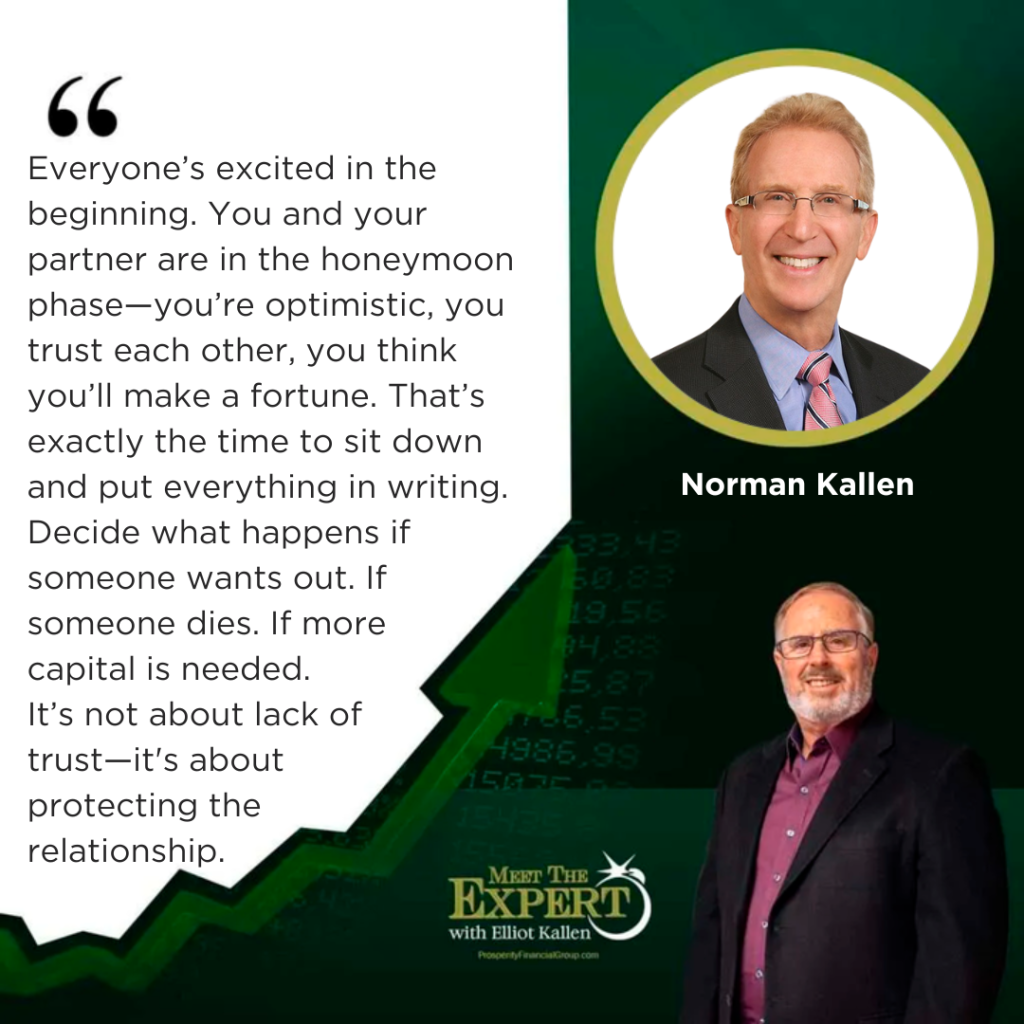
Norman Kallen is a nationally recognized M&A and tax attorney with an LLM in Taxation from NYU. He’s a founding partner at Brown, Moskowitz & Kallen in New Jersey and serves clients nationwide. Known for his deep expertise in corporate law, Norman is Elliot Kallen’s go-to legal advisor for complex business transactions.
Norman emphasizes the importance of early-stage legal planning. Founders should:
Elliot underscores the real-world consequences of ignoring these steps, sharing a cautionary tale where a lack of a clear agreement led to business bankruptcy after a partner’s death.
As businesses grow, strategic acquisitions can accelerate expansion. Key legal takeaways:
Norman reiterates the value of paying for skilled legal counsel to avoid costly missteps—illustrated by another cautionary tale where skipping personal legal representation led to a 10-year lawsuit.
Preparing for an exit requires years of intentional planning:
Elliot and Norman discuss the emotional complexity of selling a business. They advise founders to begin with the end in mind, surrounding themselves with a strong advisory team early on.
Elliot and Norman field real-world scenarios highlighting the need for proactive legal advice, from family business succession to the dangers of dual legal representation. The recurring theme: prevention is cheaper than litigation.
Norman’s parting Wisdom: surround yourself with a brain trust—a financial advisor, a tax-savvy CPA, a strategic banker, and a sharp business attorney. These four legs of the stool are essential for long-term success and peace of mind.
Want to learn more or get connected with Norman Kallen?
Contact Elliot Kallen:
[email protected]
925-314-8503
prosperityfinancialgroup.com
Contact Norman Kallen:
[email protected]
973-376-0909
bmk-law.com
Elliot Kallen: Well, good morning and good afternoon, everyone. I’m Elliot Kallen, CEO, Prosperity Financial Group, and welcome to another very exciting episode of Meet the Expert with Elliot Tallent. Today, business ownership, what you need to know, the legal intersection of the business owner and the lawyer, how this works. If you’re a business owner, an aspiring business owner, you’re in a startup mode, what I call phase one. You’re in a middle load, which means you’re finally making some Money and you’re feeling really good about the direction of your company and you want to expand. Or you’re beginning to think about it and you’re getting what I would call long in the tooth and you’re now in your 60s, maybe you’re in your 70s, depending on how long you’ve been doing this. It’s time to sell that business, transfer that business, or you’re even younger than you saying, it’s time for me to cash out, I’m an entrepreneur, I want to do something different here. Whatever that is, we’ve got one of the top business attorneys, MNA Experts in the United States, Norman Kallen. Very exciting. He’s a graduate of multiple schools in New Jersey, but we won’t hold that against him because that is New Jersey, right? But for those of you that are impressed with names, he’s also got a master’s degree at LLM in taxation from New York University. There you go. That’s a real school, New York University.
Norman Kallen: Thank you.
Elliot Kallen: And he is licensed to do this in every state. And I want you to know, the reason I bring Norman on for the most important reason in the world is because if I have a transaction happening in my life that is business and tax related and or he is the first person that I’m going to call. And I know if you’re listening to this, that you’re going to want to know, who do I call? Who do I trust? Because we live in the world of trust. You’ve got to trust who you’re calling. You hope they do a great job. You hope the deal that you just put together doesn’t end up back three years in front of a judge somewhere in district court or Delaware court or, you know, really expensive. Now I’ve got to go to Delaware to handle this or whatever I have to do. Get it right the first time. That’s so important that we do that. And that’s what Norm is so good at. It’s getting it right. It’s Norman Callen. I call him Norm. But let’s talk about this. And Norm, I want to go into order if you’re okay. How are you today, Norm? I’m good.
Norman Kallen: Thanks. Good to see
Elliot Kallen: you. Sorry. I’m yapping up a storm here. That’s okay. If you want to reach us, it’s 925-314-8503. The email is Elliott, E-L-L-I-O-T at prosperityfinancialgroup.com. And you can see about 125 of these episodes now on prosperityfinancialgroup.com. Meet the expert, Elliott Carroll. It’s very exciting. We’re about to take this to a whole new level and add things, not just for business, but for advocation and life and important things. It’s really going to help people through life. And you’re going to want to keep listening to this as we make really good adjustments. So let’s start, Norm, with the life cycle of the business, because that might be the easiest way to remember this and what you’re doing. And the first life cycle is phase one. That’s the startup mode. I’ve done that a number of times in my life. That’s where you’re still emptying the garbage can, making sure the toilets are clean. Who do I hire? Maybe I’ve got a new EEOC issue going on here, a lawsuit because I hired the wrong person. I’m really new at this. I’ve just learned that maybe I suck at this hiring thing, but I’m a really good salesperson. That’s why I started the company. I’m not very employable. Maybe that’s why I started the company. I’m a great engineer, really do great with product and software. That’s why I started the company. Lots of reasons to start it. Maybe I brought in other people to help me. Let’s start. What does the business owner and his or her partners need in phase one to make sure we’re getting the right foot in front of the left foot and doing it right?
Norman Kallen: You covered a lot of things there, so we’ll take one at a time. You have an idea. You want to go into business. You’ve never done it before. You have, or this is your second time around. Most importantly to start with is have the right people around you. That covers a number of people. Have the right accountant. Have an accountant who is going to do more than simply prepare your tax return. Who’s going to give you some business insights, some business advice based upon their experiences with other businesses. That’s what you want them to bring to the table. You want to have a good banker. Someone who understands and will grow with you is essential. If you can put your own money in and you have it, that’s fine. Sometimes you don’t. You want to borrow. The way the world is, is leverage. Use someone else’s money to make money. Third, you want a good business lawyer. Someone who understands, works with business owners, gets it, understands, can advise you what you need to get started. You talked about partners. I couch people to say the first thing they do when they have partners, they have someone they want to go into business with, their brother, their sister, a sibling, their best friend, their soulmate, whoever it is, while you’re all in the honeymoon phase, you’re all in a great sense, have a great mindset. You’re excited. You can do no wrong. You’re going to make a lot of money. Put an agreement in front of you. Get an agreement together that’s going to address a number of things. What are those types of agreements? If you’re going to form a corporation, if your accountants form a corporation and we’re going to put aside whether you make an S election or not, tax purposes, what works best, you want to have a shareholder’s agreement. Today, the way of the world, 90% of companies are forming LLCs, limited liability companies. When you have a limited liability company, you have an operating agreement and that’s going to address a number of things. Let’s stay with that for the moment. While you’re all in a good frame of mind, sit down, have your attorney talk to you about what are the components of an operating agreement? Who’s going to put in what money? Who’s going to own what interests? Money’s key. What if you need more money? Where it’s going to come from? What if someone doesn’t want to put money in? How do you manage it? Who’s going to be in charge? Who’s going to make what decisions? What require a majority? Who’s going to run it day to day? What requires a super majority, unanimous consent, simple things. If you need more money, if you want to hire someone, who makes that decision? Does everyone need to make that decision? What if you want to go and you want to rent a location? You want to invest in other things? Put all of those items down on paper, have it in an agreement, so you have a roadmap. You said before, what happens if you end up in court? You don’t want to end up in court. If you don’t have an agreement and you have a disagreement and you can’t resolve the disagreement, you can have some third party, some unrelated third party, a judge, an arbiter to make a decision for you. Figure out what you want to do now. Create your roadmap. If you have a disagreement or you have an issue that’s out there, how do you resolve it that you decide how to resolve it? And finally, the third part of any such agreement is a restriction on anyone’s ability to transfer their interests. You don’t want to give somebody some equity away to someone and have them, again, this is, I’m just talking about closed sale businesses in the general statement, all kinds of exceptions. You raise capital differently. You may go all different ways to raise capital through equity, et cetera. Well, let’s say it’s just you and a friend, you and a buddy, you and a compatriot, whatever it might be. Figure out that you don’t want to have that partner spouse as your co-owner. You don’t want to have them give it away to their children. So you have what’s called restrictions on the ability to transfer those interests. That agreement is absolutely essential. And while you’re all in a good frame of mind, put it together. You don’t put it together when you’re under pressure because you don’t think clearly and there’s a lot of anger. Put it together when you’re in a good frame of mind, you know what you want to do. And then most importantly, and I tell everyone this, and I think it’s a general piece of advice, write down your business plan. Write it down. I heard an expression a long time ago, Al. It said, if you don’t know where you’re going, any road will take you there. And that’s in your mind. You don’t have a road. So any way you go, it’s going to be a good road, but you’re not quite sure. It’s when you put it down on paper and you kind of pressure test it with you reading it again, somebody else reading it and asking you questions. It’s a great way to do things. And that’s really the best way to go. And any business advisor will tell you the same thing. Put it on paper. Lay it out, whether it’s raising money, how you’re going to spend your money, how you want to grow, what you want to do. Put it on paper.
Elliot Kallen: You know, Norm, I want to give you a real life example. I want to get your opinion on this if we could. We’re talking to Norman Callen. He is one of the top MNA and tax attorneys in the state of New Jersey, works on a national level. I brought him on because he’s the first person that I would call if I had any of those situations in front of me. So obviously he comes highly recommended for me. And if you need CPAs to talk to people, I know them, he knows them. There are enough names that are out there or people to do evaluation on your business. But here’s a real life example. And that is that, my father had a small business that he ran and he started it from scratch. And he hired this gentleman who I remember as a kid, he was so old, he played minor league baseball with Ted Williams in Rhode Island. His name was Joe from Providence. And what a super nice guy. But Joe’s story was that he and his partner, and that’s phase one again, started a company that manufactured cosmetics and lipstick, but they were novelty things. And his top customer was Walt Disney and the original Walt Disney Corporation in Los Angeles. So all the Snow White stuff and everything that started with those original movies and Mickey Mouse and shorts, everybody wanted to do that. He made it for all the parks, all the way through Florida. But primarily it was LA. And they were making money over money over money and his partner died. And so the stock went to his wife, the wife of the partner. She wanted nothing to do with it. She sold that stock or handed that stock to her brother, an accountant for about a dollar. And at the end of the day, those two people, the accountant and the original 50% owner of this company, so they had 50% learned to hate each other. And the company ended up in bankruptcy because they couldn’t do it. They couldn’t agree on anything because their anchor was so bad. What do you do? Because lots of business owners feel like that could happen to them. What do you do with preparation so this doesn’t happen?
Norman Kallen: Well, as I said to you, again, some of the key advisors when you start up a business, and I thought you’re going to go a little bit different direction, and we’ll go to that in a minute, is to find a business attorney, a corporate attorney who drafts these documents in the regular course of their business. You don’t go to an internist for a broken leg. So don’t go to a litigation attorney. Don’t go to a PI attorney, a matrimonial attorney to draft a document that a business attorney should draft up. You’re going to sit with that attorney. That attorney should provide you a questionnaire about your relationship on a number of levels as you build this company. From those answers, the attorney should be able to build out an agreement, which covers what I said to you, those three elements, capital raise, capital structure, management, and then transferability of interest. Now, I thought you’re going to go a little bit different direction with that question because it was a similar type of thing and it related to advisors. I never forget when my dad was looking at a small business, as you know, and was looking to make an acquisition, wanted to grow, not just organically, but strategically, wanted to buy a similar business to grow. And I never forgot this. This has been something that stayed with me for a long time now. He went to the accountant and he asked the accountant, what should I do? What are your thoughts on should I make this acquisition? Okay, you have a number of businesses, you represent business owners. What’s your advice to me about this to grow? And the accountant said, whatever you want to do. It was the worst piece of advice I’d ever heard. Even as a young kid, it was so disturbing to hear that he got so little help from someone that he felt he could rely on. Find the right people, ask around, talk to other business owners. Who do you use? Talk to people that you trust. We all talk about the words trusted advisor, okay? But there really are trusted advisors out there who, in addition to doing your tax returns and doing quarterly statements and coming in and checking to make sure everything is on the up and up, from their business advice, from their business experience, can give you some insight. And those are the people you want to surround yourself with as you grow, because they’ll help you grow too, and help you grow the right way.
Elliot Kallen: That phrase, trusted advisor, is so important, because I know I live in that world, you live in that world, and the CPA lives in that world, so I can’t tell you how important that is. And trust is hard to get and easy to lose. Don’t underestimate trust, whatever you do. So we’re talking with Norman Callen, he’s an attorney here. You’re listening to Meet the Expert with Elliot Callen. If you want to reach me, I’m at 925-314-8503, and I’m at elliot, E-L-L-I-O-T, at prosperityfinancialgroup.com. Dig in, send me a question, follow up. If at the end of the day we’re going to give you Norm’s information, if you want to reach him and you didn’t write it down, or you don’t have it, just send me an email and I will get you his information. Let’s talk about phase two of a company. I’m doing well. I got some money in the bank. I’ve got a bunch of people working for me. Maybe it’s eight, and maybe it’s 80, or 180, whatever that number is. It’s a flourishing business, I’m paying my bills, I’m making a nice profit. It’s amazing what we can do here when you’re profitable now. I want to expand. I’m still young. I’m 50-something years old. I want to become a much larger company. I’ve got visions in my head, and I’m going to buy some companies out, and then maybe at some time I want to sell my company, but we’ll get to the selling of my business afterwards. Let’s talk about I want to merge companies in. I want to leverage my deal. I want to go to my bank. I want to go to third-party companies I don’t even know who to trust. The old days you put an ad in the New York Times for money, but in a world of investment bankers and venture capitalists, that’s way more popular than it’s ever been in our history. But I also have heard that there’s a disproportionate amount of deals that end up back in court or in front of a mediator or an arbitrator because they were done poorly to begin with, or the numbers were misrepresented. Now I want to do it right, Norm. I want to go buy something. At first, I guess I have to hire a business broker of some kind, a finder of businesses. I’ve got to hire an attorney. What do I do? Tell me what to do now.
Norman Kallen: You have your business here. You’re moving very nicely along. There are two ways to expand your business. One is simply organically. You hire salespeople. You go out there. You generate more business. It’s a methodical process as you grow organically. The other way to grow, as you mentioned, is through acquisitions called strategic Growth. You acquire companies that are in your field to acquire new customers, new opportunities, and it could be expanding your product base. It could be expanding your service base with these other companies. We’re not going to talk about private equity here. That’s time for another discussion, but you’re looking to grow it. You have two opportunities. How do you do that? One is, if you’re in the industry, always keep your eyes and ears open. There’s always people looking to sell their businesses. That’s opportunity. People you know. A lot of times, people buy businesses from people they know in the same industry. You look for opportunities, and then also, you can go to one of these types of, and again, it depends on the nature of your business, what type of third party you might use to help you acquire a business. On the buy side, there are a lot of sell side people. This is a buy side, so you want someone to go out there and look for an opportunity for you to buy, and depending on the nature of your business, it could be a business broker who’s more of a commodity type buyer or seller of businesses. It could be what’s called an intermediary, which is a little bit for larger businesses, a little more sophisticated businesses. They’ll go out there. They’ll put together a program for you, do some research in the marketplace, look what’s out there, and ultimately, at the end of the day, then you can buy a buy side investment banker, a little more sophisticated, a little bit higher level, a little more, again, each one has its benefits, and you’re paying them different fees. Sell side is easier. It’s a percentage. Buy side, it may be for the hourly rate, whatever, something like that, it might be the case. But you want to, again, keep your eyes and ears open, look for opportunity, ask for opportunity, but you also want to have, again, your accountant or your financial people are important. When you start to get another business, when an opportunity presents itself, you absolutely, as I said earlier, you got to do your homework. You got to do what’s called due diligence. You look to your attorneys and give me a checklist. Let me know what I got to look after. What should I be examining? And by the way, you’re not expected as a business owner to know everything, okay? You know certain things about your business. There are other subject matter experts that you want to use, potentially, again, a lot depends on the size of your business, on what you’re looking at, who you’re looking at, what’s involved, okay? There’s so many issues, but when you start to have a typical checklist involved that you can give to the seller that you want to say, I want, I need to look at this information and see whether you’re a worthy seller, all right? The one thing you’re going to do, which is a seller is going to want right to start with, they’re going to want a nondisclosure agreement because whatever information they’re providing to you, they don’t want you using that against them, particularly in a strategic acquisition. So you should have, and you should be ready to provide, here’s a nondisclosure agreement. I’m acting in good faith. I’m not going to use the information that you provide to me. I just want to evaluate your business and see whether you’re a good opportunity, whether we’re a good opportunity. Important in this also is about structure. There’s so many conversations we can have, that day you go to seminars that take all day about how to do this, but, you’ve heard the experience, you want to make an asset acquisition, you want to buy the equity, different reasons to one or the other. All right? People will say I only want to buy the assets because I don’t want to take on the liabilities. I get all that. That’s a really good reason to do it and that structure is that way. However, if you’re looking at a business that has third-party contracts and those third-party contracts can be terminated if there’s a assignment of that agreement, all right? You may not be able to do an asset because those contracts are important to you. So you may have to do an equity acquisition. You buy the owner’s equity in their business like you have your equity in your business, your stock ownership, your LLC ownership. You want to do it that way. But there are ways. Again, there are tax advantages to each, to the seller and to the buyer. And by the way, just because you do an equity ownership as a buyer, there are elections you can make, and we’re not going to get into the details now, for purposes of that transaction to treat the equity acquisition as an asset purchase. So you get your step-up in basis, you get to expense items, you get to depreciate. It’s a great opportunity for a buyer. Again, talk to the right advisors. They’ll give you guidance.
Elliot Kallen: So Norma, I want to give you another real-life example that happened. And so 60% of my clients are business owners. So I’ve got lots of good examples of things, sadly, that haven’t worked that have come back and people have talked to me about that because they usually don’t share the good news. They share the bad news. It travels faster. So everybody hates paying legal fees, Norm. I don’t care who you are. Nobody likes paying their attorney, their accountant. These are just pure expenses. And this is a scenario when that was the overriding factor of something that went very wrong. And I’d Love to get your opinion on that because you know there are a handful of business owners that are listening to this that are like, yeah, why do I want to pay my lawyer? These lawyers are, whatever they are. I’ve heard all the lawyer jokes.
Norman Kallen: Yes, thank you.
Elliot Kallen: Yeah, I get it. You put it all there. You’re $400 an hour and $2,000 an hour and holy cow, what are they worth, really, at the end of the day? So what he did, he had a thriving business that he owned 50% of. And the two partners decided to sell the company to a large New Jersey generic drug company.
And they came in, they reached, kind of reached a deal that was going to be good. He was going to walk away. The other partner is going to hang around for a longer period of time. And he needed to hire outside counsel. But the outside counsel was like the typical lawyer fee from 400 to 600 to 1,000 an hour, whatever the California rates are for that person. And he thought, I’m not going to spend $30,000 to $50,000 of this deal on lawyer fees. And so, he went to the opposing lawyer and said, would you also represent me, figuring they’re already paying for it. And he said, I will, and I won’t charge you extra money for it, but I won’t, you can’t call me your lawyer. I’ll just give you the advice. Doesn’t seem very ethical, but it was done. At the end of the day, with this thing going so haywire, or I wouldn’t be bringing it up again, that cell has been in court for 10 straight years at the federal, beyond the district level, got all the way through there because it’s New Jersey and California. And I think now the buyer from this deal is just trying to wait it out until this person dies. And it’s horribly sad to watch, but there’s nothing he can do about it at all. So, he went really wrong, did he, and how do we avoid this in the future?
Norman Kallen: Okay. So, listen, there are plenty of deals. The world should live by a handshake. The world should live by a handshake. That’s how we should do business deals. But unfortunately, that doesn’t always, as you can see, doesn’t always work out so well. So really, when you’re choosing any professional, talk to people. Don’t get caught up. And again, I don’t discount the value of a dollar to anybody, but talk about value. Be concerned with value, not with pure dollars and cents, because at the end of the day, if you don’t use either the right lawyer or you don’t use a lawyer, this is what can happen when there’s a disagreement. My goal is always to protect my client’s interest, to make sure at the end of the day, what they walk away with is what they thought they were going to walk away with, and that’s protected. And any good lawyer, any good M&A lawyer, any good business lawyer will have the same goal in mind. It’s protect their client, make sure everybody understands, and you have a roadmap. Hopefully, you’ll never have to look at it again, okay? You made the deal. You’re done. You’re closed. You walk away. Thank you so much. Good doing business with you. But the best way to avoid that is to have it documented correctly and accurately. And don’t get caught up with the dollars and cents completely. I always remember looking to buy a car when my wife and I were looking to buy a car, and I had someone in a business network group that didn’t have the dealership, but every time we went to the dealership to look at a particular car, I felt like I was getting ripped off. And he said to me, it was a great piece of advice, he said, Norman, look for a dealer that has a reputation that if something goes wrong with the car, they are there to help you get it resolved with the manufacturer. If the price is a little higher than you want, if it’s within a few dollars, a little bit more than you want, don’t get caught up on that because when the big problems happen, you want the right person in place for you. And that’s what the business owner should do as well. It doesn’t mean you discount and say, oh my God, I paid so much dollars for a small deal. It overwhelmed me. I had no money left. That shouldn’t happen. There should be some relationship potentially, and you can’t always tell a relationship because sometimes a small deal can be as complicated as a large one. But you want someone who’s experienced and knows what they’re looking at, understands the process and knows what protections, and by the way, will explain the document to you so you fully understand what you’re entering into and what the concerns are and what the risks are. You know, in any deal, there’s risks, and businessmen take risks every day, whether it’s hiring somebody new, new line of business, whatever it is, but you do your homework before you take the risks, hopefully. And you realize I minimized my risks. I made them as small as I can, but I still needed to go forward because if I don’t go forward as a business owner, you die in the vine. That’s the only way to make things happen. So try to minimize, but get the right people to help you.
Elliot Kallen: We are talking with Norman Kallen, who’s a partner at Brown, Moskowitz, and Kallen in New Jersey, corporate law, tax law extraordinaire. And we’ll talk about how to reach me if you haven’t gotten it in a moment. And with the time that we have left and we still have a little bit of time here, I really want to talk about the intersection of business and law, the human side of this. So I’ve started out companies three, four, and five here in California, five being a charity foundation. And I have to tell you, it took me a little while of maturity to understand what shareholder value really is, what it represents, and how to build it. It’s just not something in my 20s and 30s I truly understood, and I wish I did. That was one of those do-overs that I wish I could do over again, but doing that. And so one of the things that you excel at, excuse me, and you extols yourself as somebody who’s extraordinary with that, is how to understand to maximize the growth of shareholder value. I’ll get the words out correctly here, Norm. Tell me what that means.
Norman Kallen: Okay. So shareholder value is really enterprise value. What is the company worth at any point in time? And how do you get there? How do you understand what it means? And the best way you can look at that is that if you were buying a business, what would be value to you? Why would you buy someone else’s business? Why is it worth what it is that they’re asking for and you’re willing to pay for it? And that’s a combination of a number of things. It’s a combination of sales, but at the same time, sales aren’t everything because if your bottom line or your revenue or your profit isn’t what it is, it’s not worth much, okay? Unless what you’re buying is one element of the business customer list, okay? But what creates value? What creates value is your brand recognition, your ability not to have the business run only in your name, but people to recognize the brand and value of the name of the business and what quality you bring to it and what reputation it has out there. And that takes time. That’s part of the evolution of a business. You know, early on when businesses start, when you’re starting up your business, it’s all about you. You want people to recognize who you are and send business your way because it’s you. Over time, you want to transition and you want it to be that the name brings people to the table, brings people to your product, to your service, to whatever it is that you provide, okay? That’s the key. And to see how that happens and to recognize what it takes and to bring the right people, the right organization creates value. Having the right people in place, the right players in place, having the right people in the right seats that can run this business without you having to look at every single item of the business.
Elliot Kallen: Well, that brings me to phase three of the business lifecycle here, using three phases. Now I’m in my 60s, 70s. It’s time for me to think about what’s next, assuming that I’m not looking to transfer this to my children, which from your experience, if it’s different than mine, that’s usually a really bad thing to do. It can work out, but it’s usually a really bad idea.
Norman Kallen: Well, it may be bad, but sometimes it’s inevitable too.
Elliot Kallen: Yeah. So if we’re looking to that, it’s time for me to exit this world, not the world, excuse me, to exit my business world. It’s time for me to look at the next phase. It’s time for me to look in the mirror and say, what’s my legacy? Is it going to be giving money to my children? Is it going to be money to my church or my foundation? Is it going to be having my name on a side of an ambulance and a building, a firehouse and the Elliot Kallen Firehouse in downtown San Francisco, whatever it is that there’s a legacy that I want, I want to think about it. So when you’re meeting with a business owner like me, who’s in phase three norm, and he says, holy cow, I have to think about the next step of my life. And I don’t know what Retirement looks like. Maybe it’s traveling golf or maybe it’s hanging out with my grandchildren every day, or maybe I want to live in Europe six months a year, whatever that phase three is now, I’m emotionally torn because it’s very much unknown for the rest of my life. I’m giving up my baby. This is my baby. I’m giving up. Oh my goodness. I’ve worked 20, 30 years, sweat, blood, everything that is in that baby and a good and badly ugly happened here. And now I’m coming to you and saying, take me through phase three norm because I don’t think I could do it without the right kind of advisor and a right kind of deal, or I’m going to go out of my mind thinking about having regrets forever.
Norman Kallen: So, again, you brought up a whole myriad of issues. So let’s start with, let me take a step back for a second before we get there, or as we’re getting there. And really what it is, Ellie, it’s a matter of succession planning and then retirement, and then what we call is your second act. Whenever you start a business, people have heard the expression, always begin with the end in mind. No matter what age you start your business, think about what do I want to ultimately do with this business? So I want to structure it and create it in a way that if I have to sell it, I’ve done the right thing. If someone looks at it, they’ll see value. It’ll minimize the risks to a buyer. It’ll maximize the return on their investment. How do I do that? And that should be something that takes place all the time. So you have a comfort level that I’ve done the right thing. First of all, before you even think about selling, you really got to sit down because it sometimes takes a couple of years to get your business in the right position to sell it, to maximize the value, to minimize the risks to a buyer. I’ll give you a quick, simple example. If you have, you know, you have a great business, you have one customer represents 65% of your business, that’s an enormous risk to a buyer. You know, it’s called customer concentration. You wouldn’t buy your business or you would discount the price of the business because of that risk. So you want to be careful about that as well. So again, always think about the end in mind. How do I maximize value? As you’re getting down the road and thinking about what do I do? What’s my second act? You got to think what matters to you in life. How do you want to be remembered? And not so much what people think of you. Okay. I’m sorry. What people say about you. I think what most people want to know is what do they think of me? What am I doing for the people around me? What’s going to give me peace of mind? Okay. What do I want my second act to be? How am I going to spend my second act? If I come into a great deal of money, do I want, do I have charitable inclinations? Do I have charitable desires to help people to go out there in the world? Do I want to do something else? Do I want to advise people? I got all this business experience, all these years of doing the right things. I’m making mistakes that I’ve learned from. And there’s no question about it. Every client I know learns more from the mistakes. Everybody tells you the same thing because you don’t remember the victories, you remember the mistakes and how you got better from those. So think about what you want to do, how you want to help others. It’s important. It gives you peace of mind. It also helps you on the growth phase because it gives you the sense like I’m building for something, whether it’s for my family, you know, and again, you said you don’t want to leave it to family. It’s an interesting thing because those are some of the hardest choices to make when you have a business, whether you want to bring a family member in. The business owners, I’ve gone through this many times on succession planning, all right? One, do your kids want in the business? And most of the time, they don’t. They’re doing something else. They see how hard you work. Young generation, I’m not working that hard. You got to be kidding me for that, okay? I want to make the money. I just don’t want to work that hard. Okay. And then all of a sudden, you have people who are in the business. Then you have issues of are they qualified to take it to the next level? Are you going to get a return on your investment if you bring your son or daughter in the business who you’re not sure can run the business? You know, my wife and I had great friends, family business of a friend of theirs, and it was an exceptionally profitable business, tremendous value, a value in the nine figures. So it was substantial. But the father recognized, I was sitting, he had children in the business. They couldn’t run the business like he could, and he made the real tough decision. He sold it. He left them a lot of money, okay, so there wasn’t a total loss here, but he recognized he’ll never get his return because they just didn’t have the same desire, the same burning and yearning to take this business to the next level, all right? And so it’s a combination of succession planning, both for you and the business, and succession planning with your second act. What do you want to do? And there are a lot of good people out there who could sit and meet with you. We’ve recommended those people to clients who say, you know, I’ve really been thinking about it. Listen, you don’t want to be busy, you know, 12 hours a day, but how many hours a day can you play golf, okay? How many hours a day can you play Pickleball, all right? Pickleball’s been the best thing ever to happen to orthopedists. You know, I was having that discussion the other day with my orthopedist. He said, this has been the best thing for that practice, was it was pickleball, okay? All these old people running around when they know they shouldn’t, but think they can, okay?
Elliot Kallen: I love that. That’s a great thing. So Norm, as we wrap this up here, and, Norm is a partner of Brown, Moskowitz and Kallenair, 20-plus-year-old firm based in New Jersey, obviously handled the New York tri-state metropolitan area, but it handles now national. And we talked about briefly being the trusted advisor. And so that’s my whole world as a financial advisor, maybe business owners, and I’ll give you my information one more time on where to reach me at Elliot, E-L-L-I-O-T, at prosperityfinancialgroup.com or 925-314-8503, and a website, prosperityfinancialgroup.com. I’ll give you Norm’s in a moment, but we talk about three very, four, maybe four very important people that need to be your trusted advisor in no particular order, and that’s your financial advisor who’s going to manage your money and your assets, it’s your CPA who’s going to give you great, not good, but great tax advice. Norm gave you a story about his father’s accountant that just was laissez-faire or lax and said whatever basically. If you want to do it, good. If you don’t want to do it, okay. Well, that’s not advice. You know, do I clean up my room? That’s not good advice. You know that’s not good advice. All right, so the financial advisor, the CPA, the banker, and not to be mentioned last, but you want to have the lawyer on your side, making sure you’re doing it right and avoiding those enormously expensive pitfalls and potholes that can change your life. Am I right, Norm?
Norman Kallen: Elliot, I wrote an article called The Four Legs of a Stool, and those are the four legs of a stool because a financial advisor, before you sell your business, can save you a lot of money. During your lifetime and growth of the business, can save you a lot of money. You need to speak to someone about what you’re doing and how you can do it. There’s so many alternatives, so many opportunities to save money, to do planning before you sell a business, as the business grows, before you pass it on, that it’s those four people. It’s the financial advisor, you said. It’s the right accountant, okay. It’s the right attorney, and it’s you. It’s you, the business owner. Those four people can make a world of difference in your life and to save you. You worked so hard all your life. Why give it away now if you don’t have to? Anything you want to add before we wrap this up, Norm? No. Again, I go back to, again, find the right people that can help you, find the right advisors. If you’re looking to sell your business, it takes time. What you want to be prepared to do, and this is why I say always have the end in mind, it’s most common that all of a sudden someone comes to you and says to you, I want to buy your business. If you have an unsolicited offer, what do you do? Be prepared. Have the right people in place to advise you what to do and how to do it, and it’s a great formula. I’ve seen it be successful. I’ve seen when it’s not in place how bad it can be. You got an opportunity. Take advantage of it.
Elliot Kallen: If anybody wants to look up what he’s talking about, we call that the brain trust. There’s a great historical document about Franklin Roosevelt and creating the first intellectually recognized brain trust. That’s what you need in your business is those trusted advisors and the people you can really trust around you to give you good, sober, sanguine advice. It’s so important that you have that done because when you’re excited about what you’re doing, you can really lose track of what’s happening because you’re so euphoric and overly euphoric, and I’ve been down that road in my younger days of being overly euphoric and not grounded enough, and boy, that’s only going to bite you in a butt at the end.
Norman Kallen: You’re so caught up in running your business.
Elliot Kallen: Yep, yep. So how do they reach you, Norm? Because this is so important. How do people reach out and talk to you?
Norman Kallen: Absolutely. Again, Brown, Moskowitz, and Kallen. My email address is nKallen at BMKB as in boy, M as in Mary, K as in kitten-law.com. My phone number is 973-376-0909. Want to say that phone number one more time? Sure. It’s nKallen at BMK-law.com, and it’s 973-376-0909. Happy to have a conversation anytime.
Elliot Kallen: And if you didn’t get that down, you didn’t write it down fast enough, you just reach out to me, and we will get you all of Norm’s information. Again, the reason I brought Norm on more than anything else is when I’m looking to hire a business attorney, when I’m looking to do an M&A deal, when I’m looking to figure out an exit strategy, he’s my first phone call. And so when you’re talking about a trusted advisor, he is my trusted advisor, and I hope you use him to become your trusted advisor. Norm, thanks for joining us today.
Norman Kallen: Absolutely, Elliot. Thank you. Have a great day.
Elliot Kallen: Have a great day, everybody. We’ll see you on the next episode of Meet the Expert with Elliot Kallen.
The post Business Ownership & Legal Mastery with Norman Kallen appeared first on Prosperity Financial Group | San Ramon, CA.